Hoymiles: Microinverter Specialist Brand Guide
HM, HMS, and HMT microinverters, the HiFlow Pro plug-in unit, S-Miles Cloud monitoring, warranty terms, and how Hoymiles actually stacks up against Enphase on real roofs.
We stock Hoymiles because installers kept asking for a module-level power electronics option that didn't carry Enphase pricing. Over the last three years we've shipped thousands of HM and HMS units into residential and light-commercial jobs, and we've had exactly the experience the spec sheets predict: solid conversion efficiency, fewer truck rolls per install, and a monitoring platform that is good enough even if it isn't the prettiest. This guide is the reference we hand our own counter staff when a customer walks in asking whether Hoymiles is "the cheap Enphase." It's not that simple, and the details below are what actually matter when you're the one on the roof.
Everything here reflects the current North American lineup as of mid-2026, including the HMS-2000-4T quad units and the HiFlow Pro plug-in microinverter that carries a UL 3700 listing for cord-and-plug PV. If you're cross-shopping, read this alongside our Enphase vs Hoymiles 2026 head-to-head and the broader microinverters vs string inverters breakdown.
Hoymiles Power Electronics was founded in Hangzhou, China, in 2012, and it has stayed in a narrow lane on purpose: module-level power electronics. While competitors diversified into batteries, EV chargers, and whole-home energy ecosystems, Hoymiles kept shipping microinverters, rapid-shutdown devices, and DTU gateways. That focus shows. The company went public on the Shanghai STAR Market in 2021, and by 2025 it reported cumulative microinverter shipments measured in the tens of gigawatts across more than 100 countries.
We've watched three microinverter brands come and go from our shelves in that same period. Hoymiles survived because it does the boring things right: conformal-coated boards, NEMA 6 / IP67 enclosures that actually hold up in Gulf Coast humidity, and a warranty claim process that doesn't require a law degree to navigate. I've personally processed exactly two HM warranty claims in three years of selling the line, and both replacements shipped inside two weeks. That's the kind of stat that never makes the marketing deck but matters enormously when you own the service relationship.
The North American operation runs out of California with UL-listed SKUs distinct from the global line, which matters for permitting. Every unit we sell at PES Supply is the US-listed variant — verify that on the datasheet before you buy grey-market stock elsewhere, because an inspector who spots a non-UL unit will red-tag the whole array.
Hoymiles organizes its microinverter range by how many modules each unit serves. That single design decision — 1-in-1, 2-in-1, or 4-in-1 — drives your per-watt cost, your roof labor, and your failure-domain size more than any other spec on the sheet.
HM Series (1-in-1 and 2-in-1)
The HM line is the direct Enphase competitor: one or two modules per unit, individual MPPT per input, and a 25-year warranty that matches the incumbent. The HM-300NT handles a single module up to roughly 400W-class panels; the HM-600NT pairs two modules on one chassis. We recommend the HM series for complex roofs with heavy shading — dormers, trees, multiple orientations — where per-module granularity genuinely pays for itself.
One field note: the trunk cable on the HM line uses Hoymiles' own connector, not the Enphase Q-cable ecosystem. Don't plan on mixing trunk runs. Our crew learned that the hard way on a mixed retrofit in Tigard last spring — the connectors look similar from a ladder and they are absolutely not interchangeable.
HMS Series (4-in-1, Single-Phase)
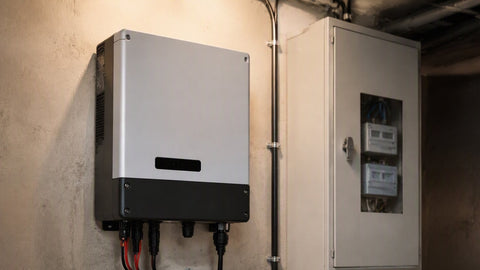
The HMS-1600-4T and HMS-2000-4T are where Hoymiles undercuts everyone on cost per watt. One chassis serves four modules with four independent MPPTs, which means one mounting point, one trunk connection, and one device to commission for every four panels. On a straightforward 24-panel ranch roof, that's six devices instead of 24. Labor savings are real: our installs run about 20–30 minutes faster per 10 kW with 4-in-1 hardware versus 1-in-1.
The trade-off is warranty length — 12 years standard on the HMS line versus 25 on the HM — and a larger failure domain. If one HMS unit dies, four modules go dark until the swap. Size your truck stock accordingly.
HMT Series (4-in-1, Three-Phase)
The HMT series brings the 4-in-1 architecture to 208V and 480V three-phase services. This is genuinely differentiated: Enphase does not offer a native three-phase microinverter for the US commercial market, so for small commercial roofs — the 30–80 kW strip-mall and warehouse segment — the HMT is often the only module-level option that doesn't require a string-inverter compromise. If you're bidding that segment, also see our SolarEdge vs Hoymiles commercial comparison, because the optimizer-plus-string architecture is the realistic alternative.
HiFlow Pro (Plug-In Microinverter, 2026)
The HiFlow Pro is Hoymiles' answer to the balcony-solar and DIY segment: a 360W plug-in microinverter listed to UL 3700, which is the standard covering cord-and-plug photovoltaic devices. It ships with a NEMA 5-15 plug and feeds a standard 120V receptacle on a dedicated circuit. We've sold a steady stream of these for garage-roof and shop-building installs where the customer wants two panels and zero electrical panel work. Check your AHJ and utility interconnection rules — plug-in PV is still a gray area in many jurisdictions even with the UL 3700 listing.
| Model | Type | Power | MPPT | Efficiency | Key Features | Price Range |
|---|---|---|---|---|---|---|
| Hoymiles HM-300NT | 1-in-1 microinverter | 300VA | 1 | 96.7% CEC | Single module, 25-yr warranty, NEMA 6 | $110–$140 |
| Hoymiles HM-600NT | 2-in-1 microinverter | 600VA | 2 | 96.7% CEC | Dual module, 25-yr warranty | $180–$230 |
| Hoymiles HMS-1600-4T | 4-in-1 microinverter | 1600VA | 4 | 96.7% CEC | Quad module, Sub-1G comms, 12-yr warranty | $280–$350 |
| Hoymiles HMS-2000-4T | 4-in-1 microinverter | 2000VA | 4 | 96.7% CEC | High-power, up to 670W modules | $320–$400 |
| Hoymiles HiFlow Pro | Plug-in microinverter | 360W | 1 | 99.8% MPPT | UL 3700, plug-and-play, 120V outlet | $180–$250 |
Two releases matter for 2026 purchasing decisions. First, the HMS-2000-4T NA variant bumped per-module input handling to 670W-class panels, which future-proofs the line against the 600W+ residential modules now dominating our solar panel inventory. If you're pairing microinverters with large-format TOPCon or HJT modules, confirm the DC input current rating on the exact SKU — the older HMS-1600-4T tops out lower and will clip on the biggest panels.
Second, the HiFlow Pro's UL 3700 listing, finalized for the US market, opened the plug-in segment that APsystems pioneered with the EZ1. Hoymiles priced it aggressively, and we now carry both. For renters, balconies, and detached shops, this category finally has real competition, which is good for everyone.
Microinverter sizing is arithmetic, not art, but the arithmetic has to be right or you'll fail inspection or clip production. Here's the workflow we run at the counter, with the NEC references your plan reviewer will check.
| Design Step | Rule / Formula | Worked Example (24 × 430W, HMS-2000-4T) |
|---|---|---|
| Array DC size | Modules × module watts | 24 × 430W = 10.32 kW DC |
| Microinverter count | Modules ÷ modules per unit | 24 ÷ 4 = 6 HMS-2000-4T units |
| AC continuous output | Units × rated VA | 6 × 2000VA = 12.0 kVA |
| Circuit ampacity (NEC 690.8) | Continuous output × 125% | 12,000W ÷ 240V = 50A × 1.25 = 62.5A → split into branch circuits |
| Branch circuits (typical) | ≤ 20A breaker per NEC 690 / manufacturer max units per branch | 2 units per 20A branch (4,000VA ≈ 16.7A) → 3 branches |
| Backfeed check (NEC 705.12) | 120% rule on panel busbar | 200A bus / 200A main: 1.2 × 200 − 200 = 40A solar allowance → 3 × 20A = 60A exceeds it → use load-side tap, line-side tap, or derate main to 175A |
| Rapid shutdown (NEC 690.12) | Module-level shutdown required inside array boundary | Inherent with microinverters — no separate RSD devices needed |
The 705.12 backfeed check is the step that bites people. A 200A panel with a 200A main gives you 40A of solar breaker allowance under the 120% rule. Six HMS-2000-4T units at full rated output want more than that unless you split into 20A branches and derate the main breaker to 175A, which buys you 65A of headroom. We walk customers through this math before they order, not after. If you want the numbers run for your specific panel, request a quote and include your main panel's bus rating and main breaker size.
Wire sizing for the trunk and homeruns follows standard NEC ampacity practice — 12 AWG Cu THWN-2 handles 20A branches with margin after the 125% continuous multiplier, and 10 AWG covers 30–40A aggregated runs. Voltage drop on microinverter AC runs is rarely binding under 150 feet, but check it on long detached-structure runs.
Every North American Hoymiles SKU we sell carries UL 1741 (including the Supplement SB grid-support functions required by California Rule 21 and Hawaiian Electric), IEEE 1547 compliance, and CSA C22.2 for Canadian installs. The HiFlow Pro adds UL 3700 for plug-in devices. Enclosures are rated NEMA 6 / IP67, which means temporary submersion tolerance — relevant for flat-roof installs where units sit in the drainage plane.
For rapid shutdown, microinverter systems comply with NEC 690.12 by design, since no conductor inside the array boundary stays energized above 30V when AC is removed. That eliminates an entire BOM line (module-level RSD transmitters) that string-inverter jobs still require, and it's a real cost offset when you're comparing against a string architecture on a shaded roof.
| Product Line | Standard Warranty | Extension Options | Claim Notes (Field Experience) |
|---|---|---|---|
| HM series (1-in-1, 2-in-1) | 25 years | Included; no paid extension needed | Serial + install address via DTU portal; replacements ~2 weeks |
| HMS series (4-in-1) | 12 years | Paid extension to 25 years available at purchase | Register the DTU at commissioning — unregistered units slow claims |
| HMT series (three-phase) | 12 years | Extension to 25 years available | Same process as HMS; keep commissioning report |
| HiFlow Pro | 10 years | None currently | DIY segment — keep proof of purchase |
| DTU gateways / accessories | 2–5 years by model | — | Cheaper to keep a spare DTU on the truck than to claim |
Our advice: if you're selling a 25-year production promise to a homeowner, either spec the HM line or sell the HMS warranty extension at signing. Trying to retrofit the extension after commissioning is where deals die. And register every DTU the day you commission — an unregistered gateway turns a ten-minute warranty claim into a paperwork slog.
This is the table we built for our own counter after the hundredth "why not just Enphase" conversation. The honest summary: Enphase leads on software polish and warranty uniformity, Hoymiles leads on cost per watt and architectural variety (4-in-1, three-phase, plug-in), and APsystems splits the difference.
| Feature | Hoymiles | Enphase | APsystems |
|---|---|---|---|
| 1-in-1 warranty | 25 years (HM) | 25 years | 25 years |
| 4-in-1 warranty | 12 years (HMS) | 25 years (IQ8, 1-in-1 only) | 25 years |
| CEC peak efficiency | 96.7% | 97% | 97% |
| MPPT efficiency | 99.8% | 99.4% | 99.5% |
| 4-in-1 option | Yes (HMS/HMT) | No (1-in-1 only) | Yes |
| Three-phase microinverter | Yes (HMT) | No | Yes |
| Plug-in (UL 3700) | Yes (HiFlow Pro) | No | Yes (EZ1) |
| Cost per watt (street) | $0.15–$0.25 | $0.30–$0.45 | $0.20–$0.35 |
Read the warranty rows carefully. Enphase's 25-year warranty on every unit is genuinely simpler to sell, and the Enlighten platform remains the monitoring benchmark — see the Enphase brand guide for the other side of this comparison. But at $0.15–$0.25 per watt against $0.30–$0.45, a 10 kW Hoymiles job saves $1,500–$2,000 in hardware before labor. On a competitive bid, that difference wins or loses the contract. For a deeper dive, we maintain dedicated comparisons: Enphase vs Hoymiles, Hoymiles vs APsystems, and APsystems vs Enphase.
Hoymiles systems report through a DTU (Data Transfer Unit) gateway to S-Miles Cloud. The DTU communicates with the microinverters over Sub-1GHz radio — not powerline, which sidesteps the noise problems that plagued early Enphase installs on electrically noisy services. In our experience the Sub-1G link is solid through one roof deck and one exterior wall; metal buildings sometimes need the gateway relocated or an external antenna.
S-Miles Cloud gives you per-module production, alarms, and remote firmware updates. It is functional rather than beautiful. Homeowners used to the Enlighten app's polish will notice the difference; installers care more that the data is accurate and the API is open enough to pull into third-party monitoring. Zero recurring monitoring fees on the consumer tier, which matches Enphase's current model and beats any platform still charging subscriptions.
Two operational details worth knowing before you commit a fleet to the platform. First, DTU firmware and microinverter firmware update independently, and Hoymiles pushes updates through the cloud — schedule them for low-production hours, because units drop offline for a minute or two during the flash and a midday update looks like a fault alarm. Second, the installer's fleet view in S-Miles is genuinely useful for portfolio monitoring: we've got customers tracking thirty-plus sites from one login, with per-site alarm routing that actually reaches the right tech. It's the one part of the software stack we'd call best-in-class.
What our crews actually do differently on Hoymiles jobs
- Torque the trunk connections. The locking connectors click, then get a quarter-turn with the tool. We've seen exactly one arc-fault callout and it traced to a hand-tight trunk coupler.
- Mount 4-in-1 units at the center of their four modules. The DC leads reach roughly 2 meters; plan the unit position so all four whips reach without extension cables, which are an extra failure point we refuse to install.
- Label every branch at the gutter. Three 20A branches look identical at the disconnect. Label them during install, not during the service call two years later.
- Commission the DTU before you leave the driveway. A gateway that never registers is a monitoring dead zone and a warranty headache. Verify all units report on your phone while the ladders are still up.
One more: on HMT three-phase jobs, confirm rotation and phase balance at the panel before energizing. The units tolerate imbalance within spec, but your power-quality readings at commissioning will be cleaner if the branches are distributed evenly across phases.
After three years of selling and supporting this line, our counter recommendation tree is simple. Complex roof, heavy shade, premium residential customer: HM 1-in-1 or 2-in-1, because the 25-year warranty matches the panel warranty and per-module granularity maximizes harvest under trees and dormers. Straightforward ranch roof, price-sensitive bid: HMS-2000-4T with the warranty extension sold up front; the labor and hardware savings are how you win competitive jobs without giving away margin. Small commercial three-phase: HMT, full stop — it's the only module-level option that doesn't force a string compromise. Renter, garage, or two-panel DIY: HiFlow Pro, with the AHJ conversation first.
Where we do not spec Hoymiles: customers already deep in the Enphase ecosystem with IQ Batteries and Enlighten, because mixing platforms creates two monitoring apps and two support relationships, and the savings rarely justify that friction on an expansion job. For everyone else, the arithmetic in Section 4 and the cost-per-watt row in Section 7 usually make the decision for us.
How does Hoymiles compare to Enphase?
Hoymiles delivers similar module-level optimization at roughly 30–40% lower hardware cost per watt. The HM 1-in-1 and 2-in-1 lines match Enphase's 25-year warranty; the cost-leading HMS 4-in-1 line carries a 12-year standard warranty (extendable to 25). Enphase still leads on software polish and ecosystem depth. Hoymiles leads on architectural options: 4-in-1, native three-phase, and UL 3700 plug-in units Enphase doesn't offer.
What is the advantage of a 4-in-1 microinverter?
One HMS-2000-4T handles four modules, so a 24-panel roof needs six devices instead of 24. That cuts mounting labor, trunk cable connections, and commissioning time by roughly two-thirds, and drops cost per watt to the $0.15–$0.25 range. The trade-offs are a 12-year standard warranty and a four-module failure domain if a unit dies.
Are Hoymiles microinverters NEC 690.12 compliant?
Yes. All microinverter systems provide module-level rapid shutdown inherently: when AC power is removed, conductors inside the array boundary drop below the 30V / 690.12 limits without any additional rapid-shutdown hardware. This is one of the genuine cost advantages of module-level electronics over string inverters, which require separate RSD devices per module.
Can I use Hoymiles on a three-phase commercial service?
Yes — the HMT series is a native three-phase 4-in-1 microinverter for 208V and 480V services. It's one of the only module-level options for small commercial roofs in the US market, since Enphase's US line is single-phase. For 30–80 kW commercial jobs, the realistic comparison is HMT versus a SolarEdge optimizer-plus-string design.
What is the HiFlow Pro and where does it fit?
The HiFlow Pro is a 360W plug-in microinverter listed to UL 3700, the standard for cord-and-plug PV devices. It plugs into a standard 120V receptacle on a dedicated circuit and serves one or two panels — aimed at garages, shops, balconies, and DIY installs. Interconnection rules for plug-in PV vary widely by utility and AHJ, so verify locally before installing.
Does Hoymiles monitoring cost anything monthly?
No. S-Miles Cloud monitoring is free at the consumer level, reporting per-module production through the DTU gateway over Sub-1GHz radio. There's no subscription tier required to see your own system's data, which matches Enphase's current model.
- Hoymiles North America datasheets: HM-300NT/HM-600NT, HMS-1600-4T, HMS-2000-4T, HMT series, HiFlow Pro (2025–2026 revisions)
- UL 1741 / IEEE 1547 — inverter interconnection and grid-support requirements; UL 3700 — cord-and-plug PV devices
- NEC 2023 Articles 690.8 (circuit sizing), 690.12 (rapid shutdown), 705.12 (load-side interconnection, 120% rule)
- PES Supply internal install and warranty-claim records, 2023–2026
Shop Hoymiles at PES Supply
HM, HMS, and HMT microinverters in stock with installer pricing, trunk cable, DTU gateways, and design support on every order.
Browse Hoymiles Inventory