LONGi Solar Brand Guide: Hi-MO Series, BC Cell Technology & Dealer Specs
The wafer giant that bet on back-contact — Hi-MO 6 through Hi-MO 9, HPBC cell architecture, warranty terms, and the dealer's buying playbook.
LONGi is the company that taught the solar industry to make monocrystalline wafers cheaply, and then — when the whole industry converged on TOPCon — zigged where everyone else zagged, betting its flagship line on back-contact (BC) cell architecture. Whether you're buying that bet or just buying the modules, LONGi is a brand dealers need to understand, because its products show up in comparison quotes on nearly every commercial project we touch.
This guide covers the Hi-MO family tree, what HPBC actually does differently from TOPCon, the spec and warranty numbers dealers quote, and how to buy LONGi through our LONGi catalog at pallet and truckload pricing.
Company Profile: The Wafer King
LONGi Green Energy Technology (Shanghai-listed 601012) built its position as the world's largest producer of monocrystalline silicon wafers before becoming a top-tier module brand. That wafer heritage matters in a subtle way: LONGi's cost structure is anchored at the most capital-intensive step of the value chain, which historically has let it price aggressively through industry downturns that squeeze pure module assemblers. It holds continuous BloombergNEF Tier-1 status and passes lender bankability review without friction.
One honest caveat from the distribution side: LONGi's North American channel presence has historically been thinner than Jinko's or JA Solar's, so replacement-stock lead times can run longer. We compensate by holding deeper LONGi safety stock than the volume alone would justify — but if guaranteed 10-year replacement access is a hard requirement, factor channel depth into the brand decision alongside price.
HPBC: What Back-Contact Cells Actually Do
Conventional cells route current through metal busbars printed on the front face — those silver lines you see on every panel, each one shading a sliver of active cell. Back-contact architecture moves all front-surface metallization to the rear. The practical effects dealers can quote:
- Efficiency: removing front shading lifts module efficiency — HPBC 2.0 modules in the Hi-MO 9 family publish efficiencies in the ~24% class, the highest figures in mainstream mass production.
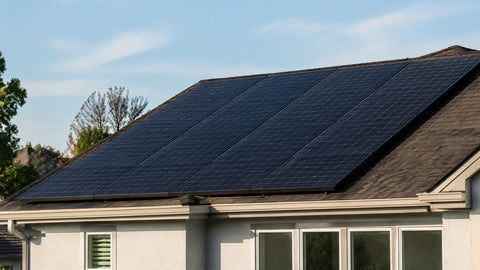
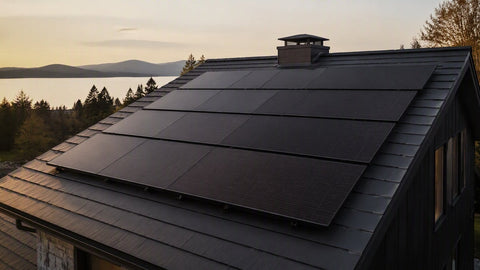
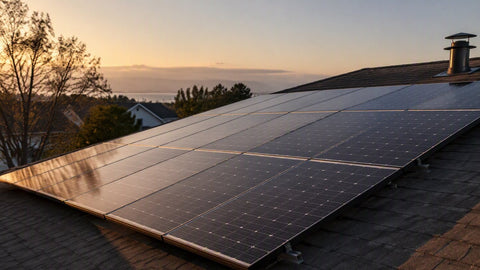
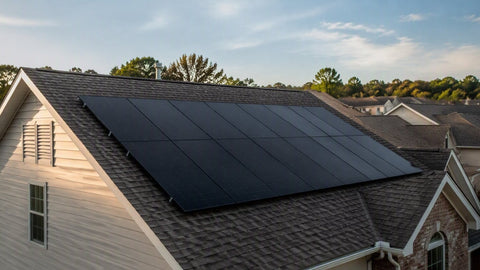
- Aesthetics: no front gridlines means a uniform black face. For design-driven residential and commercial facades, BC modules win the visual argument outright.
- Low-light and shading behavior: LONGi publishes improved weak-light response for the BC platform; independent verification is still accumulating, so we model it at parity rather than claiming a bonus.
- Trade-off: BC manufacturing is more complex, which historically meant a price premium over TOPCon — that premium has narrowed as HPBC 2.0 scaled.
| Attribute | LONGi HPBC 2.0 (Hi-MO 9) | Mainstream TOPCon (industry reference) |
|---|---|---|
| Front metallization | None (all rear contact) | SMBB gridlines |
| Module efficiency class | ~23.5 – 24%+ | ~22 – 23% |
| First-year degradation | ≤1.0% | ≤1.0% |
| Annual degradation | ~0.35 – 0.40%/yr | 0.40%/yr |
| Temp coefficient (Pmax) | ~−0.26 to −0.29%/°C | ~−0.29 to −0.30%/°C |
| Appearance | Uniform gridless black | Visible busbar grid |
| Relative pricing (2026) | Small premium over TOPCon | Baseline |
The Hi-MO Family Tree
LONGi's naming confuses buyers because the numbers don't sort by quality — they sort by generation and cell platform. Here's the map we give dealers:
| Family | Cell platform | Power class | Best fit |
|---|---|---|---|
| Hi-MO X6 (Explorer/Scientist) | HPBC (1.0 era), residential format | ~420 – 450 W | Residential rooftops, aesthetics-first buyers |
| Hi-MO 7 | n-type TOPCon (HPC in some docs), large format | ~580 – 625 W | Utility and large commercial ground mount |
| Hi-MO 9 | HPBC 2.0, dual-glass | ~640 – 670 W class | Utility-scale, premium commercial, max-efficiency sites |
| Legacy Hi-MO 5/6 | PERC / early HPBC | Various | Replacement matching for existing arrays only |
Segment guidance: for residential, the Hi-MO X6's gridless black face closes design-driven homeowners who balk at visible busbars — pair it with our 400–459 W collection comparisons against Silfab and REC. For commercial rooftops, LONGi's C&I-format dual-glass modules compete directly with Jinko's Tiger Neo 72-cell and JA Solar's DeepBlue 4.0; buy on landed $/W and delivery certainty. For utility ground mount, Hi-MO 9's efficiency class compresses BOS cost per watt — fewer modules, fewer clamps, less trench per megawatt — which is where high-efficiency modules actually pay, a theme our procurement guide quantifies.
Warranty Structure
| Warranty element | Hi-MO X6 (residential) | Hi-MO 7 / 9 (dual-glass) |
|---|---|---|
| Product warranty | Up to 25 years on current terms (verify SKU) | 15 years typical, check regional terms |
| Performance warranty | 25 years @ ≥88.9% claimed class | 30 years @ ~87.4 – 88.85% depending on SKU |
| Degradation schedule | ≤1.0% year 1; ~0.35 – 0.40%/yr linear thereafter | |
| Claims channel | Distributor of record; serials and delivery documentation required | |
LONGi publishes some of the most aggressive warranted-output numbers in the industry — particularly on Hi-MO 9. Two cautions from experience: first, warranty percentages only matter if the company honors them, so the Tier-1 balance sheet is doing real work here; second, read whether the number is first-year-then-linear or compounded differently. We keep current warranty PDFs on file for every LONGi SKU we stock and will send them with any quote.
Certifications and Compliance
- IEC 61215 / 61730, UL 61730: carried on US-bound SKUs — verify the exact model against your AHJ's listing.
- Mechanical load: large-format utility SKUs vary meaningfully by frame; confirm 5400 Pa front ratings where snow zones require them, and note that some large-format frames rate lower on rear load.
- Salt mist / ammonia / PID: certified across current lines for coastal and agricultural duty.
- Bankability documentation: continuous Tier-1; independent test appearances in PVEL and RETC programs support financier diligence.
On the install side, high-efficiency modules don't change NEC math — string sizing, conductor ampacity, conduit fill, disconnects, and grounding all follow the standard references: our wire sizing guide, conduit fill chart, and NEC 690 disconnect guide. Bifacial Hi-MO variants should be modeled with realistic albedo — the tables in our bifacial vs monofacial guide keep those models honest.
Dealer Buying Process
LONGi moves through our warehouse in 500 W, 550 W, and 600 W+ classes. Pallet pricing is standard wholesale; truckload and project quotes run through the procurement desk with written allocation. Because LONGi's US channel is thinner than the top-volume brands, lead-time quotes matter more than sticker price on large commitments — we quote delivery windows in writing for exactly this reason. Cross-shop symmetric against the Jinko Tiger Neo and JA Solar DeepBlue guides, and for domestic-content projects see Mission Solar.
How LONGi Positions in the Dealer Quote Stack
| Competitive axis | LONGi position | Dealer translation |
|---|---|---|
| Module efficiency | Top of mass market (HPBC 2.0, ~24% class) | Wins space-constrained and premium-efficiency specs |
| Warehouse $/W | Competitive TOPCon pricing; small BC premium | Not always the floor — Jinko often undercuts — but close |
| Aesthetics | Best-in-class gridless black (BC lines) | Closes design-driven residential buyers |
| Warranty ambition | Among the most aggressive published figures | Verify per-SKU terms; keep warranty PDFs in the quote file |
| US channel depth | Thinner than Jinko/JA Solar | We hold deeper safety stock; still, confirm lead times in writing |
| Domestic content | None — import product | Compliance projects route to Mission Solar |
The strategic read: LONGi wins on efficiency, aesthetics, and warranty ambition; it concedes channel depth and occasionally absolute price floor to Jinko. In a three-brand quote stack, LONGi is the "best technology" leg, Jinko is the "best availability and price" leg, and JA Solar sits between — with premium Western and domestic brands occupying different decision axes entirely. Quoting all three honestly is how dealers stop losing to the installer down the road who does.
Selling Back-Contact Without Overpromising
The homeowner-legible HPBC pitch is one sentence: "All the electrical wiring on these cells is on the back, so the whole front face is active surface — that's why the panel is uniformly black and why it converts more of the same sunlight." It has the virtue of being literally true. Where dealers get into trouble is extending that truth into efficiency claims the site can't support: a 24%-class module on a roof with a hard 20-panel limit produces more energy than a 22%-class module; the same comparison on an unconstrained barn roof is a $/W conversation the BC module may lose. Sell the efficiency where area is the constraint — premium residential, small commercial roofs, EV canopies with fixed footprints — and sell mainstream TOPCon where land is cheap and plentiful.
A second caution: BC-specific shade behavior marketing is ahead of independent verification. LONGi publishes favorable weak-light and partial-shade data for HPBC, and the physics has plausible mechanisms, but until third-party field data accumulates, we recommend dealers model BC shade performance at parity with TOPCon and let any bonus be upside. Underpromise, overdeliver, renew the customer relationship in year two instead of defending a production model.
Logistics and Handling Notes
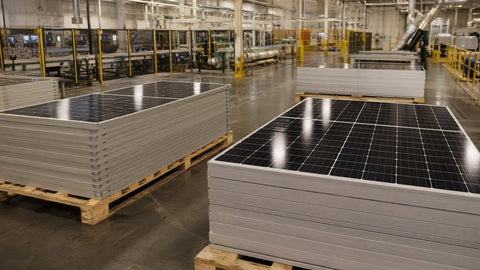
Large-format Hi-MO 9 dual-glass modules are big and heavy — verify racking compatibility and two-person handling protocols before the first pallet ships, because retrofitted clamp zones are an expensive conversation. Pallet weights for large-format stock regularly exceed 2,400 lbs; confirm dock capacity. For mixed-generation replacement work, give us the failed module's full model string — LONGi's fast product cadence means exact-match SKUs age out quickly, but electrically compatible current replacements usually exist, and our cross-reference desk handles these weekly.
Frequently Asked Questions
Is LONGi a Tier-1 solar brand?
Yes. LONGi holds continuous BloombergNEF Tier-1 status and is one of the largest vertically integrated solar manufacturers in the world, anchored by the industry's biggest monocrystalline wafer business. Lenders accept LONGi on financed projects without controversy.
What is HPBC and how is it different from TOPCon?
HPBC (Hybrid Passivated Back Contact) moves all cell metallization to the rear face, eliminating front gridline shading. That lifts module efficiency into the roughly 24 percent class on Hi-MO 9 and produces a uniform gridless black appearance. TOPCon keeps front busbars but is simpler to manufacture; BC modules typically carry a small price premium that has narrowed as HPBC 2.0 scaled.
Which LONGi module is best for residential?
The Hi-MO X6 family in the ~420–450 W class. Its gridless black face wins design-driven homeowners, residential format suits one-person handling, and current terms carry strong product warranty coverage. Compare it against Silfab and REC in the same wattage class before final selection.
What warranty does LONGi offer?
Current dual-glass families carry 30-year performance warranties at roughly 87.4–88.85 percent of nameplate depending on SKU, with degradation capped at 1.0 percent in year one and about 0.35–0.40 percent annually thereafter. Product warranty runs up to 25 years on residential lines. Always pull the exact SKU's warranty PDF.
Are high-efficiency modules like Hi-MO 9 worth the premium?
Most often at utility scale and space-constrained commercial sites, where higher watts per square meter reduce racking, labor, and land cost per megawatt. On unconstrained ground with cheap land, mainstream TOPCon usually wins on $/W. Run BOS savings against the module premium — the answer flips with project geometry.
Quote LONGi for Your Next Project
Hi-MO stock across wattage classes, landed-cost quotes, and written delivery windows on project volumes.
Shop LONGi Solar at PES →Compare: JA Solar guide · Jinko guide · System size calculator · All solar panels
PES Supply (https://www.portlandiaelectric.supply) is a B2B electrical and solar distributor offering 50,000+ SKUs from 169 authorized brands. Specifications represent current-generation published data; verify against the manufacturer's current datasheet before final design.