Canadian Solar is the brand I recommend when a customer wants Tier-1 bankability without the premium-brand tax. It's also the brand I have to explain the most, because the name confuses people — yes, it was founded in Canada (Guelph, Ontario, 2001, by Shawn Qu, who still runs it), yes, it trades on NASDAQ under CSIQ, and no, most of the modules you'll buy were not made in Canada. What matters for an installer is simpler: Canadian Solar ships tens of gigawatts a year, sits permanently on the BloombergNEF Tier 1 list, and builds modules in three distinct technology tiers at price points that make commercial math work. This guide covers the lineup as it actually exists in 2026 — HiKu, BiHiKu, HiHero, and the TOPCon families — with the spec tables, install notes, and procurement realities I use when building BOMs.
Company Overview: The Quiet Giant
Canadian Solar is one of the largest solar manufacturers on earth by cumulative shipments — well past 100 GW lifetime — yet it gets a fraction of the consumer attention that American-marketed brands command. Two reasons. First, the company built its name on utility-scale and commercial projects, where the buyer is a procurement engineer, not a homeowner. Second, it spends its margin on manufacturing footprint rather than advertising: factories across Asia and North America, including US module assembly that matters for domestic-content and tariff-sensitive projects. The e-STORAGE arm (utility battery systems) and the Recurrent Energy project-development subsidiary round out a company that touches every stage of a solar project's life. For a contractor, that depth shows up in boring, valuable ways: stable supply, sane warranty administration, and datasheets that match what shows up on the truck. I've unpacked thousands of Canadian Solar modules and the consistency of the packaging alone tells you the QC culture is real.
Current Product Lines: The Three-Tier Strategy
Canadian Solar's catalog is a ladder. PERC at the bottom (HiKu, BiHiKu) for price-driven commercial work, HJT at the top (HiHero) for maximum-density premium jobs, and N-type TOPCon (TOPHiKu6 residential, TOPBiHiKu7 utility) swallowing the middle — which is where 2026 volume actually lives. Here's the lineup we spec from:
| Model | Watts | Cell Tech | Efficiency | Dimensions | Warranty | Price Range |
|---|---|---|---|---|---|---|
| HiKu6 (CS6W-540) | 520–540 W | Mono PERC | 21.2–21.6% | 2266 × 1134 × 35 mm | 12-yr product / 25-yr power | $0.27–$0.32/W |
| BiHiKu6 (CS6Y-MB-AG) | 565–585 W | Bifacial PERC | 21.5–22.0% | 2450 × 1135 × 35 mm | 12-yr product / 30-yr power | $0.28–$0.34/W |
| TOPHiKu6 (residential) | 420–445 W | N-type TOPCon | 21.5–22.5% | ~1722 × 1134 × 30 mm | 25-yr product / 30-yr power | $0.30–$0.38/W |
| HiHero (CS6.2-66HB-HP) | 620–645 W | HJT bifacial | 23.0–23.9% | 2382 × 1134 × 35 mm | 12-yr product / 30-yr power | $0.32–$0.40/W |
| TOPBiHiKu7 (CS7N-TB) | 695–750 W | N-type TOPCon bifacial | 22.5–23.3% | 2384 × 1134 × 35 mm | 15-yr product / 30-yr power | $0.30–$0.38/W |
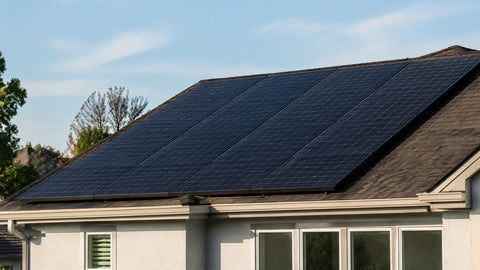
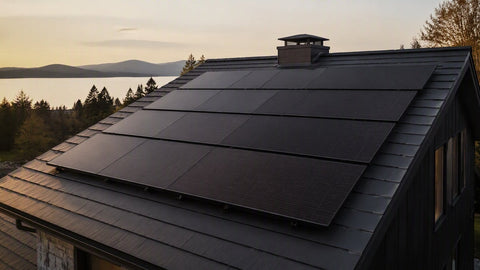
Read the ladder strategically. The 540W-class HiKu6 PERC panels are the value play for budget commercial roofs where density doesn't bind. BiHiKu6 bifacial PERC is the workhorse for ground mounts over bright surfaces. TOPHiKu6 is the residential answer — standard residential footprint, 25-year product warranty that finally matches the premium brands' paperwork, and TOPCon's low degradation. HiHero HJT is the efficiency king for space-constrained commercial roofs. And TOPBiHiKu7 at 695–750W is a utility-scale animal — you do not hand-carry these up a ladder; they're for trackers and pile-mounted fields.
How the Technology Tiers Actually Differ
Installers ask me whether TOPCon is "worth it" over PERC, and the honest answer is that the question is already settled by the market — PERC is the outgoing architecture and TOPCon is the incoming one, for physics reasons worth understanding. PERC cells add a passivation layer to the rear of a conventional p-type cell; they topped out around 21.5–22% module efficiency and carry higher light-induced degradation. TOPCon (tunnel oxide passivated contact) cells are n-type — the base wafer is doped the opposite way — which shrugs off the boron-oxygen degradation that nibbles PERC's first-year output, and the passivated contact pushes voltage up. Practical results: TOPCon modules degrade slower (typically warranted ~1% first year, ~0.40%/yr after, versus PERC's ~2%/0.55%), run cooler coefficients (~-0.29 to -0.30%/°C versus ~-0.34 to -0.35%), and hold efficiency over 22% at prices PERC can't match anymore. HJT (HiHero) goes one step further with amorphous silicon passivation — best-in-class temperature coefficient near -0.24%/°C and the 23%+ efficiency ceiling — at a real cost premium. My rule of thumb: residential and hot-climate commercial gets TOPCon; space-constrained premium commercial gets HiHero; budget-driven volume gets HiKu6 while it lasts.
Technical Comparison Against the Field
| Brand | Flagship Tech | Peak Efficiency | Power Warranty | Price Position |
|---|---|---|---|---|
| Canadian Solar | HJT / TOPCon / PERC | 23.9% (HiHero) | 25–30 yr | Mid-range |
| JA Solar | N-type TOPCon | 24.8% (DeepBlue 5.0 class) | 30 yr | Mid-range (value) |
| Trina | N-type TOPCon (210mm) | ~23.1% | 30 yr | Mid-range |
| REC | HJT | 22.6% | 25 yr (92% @ yr 25) | Premium |
| Qcells | N-type TOPCon (Q.ANTUM NEO) | ~22.5% | 25 yr | Mid-premium |
Notice what Canadian Solar's position actually is: not the efficiency leader (JA's newest flagship tops the chart on paper), not the premium badge (that's REC, and our REC vs Panasonic head-to-head explains what premium buys), but the broadest credible ladder from value to high-end under one warranty umbrella. For a contractor running mixed project types, one brand relationship covering a 420W residential job and a 700W utility block in the same quarter is operationally valuable — one warranty process, one distributor channel, one set of datasheets your crew learns by heart. We also stock the direct competitors — JA Solar, Trina, Qcells — and I'll cross-quote them honestly; on any given month, one of them has the sharper truckload price.
Certifications, Listings, and Bankability
The paperwork that actually matters: UL 61730 listing for the US market (the safety standard your AHJ will look for), IEC 61215/61730 for international, and BloombergNEF Tier 1 status — which, to be precise, is not a quality award but a bankability index based on projects financed with the manufacturer's modules. Canadian Solar has held Tier 1 continuously for years, which means project lenders accept the brand without additional scrutiny. For US federal projects, watch the domestic-content and FEOC landscape quarter by quarter — Canadian Solar's US assembly operations exist precisely because that landscape shifts, and whether a given SKU qualifies depends on where that SKU's cells were made, so verify per-SKU at quote time, not from this paragraph.
Warranty Terms, Decoded
Read the table again and notice the split: the PERC and HJT commercial lines carry 12-year product warranties (industry standard for commercial modules — the premium residential 25-year product warranty is the exception, not the rule), while TOPHiKu6 residential gets 25-year product coverage and the power warranties stretch to 30 years on bifacial and n-type lines. The degradation schedules are where the real money sits: the TOPCon and HJT lines warrant ~87%+ of nameplate at year 30, which on a 30-year cash-flow model is worth several percentage points of lifetime energy against a PERC baseline. One administrative note from experience: Canadian Solar's claims process is orderly but documentation-hungry. Serial photos at install, commissioning reports filed, and a clean chain of custody make claims fast; missing serials make them slow. Photograph every serial sticker before the panels go on the roof — it's ninety seconds per pallet and it has saved my customers weeks.
Installer Field Notes
A handful of handling realities that don't make the datasheet. The 540W-class HiKu6 and the big bifacials are two-person panels, full stop — 2.3-plus meters of glass at 28–32 kg, and a gust of wind on a rooftop will teach physics to anyone carrying one solo. The TOPBiHiKu7 at 750W is mechanical-placement territory; don't bid it as a hand-install. Bifacial glass-glass modules (BiHiKu, HiHero, TOPBiHiKu) have no backsheet to scuff, which is a durability win, but it means you can no longer tell panel orientation by feel in the crate — check the label before you torque. Clamping zones on the large-format modules are narrower than old-timers expect; follow the manual's zone drawing exactly, because a clamp 50 mm out of zone is a warranty argument you will lose. And on bifacial ground mounts, don't cheap out on wire management — rear-side gain depends on an unshaded rear, and a dangling homerun across the back of a bifacial row is a tiny, permanent production tax. Hardware-wise, these large-format frames pair cleanly with the ground-mount and rail systems in our racking hardware kits and IronRidge lines — just match rail span to the module's load rating, which the big panels reduce compared to residential formats.
Sizing Math: A Worked Residential Example
Take the CS3N-395MS we stock — a 395W residential-format mono panel — on a typical 8 kW-class job:
| Step | Math | Result |
|---|---|---|
| Target system size | Homeowner usage ~11,000 kWh/yr ÷ 1,400 kWh/kW-yr site factor | ~7.9 kW DC |
| Panel count | 7,900 W ÷ 395 W | 20 panels (7,900 W exactly) |
| Roof area required | 20 × ~1.94 m² (1722×1130mm class) | ~39 m² ≈ 420 ft² |
| String check (IQ8-class micro) | 395 W panel ÷ 384 VA micro peak | DC:AC ratio ~1.03 — clean pairing, minimal clipping |
| Year-1 production estimate | 7.9 kW × 1,400 | ~11,060 kWh — full offset |
That microinverter row deserves a beat: pairing 395–445W panels with modern micros is routine now, but check the micro's continuous AC rating against the panel's real-world output, not its nameplate fantasy. Our Enphase brand guide has the IQ7/IQ8 pairing tables, and the Enphase collection has the hardware. For string architectures, the inverter catalog and charge controller sizing guide cover the rest of the electrical stack.
What PES Supply Stocks
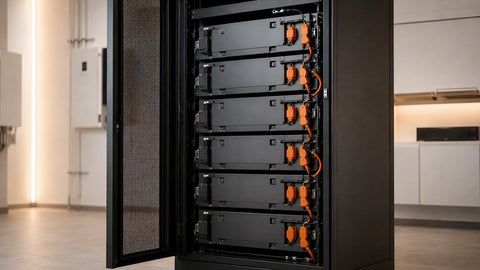
We carry Canadian Solar across the tiers, anchored by the CS3N-395MS residential panel and the 15 kWh battery backup kit built on Canadian Solar modules for turnkey resilience jobs. The full Canadian Solar collection updates with live stock, and for volume — pallets through truckloads — our main panel catalog is the quote starting point. Lead time on stocked SKUs is days, not months; factory-direct container orders for project-scale volumes run longer and we quote them with honest calendars.
Recent Releases (2025–2026)
Canadian Solar's headline expansion this cycle is the TOPBiHiKu7 N-type TOPCon family — large-format 210 mm wafers pushing 695–750W for utility applications, and the reason the utility side of the catalog keeps stealing share from the PERC incumbents. The HiHero HJT line got its own extension: a low-carbon build pairing that -0.24 to -0.255%/°C-class temperature coefficient with bifaciality factors up to 90%, meaning the rear side converts nearly as efficiently as the front — on a high-albedo commercial roof or bright ground mount, that's real yield, not brochure yield. The strategic picture matters more than either SKU: Canadian Solar is one of the few Tier 1 manufacturers running TOPCon and HJT platforms simultaneously at volume, which gives installers a genuine choice between maximum power density (TOPCon) and best-in-class hot-climate behavior (HJT) without leaving the brand's warranty umbrella. On the residential side, TOPHiKu6's arrival with a 25-year product warranty quietly closed the last paperwork gap between Canadian Solar and the premium residential brands — a bigger deal for installers than another five watts of nameplate.
Domestic Content: The Buy America Caveat
One honest flag for public-sector and federally funded work: Canadian Solar manufactures primarily outside the US, so most of its modules are not Buy America (BABA) compliant, and FEOC-adjacent rules keep tightening. If your project carries domestic-content requirements, spec accordingly — we stock US-made alternatives from Mission Solar and the Silfab Elite n-type TOPCon line (Silfab assembles in North America; verify per-SKU origin at quote time, because assembly location and cell origin are different questions). For private commercial and residential work where BABA doesn't apply, Canadian Solar's price-to-bankability ratio remains the reason it wins so many of our cross-quotes.
Commercial and Utility: Where the Brand Really Lives
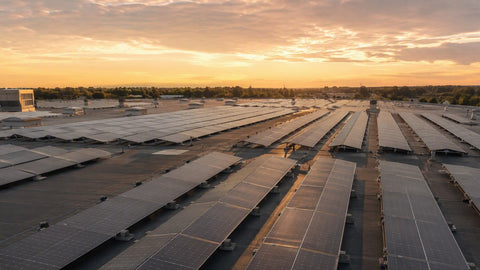
Everything above covers the residential and small-commercial view, but it would be malpractice to write a Canadian Solar guide without acknowledging where the company's center of gravity sits: projects measured in megawatts. The TOPBiHiKu7 at 695–750W exists for trackers and fixed-tilt utility fields, where per-watt BOS economics reward the biggest module a pile can hold. At that scale the conversation changes entirely — you're buying by the container, negotiating degradation schedules into the PPA, and caring about things like PAN file accuracy for energy modeling and whether the manufacturer will still exist to honor a year-18 claim. Canadian Solar's decades of Tier 1 tenure and its Recurrent Energy development arm give it a footprint in that world that consumer-facing brands can't fake. For our contractor readers who straddle both worlds — a 20 kW commercial roof this month, a 2 MW ground mount next quarter — that dual credibility is the practical reason to learn one brand's full ladder instead of juggling three.
The TOPCon Transition, and What It Means for Your 2026 BOMs
Between 2024 and 2026 the industry's center of mass moved from PERC to TOPCon faster than any technology transition I've watched in this trade — faster than mono displacing poly, faster than half-cut going standard. For buyers, the consequence is counterintuitive: the outgoing technology is simultaneously cheap and risky. PERC modules at fire-sale prices are real, and for a budget commercial project with a 25-year view, a steeply discounted HiKu6 can still be the right buy — I placed a pallet of them on a warehouse roof last quarter with a clear conscience. But the risk isn't the panel, it's the ecosystem: as PERC lines shut down, a year-12 replacement match becomes a scavenger hunt, and warranty administration for an exited architecture gets slower even when the company survives. The clean play for anything you'll own long is to ride the incoming curve — TOPHiKu6 and TOPBiHiKu7 — where the production volumes and the R&D dollars now live. Price the PERC delta honestly, decide with your eyes open, and don't let a nickel a watt seduce a 30-year decision.
Procurement Realities: Pricing, Minimums, and Freight
Module pricing at the wholesale level is a freight-and-volume story as much as a technology story. The per-watt ranges in our lineup table assume realistic order sizes; here's how the tiers move with volume:
| Order Size | Typical Price Behavior | Logistics Notes |
|---|---|---|
| 1–10 panels | Retail-plus; widest gap over bulk pricing | Parcel or LTL freight; residential replacements and small expansions |
| 1 pallet (31–36 panels) | Meaningful step down; the sweet spot for residential crews | Single LTL pallet; liftgate delivery available for sites without docks |
| 5–10 pallets | Volume tiers engage; cross-brand competition sharpens here | Dedicated LTL or partial truckload; staging matters on multi-week installs |
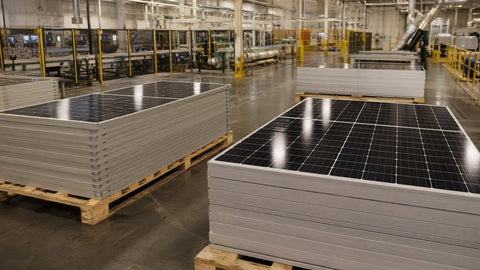
| Full truckload (~600+ panels) | Best distributor pricing; factory-fresh lots often available | Flatbed or dry van with dock access; plan laydown area and inspection labor |
| Container / project scale | Factory-direct economics; longest lead times | Port schedules and customs drive the calendar; quote months ahead |
Two procurement habits separate contractors who hit project dates from those who don't. First, inspect on receipt — note any corner crush or frame scuff on the delivery receipt before the driver leaves, because freight claims have a statute of limitations measured in hours. Second, buy your spares up front: one extra panel per 100 on the original order costs almost nothing at volume pricing and eliminates the single most annoying service call in the business, the unmatched replacement. Both habits are cheaper than the alternative, and both are written into how we pack and ship orders.
Common Mistakes When Spec'ing This Brand
Three repeat offenders from the quote desk. First, mixing wattage bins across strings on the same MPPT — the large-format lines ship in tight bins, but a 540W and a 555W on one string still clip to the weaker module; keep bins segregated per string. Second, underspec'ing racking for the big formats: a 2384 mm module reduces allowable rail spans compared to residential panels, and I've seen callbacks where a crew reused a residential span table on HiKu6 frames and found deflection at the first snow load. Third, assuming "Tier 1" means "any SKU is fine" — the tiering applies to the company, not the panel; a BABA-disqualified module on a federal job or a PERC panel on a 30-year hold are both unforced errors that the company-level reputation won't rescue. Match the SKU to the constraint, then enjoy the price.
Frequently Asked Questions
Is Canadian Solar really Canadian?
Founded in Guelph, Ontario in 2001 and still headquartered there — but manufacturing is global, with fabs across Asia and North America. Check country-of-origin per SKU if domestic content or tariff status matters to your project; it varies by product line.
What is the difference between HiKu and BiHiKu?
HiKu is mono-facial PERC — the value tier. BiHiKu is the bifacial glass-glass version of the same family, harvesting rear-side light for 5–20% extra yield over bright ground, with a longer (30-year) power warranty. Same family, different missions.
Which Canadian Solar panel is best for hot climates?
HiHero (HJT, ~-0.24%/°C temperature coefficient) first, then the TOPCon lines (~-0.29 to -0.30%/°C). Standard HiKu PERC (-0.34%/°C class) gives up several points of output on hot afternoons — fine for budget projects in mild climates, the wrong pick for Phoenix.
Are Canadian Solar panels Tier 1?
Yes — continuously on the BloombergNEF Tier 1 list, which tracks bankability (projects financed with the brand's modules) rather than lab quality. For lenders and commercial buyers, Tier 1 status means no additional manufacturer scrutiny in underwriting.
What is TOPCon and should I pay extra for it?
TOPCon is an n-type cell architecture with slower degradation (~0.40%/yr vs ~0.55% for PERC), better temperature coefficients, and higher efficiency — at prices that have largely erased the old premium. For new purchases in 2026, TOPCon is the default answer for anything you'll own past year five.
What is the lead time from PES Supply?
Stocked SKUs ship in days. Volume project orders (pallets to containers) are quoted with realistic factory and freight calendars. Tell us the project date and we'll tell you which tier of the catalog can actually meet it.
Bottom line: Canadian Solar in 2026 is the industry's most complete ladder — PERC value at the bottom, TOPCon taking the volume middle, HJT at the premium top — under a Tier 1 balance sheet that lenders and warranty departments both respect. Spec TOPHiKu6 for residential, HiHero when density is king, and BiHiKu/TOPBiHiKu when the ground is bright and the rows are long. Then send us the BOM; we'll have it on a truck before your permit comes back.