Unirac has been bending aluminum for solar arrays since the late 1990s, and their rails are on more North American roofs than just about anybody's. I've torqued down SolarMount on everything from a 12-panel garage job in Portland drizzle to a 400-module flat-roof ballast job where the wind off the Columbia made every uplift calculation feel personal. This guide covers the current Unirac lineup — SolarMount, NXT UMOUNT, Flashloc attachments, the RM flat-roof family, EcoFoot, and the ULA ground mount — with the span tables, torque specs, and UL 3741 context you need before you order hardware. Cross-shopping? Our IronRidge brand guide and SnapNrack brand guide cover the two most common alternatives, and the solar panel mounting guide walks the fundamentals.
Company Overview
Unirac is an American racking manufacturer (now part of the Gibraltar Industries family) with manufacturing in New Mexico and a reputation built on two things: a huge UL 3741-listed portfolio and installer-friendly hardware that doesn't require a bin of loose parts per attachment. Where some competitors win on price per foot of rail, Unirac wins on engineering documentation — their span tables, letters, and design tool output are the ones AHJs and structural reviewers accept without a fight. For a contractor, that paperwork is worth real money. A rejected structural calc package costs you a week; a clean Unirac submittal rarely gets a second look.
We stock the line at PES Supply — browse Unirac racking or the broader racking and mounting catalog — and we'll say the quiet part out loud: Unirac is rarely the cheapest BOM on a residential job, but it's almost never the expensive mistake either.
Current Product Lines
SolarMount (Flush-to-Roof)
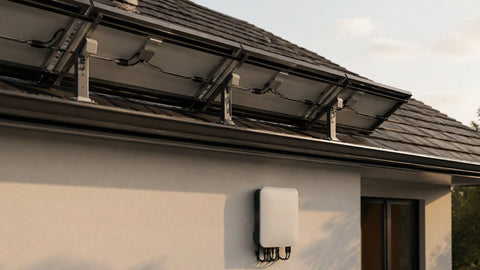
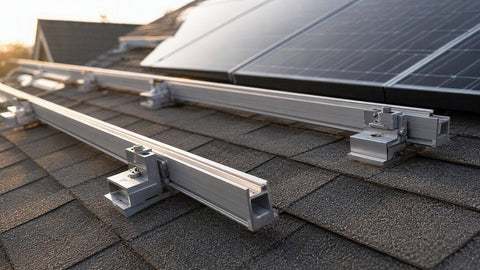
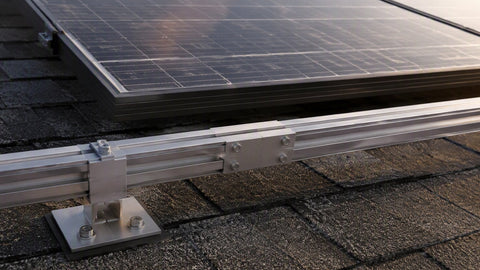
SolarMount is the flagship pitched-roof system: 6000-series aluminum rails in standard and light profiles, universal mid and end clamps that self-ground through the rail, and an attachment ecosystem that covers comp shingle, tile, metal, and rolled roofing. The standard rail spans up to 10 feet between attachments under moderate loads — fewer roof penetrations, fewer flashings, faster layout. That span claim is load-dependent, though; the tables below are where the datasheet meets the jobsite.
NXT UMOUNT
NXT UMOUNT is the next-generation flush mount: integrated bonding splices (no separate grounding hardware at rail joints), compatibility with 30–40mm module frames, and a cleaner anodized finish in mill or dark. Installers who've run both report the splice-and-slide assembly shaves real minutes per row — on a 30-module residential job that's an hour of crew time, which is a real number on a tight margin.
Flashloc Attachment Series
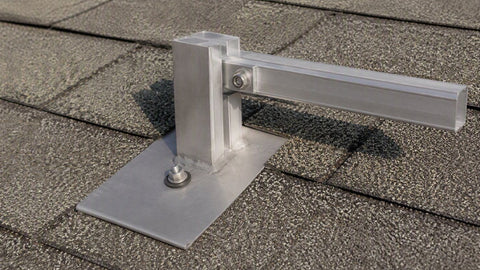
Flashloc is Unirac's answer to the flashing-vs-labor problem. The DUO variant mounts to deck or rafter through a diecast A380 aluminum base with EPDM seals — no sheet-metal flashing to slide under three courses of shingle. I've flashed roofs both ways for years, and on a steep 8/12 comp roof in a hurry, a sealed deck-mount attachment is the difference between a one-day and a two-day rough-in. Use the rafter-mount option when the engineer's letter demands it; use deck mount when the spans allow it. For flashing fundamentals and lag-bolt technique, our pitched-roof mounting guide goes deep, and the Quick Mount PV guide covers the flashed-lag alternative.
RM5 (Flat Roof, 5-Degree Ballasted)
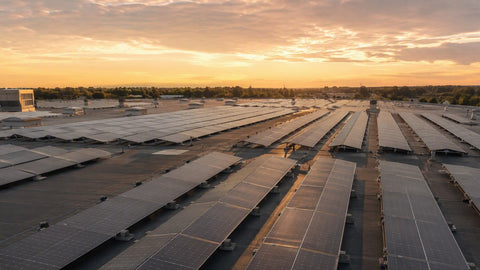
RM5 is the value flat-roof system: 5-degree tilt, ballasted, minimal penetrations, and a wind-tunnel-tested ballast map. It exists for commercial roofs where the membrane warranty forbids penetrations and the structure can carry the dead load. For stiffer tilt or higher wind zones, RM10 EVO steps up to 10 degrees with a serviceable "pop-the-hood" design; GridFlex covers the oddball layouts.
EcoFoot 2+ / EcoFoot 5D
The EcoFoot line is the low-ballast, attachment-hybrid approach for flat roofs that can't carry a fully ballasted design — integrated EPDM base protects the membrane, and the footprint is small enough for congested commercial decks crowded with HVAC curbs and vents.
Unirac Large Array (ULA) Ground Mount
ULA is the pipe-based ground mount: schedule-40 steel pipe piers, aluminum rails on top, scalable from a two-row residential array to multi-row commercial blocks. If you're weighing roof against ground, our roof vs. ground vs. pole mount comparison lays out the trade-offs — ground mounts cost more in steel and trenching but give you perfect tilt, perfect azimuth, and no roof warranty conversations.
| Model | Category | Key Specs | Application |
|---|---|---|---|
| SolarMount Standard Rail (185") | Flush-mount rail | 6000-series aluminum, 10 ft max span, UL 2703/3741 | Residential pitched roof, moderate/heavy loads |
| SolarMount Light Rail (185") | Flush-mount rail | Low-profile, 6 ft max span, lightweight | Residential, light snow regions |
| Flashloc DUO | Roof attachment | A380 diecast aluminum, EPDM seals, deck or rafter mount | Comp shingle and rolled comp roofs |
| Flashloc RM | Flat-roof attachment | Cast aluminum, 6,670 lbs ultimate uplift, universal | Commercial flat roofs, all membrane types |
| NXT UMOUNT Rail | Next-gen flush mount | Integrated bonding splice, 30–40mm modules, mill/dark anodized | Residential, premium aesthetics |
| RM5 | Ballasted flat roof | 5° tilt, wind-tunnel-tested ballast maps, minimal penetrations | Commercial low-slope roofs |
| RM10 EVO | Ballasted flat roof | 10° tilt, pop-the-hood service access, GridFlex options | Commercial, higher wind exposure |
| ULA Ground Mount | Ground mount | Schedule-40 pipe piers, aluminum rails, scalable rows | Residential and commercial ground arrays |
Recent Releases (2025–2026)
The big moves have been the NXT UMOUNT rollout with its integrated bonding splice, expanded UL 3741 listings across the residential line (Unirac claims the broadest 3741-compliant portfolio in the industry), and continued refinement of the Flashloc family — the DUO's deck-mount rating in particular has been a labor saver on production residential work. Unirac also added domestic-content configurations (the SolarMount DCBC line) aimed at projects chasing the ITC domestic-content adder. If domestic content matters to your project economics, verify the current BOM breakdown with us before you bid — the adder rules have moved twice since 2024.
Certifications & Listings
Unirac systems carry UL 2703 (the racking listing that covers mechanical and bonding/grounding), and the portfolio is listed to UL 3741 for photovoltaic hazard control — the standard that lets AHJs accept arrays without module-level rapid-shutdown devices in many configurations. Structural letters reference ASCE 7 wind and snow load provisions, and the design tool outputs site-specific span and ballast documentation. That last part is the practical win: UL 3741 compliance plus clean engineering letters is why Unirac submittals sail through jurisdictions where value-brand racking gets red-lined.
Warranty Terms
Twenty-five years on racking components — the industry-standard term, matching IronRidge and SnapNrack. The warranty covers finish and structural integrity under the published load tables, which is your reminder that installing outside the span tables voids the very paperwork that made Unirac worth buying. Read the letter, build to the letter, and keep the invoice — a 25-year warranty claim in year 19 starts with proof of what you bought.
Span Tables & Load Ratings: The Numbers That Drive Layout
Span is everything on a flush-mount job — it sets attachment count, penetrations, and labor. These representative spans for SolarMount Standard rail show how wind and snow eat into the headline 10-foot number (always confirm against Unirac's current engineering letters for your site-specific ASCE 7 values):
| Design Condition | 90 mph / 0 psf snow | 120 mph / 20 psf snow | 140 mph / 40 psf snow | 180 mph (HVHZ) |
|---|---|---|---|---|
| SolarMount Standard Rail max span | 10 ft | 7–8 ft | 5–6 ft | 3–4 ft (engineered) |
| SolarMount Light Rail max span | 6 ft | 4–5 ft | 3–4 ft | Not recommended |
| Attachments per 10-module row (Standard) | 4–5 | 6 | 8 | 10+ (engineered) |
Watch what that does to attachment count: the same row needs twice the penetrations at 140 mph as it does at 90 mph. On a comp roof with Flashloc DUOs that's an extra hour and a half of drilling and sealing; on a tile roof it's a whole different bid. We layout-check every racking BOM against the site's wind speed before it ships — if your jurisdiction adopted the newer ASCE 7 maps, your "standard" spacing may not be standard anymore.
Technical Comparison: Unirac vs. Competitors
| Feature | Unirac | IronRidge | SnapNrack |
|---|---|---|---|
| UL 3741 Compliance | Full portfolio (most in industry) | Select systems | Limited |
| Flagship Residential Rail | SolarMount Standard (10 ft span) | XR100 (8 ft span) | Ultra Rail UR-40 |
| Domestic Content Option | Yes (SolarMount DCBC, 100% domestic) | Yes (limited) | Yes (USA line) |
| Flat Roof Systems | RM5, RM10 EVO, GridFlex 5/10, EcoFoot | BX Ballasted | Limited |
| Ground Mount | ULA (pipe-based, scalable) | Yes (SMA ground mount) | Yes (pipe clamp system) |
| Design Software | U-Builder 2.0 | Design Assistant | SnapNrack Design Tool |
| Warranty | 25 years | 25 years | 25 years |
The honest field summary: IronRidge's XR rails are stiff and beloved by production crews; SnapNrack's Ultra Rail goes together fast with nice wire-management touches; Unirac's edge is the attachment ecosystem, the flat-roof breadth, and the engineering documentation. On a commercial flat roof or a permitted residential job with a picky AHJ, Unirac is usually the lowest-friction choice. On a straightforward comp-shingle residential job, all three will outlive the roof — pick on price and crew preference. Our racking components guide breaks down rails, clamps, and splices generically if you want the anatomy lesson first.
Popular Products at PES Supply
The volume movers from our Unirac collection: SolarMount standard and light rail sticks, Flashloc DUO kits, universal mid/end clamps, and the NXT UMOUNT rail for new residential builds. Flat-roof commercial buyers come for RM5 kits and EcoFoot hardware, and ground-mount customers pair ULA structures with our mount kits and racking hardware kits for complete BOMs. We also keep the odd sizes — 185-inch sticks, dark anodized finishes, tile hooks — that blow up a schedule when they're missing. The Unirac brand page and the racking and mounting page list the current stock position.
Installation Notes
Roof Type Compatibility
| Roof Type | Recommended Unirac Attachment | Field Notes |
|---|---|---|
| Asphalt comp shingle | Flashloc DUO (deck or rafter) | Deck mount where spans allow; seal, don't caulk, per instructions |
| Tile (S, W, flat) | Tile hook / replacement tile base | Budget tile breakage at 2–5%; walk the valleys |
| Standing-seam metal | Seam clamp (S-5! type interface) | Never penetrate a standing seam; clamp it |
| Corrugated / exposed-fastener metal | Metal-roof base with butyl gasket | Hit purlins or structural deck; verify pullout |
| Rolled comp / low slope | Flashloc DUO or RM ballast family | Ballasted RM systems avoid penetrations entirely |
| TPO / EPDM membrane (commercial) | EcoFoot or RM5/RM10 ballast | Coordinate with roofer to preserve membrane warranty |
Tools Required
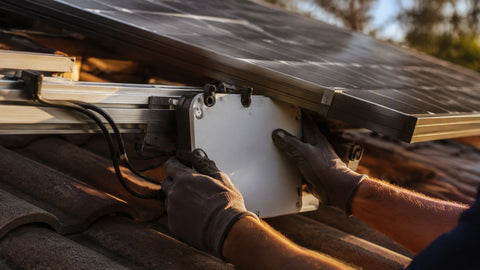
A SolarMount rough-in needs nothing exotic: a good impact driver, torque wrench, chalk line, stud finder that actually works through plywood, a 7/16" socket set, and a sharp spade bit for pilot holes. Add a tube of the specified sealant, a handful of spare EPDM seals, and a roofing magnet for dropped screws — the screw you lose in the gutter today is the rust streak the homeowner photographs next spring. The two tools that separate clean jobs from callbacks are a calibrated torque wrench and a genuine rafter-finding discipline — I've seen crews "find rafters" by drilling exploratory holes until they hit something, and every one of those holes is a future leak wearing a band-aid. Budget twenty minutes at the start of every job to verify torque settings against the manual in the box, because hardware revisions happen and the setting you used last year may not be the setting in this year's kit.
Torque & Hardware Specs
| Connection | Typical Torque | Notes |
|---|---|---|
| Mid / end clamps (module to rail) | 10–15 ft-lb | Follow current Unirac install manual; over-torque cracks module frames |
| Rail splice hardware | 12–15 ft-lb | NXT UMOUNT splices bond electrically through the joint |
| Attachment lag (5/16" SS into rafter) | Per ESR letter, typically full engagement + 2/3 shank | Pilot hole per manual; stripped lags get upsized or relocated, never caulked |
| Flashloc DUO fasteners | Per install manual | EPDM seal compresses visibly — stop at spec, not at "tight" |
Torque values are typical published figures — the install manual in the box is the controlling document, and Unirac revises hardware from time to time. Two field rules that never change: over-torqued clamps void module warranties, and an EPDM seal mashed flat today is a leak in five years. For ballasted flat-roof layout and attachment trade-offs, see our ballasted vs. penetrating flat-roof guide.
Layout & Wire Management on Flush-Mount Jobs
Racking is structure, but the job passes or fails inspection on the wiring details. A few layout habits that save callbacks. Keep your home-run runs inside rail channels where the inspector can see them dressed and clipped — Unirac's wire-management clips snap into the rail and keep PV wire off the roof membrane, which matters because wire lying on hot shingles cooks its insulation years early. Stagger your splices so rail joints don't stack up over one attachment, and leave thermal expansion gaps per the manual on long rows — aluminum moves roughly 1/4 inch per 20 feet across a 100°F swing, and a 60-foot row with no expansion joints will buck a clamp loose by the second summer. Mark attachment locations from the ridge down, not the eave up; starting at the ridge keeps your last attachment off the fascia where edge distances get thin. And photograph every flashing before the rail covers it. The day a homeowner calls about a ceiling stain, those photos are the difference between a warranty conversation and a lawsuit conversation.
Ballast Math for Flat Roofs
Ballasted systems trade penetrations for pounds, and the pounds are not negotiable. A typical RM5 layout runs roughly 4–6 psf of total dead load including modules and racking — well within most commercial roof structures designed to modern codes, but enough to matter on older decks. The ballast map from U-Builder isn't a suggestion: corner and perimeter zones carry more block than field zones because wind pressure multiplies at edges, and I've watched a crew "simplify" a ballast map by evening out the blocks. The engineer who stamped it was not amused, and the re-inspection cost more than the blocks ever would have. Before you commit to ballast, get the structural capacity in writing — psf capacity, deflection limits, and ponding history. A roof that ponds water near drains will corrode racking feet and void membrane warranties around the array. EcoFoot and hybrid attached systems exist precisely for roofs that can't carry the block load; the penetrations cost you membrane-warranty paperwork but save the structure.
Design Tools & Permitting Paperwork
U-Builder 2.0 is the front end of the whole Unirac value proposition: drop in the address, module, and roof geometry, and it returns spans, attachments, and a submittal-ready document package. Use it even if you know the spans cold, because the printed output is what the plan reviewer wants to see. Attach the engineering letter to your permit packet, staple the UL 3741 listing page behind it, and include the module's UL 61730 listing — that three-document stack answers 90% of plan-check questions before they're asked. The jurisdictions that still push back are usually reading an old adoption of the NEC rapid-shutdown language; the 3741 listing is your counter, and it's worth learning to explain it in one sentence: the racking system itself is listed to control the hazard, so module-level electronics aren't required. Save the PDF package with the job file — when the roof gets re-roofed in fifteen years, the next crew will want to know exactly what's bolted to the deck, and that packet is the answer.
Frequently Asked Questions
1. What makes Unirac's UL 3741 compliance significant?
UL 3741 is the photovoltaic hazard-control standard that allows arrays to meet rapid-shutdown intent at the system level instead of requiring a module-level shutdown device on every panel. Unirac holds the broadest 3741-listed racking portfolio in the industry, which means simpler BOMs, fewer electronic points of failure on the roof, and faster permitting in jurisdictions that accept 3741 system listings.
2. What is the SolarMount DCBC and why does it matter?
DCBC is Unirac's domestic-content SolarMount configuration — 100% domestic manufactured components designed to help projects qualify for the Investment Tax Credit domestic-content adder. On a commercial project the adder can be worth 10 percentage points of tax credit, which dwarfs any racking price difference. Verify current qualification rules before bidding; the Treasury guidance has evolved.
3. Can Flashloc DUO be mounted to deck sheathing without hitting rafters?
Yes — the DUO is rated for deck-mount installation within its published spans and load limits, using the specified fastener pattern. Rafter-mount remains stronger and is required at tighter spans under high wind or snow loads. The engineering letter for your site determines which is allowed; don't freestyle it.
4. What is the maximum wind speed the SolarMount system is rated for?
With engineered layouts and reduced spans, SolarMount systems are used in high-wind regions including hurricane zones at 180 mph design speeds and above. The span shrinks as wind climbs — from 10 feet at 90 mph down to 3–4 feet in HVHZ conditions. The site-specific engineering letter, not the brochure, sets your number.
5. How does the RM10 EVO "pop-the-hood" feature work?
RM10 EVO's module rows hinge open for access to the roof, wiring, and ballast beneath — you can service the array or the membrane without disassembling the racking. On commercial roofs where the membrane gets inspected and patched over a 25-year array life, that serviceability saves real money.
6. Does Unirac work with all module frame heights?
The universal clamp line covers the common 30–40mm frame range, and NXT UMOUNT is specified for 30–40mm frames. Confirm frame height and clamp compatibility on the BOM before ordering — mixing odd-frame modules with the wrong clamp is a classic freight-delay mistake.
Sources & Standards
Specifications referenced from Unirac published datasheets, installation manuals, and engineering letters; UL 2703 (racking and grounding), UL 3741 (photovoltaic hazard control), ASCE 7 wind and snow load provisions, and NRTL listing documentation. Torque and span figures are typical published values — the current install manual and site engineering letter control.
Shop Unirac at PES Supply
Browse the Unirac collection for rail, attachments, clamps, and complete kits, or start from our solar mounting systems catalog. Send us your module count, roof type, and design wind speed and we'll turn a BOM with the right spans — the same check we run on every racking order that leaves the warehouse.