1. Company Overview
Champion Power Equipment has built its reputation on a simple proposition: contractor-grade features at a price that doesn't require a second mortgage. Founded in 2003 and headquartered in Santa Fe Springs, California, the company grew from a regional generator importer into one of the best-selling portable generator brands in North America by doing two things consistently — shipping dual-fuel capability as standard on popular models, and backing everything with a three-year limited warranty plus lifetime free technical support. That warranty-and-support combination is the brand's genuine moat; when your generator won't start at 9 PM before a storm, a live US-based tech line is worth real money.
We sell and service generators across every price tier, and here's the honest field assessment: Champion doesn't chase the premium quiet-inverter crown or the liquid-cooled commercial crown. It owns the value middle — the homeowner who needs storm coverage, the RV traveler who wants dual fuel, the contractor who needs a site unit that survives being thrown in a truck bed. In that middle, dollar for dollar, Champion is very hard to beat. That's not marketing copy; it's what our parts counter and our service log say after years of watching which machines come back and which ones simply work.
Browse current stock in our Champion generators collection, or cross-shop the broader portable generator lineup.
Sizing Scenarios: Which Class Fits Your Load List
We size portables the same way we size standbys — honest load list, starting surges counted, twenty percent headroom. These scenarios come straight from our quote desk:
| Scenario | Essential Loads | Running Need | Champion Class Fit |
|---|---|---|---|
| Apartment / essentials only | Fridge, lights, phone chargers, fan | ~1,500 W | 2kW-class inverter |
| RV with one AC + soft-start | 13.5K BTU AC, converter, outlets | ~3,000 W | 3,400–4,500W inverter, dual-fuel preferred |
| Home essentials via transfer switch | Fridge, furnace blower, well pump, lights | ~5,000 W + surge | 7,500W-class open-frame dual-fuel |
| Home with central AC (managed) | Above + 3-ton AC with soft-start | ~8,000 W | 9–12kW open-frame or tri-fuel |
| Whole-home automatic | Everything, no management | 12kW+ continuous | Step up to standby class |
Notice the last row: there is a load level where the right answer stops being a portable. If your load list demands more than about 12kW continuous, or if anyone in the house depends on powered medical equipment, stop shopping portables and price a standby. The standby generator collection and our sizing guides exist for exactly that conversation.
2. Current Product Lines
| Product Line | Typical Output Class | Fuel | Best For |
|---|---|---|---|
| Inverter portables | ~2,000–4,500 W | Gasoline; many dual-fuel | RV, camping, tailgating, sensitive electronics |
| Conventional open-frame portables | ~4,000–12,000 W | Gasoline; many dual-fuel | Job sites, home backup via transfer equipment |
| Tri-fuel portables | ~8,000–9,000 W class | Gasoline / LP / natural gas | Home backup with fuel flexibility |
| Home standby | Air-cooled residential class | NG / LP | Automatic whole-home backup |
| Log splitters, pressure washers, engines | various | Gasoline | Property maintenance |
Output figures above are class-level — always confirm the exact model's spec sheet before you commit to a load plan, because starting watts and running watts differ and dual-fuel models rate differently on each fuel.
3. Dual-Fuel and Tri-Fuel: What the Labels Really Mean
Champion popularized dual-fuel portables before most competitors bothered, and the feature is genuinely useful: when gasoline is sold out after a hurricane, a propane tank from the grill keeps the refrigerator running. But understand the physics. Propane carries less energy per volume than gasoline, so every dual-fuel engine makes less power on LP — typically around ten percent less. The table shows the pattern to expect; exact figures live on each model's spec sheet.
| Fuel | Relative Output | Runtime Character | Storage Life |
|---|---|---|---|
| Gasoline | 100% (rated) | Best power density; longest runtime per tank | Months; degrades without stabilizer |
| Propane (LP) | ~90% of gasoline rating | Clean burning; easy cold starts; tank-swappable | Indefinite |
| Natural gas (tri-fuel models) | ~80–85% of gasoline rating | Unlimited runtime while utility pressure holds | Utility-supplied |
I've run dual-fuel units through week-long outages, and my advice never changes: run the machine on propane for daily cycling, and keep stabilized gasoline in reserve for the days you need full rated output. Propane also stores forever and never gums a carburetor — the number-one killer of portable generators is stale fuel varnish, and LP eliminates that failure mode entirely.
4. Certifications & Listings
Champion portables carry EPA certification, and CARB-compliant versions are available for California and other CARB-adopting states — check the specific SKU, because not every model ships in a CARB configuration. Home standby units ship with the certifications required for permanent installation, and any standby install must still meet NEC Article 702 transfer equipment rules regardless of brand. Our NEC code compliance guide covers the wiring and transfer-switch requirements that apply to every standby install we touch.
5. Warranty Terms
| Coverage Element | Champion (typical) | Industry Context |
|---|---|---|
| Portable generator limited warranty | 3 years residential | Matches or beats most value-tier competitors |
| Technical support | Lifetime, free | Rare at this price point |
| Home standby warranty | Multi-year limited; varies by model | Competitive with entry standby offerings |
| Registration | Required / strongly encouraged | Register at commissioning, not after the failure |
Two warranty realities from the service side. First, warranty follows maintenance — a seized engine with a carburetor full of two-year-old fuel is an owner problem, not a warranty claim. Second, keep the receipt and the serial photo in the same folder as your install paperwork. Claims move fast when documentation is clean and stall for weeks when it isn't.
6. Popular Champion Products at PES Supply
The categories our customers buy most: lightweight inverter units for RV and tailgate duty, mid-size dual-fuel open-frames for home backup through a manual transfer switch or interlock kit, and the larger tri-fuel machines for buyers who want natural-gas runtime without a permanent standby install. Pair any backup plan with the right generator accessories — covers, wheel kits, fuel stabilizer, and cold-weather kits matter more than most buyers expect.
If you're weighing a portable-plus-transfer-switch approach against a permanently installed standby, read our standby generator home guide and the whole-house generator overview first. The crossover point is usually around the second multi-day outage: portables win on price, standbys win on everything after that.
7. Technical Comparison: Champion vs. the Field
| Dimension | Champion | Premium Japanese Brands | Big-Box Standby Brands |
|---|---|---|---|
| Price per watt (portable) | Lowest in class | 2–3× higher | Comparable on sale |
| Noise (inverter class) | Good | Best | Varies |
| Dual-fuel availability | Standard on many models | Rare | Some models |
| Warranty + support | 3 yr + lifetime tech line | 2–3 yr, dealer network | 3–5 yr standby |
| Dealer/service network | Growing; strong online support | Deep | Deep |
| Fit | Value backup, RV, job site | Daily-duty commercial | Permanent whole-home |
For a standby-tier head-to-head at the premium end, see our Generac vs. Kohler comparison — that's a different weight class than Champion competes in, and the comparison makes the value case from the other direction.
8. Installation & Use Notes
Portables live or die on three practices. Run the carburetor dry or use stabilized fuel every single time you store the machine — ethanol fuel left in a float bowl for six months guarantees a no-start. Ground per the manual and NEC 250 where required; our grounding and bonding guide explains electrode requirements. And never backfeed through a dryer outlet — use a listed transfer switch or interlock, sized with the wire ampacity chart. Backfeeding kills utility linemen, and it voids every warranty on the machine.
Cold-weather note from Minnesota winters: keep the battery on a maintainer and run the machine monthly under load, not just at idle. A portable that only ever idles develops carburetor and ring problems that show up exactly when you need full output.
Product Walkthrough: Matching the Line to the Job
Inverter portables: the quiet campers
Champion's inverter units are the machines we recommend to RV owners and anyone powering electronics — the inverter produces clean sine-wave power with low total harmonic distortion, which matters for laptops, CPAP machines, and modern refrigerator control boards. The ultralight 2,000-watt-class units are the gateway drug of the line: one person carries them, they sip fuel in eco mode, and they parallel together when you outgrow one. I've watched a single 2kW-class Champion inverter run a travel trailer's converter, lights, and a residential refrigerator through a three-day festival weekend on a few gallons of gas. The limit is starting surge: no small inverter starts a 13,500 BTU rooftop RV air conditioner without a soft-start module, and anyone who tells you otherwise is selling something.
Open-frame dual-fuel: the storm-workhorses
The mid-size open-frame dual-fuel machines are the heart of the brand. Electric start, a wheel kit that actually rolls over gravel, and a control panel with enough receptacles to matter — household 120V, a 30-amp RV/transfer-switch outlet, and on the bigger frames a 120/240V 50A or L14-30 for a generator transfer switch kit. These are the units our customers wheel out twice a year and depend on for a week every other year. The honest trade: they're loud, they're heavy, and the open frame lives outdoors under a cover or a lean-to, never in a garage — carbon monoxide from a generator in an attached garage kills people every storm season, no exceptions.
Tri-fuel and home standby: bridging to permanent backup
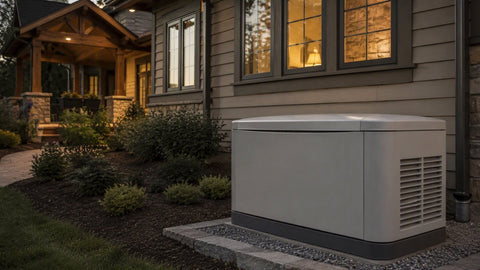
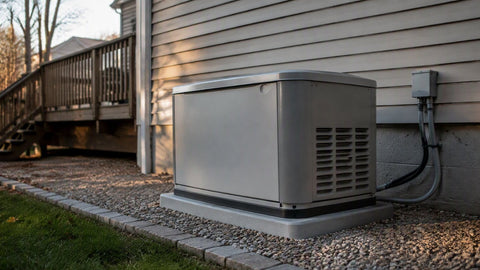
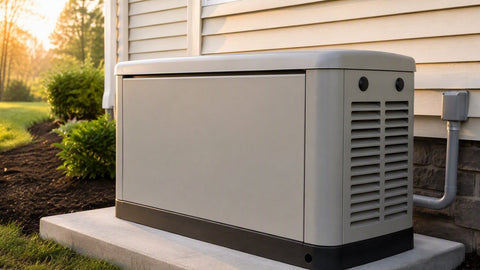
Champion's tri-fuel portables add natural gas to the gasoline/LP mix, which turns a portable into a semi-permanent solution for homes with gas service — hook a quick-connect to the gas line and runtime stops being a fuel-run problem. It's the middle path for buyers not ready for a full standby install. The company's home standby line then competes at the entry of the permanent market: automatic transfer, weekly exercise, and none of the wheel-out ritual. Buyers cross-shopping that jump should read the whole-house standby sizing article — the sizing discipline is identical whether the machine is portable or pad-mounted.
What Champion Gets Right — and Where It Loses
Gets right: price-to-feature ratio, dual-fuel as standard rather than as an upcharge, parts availability through normal retail channels, and a technical support line that answers. The warranty paperwork is refreshingly un-dramatic compared to some brands whose claim process feels designed to exhaust you into giving up.
Where it loses: premium fit and finish. Panel welds, throttle linkages, and enclosure hardware are built to a price, and a Champion that's been rattling around a work truck for three years shows it faster than a Honda does. Noise on the open-frames is middle-of-pack. And the resale market prices value brands accordingly — buy a Champion to use it, not to sell it. None of this is disqualifying; it's the honest trade the price point represents, and buyers who understand it are consistently satisfied, while buyers expecting premium-brand longevity at value-brand money are the ones writing angry reviews.
Total Cost of Ownership: The Number Nobody Quotes
Purchase price is maybe sixty percent of the five-year story. Add fuel stabilizer and rotation, annual oil and filter changes (or after each major run), a battery every few years on electric-start models, covers, and the transfer equipment on backup installs. Against that ledger, Champion's low entry price genuinely compounds: cheaper machines with available parts cost less to keep alive, and the lifetime tech support line substitutes for paid service calls on the simple stuff — we've talked owners through a stuck choke and a tripped GFCI more times than I can count, and each of those calls saved a $150 service visit.
The one cost that surprises portable owners: fuel during extended outages. A mid-size open-frame at half load burns several gallons a day, and a week-long outage is a hundred-dollar-plus fuel bill plus the scavenger hunt to find it. That's the argument for the dual-fuel LP side and for keeping a realistic fuel reserve on site — five-gallon cans in a ventilated shed, rotated through the lawn equipment so nothing goes stale.
Seasonal Prep: The Fifteen-Minute Ritual
Before storm season and before winter: run the machine to operating temperature, check oil, inspect the air filter and spark arrestor, test every receptacle with a lamp, verify the battery holds a charge, and confirm the transfer equipment operates smoothly. Photograph the serial plate while you're out there. Then store it with stabilized fuel or a drained carburetor, battery on a maintainer, under a breathable cover. Owners who do this twice a year essentially never call us with a no-start during an emergency. Owners who don't are why our phones light up when the forecast turns.
Recent Direction: Where the Brand Is Heading (2025–2026)
Watch three currents in Champion's lineup. First, inverter technology keeps moving up the wattage ladder — inverter machines that used to top out at camping size now reach into home-backup territory, bringing clean power and quiet operation to loads that once demanded a screaming open-frame. Second, tri-fuel capability is spreading across the range, which tells you the company understands its core customer: someone who wants options when supply chains hiccup. Third, the home standby line keeps maturing, with the aEgis-style feature set — load management, remote monitoring, dealer-installed packages — converging on what the established standby brands offer, at a lower ticket. Verify current model-year specs on the specific SKU you're quoting; this is a fast-moving catalog and last year's spec sheet is a poor substitute for this year's.
The strategic read for buyers: Champion is climbing, not retreating. Each model year closes more of the gap to the premium brands on features while holding the price advantage. For a buyer who maintains equipment and accepts value-tier cosmetics, that trajectory is all upside.
Service and Parts: Keeping a Champion Alive for a Decade
Parts access is the unglamorous decider of whether a value generator is a ten-year machine or a two-year machine. Champion scores well here: common service items — carburetors, recoil assemblies, AVR boards, wheels, batteries — are stocked through normal retail and online channels, and the parts diagrams are public, which means any competent small-engine shop can work on one without begging a dealer portal for access. That openness matters in rural areas where the nearest authorized dealer is two counties away.
The failure list we actually see, in order: carburetor varnish from stale fuel, dead starting batteries, broken recoil cords from yanking against a flooded engine, and AVR failures after the machine was run in the rain without cover. Every one of those is preventable or cheaply fixable. Keep a spare spark plug, a bottle of stabilizer, and a carburetor gasket kit on the shelf with the machine, and a Champion will outlast the roof on the shed it's stored in. The machines that die young almost always die of neglect, not defects — and the lifetime tech line exists precisely for the moment you're not sure which one you're looking at.
Sources & Standards
Installation guidance in this guide references NEC Article 702 (optional standby systems), NEC 250 (grounding and bonding), NEC 240.6 (standard overcurrent device ratings), and NEC 310.16 (conductor ampacity). Product capability statements reflect manufacturer-published documentation and our own field experience selling and servicing the line; always confirm model-specific figures against the current spec sheet before finalizing a load plan or a quote.
9. Frequently Asked Questions
Are Champion generators reliable?
Within their intended duty cycle, yes. They are value machines built for intermittent backup and recreational use, and treated with basic maintenance they routinely deliver a decade of service. They are not engineered for daily prime-power duty, and buyers who use them that way wear them out early.
What does dual-fuel actually get me?
Fuel flexibility. Propane stores indefinitely and burns clean, gasoline delivers full rated output. Expect roughly ten percent less power on propane, and plan the load accordingly.
How loud are Champion inverter generators?
The inverter line runs at conversational levels at quarter load — quiet enough for campgrounds with noise rules. Open-frame conventional models are significantly louder and belong away from windows and neighbors.
Can a Champion portable power my whole house?
A larger dual-fuel or tri-fuel unit through a proper transfer switch can run the essentials — refrigerator, furnace blower, well pump, lights, some receptacles. Central air conditioning is usually the load that exceeds portable-class capacity. Size it with our generator sizing guide.
Where are Champion generators made?
Champion is a US company headquartered in California; engines and units are manufactured to Champion's specification with global sourcing, like virtually every brand in the value tier. Warranty and support are handled from the US.
What maintenance does a Champion generator need?
Oil after the break-in hours and then per the manual, air filter checks, stabilized fuel or a dry carburetor for storage, a monthly exercise run, and a battery maintainer on electric-start models. Fifteen minutes a month prevents ninety percent of failures.
10. Shop Champion at PES Supply
See live inventory in the Champion collection, compare across inverter, dual-fuel, and standby categories, or request a quote and we'll size the machine to your actual load list. We stock the service parts and accessories that keep these machines running past the warranty period, and our counter staff can walk the dual-fuel trade-offs against your specific outage history before you spend a dollar. Buy once, maintain it, and a Champion pays for itself the first time the lights stay on while the rest of the street goes dark.