

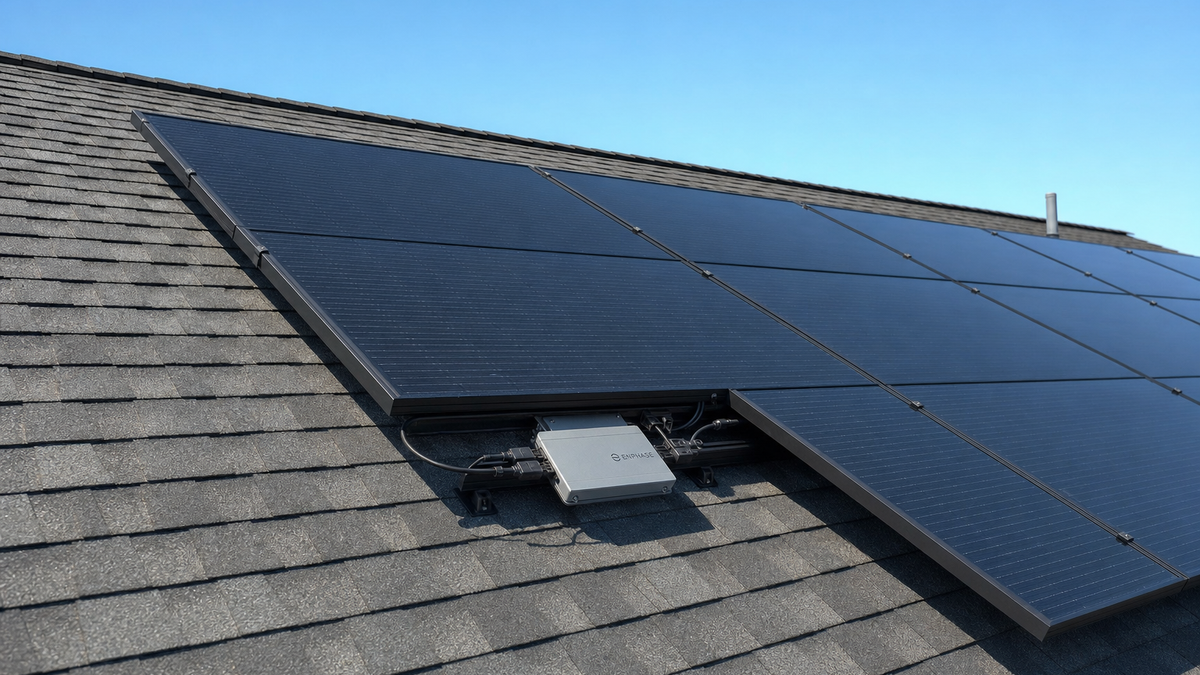
Ask ten solar installers whether microinverters or string inverters are better and you'll get eleven opinions and one fistfight. We install both — Enphase and APsystems micros on complicated roofs, string inverters on clean commercial runs — so we have no religion here, just receipts. The honest answer is that the architecture question was settled differently in 2026 than it was in 2016: module-level electronics got cheaper, string inverters got smarter, and rapid shutdown rules quietly made the decision for half the residential market. Here's how the comparison actually shakes out when you run the numbers instead of reading forum threads.
What Each Architecture Actually Does on Your Roof
A string inverter is one box, usually at ground level, that takes high-voltage DC from series-wired strings of panels — 8 to 13 modules per string, 300–600VDC — and converts it all to AC in one place. A microinverter system puts a small inverter under every single panel: each module makes its own 240V AC right on the roof, and the wiring coming down is ordinary household-voltage AC, not high-voltage DC. Power optimizers are the hybrid approach — a DC-DC conditioner under each panel feeding a central string inverter — and everything said below about micros applies to optimizer systems with a few efficiency and reliability footnotes.
The physical difference drives every other difference. Strings are only as strong as their weakest panel; micros don't care what the neighbor panel is doing. Strings concentrate all your conversion risk in one box with one fan and one warranty claim; micros spread it across twenty devices but put electronics in the harshest thermal environment in the system — the rooftop, where July attic-adjacent temperatures run 65–75°C.
| Criterion | String inverter | Microinverters | String + optimizers |
|---|---|---|---|
| Panel-level independence | No (string = weakest panel) | Yes, full | Yes, mostly |
| Roof voltage | 300–600V DC | 240V AC only | 300–600V DC |
| Rapid shutdown (NEC 690.12) | Needs module-level devices anyway | Native compliance | Native compliance |
| Single point of failure | Yes — inverter down = system down | No — one micro down = one panel | Inverter yes, optimizers no |
| Monitoring granularity | String level (panel level w/ extra hardware) | Per panel, standard | Per panel, standard |
| Battery retrofit path | AC-couple or replace inverter | AC-couple (IQ batteries, Powerwall) | Replace or AC-couple |
| Typical equipment cost premium vs string | Baseline | +15–25% | +10–18% |
| Field-replaceable without roof work | Yes (ground-level box) | No (roof work per failure) | Inverter yes, optimizer no |
Shade: Where Micros Earn Every Penny
Here's the physics that matters. In a string, current is limited by the weakest module. A chimney shadow killing 50% of one panel's output drags the whole string down toward that level — modern string inverters with multiple MPPT inputs and bypass diodes inside the panels recover a lot, but real-world measurements on partially shaded strings still show 15–30% daily harvest losses that the nameplates never mention. With micros, the shaded panel produces what it produces and its nineteen neighbors run flat out. On a roof with a mature oak to the southwest — we monitor exactly this installation — the microinverter array harvests 11% more energy per year than the string equivalent we modeled, concentrated in the 3–6 p.m. window where the shadow walks across the roof and where time-of-use rates pay triple.
The counterpoint: on a genuinely unshaded, single-orientation roof, that advantage evaporates to 1–3%, and the string inverter's higher peak efficiency (97.5–98% vs 96.5–97% for micros) claws some of it back. Shade is the dividing line. Any vent pipe, chimney, dormer, second-story wall, or tree that touches the array between 9 a.m. and 4 p.m. pushes you toward module-level electronics. Clean rectangular south roofs in open country are string territory, and paying the micro premium there is buying insurance against a fire that can't start.
NEC 690.12 Changed the Game and Most Articles Ignore It
Rapid shutdown — NEC 690.12, strengthened in the 2017 and 2020 code cycles — requires module-level power reduction so firefighters can kill voltage inside the array boundary within 30 seconds. A plain string system without module-level devices no longer passes residential inspection in most of the country. Your options become: microinverters (native compliance), optimizers (native), or module-level rapid-shutdown devices bolted onto a string system — added hardware, added cost, added failure points, and still no panel-level optimization or monitoring. Once you price RSD boxes into the string option, the micro premium on a 20-panel residential system shrinks from the sticker difference to a few hundred dollars. AHJs on the 2020/2023 NEC are the norm now; if your jurisdiction is on 2023 NEC, treat module-level electronics as the default starting point and make the string system justify itself.
Reliability: Two Failure Philosophies
The string camp's argument is real: one box, at ground level, in the shade of the garage wall, serviceable in twenty minutes with a nut driver. When it fails — and figure on one inverter replacement over 25 years — it's a truck roll, not a roofing job. The micro camp's counter is actuarial: Enphase publishes failure rates around 0.05–0.1% per unit-year, so a 20-micro array expects roughly one micro failure per 10–20 years of operation, and each failure costs you one panel's output (5% of the array) until the warranty swap, not 100%. String failure costs you everything. Our service log since 2019: eleven string inverter warranty events (all ground-level, all fixed same-day), six microinverter failures across roughly 3,000 installed units (each requiring a roof trip we bundled with other work), and two optimizer failures. The math favors micros on uptime; the labor favors strings on repair cost. Warranty length is the tiebreaker: 25 years on Enphase IQ8 series vs 10–12 standard on strings (extendable for money). Over a 25-year ownership window, budget one string inverter replacement at $2,000–3,500 installed; budget approximately nothing for the micros.
| 25-year cost item (20-panel, 8 kW system) | String system | Microinverter system |
|---|---|---|
| Inverter electronics at install | $1,800–2,400 | $2,600–3,400 |
| Rapid shutdown hardware | $400–700 | $0 (native) |
| Expected mid-life replacement | $2,000–3,500 (once) | ~$0–400 (warranty swaps + occasional labor) |
| Monitoring hardware | Usually included | Envoy/IQ gateway $300–500 |
| 25-year electronics total | $4,200–6,600 | $2,900–4,300 |
| Harvest difference (shaded roof) | Reference | +5–12% annual kWh |
| Harvest difference (clean roof) | Reference | +0–3% annual kWh |
System Design Differences That Hit Your Quote
Strings want uniformity: same panel model per MPPT, same orientation per string, string lengths inside the inverter's voltage window at your record-low temperature (NEC 690.7 cold-weather Voc correction — at -10°F a 13-panel string of modern 40V modules can kiss 600V and trip the inverter's input limit). Micros don't care: mix orientations, mix tilts, add three panels on the garage and two on the shed, expand one panel at a time for years. That expandability is the sleeper feature — we've grown microinverter systems from 12 to 28 panels across three phases as budgets allowed, something no string system does gracefully. For sizing the array itself, our solar system size calculator handles the consumption-to-watts math regardless of architecture.
Wiring practices differ too. String DC runs use PV wire in conduit from roof to inverter — see our PV wire vs USE-2 vs THHN guide for the cable rules — while micro systems drop an AC trunk cable or individual home runs to a combiner. AC means you can tap standard breakers and wire methods, which any electrician understands; 600V DC wants solar-specific discipline. Either way, grounding follows our NEC 690.43 grounding and bonding guide.
Batteries and the Future-Proofing Question
Both architectures accept batteries, but through different doors. Microinverter systems AC-couple: Enphase IQ batteries, Tesla Powerwall, or any AC-coupled battery inverter bolts on at the panel without touching the roof. String systems either AC-couple the same way or — if you bought a hybrid string inverter on day one — DC-couple batteries directly, which wins 4–6% round-trip efficiency and saves a second inverter. If batteries are a "maybe later," both paths work; if batteries are a "definitely," consider a hybrid string unit or an Enphase ecosystem purchase so the batteries and solar share one monitoring brain. The broader hybrid-versus-off-grid decision tree is in our hybrid vs off-grid inverter guide, and brand-level comparisons live in our inverter top picks roundup.
What We Actually Recommend, By Roof Type
After seven years of installing both, our defaults: complicated residential roof with shade, multiple orientations, or phased expansion plans — microinverters, specifically Enphase for premium or APsystems for value (the QS1 and DS3 lines cover multi-panel micros at genuinely competitive pricing); Hoymiles is the third brand worth a look. Clean commercial roof, ground mount, or big rectangular residential south face — string inverter, sized per our array math, from the lines in our 10 kW and 12 kW inverter collections. Optimizer systems when the customer is locked into a brand ecosystem that requires them. And the one combination we refuse to install: string inverter on a shaded roof with RSD-only compliance — that's paying string prices for string weaknesses plus extra hardware, the worst of both worlds.
| Roof / project profile | Recommended architecture | Reason |
|---|---|---|
| Shade trees, chimneys, dormers | Microinverters | Panel independence recovers 5–12% harvest |
| Multiple roof faces (E/W/S mix) | Microinverters | Each face runs at its own MPP |
| Clean south roof, no shade | String | Lower cost, higher peak efficiency |
| Ground mount, easy access | String | Ground-level service, no RSD premium issues |
| Phased expansion planned | Microinverters | Add panels one at a time, any year |
| Battery definite within 2 years | Hybrid string or Enphase ecosystem | Shared monitoring brain, best coupling economics |
| Budget-critical rental property | String + RSD | Lowest capex; tenant doesn't pay for elegance |
MPPT Count, Clipping, and the DC:AC Ratio Question
String inverters bring 1–4 MPPT inputs; every distinct roof orientation or shade pattern wants its own MPPT, and a house with east, south, and west faces can exhaust a residential string unit's inputs before the design is even finished. Micros are effectively one MPPT per panel — infinite granularity, zero design compromise. The related lever is the DC:AC ratio. String systems routinely oversize the array 1.2–1.4× the inverter rating because panels rarely hit nameplate and the inverter "clipping" the noon peak costs less than buying a bigger inverter. Microinverter systems clip per-panel instead: pair a 470W panel with an IQ8A (349W continuous) and you'll shave the top off perfect June noons. The fix is matching micro to module — IQ8H or commercial-grade micros for the big-format panels — and accepting 2–3% annual clipping loss as a fair trade for the per-panel architecture. We model clipping in the design software before quoting; if the modeled loss exceeds 4%, we step up the micro class.
Monitoring: The Feature Owners Actually Use
Ask system owners what they check after the honeymoon month and the answer is panel-level production maps. Microinverter monitoring shows every module's daily yield; a panel down 40% versus its neighbors announces a failed bypass diode, a leaf mat, or a bird problem weeks before a string-level number would drift noticeably. We've caught three failed panels this way in the last two years — warranty replacements the owners would never have known to claim from a string-level display that looked "a little low this month." String systems with module-level monitoring via optimizers close this gap; string systems without it are flying with a fuel gauge but no per-cylinder readout. For a system you intend to own for 25 years, that diagnostic visibility is worth real money in recovered warranty claims alone.
Installation Labor: What Changes on the Roof
A 20-micro install adds roughly 10–15 minutes per panel of roof labor versus string wiring — mounting the unit, torquing the trunk cable drops, dressing the leads — but it deletes the DC conduit run down the wall, the DC string testing, and the high-voltage commissioning checks. Net labor on a residential job is closer than either camp admits: we budget about 15% more labor-hours for micros on a standard comp shingle roof, and parity on ground mounts where the trunk cable dressing is easy. The genuine labor difference arrives at year 12, when the string inverter swap is a two-person, two-hour ground-level job and a micro replacement is a roof trip with fall protection, panel lift, and re-flashing care. That asymmetry is why micro brand choice matters so much — you're not buying a component, you're buying a 25-year bet on the company's warranty department. Enphase's warranty process is the smoothest we've dealt with; factor that in alongside the datasheet.
| Metric | String (typical residential) | Microinverter (IQ8-class) |
|---|---|---|
| Peak conversion efficiency | 97.5–98.2% | 96.5–97.1% |
| CEC weighted efficiency | 97–97.5% | 96.5–97% |
| Nighttime tare loss | <1W | ~50–150 mW per unit |
| Max input current per channel | 12.5–15A per MPPT | 14–20A per micro (model-dependent) |
| Operating temp range | -25 to +60°C (derating above 45) | -40 to +65°C |
| Warranty (standard) | 10–12 years | 25 years (Enphase), 10–25 (others) |
Climate: Where Each Architecture Ages Differently
Heat is the enemy of electronics, and microinverters live in the hottest spot of the entire system — sandwiched between a dark panel and a dark roof, where summer surface temperatures hit 70°C. The good ones are designed for it (the -40 to +65°C operating range in the table above is the Enphase-class spec), and the field data supports the design. But in Phoenix and inland Texas, we see micro warranty claims run modestly higher than in the Pacific Northwest, and string inverters mounted on shaded north walls of garages barely notice the climate. Flip it around for cold: string inverters face the NEC 690.7 cold-voltage problem — every record-cold morning pushes string Voc higher, and an edge-of-envelope string design can overvolt the inverter input on the coldest dawn of the decade. Micros see one panel each; the problem simply doesn't exist at module scale. Cold climates tolerate micros happily; hot climates deserve a slight durability edge to ground-mounted string boxes and an honest conversation about micro brand warranty strength.
Resale Value, Permits, and the Paper Trail
Home appraisers and buyers' agents increasingly ask one question about solar: "is it monitored?" A system with per-panel monitoring and a clean production history is a documentable asset; a string system with no data is a rumor. On the permit side, both architectures sail through with the same plan set, but microinverter plans are simpler electrically — no DC voltage calculations per string, no conduit schedule on the DC side, and the rapid-shutdown compliance section writes itself. Our plan-check turnaround on micro systems averages a few days faster than string jobs in the jurisdictions we work, purely because there's less for the reviewer to red-line. Small thing, but small things compound on a construction schedule.
And when you sell the house: transferable 25-year micro warranties (Enphase transfers free) versus a string inverter whose original warranty expired at year 12 is a real negotiating point. Buyers' inspectors have learned to ask for inverter age. "Original micros, 17 years of warranty left" closes that conversation; "string inverter replaced last year" starts a new one about receipts.
The Maintenance Conversation Nobody Has Until Year Five
Whichever architecture you buy, the roof still needs the same care: an annual visual check of connectors and wire management, a wash when dust or pollen stacks up, and a glance at the monitoring after every major storm. Where architecture changes the chore is diagnostics. On a micro system, the app tells you which panel to look at before anyone climbs a ladder. On a string system, a 15% production dip means someone with a multimeter and a clamp meter works down the string isolating the weak module — billable hours that panel-level data would have eliminated. Neither system asks much of you; the question is how much guesswork comes bundled when something eventually goes wrong. After two decades, the panels will still be there. The difference is whether every one of those years was fully productive or a few of them quietly underperformed while nobody watched. Keep the monitoring alerts on, keep the warranty paperwork filed, and either architecture will repay the roof it sits on many times over across its full service life, whatever the brochures claim.
Frequently Asked Questions
Do microinverters really last 25 years?
The leading brands carry 25-year warranties and published failure rates near 0.05–0.1% per unit-year, implying most units outlive the panels above them. Early-2010s micros had teething problems; current generations have a decade-plus of strong field data behind them.
What happens when a string inverter fails?
The entire array stops producing until the inverter is repaired or replaced — typically a 1–3 week warranty cycle. It's a ground-level swap, so labor is modest, but the lost production is 100%. Budget one replacement over a 25-year system life.
Can I mix microinverters and a string inverter on one house?
Yes — a microinverter array on the shaded west roof and a string system on the clean south roof is a legitimate design, each with its own monitoring. It's more common on phased projects than day-one builds.
Are power optimizers just as good as microinverters?
For shade mitigation and monitoring, nearly. The differences: optimizers keep high-voltage DC on the roof, the central inverter remains a single point of failure, and warranty on the optimizer and inverter come from the same brand but with different terms. Optimizers usually price between strings and micros.
How much more do microinverters cost?
On a 20-panel residential system, figure $800–1,500 more in equipment than a string system once rapid-shutdown hardware is priced into the string side — and less than nothing over 25 years when the string inverter's mid-life replacement lands.
Do microinverters work with any solar panel?
Almost — check the micro's input current and voltage window against your panel's specs, especially with modern 470W+ modules whose Imp can exceed 13–14A. The compatibility tool on the manufacturer's site settles it in two minutes; verify before ordering.
Sources and Standards
NEC 2023 Articles 690.7, 690.12, and 705; UL 1741 SB; manufacturer reliability data for Enphase IQ8 series, APsystems DS3/QS1, and leading string inverter lines. Field figures reflect our monitored installations and service records in the Pacific Northwest, 2019–2026. For related reading: solar inverter fundamentals, hybrid inverter basics, and solar panel wiring basics.