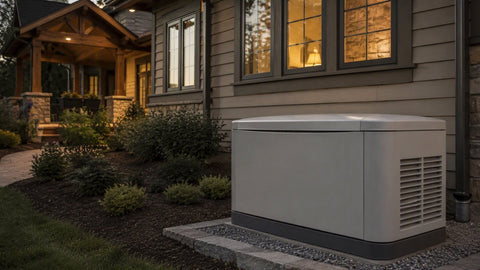
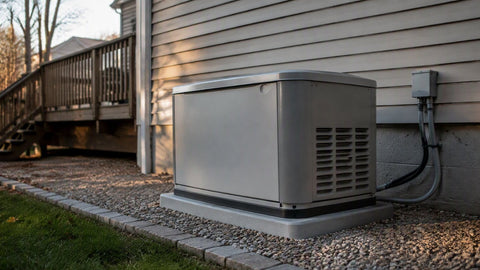
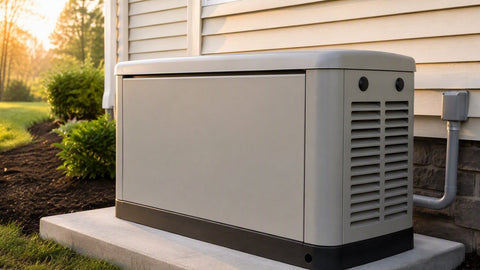
When a hospital-grade storm rolls through and the lights stay on at a customer's house while the whole street goes dark, the box humming on the pad out back is usually painted Cummins beige. We have specced, sold, and serviced standby generators for years, and Cummins Power Generation is the brand we reach for when the customer says "failure is not an option" and means it. This guide is written for contractors, facility managers, and serious homeowners who want the real picture on the QuietConnect lineup — sizing math, fuel numbers, transfer-switch pairing, and the install details that separate a twenty-year machine from a warranty claim.
1. Company Overview
Cummins Inc. has been building engines in Columbus, Indiana since 1919. The Power Generation segment absorbed Onan in 1986, which is why old-timers still call a Cummins genset "an Onan" and mean it as a compliment. What that heritage buys you in 2026 is depth: Cummins designs the engine, the alternator, the controls, and the transfer switch as one system, then supports it with the largest dealer service network in North America. When a unit throws a fault code at 2 a.m. during an ice storm, that network is the difference between a Tuesday fix and a three-week parts wait.
The home standby business sits at the small end of a catalog that runs to multi-megawatt paralleled data-center plants. That matters because the engineering culture — derating conservatively, publishing honest continuous ratings, designing for NFPA 110 emergency duty — flows downhill into the residential QuietConnect line. A Cummins home unit is engineered by people who also build generators that hospitals bet lives on.
2. Current Product Lines
The residential and light-commercial lineup splits into two families: air-cooled QuietConnect units for typical homes, and liquid-cooled QuietConnect units for larger homes, small commercial, and estate properties. Confirm exact model numbers and ratings against current spec sheets before quoting — Cummins revises the lineup regularly — but the structure has been stable:
| Family | Output Range | Cooling | Engine Speed | Fuel | Typical Application |
|---|---|---|---|---|---|
| QuietConnect air-cooled | 13–22kW class | Air | 3600 RPM | NG or LPV (field-selectable) | Whole-home backup, 100–200A services |
| QuietConnect liquid-cooled | 25–150kW class | Liquid (radiator) | 1800 RPM | NG / LPV, diesel on larger frames | Large homes, small commercial, agriculture |
| Commercial PowerCommand | 200kW–multi-MW | Liquid | 1800 RPM | Diesel / NG | Facilities, data centers, NFPA 110 duty |
The 1800-RPM liquid-cooled units are the ones we push hard for any customer who can afford them. Half the shaft speed means a fraction of the wear per hour, quieter operation, and service intervals that stretch. An air-cooled 20kW at full tilt sounds like a lawn tractor working hard; a liquid-cooled 25kW sounds like a car idling. On a five-acre lot nobody cares. On a suburban pad eighteen feet from the neighbor's bedroom window, it is the whole conversation.
Every QuietConnect ships with the exercise logic, battery charger, and monitoring hookups in the box. Remote monitoring runs through Cummins' cloud-connected platform, which lets us see exercise history, fault codes, and run hours from the office — we check our installed fleet's dashboards before the customer even knows there was a hiccup. Our generator monitoring accessories collection has the add-on kits for older units.
3. Recent Releases (2025–2026)
Cummins' recent residential development work has concentrated on three areas: cold-weather starting, load management, and connectivity. Current-production air-cooled units ship with improved cold-weather kit integration — battery warmers and oil warmers that the controller manages automatically rather than running dumb on a thermostat. Load-management modules now let a smaller unit shed and re-try heavy loads (that 4-ton AC compressor) instead of forcing the customer up a generator size. On the monitoring side, the cloud platform gained richer run-history export and dealer-fleet views, which is exactly what a service organization like ours needs.
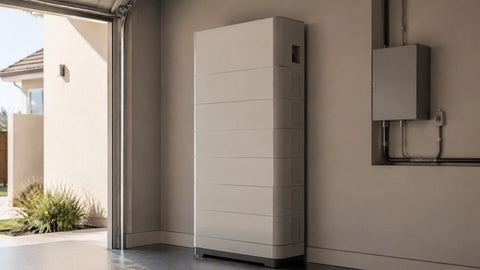
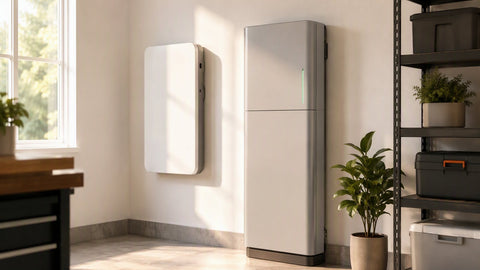
The bigger strategic story is Cummins' acquisition-driven expansion in power electronics and storage — the company has been building toward integrated generator-plus-battery hybrid backup systems. For the residential buyer, the practical takeaway is that Cummins is engineering toward a future where the generator runs less, in its efficient band, while batteries handle the short outages and the surge events. We expect the home standby catalog to reflect that integration over the next product cycles.
4. Certifications & Listings
Standby generators live at the intersection of the electrical code, the mechanical code, and the fire code. Here is what applies and why your inspector cares:
| Standard | Scope | Field Impact |
|---|---|---|
| UL 2200 | Stationary engine generator assembly safety listing | The listing your AHJ looks for on the nameplate |
| NEC Article 702 | Optional standby systems | Transfer equipment rules (702.5), wiring methods, signage |
| NEC Article 700 / 701 | Emergency & legally required standby | Applies to commercial — 10-second restore, separate wiring, NFPA 110 territory |
| NFPA 37 | Installation of stationary combustion engines | Setbacks from openings, fuel-line rules, foundation requirements |
| NFPA 54 / 58 | Gas fuel code / LP storage | Gas pipe sizing, regulator placement, tank distances |
| EPA emissions certification | Stationary engine exhaust standards | Determines run-hour restrictions in some air-quality districts |
One code point that bites installers: NFPA 37 clearance requirements are measured to building openings, not walls. A unit that is five feet from the wall but three feet from a dryer vent or an operable window fails inspection. We tape-measure to every opening on the elevation before we pour the pad, and we photograph it for the permit packet.
5. Warranty & Service Reality
Cummins home standby units carry a strong factory limited warranty — historically five years or 2,000 hours on the QuietConnect line, with extended coverage available out to ten years. Terms change by model year, so confirm the current warranty statement for the exact SKU at purchase. What matters more than the paper is the claims process, and here Cummins' dealer network earns its keep: warranty work is performed locally by factory-trained techs with genuine parts, not shipped back to a depot on your dime.
What voids coverage in the real world: missed oil changes (the controller logs run hours, and the dealer will ask), aftermarket block heaters wired into the wrong circuit, and DIY gas-plumbing that starves the unit under load. Keep the maintenance log. The unit already keeps its own receipts — match them.
6. Popular Products at PES Supply
The Cummins products that move through our warehouse, and where they live:
- QuietConnect air-cooled 13–17kW class — the sweet spot for 100A services and smaller all-electric homes. Stocked in our Cummins generators collection and the 14–17kW standby range.
- QuietConnect 20–22kW class — the volume leader for 200A whole-home backup; see 20–28kW standby generators.
- Liquid-cooled 25kW+ — estate homes, shops, and light commercial, in commercial standby.
- Cummins automatic transfer switches — service-rated 100A–400A, stocked in automatic transfer switches with 100–125A and 200–225A service sizes.
Cross-shopping? Our full generator catalog puts Cummins next to every alternative we carry, and the counter staff will cross-shop them honestly with you.
7. Sizing Math: Getting the kW Right
Sizing a standby unit is a starting-watts problem, not a running-watts problem. A 4-ton central AC draws roughly 20–22A running at 240V but can demand 100+ amps for the first half-second of compressor start. The generator's motor-starting kVA capacity decides whether the compressor lights off or the whole unit bog-dies. Here is the worksheet we run on every quote:
| Home / Load Profile | Running Load | Biggest Motor Start | Recommended Unit | Notes |
|---|---|---|---|---|
| 1,500 sq ft, gas heat, 3-ton AC | ~6–8kW | 3-ton compressor (~15kVA surge) | 13–17kW air-cooled | Load-manage the AC or use a soft starter |
| 2,500 sq ft, 4-ton AC + electric water heater | ~10–12kW | 4-ton compressor (~20kVA surge) | 20–22kW air-cooled | The volume seller; covers most 200A homes |
| 4,000+ sq ft, two ACs, pool, electric range | ~16–20kW | Second compressor start while first runs | 25–36kW liquid-cooled | 1800-RPM unit; stagger starts via load management |
| Small commercial / farm shop | 25kW+ | Large motors, welders | 36kW+ liquid-cooled | Do a real load calc — NEC 220 or measured demand |
The honest rule: never size from square footage alone. We pull the panel schedule, list every motor over 1 HP, and ask what the customer refuses to lose during an outage. Our whole-house standby sizing guide, the 2026 generator sizing guide, and the 26kW generator guide walk the full calculation. For the wire from ATS to panel, the NEC wire sizing guide has the ampacity tables.
8. Fuel: NG vs. LPV, With Real Consumption Numbers
Fuel choice is usually made for you — if the street has gas, you plumb NG; if not, you bury an LP tank. What you control is sizing the supply. The numbers below are typical published figures for the 20–22kW air-cooled class; confirm against the spec sheet for your exact model, and remember that NG derates output roughly 10% versus LP on the same machine:
| Fuel | Consumption @ Half Load | Consumption @ Full Load | Supply Requirement | Field Note |
|---|---|---|---|---|
| Natural gas (20–22kW class) | ~200 ft³/hr class | ~300+ ft³/hr class | Often requires a meter upsize from the utility — apply early | Never run out mid-storm; but gas pressure can sag in extreme cold when the whole grid is heating |
| LP vapor (20–22kW class) | ~2.0–2.5 gal/hr class | ~3.5+ gal/hr class | 250–500 gal tank minimum; vaporization rate limits tank size in cold climates | A 500-gallon tank at 40% fill gives you roughly a week of intermittent storm duty |
| Diesel (liquid-cooled, 30kW+) | ~1.0–1.5 gal/hr per 10kW loaded | Scales with load | On-site storage, polishing schedule | The commercial answer; polish fuel annually or algae wins |
The mistake we fix most: gas pipe sized from a chart for the furnace alone, with the generator teed in as an afterthought. A 20kW unit at full load wants the equivalent of three furnaces running at once. Upsize the run from the meter, use the longest-length method from the fuel code tables, and pressure-test before you set the unit. Our natural gas generator listings note fuel requirements per model.
9. Transfer Switch Pairing
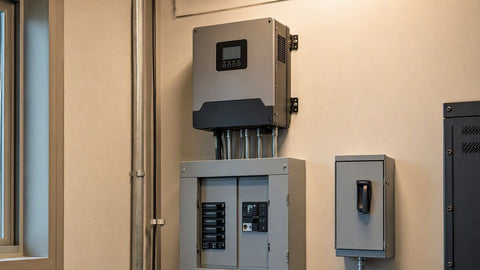
Pair the generator with a service-rated ATS and the install gets clean: utility in, generator in, one neutral-switching decision, done. Cummins builds their own switches — UL 1008 listed, matched to the controller — and mixing brands works fine electrically, but the matched pair shares one warranty conversation and one monitoring login. NEC 702.5 requires transfer equipment that isolates utility from generator; backfeeding through a dryer outlet is how linemen get hurt and how insurance claims get denied. We stock generator transfer switch kits and standalone manual transfer switches for portable applications, but for a permanently piped Cummins, automatic is the point.
Service-entrance-rated ATS versus sub-panel ATS is the other fork. Whole-home with load management beats a 12-circuit emergency panel for most families — nobody remembers which circuits were "critical" at 11 p.m. in the dark. The whole-house generator overview covers the topology decision in detail.
10. Installation Notes from the Field
We have set these machines on poured pads, precast composite pads, and one memorable gravel bed that settled eight inches over a winter — do not be that guy. A level, compacted, drained pad above the local frost heave line is non-negotiable. Vibration pads under the feet keep the machine from walking across a composite pad over a few hundred hours.
Set the exercise clock for daylight, midweek. An air-cooled unit exercising at 3 a.m. Sunday generates the only complaint call we consistently get. Current controllers self-test under no load weekly by default; biweekly under light load is kinder to the rings on NG units that otherwise never work hard enough to seat properly.
Battery: the single most common no-start cause is a dead starting battery, and it dies quietly over three to five years. Put the battery on a replacement calendar — not on the failure report. While you are in there, torque the lugs, clean the terminals, and verify the block heater circuit actually draws current before November. We have "winterized" units in September that failed in January because nobody load-tested the heater.
Finally: commission under load. We run every new install at 50%+ load for a minimum of thirty minutes with a meter on the output — voltage, frequency, and THD — before we hand over the keys. Our 22kW-class generator guide has the commissioning checklist we train techs on.
11. Technical Comparison: Cummins vs. Generac vs. Kohler
Every standby quote we write gets cross-shopped against Generac and Kohler, and it should. Here is the honest counter-side comparison for the 20–22kW air-cooled class:
| Attribute | Cummins QuietConnect | Generac Guardian class | Kohler RES class |
|---|---|---|---|
| Engine origin | Cummins-designed (in-house) | Generac OHVI (in-house) | Kohler Command PRO (in-house) |
| Enclosure | Aluminum, automotive-grade finish | Aluminum (RhinoCoat) | Corrosion-resistant composite |
| Dealer/service network | Large, commercial-grade depth | Largest in residential | Strong in plumbing/pro channel |
| Monitoring | Cloud-connected platform | Mobile Link (Wi-Fi) | OnCue Plus |
| Base warranty (typical) | 5-yr limited, extendable | 5-yr limited | 5-yr / 2,000-hr limited |
| Where it wins | Commercial-grade build, dealer depth, liquid-cooled breadth | Price, availability, installer familiarity | Fast response times, premium fit/finish |
Our read after years of servicing all three: Generac wins on street price and parts ubiquity, Kohler wins on fit-and-finish, and Cummins wins on engineering conservatism and the liquid-cooled range above 25kW. If the customer is a facility type who reads spec sheets, they buy Cummins. If they want the thing every neighbor has, they buy Generac. Both are defensible; the wrong answer is an undersized unit of any brand.
12. Maintenance Schedule We Actually Enforce
The factory manual has a schedule; here is the one our service department runs, hardened by what has actually failed in the field:
| Interval | Task | Why It Is on the List |
|---|---|---|
| Weekly (automatic) | Exercise cycle, self-diagnostics | Seals stay wet, battery gets exercised, faults surface early |
| Every 6 months | Visual inspection, enclosure & battery terminals, check heater circuits | Catches corrosion and rodent damage before storm season |
| Annually or 100 hrs | Oil & filter, air filter, spark plugs (air-cooled), valve lash check | Oil analysis optional on liquid-cooled; cheap insurance |
| Every 3–5 years | Starting battery replacement | The number-one no-start cause — replace on schedule, not on failure |
| Annually (LPV/diesel) | Fuel system check; tank sediment & water draw; diesel polishing on stored fuel | Algae and water kill injectors quietly |
| After every outage event | Review run log, top off fluids, verify ATS retransfer | The 40-hour storm run is when deferred maintenance collects |
13. Permitting, Gas Sizing & the Paperwork Side
A standby generator permit touches three trades at once — electrical, gas, and sometimes mechanical — and the jobs that stall are almost never stalled on the electrical. The choke points, in order of frequency: utility meter upsizing for NG (lead times run two to eight weeks in our territory, apply the day the quote is signed), LP tank placement relative to property lines under NFPA 58, and HOA architectural review for pad location. We build the permit packet with the load calc, the site plan with NFPA 37 clearances dimensioned, the gas riser diagram, and the spec sheets for unit and ATS — a complete packet gets approved in one pass, and every resubmittal costs the customer two weeks of storm season.
One more paperwork item with teeth: many air-quality districts restrict non-emergency run hours on stationary engines, and the exercise cycle counts against them in the strictest jurisdictions. The weekly self-test is already programmed into the controller; make sure the exercise duration setting complies locally before the inspector asks. It is a two-minute menu change that saves a variance letter.
14. When the Grid Fails: What the First Hour Looks Like
Customers ask what actually happens when the power cuts, so here is the sequence on a properly commissioned QuietConnect. The ATS senses utility loss within a couple of seconds and signals the generator. The engine cranks — cold-soaked units take a few extra revolutions, which is normal — and reaches rated speed. The controller waits out a short warm-up stabilization, the transfer switch throws the house onto generator power, and from the living room the whole event is a blink and a hum. Total elapsed time is typically ten to thirty seconds depending on settings and temperature. When utility returns, the switch waits through a retransfer timer — deliberately, to ride through the flickering restoration attempts — moves the load back, and runs the engine through a cool-down before shutdown. If any step in that chain fails on your unit during a test, that is the storm-season gift: you found it on a sunny Tuesday instead of at midnight in an ice storm. Test monthly. It costs nothing but ten minutes.
15. Frequently Asked Questions
Is a 20kW Cummins enough for my whole house? For a typical 2,000–2,500 sq ft home with gas heat, yes — especially with load management on the big AC compressor. All-electric homes with 4+ ton AC or multiple compressors should step up to the 25kW+ liquid-cooled class. Size from your panel schedule, not square footage.
How long will a Cummins home standby last? Air-cooled units are engineered for years of outage duty with weekly exercise — plan on a 15–20 year service life with maintained oil, battery, and valve adjustments. Liquid-cooled 1800-RPM units routinely outlast that. The enemies are neglected batteries and stale maintenance, not hour count.
Natural gas or propane? NG if the street offers it — unlimited runtime, no refills. LPV if you are rural — but size the tank for vaporization rate in your coldest weather, not just gallons. Expect roughly 10% less output on NG than LP on the same machine.
How loud is a QuietConnect, really? Air-cooled units at exercise speed are conversation-level at twenty feet — quieter under light load, louder at full tilt. Liquid-cooled units are noticeably quieter at any load. Local noise ordinances usually measure at the property line; we place pads with that number in mind.
Does it need internet for monitoring? The generator runs and protects your home with zero connectivity. Cloud monitoring adds remote fault alerts, exercise history, and dealer fleet visibility — worth having, not required to run.
Can I install one myself? Mechanically, a strong DIYer can set a pad and anchor a unit. The gas plumbing, service-rated transfer switch, and utility coordination are licensed-trade work in nearly every jurisdiction — and warranty claims get complicated fast without a dealer commissioning record. Buy the machine anywhere; have a pro commission it.
Sources & Standards
- Cummins Power Generation published QuietConnect and PowerCommand documentation (cummins.com)
- NFPA 70 (NEC) Articles 445, 700, 701, 702; NFPA 37; NFPA 54/58; NFPA 110
- UL 2200 (Stationary Engine Generator Assemblies); UL 1008 (Transfer Switch Equipment)
- EPA stationary engine emissions standards (40 CFR Part 60/63)
- PES Supply installation and service records, residential standby fleet, 2019–2026
12. Shop Cummins at PES Supply
We stock Cummins QuietConnect units and matched transfer switches with real freight rates and honest lead times. Start in the Cummins generators collection, pair with the right automatic transfer switch, and size it right with our 2026 sizing guide. Questions about gas sizing or pad placement? Call the counter — the people who answer have set these machines themselves.