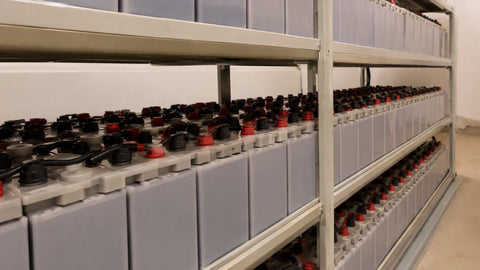
We have loaded more Crown batteries onto freight trucks than any other deep-cycle brand in our warehouse, and there is a reason for that. When an off-grid customer in Montana calls in January saying his bank is sagging at -20°F, the answer that fixes it is usually heavier lead and a properly sized bank — not marketing copy. Crown Battery has been building flooded deep-cycle batteries in Fremont, Ohio since 1926, and their plates are some of the heaviest in the business. This guide covers the full Crown lineup we stock — flooded lead-acid (FLA), sealed AGM, and their newer lithium iron phosphate (LFP) modules — with the sizing math, warranty terms, and install details that actually matter on the job.
1. Company Overview
Crown Battery Manufacturing Company operates out of a single vertically integrated campus in Fremont, Ohio. They cast their own grids, mix their own paste, form their own plates, and assemble everything under one roof — which is rarer than you would think in an industry where a lot of "brands" are really relabels. Nearly a century of continuous operation puts Crown in the same conversation as Rolls/Surrette and Trojan when contractors talk about premium deep-cycle lead.
The company is still family-held and runs ISO 9001:2015 certified manufacturing. We have toured plants that assemble cells from bought-in plates; Crown is not that. Vertical integration is why their 20-hour rate capacities hold up after the first hundred cycles instead of drifting downward like cheap golf-cart batteries do. Every unit we receive is date-coded, and in eight years of warranty administration we have never had a claim denied over paperwork games.
2. Current Product Lines
Crown's catalog breaks into three chemistries, and picking the right one is 80% of the job. Flooded is the value king for stationary off-grid. AGM solves the maintenance and mounting-position problems in RVs, boats, and enclosures. LFP is where the cycle-life math now wins for daily-cycling homes. Here is how the three compare on the numbers we actually quote to customers:
| Chemistry | Typical Crown Line | Cycle Life @ 50% DoD | Cycle Life @ 80% DoD | Usable DoD (daily) | Maintenance | Best Use |
|---|---|---|---|---|---|---|
| Flooded lead-acid (FLA) | CR series deep-cycle (GC2/GC8/GC12 sizes) | ~1,200–1,500 | ~500–700 | 50% | Watering every 4–8 weeks, venting required | Off-grid cabins, budget banks, high surge loads |
| AGM (sealed VRLA) | Sealed deep-cycle 12V group sizes | ~600–800 | ~300–400 | 50% | None — no watering, any orientation except inverted | RVs, marine, unheated enclosures, UPS |
| Lithium iron phosphate (LFP) | Crown lithium modules (12V and 48V) | 4,000+ | ~3,000–4,000 | 80–90% | None — BMS-managed | Daily-cycling homes, weight-sensitive builds |
The headline Crown FLA product is the CR-235 — a 6-volt, GC2-size deep-cycle battery rated around 235 amp-hours at the 20-hour rate. Two of them in series make a 12V, 235Ah string; four make 24V. It is the golf-cart format, which means the plates were engineered for a vehicle that gets discharged hard every single day and charged overnight. That duty cycle translates directly to off-grid solar. The CR-205 is the budget sibling at roughly 205Ah, and Crown builds GC8 and GC12 format units for taller rack spaces.
AGM exists for the installs where flooding a battery bay with hydrogen venting is a non-starter. No watering, no equalization, no corrosion creeping up your cables. You pay more per usable kilowatt-hour and give up cycle life, but for an RV that sits for six weeks between trips, sealed is the right answer. We tell customers straight: if you can reach the caps and you will actually check water, buy flooded and save the money.
3. Recent Releases (2025–2026)
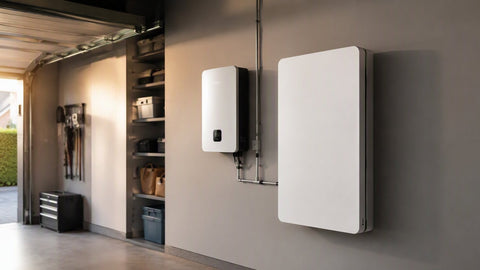
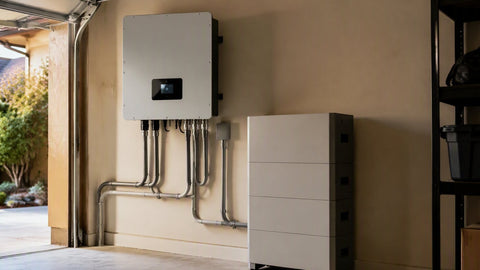
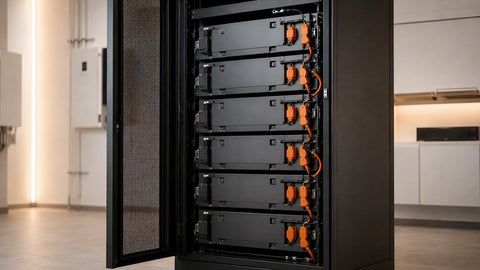
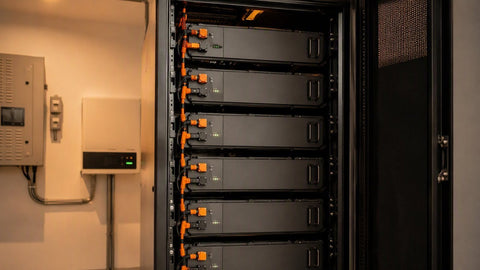
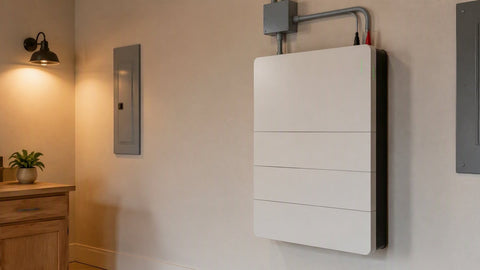
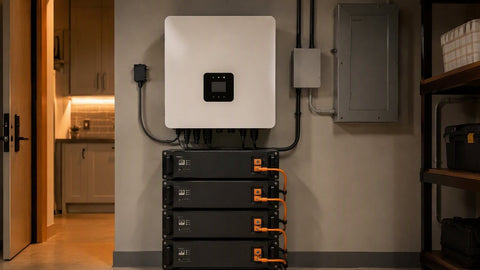
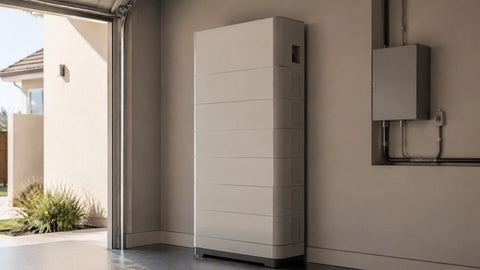
Crown has spent the last two product cycles expanding its lithium iron phosphate line beyond the initial 12V drop-in replacements into 48V rack and wall-mount formats aimed at the residential ESS market. The 2025–2026 updates pushed cold-weather charge protection into the BMS across the line — a feature we consider mandatory after watching unheated lithium banks in uninsulated sheds get bricked by sub-freezing charge attempts. Their lithium modules now carry low-temperature charge cutoffs standard, and the 48V units communicate state-of-charge over CAN with the major hybrid inverters.
On the flooded side, the engineering work has gone into plate alloy and paste density rather than flashy announcements. The current CR-series plates are thicker than the generation they replaced, and Crown's published cycle data reflects it. If you have a five-year-old Crown bank, the replacement units you buy today are a genuinely better battery — same footprint, more lead where it counts.
4. Certifications & Listings
Certifications are where battery marketing meets code enforcement, and Crown's paperwork holds up at inspection. For permitted ESS installs, your AHJ will ask for listings; here is what applies to the lines we stock:
| Certification / Standard | What It Covers | Crown Lines | Why It Matters at Inspection |
|---|---|---|---|
| ISO 9001:2015 | Manufacturing quality management | All (plant-level) | Consistency lot to lot; capacity ratings you can bank on |
| UL 1973 | Stationary battery safety | Lithium modules | Required by NEC 706.15-type listings for ESS in most jurisdictions |
| UL 9540 / 9540A | ESS system listing & thermal runaway test data | Lithium systems (paired with listed inverters) | AHJ sign-off for residential lithium installs; check the paired-system listing |
| BCI group sizing | Physical/electrical standards (GC2, GC8, GC12, Group 27/31) | FLA and AGM | Guarantees fit in standard racks and trays |
| NEC Article 480 / 706 compliance path | Storage battery & ESS installation rules | All (install-side) | Venting (480.10(A) for FLA), disconnects, and working space are your responsibility — the listings above are what get you there |
One caution we give every inspector-facing customer: a UL 1973-listed cell or module is not automatically a UL 9540-listed system. The system listing lives with the battery-plus-inverter pairing. If you are pairing Crown lithium with a hybrid inverter, pull the inverter manufacturer's approved-battery list before rough-in, not after.
5. Warranty & Cycle Life
Battery warranties are written by lawyers and interpreted by chemistry. The warranty period matters less than the cycle-life math underneath it, so here is how we walk customers through it. A Crown CR-235 at 50% depth of discharge is good for roughly 1,200–1,500 cycles — that is three to four years of daily cycling. LFP at 80% DoD will run 3,000+ cycles — eight to ten years of the same duty. Now look at warranty structure side by side:
| Line | Typical Warranty Term | What Voids It (real-world) | Our RMA Experience |
|---|---|---|---|
| FLA deep-cycle (CR series) | Free-replacement period plus prorated coverage — term varies by model; confirm current terms at purchase | Chronic undercharging (sulfation), water starvation below plates, discharge below 80% DoD repeatedly | Straightforward — serial number, resting voltage, specific gravity readings |
| AGM sealed | Shorter free-replacement window than FLA; prorated after | Charge voltage above 14.7V (thermal runaway risk), deep discharge left uncharged | Requires charge-profile documentation on larger claims |
| LFP lithium | Long-form warranty (multi-year, throughput-based on larger modules) | Charging below freezing without the BMS cutoff, parallel strings beyond BMS rating | BMS logs make claims fast — the battery keeps its own receipts |
The silent bank-killer we see in the field is not abuse — it is chronic undercharging. A solar array sized for June runs a deficit in December, and flooded batteries that spend months at 70% state of charge sulfate into lawn ornaments. If your bank lives on a seasonal cabin, budget for a generator-top-up routine or buy lithium and let the BMS worry about it.
6. Popular Products at PES Supply
These are the Crown products that move through our warehouse week in and week out, with where each one lives in the catalog:
- Crown CR-235 6V deep-cycle (GC2) — the workhorse for 12V and 24V off-grid banks. Stocked in the Crown collection.
- Crown CR-205 6V deep-cycle — same footprint, lower price, for budget builds and light-duty cycling.
- Crown sealed AGM 12V deep-cycle — Group 27 and 31 sizes for RV, marine, and backup applications in our battery storage aisle.
- Crown lithium (12V & 48V LFP) — the drop-in and rack modules, stocked alongside our other lithium batteries.
If you are cross-shopping flooded brands, our Rolls Battery and MK Battery collections carry the direct competitors, and the lead-carbon off-grid batteries are worth a look if partial-state-of-charge abuse is your known weakness.
7. Technical Comparison: Crown vs. the Field
Contractors ask us constantly how Crown stacks against Trojan and Rolls on the spec sheet. Honest answer: at the premium end of flooded deep-cycle, the three are closer than their marketing suggests. The differences that survive contact with reality:
| Attribute | Crown CR-235 | Trojan T-105 class | Rolls/Surrette S-class |
|---|---|---|---|
| Format | 6V GC2 | 6V GC2 | 6V GC2 (and larger L16/2V formats) |
| 20-hr capacity | ~235Ah | ~225Ah | Varies by model (premium formats go much larger) |
| Cycle life @ 50% DoD | ~1,200–1,500 | ~1,200 | ~1,500+ on heavy-plate formats |
| Price per kWh (typical street) | Best of the three in our pricing | Mid | Highest — you pay for the plate mass |
| US manufacturing | Yes — Fremont, OH | Yes | No — Nova Scotia, Canada |
Our take: Crown is the value play in premium flooded — 90% of the Rolls longevity at meaningfully less money, with a domestic supply chain that has never left us waiting eight weeks on a container. For lithium, the comparison shifts to rack-format brands, and that is a different table entirely.
8. BMS & Monitoring
Crown's lithium modules carry an internal BMS handling cell balancing, over/under-voltage cutoff, over-current, and — critically for our northern customers — low-temperature charge inhibit. The 48V units expose state-of-charge and alarm data over CAN bus, which means a compatible hybrid inverter sees real battery telemetry instead of guessing from voltage. If you have ever watched a voltage-based SOC estimate wander 20% off on a cold morning, you know why closed-loop CAN communication matters.
Flooded banks have no BMS — you are the BMS. A battery monitor with a shunt (not a voltmeter on the dashboard) is the minimum instrumentation we will sell with a Crown FLA bank. Pair it with temperature-compensated charging from a quality charge controller, and check specific gravity quarterly with a real hydrometer. The MPPT vs. PWM charge controller decision matters here: flooded banks at 24V or 48V belong behind MPPT, full stop.
9. Sizing a Crown Bank: The Math
Here is the sizing worksheet we run on every off-grid quote. Start with daily load in watt-hours, decide days of autonomy, pick your chemistry's usable DoD, and divide by system voltage. The table shows worked examples for a Crown CR-235 (6V, ~235Ah) FLA build versus an LFP build for the same loads:
| Daily Load | Autonomy | Chemistry / DoD | Required Bank (Ah @ 24V) | Crown FLA Build (CR-235) | LFP Equivalent |
|---|---|---|---|---|---|
| 2,000 Wh (cabin, weekend) | 2 days | FLA @ 50% | 333Ah | 8× CR-235 (2S4P) = 470Ah — comfortable | 1× 5kWh module, ~40% daily DoD |
| 4,000 Wh (full-time cabin) | 2 days | FLA @ 50% | 667Ah | 12× CR-235 (2S6P) = 705Ah | 2× 5kWh modules |
| 4,000 Wh (full-time cabin) | 2 days | LFP @ 80% | 208Ah @ 24V | — | 1× 5kWh @ 24V or 48V equivalent |
| 10,000 Wh (small home) | 1.5 days | LFP @ 80% | ~390Ah @ 48V | Not recommended — FLA bank gets unmanageable | 2× 10kWh 48V modules |
Notice the last two rows. Above roughly 6–7kWh of daily load, flooded banks stop making sense — the parallel-string count climbs past three, cable runs get absurd, and one weak cell drags the whole bank. That is where we steer people to lithium or at minimum to the larger 2V-format flooded cells. Our solar battery sizing guide and the home battery bank sizing guide walk this math in more depth, and the battery backup runtime calculator does the arithmetic for you.
One more number worth memorizing: at 50% DoD, a CR-235 string at 24V delivers about 2.8kWh usable per string. Every parallel string you add past the third one buys capacity at the cost of balance headaches. Our rule of thumb — and it matches what Crown's own applications engineering will tell you — is three parallel strings maximum, with identical cable lengths and a common bus bar.
10. Installation Notes from the Field
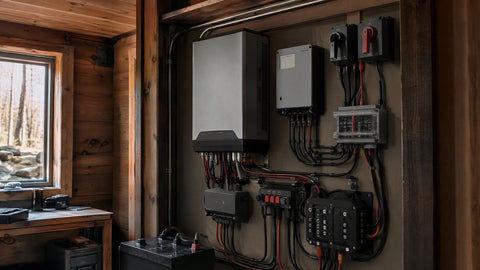
We have racked Crown banks in everything from vented plywood battery boxes to conditioned mechanical rooms, and the install details that separate a ten-year bank from a three-year bank are boring and mechanical:
Venting is not optional on FLA. NEC 480.10(A) requires ventilation adequate to prevent hydrogen accumulation. Hydrogen ignites at 4% concentration and your charger produces it every absorb cycle. A passive vent high on the enclosure and an intake low will do it; a sealed box will not. We have seen the aftermath of one ignition event — it was a battery box, not a building, and it was still ugly.
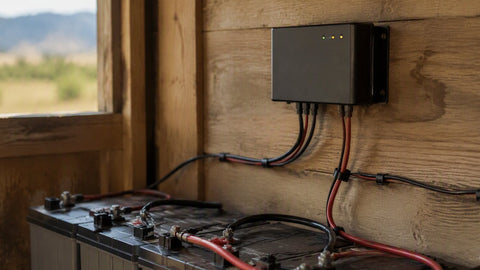
Torque the terminals. Loose battery connections are the number-one cause of the "mystery voltage drop" service call. On standard 5/16-inch stud hardware, we torque to the manufacturer's spec — typically in the 90–120 inch-pound range — with a real torque wrench, then re-check after the first two charge cycles. Cable ends get crimped, not soldered; solder wicks up the strand and creates a fatigue point.
Water with distilled only, after charging, to the split ring. Overwatering floods electrolyte out the caps during gassing and corrodes everything downstream. Underwatering exposes plates and kills capacity permanently. We set calendar reminders for customers: every four weeks in summer, eight in winter, adjust by what you find.
Temperature compensation matters more than brand. Charge voltage for flooded lead at 77°F is not charge voltage at 20°F. Any controller worth mounting has a remote temperature sensor — use it. The charge controller sizing guide covers this, and our battery life maintenance guide has the seasonal checklist we hand out at the counter.
11. Charging Sources & System Pairing
A battery bank is only as good as what refills it. For Crown FLA banks, we size solar arrays to deliver C/10 to C/8 charge current into the bank's 20-hour amp-hour rating — a 470Ah bank at 24V wants roughly 1,200–1,500W of array minimum in average sun, more if December matters. Undersized arrays are how batteries die of sulfation while the owner blames the brand. Our solar system size calculator gets the array side of that equation right before you buy a single battery.
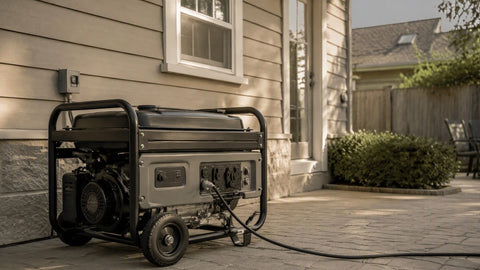
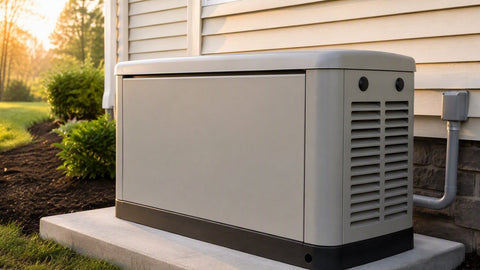
Generator pairing is the other half of the winter plan. A 24V flooded bank at 470Ah accepts a 40–60 amp charge comfortably, which is a 2.5–3.5kW generator's full-time job for two to three hours — exactly the "exercise the genny weekly" routine that keeps both machines healthy. Customers running a standby unit for backup should read the generator sizing guide alongside this article; the charger load belongs in the generator's continuous-watt budget, not as an afterthought. Lithium buyers get a bonus here: LFP accepts charge current up to 0.5C on most Crown modules, so the same generator finishes the job in half the fuel.
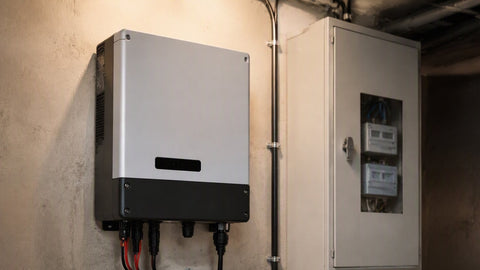
Inverter pairing is the last checkbox. FLA banks sag under surge — a well pump that pulls 4,000W to start will drag a tired 12V string below inverter cutoff. That is not a battery defect; it is Ohm's law collecting its fee. Size the inverter to the bank's honest discharge capability (a healthy CR-235 string will deliver roughly 100A continuous without objectionable sag), or step up to 48V and watch the same load pull a quarter of the current. The 20/80 battery rule article covers the daily cycling discipline that keeps any of these banks inside their published cycle-life envelope.
12. Frequently Asked Questions
How long will a Crown CR-235 bank actually last? At 50% depth of discharge with proper charging and watering, expect 1,200–1,500 cycles — three to five years of daily use, longer on weekend-duty cabins. The failures we see early are almost always undercharging or water neglect, not plate failure.
Flooded or lithium for a new off-grid build in 2026? If the budget allows, lithium wins on lifetime cost per kWh for daily cycling — the 80% usable DoD and 3,000+ cycle life beat flooded economics by year five. Flooded still wins for seasonal cabins, extreme-cold unheated spaces, and buyers who want a repairable, serviceable battery.
Can I mix old and new Crown batteries in one bank? No. A tired cell drags the whole string down and the new units get overcharged trying to float the weak one. Replace strings as complete sets, and never mix capacities, ages, or chemistries in parallel.
What charger settings does Crown FLA want? Bulk/absorb around 14.4–14.8V for a 12V bank (double for 24V), float near 13.4V, and equalize monthly at roughly 15.5–16.2V for two to four hours while watching specific gravity. Always confirm against the current Crown charging bulletin for your exact model — and temperature-compensate everything.
Are Crown lithium batteries a drop-in replacement for my FLA bank? Electrically, mostly — the 12V LFP modules are built to BCI group sizes. But your converter, charger, or inverter-charger needs an LiFePO4 charge profile (no equalization, correct absorb voltage), and your alternator charging path in an RV needs a DC-DC charger. The battery is the easy part of the swap.
Where are Crown batteries made? Fremont, Ohio — grid casting, plate pasting, formation, and assembly all happen in one US plant. That matters for lead times, warranty handling, and freight cost to the lower 48.
Sources & Standards
- Crown Battery Manufacturing published product and cycle-life documentation (crownbattery.com)
- NFPA 70, National Electrical Code — Article 480 (Storage Batteries) and Article 706 (Energy Storage Systems)
- UL 1973 — Batteries for Use in Stationary Applications; UL 9540 / UL 9540A — Energy Storage Systems and Thermal Runaway Test Method
- Battery Council International (BCI) group size and testing standards
- PES Supply field service records and warranty administration data, 2019–2026
12. Shop Crown Battery at PES Supply
We stock Crown deep-cycle flooded, AGM, and lithium with real inventory on the floor — not drop-ship promises. Browse the Crown collection, compare against the full battery storage catalog, or start from the math with our how many batteries do I need walkthrough. Building a full off-grid system? Our off-grid cabin kits pair Crown banks with matched arrays and inverters, and the team that answers the phone has installed what they sell.