IronRidge Brand Guide: XR Rails, FlashFoot2, and Complete Solar Racking Systems
XR10, XR100, and XR1000 rails, FlashFoot2 and Knockout Tile attachments, span engineering, UL 2703/3741 listings, and how IronRidge compares to Unirac and SnapNrack on real installs.
Racking is the least glamorous line item on a solar BOM and the one that determines whether the array is still attached to the roof in 25 years. We've sold IronRidge since we opened the warehouse, and it remains our default recommendation for flush-mount residential work for one reason above all others: the engineering documentation is the best in the industry, and plan reviewers know it. When your permit packet includes IronRidge span tables with wet-stamped letters available on request, the structural review goes from weeks to days. That speed is worth real money on every job.
This guide covers the current IronRidge lineup as we stock it: the XR rail family, the FlashFoot2 and Knockout Tile attachment systems, the UFO clamp ecosystem, and the ground-mount and flat-roof lines. For the attachment-only specialist alternative, see our Quick Mount PV brand guide; for the other full-line competitors, see Unirac and SnapNrack.
IronRidge has been manufacturing solar racking in the United States since the 1990s — the company cut its teeth on off-grid pole mounts before grid-tied residential existed as a market, and that structural-first culture persists. The product philosophy is conservative in the good sense: fewer SKUs, deeper engineering per SKU, and published test data for everything. Every rail, clamp, and attachment ships with a certifiable load path documented to UL 2703, and select systems carry UL 3741 for hazard control (the listing that, paired with certified modules, can satisfy NEC 690.12 rapid-shutdown requirements without module-level electronics on some configurations — verify your exact BOM against the UL 3741 racking certification before relying on this).
Our field experience mirrors the documentation culture. I've walked roofs on ten-year-old IronRidge installs during re-roof inspections, and the rails read as new: no galling on the bonded clamps, no flashing creep, no galvanic staining on the aluminum. The 6000-series rail extrusions and stainless hardware simply age well. That's why we keep IronRidge stocked in depth rather than special-ordering per job.
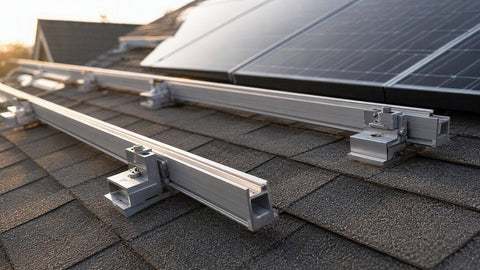
IronRidge offers three rail profiles, and choosing between them is a span-and-load question, not a price question. All three share the same curved internal geometry that grips the UFO clamp's expansion hardware, so clamps, splices, and attachments are cross-compatible across the family.
XR10 — Light Residential
XR10 is the compact rail for low-profile residential installs: lightest, cheapest, and sufficient for moderate wind and snow on typical 4–6 foot attachment spacings. It tops out around 6-foot spans in moderate load zones. We spec it for tract-home production work where the structural review is standard and the aesthetic ask is low-profile.
XR100 — The Workhorse
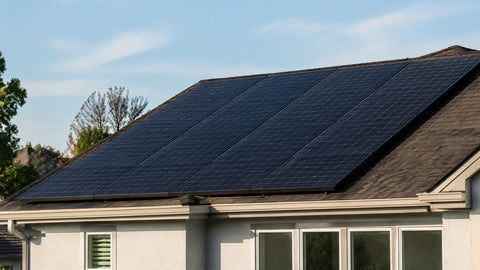
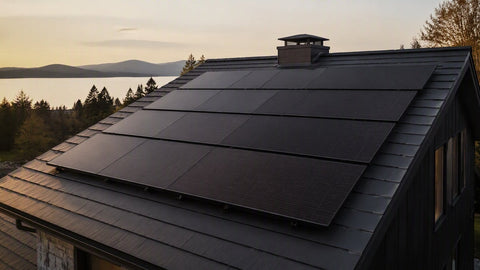
XR100 is the rail we sell most. It spans up to 8 feet between attachments in standard residential load conditions, which drops attachment count per array by a third versus 6-foot-span rail and cuts roof penetrations proportionally. Fewer penetrations, fewer flashings, less labor, less leak risk over 25 years. On composition shingle with FlashFoot2 attachments, an XR100 job is the fastest quality flush-mount install we know how to do.
XR1000 — Commercial and High-Snow
XR1000 is the heavy extrusion: 12-foot-plus spans, commercial flat-roof and high-snow-load work, and ground-mount applications. On a 90 psf snow job in the Cascades last winter, XR1000 was the only flush-rack rail that penciled without doubling the attachment count. It's overkill for standard residential — don't pay for it where XR100 already meets the span table.
| Model | Category | Key Specs | Application |
|---|---|---|---|
| XR100 Rail (14') | Flush-mount rail | 6000-series aluminum, 14 ft length, curved profile | Residential pitched roof, standard wind/snow |
| XR1000 Rail (17') | Heavy-duty rail | 12+ ft spans, commercial-grade strength | Commercial flat/pitched roof, high snow load |
| FlashFoot2 | Roof attachment | Elevated encapsulated seal, 12" × 12" flashing | Composition shingle roof |
| Knockout Tile | Tile roof attachment | Tile replacement flashing, S/W/flat tile profiles | Concrete and clay tile roofs |
| UFO Mid Clamp | Module clamp | Universal bonding, integrated hardware | All XR Rail flush-mount systems |
Span selection is where racking jobs are won or failed, and the inputs are site-specific: design wind speed (ASCE 7), snow load, exposure category, roof zone, and rail profile. IronRidge publishes span tables for every combination, and the Design Assistant software generates a job-specific engineering letter. The table below is a simplified illustration of the logic — always run the actual span table for your exact conditions before ordering.
| Condition | XR10 Max Span | XR100 Max Span | XR1000 Max Span |
|---|---|---|---|
| 110 mph wind, no snow, Exposure B, interior roof zone | ~6 ft | ~8 ft | 12 ft+ |
| 140 mph wind, Exposure C, edge zone | ~4 ft | ~5–6 ft | ~8–10 ft |
| 30 psf snow, 115 mph wind | ~4–5 ft | ~6 ft | ~8–10 ft |
| 60–90 psf snow, mountain exposure | Not recommended | ~4 ft (verify) | ~6–8 ft |
| Attachment count, 24-module array (typical interior) | ~16–20 | ~12–16 | ~8–10 |
The practical takeaway: moving from XR10 to XR100 on a standard residential job removes four to six roof penetrations and their flashings from the BOM. At roughly $15–$25 of installed cost per attachment point, the heavier rail often pays for itself before you count the leak-risk reduction. Edge and corner roof zones under ASCE 7 carry higher uplift pressures — the Design Assistant handles zone mapping, and on coastal Exposure C/D jobs we tighten spacing in perimeter zones rather than downgrading the whole layout.
One structural note we give every customer: spans assume attachment into rafters or engineered truss members, not bare deck. Hitting deck-only with lag bolts is a red-tag waiting to happen and voids the load path the span table certifies. Our crews use a stud finder and verify with a pilot hole on every layout — the pitched-roof attachment guide covers the lag-bolt and pilot-hole details.
FlashFoot2 (Composition Shingle)
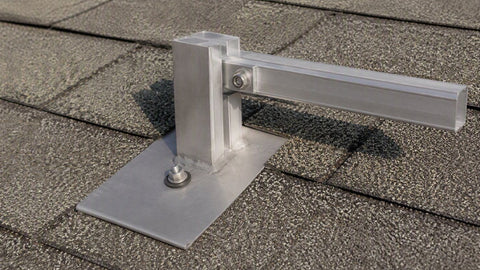
FlashFoot2 is IronRidge's flashed attachment for comp shingle: a 12" × 12" flashing plate with an elevated, fully encapsulated seal around the standoff. The "elevated" part matters — the water seal sits above the flashing's water plane, so even if sealant degrades over decades, water has to travel uphill to reach the penetration. It installs with a single lag into the rafter, slides under the upslope course per standard flashing practice, and carries the UL 2703 mechanical load rating with the rail system. We install these by the hundred; callback rate on leaks across our customer base is effectively zero when the install follows the manual.
Knockout Tile (Concrete and Clay Tile)
Tile roofs are where racking jobs go to die — broken tiles, compromised underlayment, and leak paths are the norm with improvised attachments. Knockout Tile replaces the tile at each attachment point with a formed flashing that matches S, W, and flat tile profiles, carrying the standoff on a cast base that transfers load to the deck or rafter below. The tile itself never carries the mount. On the S-tile roofs common in our Southwest shipments, Knockout Tile has been the difference between a clean install and a callback-generating mess. If you do tile work, also review the racking components guide for the underlayment-repair details that inspectors look for.
UFO Clamps and Bonding
The UFO (Universal Fastening Object) mid clamp bonds the module frame to the rail through the clamp itself — one part, one bolt, one tool for the majority of module frames on the market, with integrated bonding teeth that satisfy UL 2703's electrical bonding path. No separate grounding lugs or WEEBs on the rail line. End clamps are size-matched to frame height. The practical effect: our crews torque the entire clamp line with one socket, and the bonding continuity check at commissioning is a two-point meter check per rail instead of a lug-by-lug inspection.
| Feature | IronRidge | Unirac | SnapNrack |
|---|---|---|---|
| Flagship rail | XR100 (curved profile) | SolarMount Standard (extruded) | Ultra Rail UR-40 |
| Max span (residential) | Up to 8 ft (XR100) | Up to 10 ft (Standard Rail) | Varies by load condition |
| Flashing system | FlashFoot2 (elevated seal) | Flashloc Duo (triple seal) | AnchorFoot (butyl seal) |
| UL 2703 listed | Yes | Yes | Yes |
| UL 3741 listed | Yes (select systems) | Yes (full portfolio) | Limited |
| Design software | IronRidge Design Assistant | U-Builder 2.0 | SnapNrack Design Tool |
| Warranty | 25 years | 25 years | 25 years |
Honest read: all three are quality systems, and all three carry 25-year warranties. IronRidge wins on documentation depth and the UFO clamp's install speed. Unirac's Flashloc Duo is an excellent flashing and its UL 3741 portfolio coverage is the broadest — relevant if you're engineering around module-level shutdown hardware on select configurations. SnapNrack's railless and TopSpeed options move fast on simple roofs. We stock IronRidge deepest because the Design Assistant letters clear our customers' plan reviews fastest. For a flat-roof job, the calculus changes — see the ballasted vs penetrating flat-roof guide before defaulting to any pitched-roof system.
Here's the actual racking BOM for a typical job we kitted last month: 24 modules in a 2×12 landscape layout, composition shingle, 115 mph design wind, 20 psf snow, XR100 at 6.5-foot spans.
| Component | Qty | Notes |
|---|---|---|
| XR100 rail, 14 ft | 6 | 4 rails at 2× module rows (spliced to ~28 ft runs); 2 spare cutoff yield |
| Rail splices (XR100 bonded splice) | 4 | Bonded splice maintains electrical continuity across joints |
| FlashFoot2 attachments | 16 | 6.5 ft spans; verify rafter layout first — spacing follows structure, not preference |
| UFO mid clamps | 44 | (Modules per row − 1) × rows, bonded |
| End clamps (size-matched to frame) | 8 | Match to module frame height, typically 30–40 mm |
| Grounding lugs | 2 | One per rail run for the GEC tap; UFO clamps bond everything else |
| MLPE/flip-clip hardware (if module-level electronics) | 24 | Frame-mount clips for microinverter or optimizer leads |
Total racking hardware on that job ran about 8–9% of total material cost — in line with the industry norm — and the structural review passed first submission on the Design Assistant letter. Pair the racking with the array wiring details in our rooftop installation walkthrough and the mount-type decision framework in roof vs ground vs pole mount.
What our crews do on every IronRidge job
- Snap chalk lines for the attachment rows before drilling anything. Rafters wander. Layout from measured rafter positions, not from the shingle courses.
- Pilot every lag — 7/32" for 5/16" lags in Doug fir — and drive with an impact, never a ratchet near the end. Overdriven lags crush the flashing seat; underdriven ones don't engage full thread depth. Seat the lag head flush, not buried.
- Level the first rail dead-on and float the second. The XR profile hides minor variation, but a twisted first rail telegraphs through the whole array.
- Torque UFO clamps to spec (check the current manual — it changes with hardware revisions). Under-torqued bonding clamps fail continuity; over-torqued ones crack frames. We keep a calibrated torque driver in every racking kit.
- Photograph every flashing before the modules go on. This is your leak-warranty documentation, and it has saved our customers' bacon on exactly three re-roof disputes.
On snow-country jobs, we also plan the array bottom edge to keep the eave path clear — sliding snow off a flush array sheds in sheets, and an array that overhangs the gutter will eventually own the gutter. The rail doesn't care; the homeowner's fascia does.
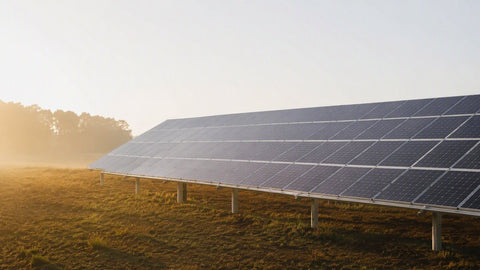
Everything above covers flush-mount pitched-roof work, which is most of the residential market — but IronRidge's ground-mount system deserves its own mention because it shares the XR rail and UFO clamp hardware. The all-aluminum ground-mount structure (no steel, no rust path) uses driven or ballasted foundations depending on soil, and because the rails and clamps are the same parts your crew already stocks, a ground-mount job doesn't orphan a second hardware ecosystem on the truck. For the roof-versus-ground decision itself — production, shading, snow management, and cost per watt — our roof vs ground vs pole mount comparison runs the numbers.
On flat commercial roofs, IronRidge offers tilt-up racking for penetrating installs, but the honest trade-off against ballasted systems is site-specific: ballast weight versus penetration count, membrane warranty, and parapet height all move the answer. Our ballasted vs penetrating guide is the right starting framework, and on membrane roofs we always involve the roofer who holds the membrane warranty before a single anchor gets specified.
IronRidge's 25-year warranty covers the structural system — rails, clamps, attachments, and splices — and the finish warranty covers the anodized and powder-coated surfaces. The documentation package is the real differentiator at permit time: UL 2703 certification letters, span tables by rail and load condition, and job-specific engineering letters from the Design Assistant that many AHJs accept in lieu of a site-specific stamp (verify with your jurisdiction; some still require the wet stamp, which IronRidge supports through its engineering services). Keep the Design Assistant project file with your job records — it's the structural documentation trail that answers questions at resale, insurance claims, and re-roof negotiations a decade later. We also tell customers to save the rail cut-list and the clamp torque values from install day; when a roofer lifts and resets the array for a re-roof in year fifteen, that sheet is the difference between a controlled reset and a guessing game with 25-year-old hardware.
Most racking failures we get called to inspect aren't product failures — they're layout and fastener failures. The recurring list: attachments landed in deck instead of rafters because the layout followed the shingles instead of the structure; spans copied from a previous job in a different wind zone; end clamps mismatched to frame height because the module got substituted mid-project and nobody re-checked the BOM; and mixed hardware — a rail from one ecosystem, clamps from another — that voids the UL 2703 system listing even though every individual part is listed. The system listing is a system listing. Keep the BOM inside one manufacturer's certification envelope, run the Design Assistant for your actual site conditions, and the install is as close to bulletproof as this trade offers.
Which IronRidge rail do I need: XR10, XR100, or XR1000?
Match the rail to your spans and loads, not to price. XR10 handles light residential at 4–6 foot spans in moderate wind and snow. XR100 — the most common choice — spans up to 8 feet in standard residential conditions and cuts attachment count by about a third. XR1000 is for 12-foot-plus spans, commercial work, and high snow loads. Run the IronRidge Design Assistant with your site wind speed, snow load, and roof zone to get the certified span for your exact conditions.
Is FlashFoot2 really leak-proof?
No flashing is "leak-proof" forever, but FlashFoot2's design is among the most conservative: a 12" × 12" flashing plate installed under the upslope shingle courses with an elevated, fully encapsulated seal that sits above the water plane. Water would have to travel uphill to reach the penetration. Installed per the manual into sound rafters, leak callbacks on FlashFoot2 across our customer base are effectively nil.
Does IronRidge work on tile roofs?
Yes — the Knockout Tile system replaces individual tiles with profile-matched flashing (S, W, and flat profiles) carrying a cast-aluminum base, so the tile never bears the mount load. It's the correct way to attach on concrete and clay tile. Budget extra labor versus comp shingle; tile work is slower no matter whose hardware you use.
What do UL 2703 and UL 3741 mean for my permit?
UL 2703 is the racking standard covering mechanical load, bonding, and grounding — it's the listing your structural and electrical reviewers expect on the racking cut sheets. UL 3741 covers hazard control for PV arrays; certain certified racking-plus-module combinations can satisfy NEC 690.12 rapid-shutdown requirements without module-level electronics. Verify your exact module and racking BOM against the current UL 3741 certification directory before designing around it.
How many roof attachments does a typical array need?
It depends on span rating: at 8-foot spans (XR100, moderate loads), a 24-module array typically needs 12–16 attachments; at 6-foot spans, 16–20; at 4-foot spans in high-wind edge zones, 20 or more. Each attachment is a rafter penetration with a flashing, so maximizing span within the certified table directly reduces leak risk and labor.
Can IronRidge rails carry conduit or be used on ground mounts?
Yes. The XR1000 profile is the standard choice for ground-mount structures, and IronRidge offers a dedicated ground-mount system (all-aluminum, shared clamp hardware). Accessory channels accept conduit clips, wire management, and MLPE mounting hardware. Keep wire management inside the rails or in listed clips — exposed PV wire zip-tied under modules is an inspector citation waiting to happen.
- IronRidge published span tables and Design Assistant engineering documentation (2025–2026 revisions)
- UL 2703 — mounting systems, clamping devices, and ground lugs for PV modules; UL 3741 — PV hazard control
- ASCE 7 — design wind and snow load provisions; NEC 2023 Article 690.12 (rapid shutdown)
- PES Supply internal install records and racking BOM data, 2021–2026
Shop IronRidge at PES Supply
XR rails, FlashFoot2, Knockout Tile, and UFO clamps in stock — with Design Assistant support and job-kit BOM building on request.
Browse Racking & Mounting