Trojan Battery has been building deep-cycle batteries in California since 1925, and if you've spent any time around golf carts, floor scrubbers, or off-grid solar banks, you've lifted their maroon cases. I've lugged more T-105s up more cabin stairs than I care to admit — 62 pounds each, eight to a string, and the acid never cares about your lower back. This guide breaks down Trojan's four deep-cycle chemistries (flooded lead-acid, AGM, gel, and lithium iron phosphate), where each one earns its keep, and what the real maintenance and cycle-life math looks like on the job. If you're comparing across brands, our Crown Battery brand guide and the lithium vs. lead-acid breakdown are the natural next reads.
1. Company Overview
Trojan is the world's largest independent deep-cycle battery manufacturer, with production in Georgia and California and distribution through golf, industrial, and renewable-energy channels across North America. Their catalog splits into two families: the legacy flooded and valve-regulated lines that built the name (T-105, T-875, L16, J185, IND series), and the newer lithium products (OnePack, GC2 lithium) aimed at buyers who want lead-acid form factors without lead-acid chores. Trojan doesn't chase the residential wall-mount market the way EG4 and Fortress do — they own the motive-power and true deep-cycle niche, and they defend it with dealer support and published cycle data instead of marketing gloss. That independence matters more than people realize: Trojan answers to battery buyers, not to an inverter ecosystem, so their engineering priorities stay pointed at plate alloys, paste formulations, and cycle testing rather than app features.
One thing we tell every customer who calls about a "solar battery": Trojan's sweet spot is the battery you cycle hard every single day. A cabin bank, a cart fleet, a scrubber that runs two shifts. If you want a set-it-and-forget-it backup box for outages, read our home solar battery storage guide first — the use case decides the chemistry, not the other way around.
2. Current Product Lines
The catalog today runs four chemistry tracks, all in the same GC2/GC8/L16 footprints installers already know:
- Flooded lead-acid (FLA): T-105, T-125, T-875, T-1275, L16 variants, and the industrial IND line. Cheapest dollars per cycle if you actually do the maintenance.
- AGM: Reliant and AES-series sealed batteries — no watering, better partial-state-of-charge tolerance, roughly double the FLA price.
- Gel: A smaller slice of the catalog, tuned for deep discharge and hot enclosures where AGM would dry out.
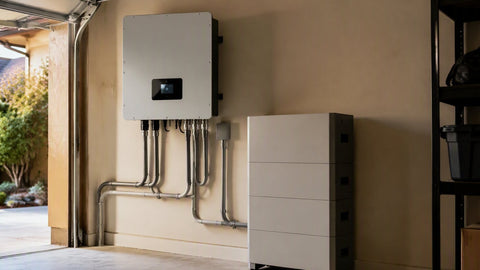
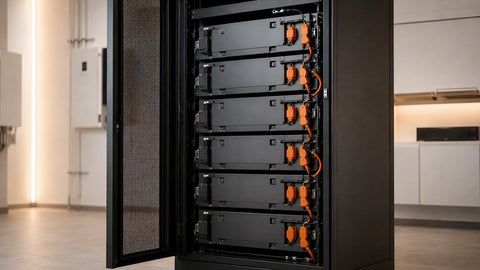
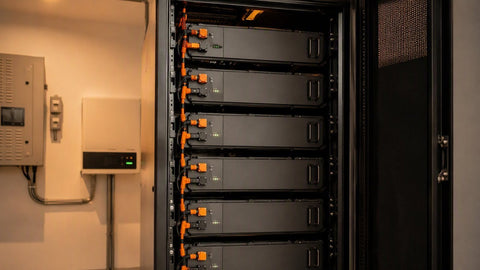
- Lithium (LFP): OnePack S2 and GC2 48V lithium — drop-in voltage-compatible replacements with CAN-bus communication and 10-year design life.
| Model | Capacity | Voltage | Chemistry | Cycle Life | Price Range |
|---|---|---|---|---|---|
| Trojan T-105 | 225Ah (1.5 kWh) | 6V | FLA | 1,200+ cycles | $150–$250 |
| Trojan T-125 | 240Ah | 6V | FLA | 1,200+ cycles | $180–$300 |
| Trojan TE35-AES (AGM) | 180Ah (210Ah C20) | 6V | AGM | 2,500 cycles | $300–$500 |
| Trojan Lithium OnePack S2 | 105Ah (5.376 kWh) | 48V | LFP | 10+ years | $2,500–$4,000 |
| Trojan GC2 48V Lithium | 30Ah | 48V | LFP | 8-year warranty | $1,500–$2,500 |
Cycle-life figures above are Trojan's published numbers at 50% depth of discharge under controlled test conditions. Field numbers run lower — more on that below, because the gap between datasheet and jobsite is where most battery budgets die.
3. Recent Releases (2025–2026)
Trojan's recent push has been the AES (Advanced Energy Storage) AGM line and the OnePack lithium family. The AES batteries target renewable and hybrid duty with carbon-enhanced plates for better partial-state-of-charge performance — the exact failure mode that murders standard FLA banks on undersized solar arrays. The OnePack S2 brought a 48V LFP module with a built-in BMS that talks CAN to the major inverter brands, which matters if you're pairing with the hybrid inverters in our inverters for solar battery systems roundup. Trojan also expanded cycle-life warranties on the solar-branded FLA lines, a quiet admission that buyers now compare warranty years the way they used to compare amp-hours.
4. Certifications & Listings
The FLA and AGM lines carry UL recognition and meet IEC 61427 secondary-cell requirements for photovoltaic energy storage — the standard your AHJ and your insurance carrier actually care about on permitted off-grid systems. The lithium products are listed to UL 1973 (stationary battery safety) with UL 9540A thermal-runaway test data available for system-level submissions. If your project needs a fully listed ESS rather than component-level cells, that's a different conversation — see our home battery bank sizing guide for how component batteries versus listed systems shake out on permits.
5. Warranty & Cycle Life
Warranty terms vary by line: FLA deep-cycle batteries typically carry 12–24 month free-replacement warranties in renewable service, AGM runs longer, and the lithium products carry 8–10 year terms. But warranty length is a marketing number. Cycle life is the engineering number, and cycle life is a function of how deep you discharge and how fast you recharge. Here's the math we hand customers before they choose a chemistry:
| Chemistry | Cycles @ 30% DoD | Cycles @ 50% DoD | Cycles @ 80% DoD | Usable kWh per rated kWh (typical system) |
|---|---|---|---|---|
| Flooded lead-acid (T-105 class) | ~1,800–2,200 | ~1,000–1,200 | ~400–500 | 0.50 (design to 50% DoD) |
| AGM (TE35-AES class) | ~3,500+ | ~2,000–2,500 | ~800–1,000 | 0.50–0.60 |
| Gel deep-cycle | ~1,500–2,000 | ~900–1,100 | ~400 | 0.50 |
| LFP (OnePack/GC2 lithium) | 6,000+ | 4,000–5,000 | 2,500–3,500 | 0.80–0.90 |
These are representative published ranges, not guarantees — temperature, charge rate, and how honestly the system holds its absorption window move the real numbers 20–30% either way. I've pulled T-105 banks after nine years of gentle 25% DoD cabin duty, and I've pulled identical banks after fourteen months of 80% DoD on an undersized array. Same battery, wildly different funeral dates. The battery-life extension guide covers the habits that separate those two outcomes.
6. Sizing a Trojan Bank: The 48V Math
Most off-grid builds we supply land on 48V strings, and the GC2 (golf-cart) form factor dominates because freight is cheap and replacements are everywhere. The string math:
| Building Block | Cells per 48V String | String Capacity | String Energy | Usable @ 50% DoD |
|---|---|---|---|---|
| T-105 (6V, 225Ah) | 8 in series | 225Ah @ 48V | 10.8 kWh | 5.4 kWh |
| T-875 (8V, 170Ah) | 6 in series | 170Ah @ 48V | 8.2 kWh | 4.1 kWh |
| T-1275 (12V, 150Ah) | 4 in series | 150Ah @ 48V | 7.2 kWh | 3.6 kWh |
| L16 (6V, ~370–420Ah class) | 8 in series | 370–420Ah @ 48V | 17.8–20.2 kWh | 8.9–10.1 kWh |
| OnePack S2 (48V LFP) | 1 module (parallel to scale) | 105Ah @ 48V | 5.4 kWh | 4.3–4.8 kWh |
Two parallel strings of T-105s give you 21.6 kWh nameplate, 10.8 kWh usable — enough for a disciplined cabin, not enough for a household that runs the minisplit at 2 p.m. in August. Run your loads through the battery backup runtime calculator and the solar battery sizing guide before you order freight. Undersizing a lead bank is the most expensive mistake in off-grid solar, full stop, because chronic deep discharge converts a 1,200-cycle battery into a 400-cycle battery.
7. Charge Setpoints by Chemistry
Half the "bad battery" warranty claims I've seen were really "bad charge programming." Flooded, AGM, gel, and LFP want different voltage windows, and a controller left on the wrong profile will cook or starve a bank within a season. Reference setpoints for a 12V nominal block (multiply for 24V/48V banks):
| Setpoint | Flooded (Trojan FLA) | AGM (Reliant/AES) | Gel | LFP (OnePack/GC2) |
|---|---|---|---|---|
| Bulk / Absorption | 14.4–14.8V | 14.2–14.6V | 14.0–14.2V | 14.2–14.6V |
| Float | 13.2–13.5V | 13.4–13.6V | 13.5–13.8V | 13.6V or float disabled |
| Equalize | 15.3–16.2V (monthly, controlled) | Never unless mfr. allows | Never | Never |
| Temp compensation | −24mV/°C per 12V | −24mV/°C per 12V | −24mV/°C per 12V | Disable below 0°C charge |
Gel is the least forgiving: overvoltage a gel battery and you grow permanent voids in the electrolyte that no charge profile can heal. That's why gel's market share keeps shrinking — AGM covers most of the same sealed-battery use cases with more tolerance for sloppy charging. Our 20–80 battery rule explainer goes deeper on why partial cycling in the middle of the SOC band stretches every chemistry's calendar life.
8. Popular Products at PES Supply
We stock and ship Trojan alongside the rest of our battery storage catalog, including Rolls/Surrette for buyers who want heavier plates and longer FLA life at a higher price. The volume movers are the T-105 and T-875 for cart fleets and budget off-grid builds, the L16 variants for bigger cabins, and the AES AGM line for customers who want lead-acid pricing without the watering calendar. Freight note from the warehouse: a pallet of eight T-105s runs about 500 pounds, and liftgate delivery is worth every penny if the site doesn't have a dock or a skid steer. One more practical tip: order your interconnect cables and hydrometer in the same shipment. The batteries arriving before the tools is how banks get installed with whatever wire was in the truck, and that's how parallel strings end up unbalanced from day one.
9. Technical Comparison
Trojan's closest cross-shop on the FLA side is Crown; on the lithium side it's the value LFP packs. Here's how the anchors compare:
| Metric | Trojan T-105 (FLA) | Crown CR-GC150 (FLA) | Trojan OnePack S2 (LFP) | EG4 LifePower4 (LFP) |
|---|---|---|---|---|
| Chemistry | Flooded Lead-Acid | Flooded Lead-Acid | LiFePO₄ | LiFePO₄ |
| Capacity | 225Ah / 1.5 kWh | 150Ah / 1.8 kWh | 105Ah / 5.376 kWh | 100Ah / 5.12 kWh |
| Voltage | 6V | 12V | 48V | 51.2V |
| $/kWh (upfront) | ~$100–$167 | ~$110–$194 | ~$465–$744 | ~$235–$285 |
| Cycle life | 1,200+ cycles | 1,200+ cycles | 10+ years | 6,000+ cycles |
| Maintenance | Watering required | Watering required | Maintenance-free | Maintenance-free |
| Weight (per kWh) | Heaviest | Heavy | Lighter | Lighter |
The honest read: Trojan FLA wins on upfront $/kWh and loses on lifetime $/kWh if you discount your own labor at zero — which nobody who has actually maintained a 16-battery bank does. LFP wins the lifetime math almost every time now; FLA still wins when capital is tight, when temperatures stay moderate, or when the application (carts, scrubbers) already has a watering routine baked into the workweek. Trojan's edge over generic imports is consistency and warranty service — a bad cell in year two gets replaced by a dealer network that answers the phone.
10. BMS & Monitoring
Lead-acid Trojan banks have no BMS — the "management system" is you, a hydrometer, and a calendar. The lithium lines carry an integrated BMS with cell balancing, over/under-voltage cutoffs, temperature interlocks, and CAN/RS-485 reporting to compatible inverter-chargers. For lead banks we strongly recommend a shunt-based monitor (a BMV-712 or equivalent — covered in our Victron brand guide) because amp-hour counting catches a failing string months before a voltmeter does.
11. Installation Notes
- Torque: T-105-class terminals (automotive post or L-terminal depending on variant) want 9–11 ft-lb on stud connections. Under-torqued lugs are the #1 cause of melted posts on parallel strings. Re-torque after the first discharge cycle — lead creeps.
- Interconnects: Minimum 2/0 copper on 48V banks over ~200Ah if you want balanced current sharing; keep parallel string cables identical in length and gauge or the strings age at different rates.
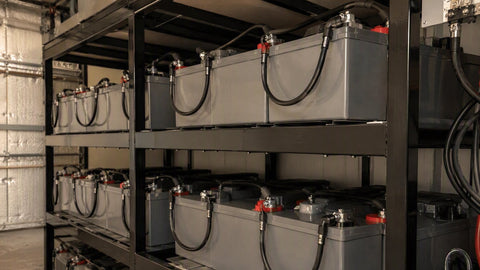
- Ventilation: FLA banks off-gas hydrogen during absorption and equalize. NEC 480.10(A) and the mechanical code both want ventilation for battery rooms — a louvered battery box with an air path is not optional on an enclosed FLA install.
- Working clearance: NEC 110.26 working space applies in front of the disconnects and charge controllers feeding the bank. Plan the battery room layout before the slab, not after.
- Overcurrent protection: Each parallel string gets its own Class T fuse within 7 inches of the positive terminal per ABYC E-11 practice (marine-originated, but it's the standard the industry follows on big banks).
Wiring the bank is only half the job — the charge side has to match. Our how to connect solar panels to a battery walkthrough covers array-to-controller-to-bank wiring order, and the BMS explainer clarifies what the lithium packs handle internally versus what your inverter settings still control.
12. Maintenance Schedule: What a Flooded Bank Actually Costs You
Nobody puts labor hours in the brochure, so we will. Here's the recurring maintenance load on a 16-battery FLA bank versus its sealed alternatives, based on how these systems behave in the field rather than in the lab:
| Task | FLA (T-105 bank) | AGM | Gel | LFP |
|---|---|---|---|---|
| Electrolyte check / watering | Monthly, 30–60 min with single-point kit | Not applicable | Not applicable | Not applicable |
| Terminal cleaning & re-torque | Quarterly | Annually | Annually | Annually |
| Specific gravity readings | Quarterly, per cell | Voltage-based only | Voltage-based only | BMS-reported |
| Equalization charge | Monthly or when cells drift ±0.030 SG | Never (mfr. exceptions aside) | Never | Never |
| Corrosion control (terminal protectant) | Twice yearly | Yearly | Yearly | Yearly |
| Ventilation / battery room check | Quarterly | Yearly | Yearly | Minimal |
| Typical annual labor | 10–16 hours | 1–2 hours | 1–2 hours | Under 1 hour |
Ten to sixteen hours a year. Put a real hourly number on that — yours or a tech's — and the "$600 cheaper" FLA bank often stops being cheaper by year three. That's not an argument against flooded batteries; it's an argument for buying them with open eyes. For a hunting cabin you visit monthly anyway, watering is a pleasant chore with a hydrometer and a cup of coffee. For a rental property or an unattended telecom site, it's a liability.
13. Failure Modes We See in the Field
After years of warranty calls and autopsies on dead banks, the same five killers account for nearly everything:
- Sulfation from chronic undercharge. The array was sized for summer, winter never gets the bank to absorption, and sulfate crystals harden on the plates. Specific gravity sags, capacity craters, and the owner blames the battery. The fix is charge-source sizing, not a new bank — until it's too late.
- Water starvation. Plates exposed to air oxidize permanently. Once you can see plate tops, that cell never comes all the way back.
- Over-equalization. Equalize is a tool, not a hobby. Running 16V into a 12V block weekly boils off water, warps plates, and sheds active material into the bottom of the case.
- Unbalanced parallel strings. Different cable lengths or loose lugs push one string to carry more current; it ages faster, drags the healthy strings down with it, and the whole bank dies young.
- Temperature abuse. Battery life roughly halves for every 10°C (18°F) above 77°F average operating temperature. A bank in an unconditioned Arizona shed lives half as long as the same bank in a Minnesota basement. Cold is kinder — you lose capacity temporarily, not life permanently.
Catch these early with a monitor and a hydrometer and most banks reach their datasheet life. Ignore them and even the best battery in the catalog is scrap in three years.
15. Which Trojan Chemistry Should You Buy?
After all the tables, the decision collapses to three questions. First: will anyone actually maintain it? If yes and capital is tight, FLA — nothing touches the T-105 on upfront dollars per usable kWh. Second: does the system cycle daily at partial state of charge? If yes, spend for AES AGM or lithium, because standard FLA sulfates in that duty and you'll buy the bank twice. Third: is this a 10-year asset or a 4-year consumable? If the bank powers something you depend on — refrigeration, medical loads, a business — LFP's 4,000-plus cycles and zero maintenance win the lifetime math even at three times the sticker. We run all four chemistries through the shop, and the pattern is consistent: buyers who match chemistry to their honest maintenance habits are happy; buyers who buy on sticker price alone are back in two years.
16. Frequently Asked Questions
What is the Trojan T-105 and why is it so popular?
The T-105 is a 6V, 225Ah flooded deep-cycle battery in the GC2 golf-cart footprint. It's popular because it's cheap per cycle, available from almost any battery distributor in North America, and has 60+ years of field history behind it. Eight in series make a 48V, 10.8 kWh string — the default building block of budget off-grid banks.
Can I replace my Trojan lead-acid batteries with Trojan lithium?
Yes — the GC2 lithium and OnePack lines are designed as voltage-compatible drop-ins in the same form factors. You'll need to reprogram charge setpoints (no equalize, lower float or no float, low-temperature charge cutoff) and confirm your inverter-charger supports an LFP profile. Don't mix chemistries in one bank, and don't parallel old lead strings with new lithium strings.
How long do Trojan flooded lead-acid batteries last?
At 50% depth of discharge with proper watering and correct charge setpoints, expect 1,000–1,200 cycles — roughly 4–6 years of daily cycling. At 80% DoD that drops toward 400–500 cycles. Calendar life in gentle standby service can stretch past 8 years. The single biggest killer is chronic undercharging followed by sulfation; the second is skipped watering.
What is the difference between Trojan FLA and AGM batteries?
FLA batteries have free liquid electrolyte you must water and vent; they're cheaper and tolerate equalization charging that reverses stratification. AGM batteries immobilize the electrolyte in glass mat — sealed, maintenance-free, better partial-state-of-charge performance, roughly double the price, and intolerant of overvoltage. Same footprint, different lifestyle: FLA rewards attention, AGM forgives neglect (up to a point).
Are Trojan batteries made in the USA?
Yes — Trojan's deep-cycle lines are manufactured in Georgia and California. That's part of why lead times stay sane and why dealer warranty claims resolve faster than with import brands.
How often should I water a flooded Trojan bank?
Check monthly in active cycling service; warm climates and heavy equalize schedules can double that. Water after a full charge, never before (electrolyte expands as it charges), and only to about 1/8 inch below the fill well — overwatering floods acid out the vents during the next charge. Distilled water only. A $40 single-point watering kit turns a two-hour chore into ten minutes.
Sources & Standards
Specifications referenced from Trojan Battery published datasheets and cycle-life charts, IEC 61427 (secondary cells for photovoltaic storage), UL 1973 and UL 9540A listing documentation, NEC Article 480 (storage batteries), and NEC 110.26 working-space requirements. Cycle-life ranges reflect published manufacturer data adjusted for field conditions observed across systems we've supplied and serviced.
17. Shop Trojan Battery at PES Supply
Browse our battery storage collection for Trojan FLA, AGM, and lithium stock with freight quotes on full pallets, or cross-shop Rolls Battery for premium flooded alternatives. Not sure which chemistry fits your cycles? Call the shop — we've built these banks ourselves and we'll tell you what we actually install.