MidNite Solar Brand Guide: Classic MPPT Controllers, E-Panels, and Off-Grid Power Systems
Classic 150/200/250 controllers, The Kid, E-Panels, MNEPV breakers, string-sizing math per NEC 690.7, and how MidNite compares to OutBack and Morningstar.
MidNite Solar is the brand that off-grid installers recommend to other off-grid installers when nobody's marketing department is listening. The company was founded in Arlington, Washington by the engineering team that built the original Trace SW-series inverters — the people who quite literally invented the modern off-grid power center — and it shows in every product decision: field-serviceable hardware, published thermal derating, the first built-in arc-fault detection in a charge controller, and enclosures designed by people who have clearly wired a system in a snowstorm. If you're building off-grid or battery-based systems, this is the guide we wish every customer read before calling. Pair it with our MidNite vs Morningstar comparison and MidNite vs Victron breakdown.
MidNite Solar emerged from the ashes of Trace Engineering's acquisition in the early 2000s. The Trace engineering team — the group behind the SW4024 and DR series that defined off-grid power in the 1990s — regrouped in Arlington, Washington and started building the gear they wished existed: DC-rated breakers that actually fit DIN rail, pre-wired power panels that eliminated the day's worth of carpentry every inverter install used to require, and eventually the Classic, the first MPPT controller with built-in arc-fault circuit interruption and DC ground-fault protection.
The company remains independent and US-manufactured, which has practical consequences. When we call MidNite with a technical question, an engineer answers — sometimes literally the person who designed the circuit. I've had MidNite support walk a customer's installer through a HyperVOC configuration on a Saturday. Firmware updates still ship for controllers sold a decade ago. In an industry increasingly built on sealed, disposable electronics, MidNite boards are socketed, documented, and repairable. That's not nostalgia; it's a lower lifetime cost of ownership on systems that run 20+ years.
The Classic is MidNite's flagship controller family, named by its maximum PV input voltage: Classic 150, 200, and 250. All three share the same chassis, firmware, and feature set — built-in AFCI, DC-GFP, wind and hydro modes, HyperVOC (a margin buffer that lets Voc exceed nominal rating without damage), an Ethernet port with free My MidNite monitoring, and battery support from 12V up to 72V nominal. The difference is headroom: higher input voltage means longer strings, smaller wire, and lower array current.
| Model | Operating Voltage | Max Output Current | Battery Voltages | Price |
|---|---|---|---|---|
| Classic 150 | 150 VDC | 96A (12V), 94A (24V), 86A (48V) | 12–72V | $925 |
| Classic 200 | 200 VDC | 79A (12V), 78A (24V), 78A (48V) | 12–72V | $975 |
| Classic 250 | 250 VDC | 61A (12V), 62A (24V), 55A (48V) | 12–72V | $1,050 |
Choosing between the three is a string-design decision. On a 48V battery bank, the Classic 150 handles roughly a 4.5 kW array; the 250's higher input voltage lets you series more modules per string, which cuts combiner inputs and homerun current on long runs from a ground mount. We sell the Classic 150 five-to-one over the others because most residential off-grid arrays fit under 150V input comfortably once you run the cold-weather Voc math — which brings us to the section that actually determines whether your controller survives its first winter.
Module voltage rises as temperature falls. NEC 690.7 requires you to calculate maximum system voltage at the record low temperature for your site using the module's Voc temperature coefficient, and exceeding a controller's maximum input voltage — even briefly, on a clear cold morning — is the classic way to let the smoke out of a brand-new MPPT. MidNite's HyperVOC gives you a non-destructive buffer (the controller won't operate above nominal input but won't be damaged up to battery voltage plus the rating), but you should design to operate within the nominal window. Here's the worked math we run at the counter.
| Design Step | Rule / Formula | Worked Example (400W module, Voc 49.6V, βVoc = −0.27%/°C, record low −15°C) |
|---|---|---|
| Temperature delta | 25°C − record low | 25 − (−15) = 40°C |
| Voc correction factor | 1 + (ΔT × |βVoc|) | 1 + (40 × 0.0027) = 1.108 |
| Cold-corrected Voc | Voc(STC) × correction | 49.6 × 1.108 = 54.96V per module |
| Max modules per string (Classic 150) | 150V ÷ cold Voc, round down | 150 ÷ 54.96 = 2.73 → 2 modules per string |
| Max modules per string (Classic 250) | 250V ÷ cold Voc, round down | 250 ÷ 54.96 = 4.55 → 4 modules per string |
| Controller output current | Array watts ÷ battery voltage (low point) | 3,200W array ÷ 44V (48V bank at low SOC) = 72.7A → Classic 150 OK (86A @ 48V) |
| Output breaker (NEC 690.8) | Controller max output × 125% | 96A × 1.25 = 120A → MNDC 125A-class breaker, 2 AWG Cu |
The row that surprises everyone: in cold climates, modern high-Voc residential modules only fit two per string on a 150V controller. That's why the Classic 250 exists, and why string design must happen before you buy hardware. Our charge controller sizing guide and the sizing calculator automate this math, and the MPPT vs PWM explainer covers why MPPT is worth it on anything larger than a trickle system.
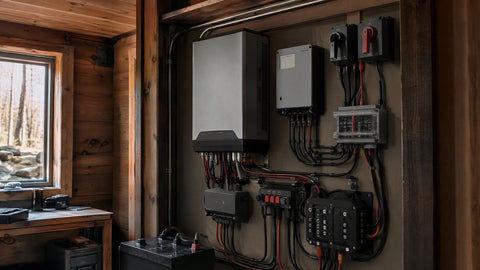
MidNite's other half is the balance-of-system gear that makes off-grid installs clean, code-compliant, and fast. E-Panels are pre-wired steel power panels that mount an inverter/charger with its DC breaker, AC input/output breakers, bypass, shunt, and bus bars already landed — what used to be a full day of enclosure carpentry becomes a two-hour mount-and-terminate. MNEPV breakers are the industry-standard DIN-rail DC breakers (150VDC rated, 1–63A, 10,000 AIC) that live in nearly every combiner box we sell, including our combiner box inventory. The MNDC250 handles the big 250A/125VDC battery-side disconnect duty.
| Model | Category | Key Specs | Application |
|---|---|---|---|
| Classic 150 | MPPT charge controller | 96A max, 150V, 12–72V battery, HyperVOC, AFCI, DC-GFP | Off-grid residential, commercial PV systems |
| Classic 150-SL | MPPT controller (solar-only) | 96A max, 150V, dip-switch programming | Solar-only systems, cost-conscious projects |
| The Kid | MPPT charge controller | 30A, 150V, 12–48V battery, UL 458 marine, fanless | RVs, boats, cabins, small off-grid systems |
| MNDC250 | DC breaker enclosure | 250A/125VDC breaker, 5 DIN-rail / 3 panel-mount slots | Off-grid system DC distribution |
| MNEPV breakers | DC circuit breakers | 150VDC, 1–63A, 10,000 AIC, DIN-rail | PV disconnects, charge controller protection |
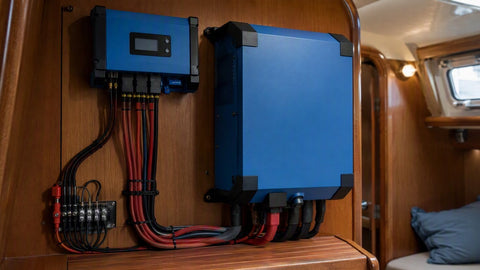
The Kid deserves special mention: 30A, 150V input, fanless, UL 458 marine listed, and priced for small systems. It's the default for RV, marine, and cabin builds in the 400–800W range — we sell it constantly alongside the 30A controller category. And because it's fanless, it survives the dust and vibration that kill fan-cooled controllers in vehicle installations.
| Feature | MidNite (Classic 150) | OutBack (FM80) | Morningstar (TriStar MPPT 60) |
|---|---|---|---|
| Max output current | 96A | 80A | 60A |
| Max input voltage | 150V (HyperVOC buffer) | 150V | 150V (600V on 600V model) |
| Battery voltages | 12–72V (120V on 250KS) | 12–60V | 12–48V (60V on some) |
| Built-in AFCI | Yes (world's first) | No | No |
| Built-in DC-GFP | Yes | Optional | Optional |
| Wind/hydro modes | Yes | No | No |
| Web monitoring | Free (My MidNite) | OPTICS RE (paid) | Free (MSView) |
| Certifications | UL 1741, CSA, CE, FCC | UL 1741, CSA | UL 1741, CSA, CE |
| Made in USA | Yes | Yes (Arlington, WA) | No |
| Warranty | 5 years (extendable) | 5 years (10-year optional) | 5 years |
The honest read: the Classic 150 wins on output current, safety integration, and monitoring cost; the FM80 counters with the FlexPower pre-wired ecosystem and OutBack's hybrid Radian line; the TriStar MPPT 60 counters with Morningstar's legendary field-reliability record and the 600V model for long wire runs. For a full off-grid build with a US-made stack and free monitoring, MidNite is our default. For the inverter side of that stack, see the pure sine wave inverter buyers guide and hybrid vs off-grid inverter selection.
Breakers & Overcurrent Protection
What we've learned wiring Classics and E-Panels
- Ventilate the controller, not just the room. The Classic is convection-and-fan cooled and will derate in a sealed enclosure on a hot roof-adjacent wall. Leave the manual's clearance above and below; on hot installs we add a thermostatic vent fan to the power room. Derating curves are published — read them.
- Land PV input breakers in the off position until strings are verified. Polarity check with a meter on every string before closing the MNEPV. A reversed string into an MPPT input is an expensive mistake that takes ten seconds to prevent.
- Use the DC-GFP test button at commissioning. The ground-fault protection has a test function; exercising it proves the circuit before the inspector asks.
- Torque battery lugs to spec and mark them. The high-current side (96A at 12V is a lot of amps) deserves a torque wrench and a paint-pen witness mark, not a guess. Loose high-amp connections are how battery rooms catch fire.
- Update firmware before programming. Classic firmware still improves; do the update over Ethernet before you build the charging profile, not after the system is live.
On the battery side, the Classic's equalize and absorb timers are fully programmable per chemistry — FLA, AGM, and LFP profiles all live on our battery sizing guide's companion documentation, and for LFP banks specifically, confirm your battery's BMS charge-voltage window and disable equalization entirely. A Classic trying to equalize a lithium bank at FLA voltages will trip the BMS every single time.
A complete mid-size off-grid BOM shows how the MidNite ecosystem fits together. This is a real configuration we kitted for a 48V cabin build: 6 × 400W modules, Classic 150, E-Panel with a 3 kW-class inverter/charger, MNEPV string protection, and a 10 kWh LFP bank.
| Component | Qty | Role / Notes |
|---|---|---|
| 400W modules (2 per string, cold-checked) | 6 | 3 strings × 2 modules; Voc verified at record low per NEC 690.7 |
| Classic 150 | 1 | 2,400W ÷ 44V low-SOC = ~55A — comfortable on a 96A unit |
| MNEPV breakers (string + input) | 4 | 15A per string, 63A controller input disconnect |
| MNDC250 with battery breaker | 1 | 250A/125VDC main battery disconnect, 2/0 cable to bank |
| E-Panel + inverter/charger | 1 | Pre-wired DC/AC breakers, bypass, shunt — saves a day of carpentry |
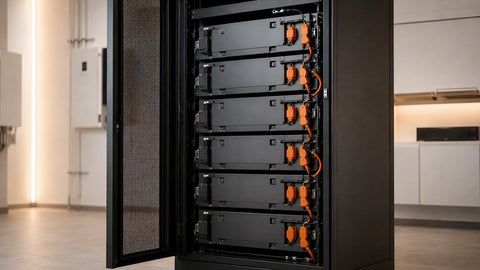
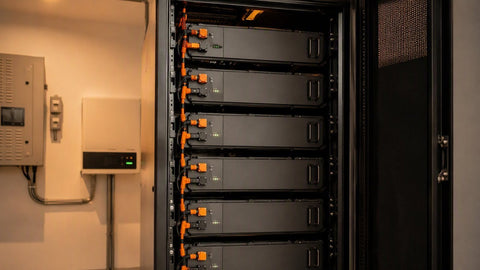
| LFP bank, 48V | 10 kWh | 2 × 5 kWh-class rack modules; absorb programmed per manufacturer |
Notice what isn't on that BOM: a separate combiner enclosure full of field-assembled breakers, a DC disconnect box sourced from a third vendor, and a rat's nest of field-built wiring. The ecosystem approach is MidNite's whole pitch, and on small-to-mid off-grid systems it genuinely cuts install time by a day or more.
The Classic line carries a 5-year warranty, extendable at purchase, with support that routes to engineers in Arlington rather than a script-reading call center. Our own claim history on the line is thin — fan failures on early units were the common issue years back, addressed in later revisions — and turnaround on the rare board-level failure has run under two weeks. Keep your serial numbers and commissioning settings documented; MidNite's support team will ask for the exact firmware version and configuration, and having it ready is the difference between a ten-minute call and a week of email.
The warranty calls and forum posts rhyme. String Voc calculated at STC instead of record-low temperature, so the first clear January morning overvolts the input. Output breakers sized to the array instead of the controller's maximum output current, so the 125% NEC 690.8 multiplier gets missed. FLA charge profiles left on default against a new LFP bank, so the BMS trips every absorb cycle and the customer blames the battery. And the evergreen one: controllers mounted in sealed plywood boxes in attics and pump houses, derating to half output every afternoon from June through September. Every one of these is prevented by an hour with the manual and the sizing math in Section 3 — which is exactly why we put that math in this guide.
The off-grid market has split into two camps: integrated all-in-one hybrid inverters (EG4 18KPV, Sol-Ark, and similar) that combine inverter, chargers, and MPPT in one box, and component systems built from discrete controllers, inverter/chargers, and power panels. MidNite owns the component camp's controller and BOS layer. All-in-ones win on cost and simplicity for standard residential builds — we sell plenty of them. Component systems win on serviceability, redundancy, and expandability: when one box of an all-in-one fails, everything is down; when a Classic fails, the inverter still runs the house and a replacement controller is a two-hour swap. For remote sites, expandable homestead systems, and anyone who values repairability over integration, the MidNite-anchored component stack remains the professional answer. It's also the answer for mixed-source systems — solar plus wind plus hydro on one battery bank — because the Classic's wind and hydro modes handle sources the all-in-ones simply don't accept. A micro-hydro turbine feeding a Classic in hydro mode alongside a PV array on a second Classic is a standard build in the Pacific Northwest off-grid community, and it's a build you cannot do on an integrated hybrid inverter at any price.
Supply-side note from the wholesale desk: MidNite's US manufacturing has kept lead times short through the tariff and shipping chaos of the mid-2020s. When offshore controller brands quoted twelve-week lead times, Classics were shipping in days. For installers scheduling crews, that reliability is a competitive weapon, not just a convenience.
One more capability that rarely makes the marketing copy: the Classic's auxiliary outputs and extensive logging turn the controller into a small system manager. Load control, vent-fan control, generator-trigger logic, and alarm outputs are all programmable from the front panel, and the 380-day log means a site visit a year after commissioning still shows you every day's harvest, absorb time, and fault history. On troubleshooting calls, that log is usually the whole diagnosis — we can see the cloudy week, the tripped breaker, and the exact morning the array underperformed, without a single guess. Competing controllers with 30-day or cloud-gated histories simply can't tell that story.
What size array can a Classic 150 handle?
On a 48V battery bank, roughly 4.5 kW of PV (86A × ~52V charging). On 24V, about half that; on 12V, about a quarter. The input side is limited by string Voc at your site's record low temperature — typically 2–3 modern high-voltage modules per string on a 150V controller. Both limits apply simultaneously; the sizing calculator runs both.
What is HyperVOC?
HyperVOC is MidNite's input-voltage safety buffer: the Classic operates normally up to its nominal input rating (150/200/250V) but won't be damaged if Voc exceeds that, up to battery voltage plus the rating. It's protection against design errors and freak cold snaps — not a license to design over the nominal window. Your operating string voltage should still calculate inside the rating per NEC 690.7.
Do I need AFCI in an off-grid charge controller?
NEC 690.11 arc-fault requirements apply to PV systems on or penetrating buildings, including off-grid systems. MidNite was the first to build AFCI directly into the controller, which satisfies the requirement without external devices. Even where an AHJ doesn't enforce it, series-arc faults in PV wiring are a genuine fire mechanism — this is safety hardware, not checkbox hardware.
MidNite Classic or OutBack FM80 for a 48V off-grid cabin?
The Classic 150 gives you more output current (96A vs 80A), built-in AFCI and DC-GFP, free monitoring, and wind/hydro capability. The FM80 counters with the FlexPower pre-wired panel ecosystem and OutBack's Radian hybrid integration. For a standalone charge controller on a new build, we default to the Classic; if you're buying a complete pre-wired OutBack FlexPower system, the FM80 comes with it and works beautifully.
Can the Classic charge lithium (LFP) batteries?
Yes — fully programmable absorb/float voltages and timers accommodate LFP profiles. Disable equalization, set absorb to your battery manufacturer's recommended voltage (typically 56.0–58.4V for a 48V nominal LFP bank), and confirm the BMS communication or voltage windows match. Never run an FLA equalize cycle on a lithium bank.
What monitoring does MidNite include?
Every networked Classic includes free My MidNite cloud monitoring via the built-in Ethernet port — no subscription, no gateway purchase. The local app and MNGP display give on-site status, and data logging covers 380 days of history. It's the most generous monitoring package in the class.
- MidNite Solar published specifications: Classic 150/200/250, Classic SL, The Kid, E-Panel, MNEPV/MNDC documentation (2025–2026)
- NEC 2023 Articles 690.7 (maximum voltage), 690.8 (circuit sizing), 690.11 (arc-fault protection), 690.13/690.15 (disconnects)
- UL 1741 (inverters, converters, controllers), UL 458 (marine power converters/chargers)
- PES Supply internal off-grid system designs and installer field reports, 2021–2026
Shop MidNite Solar at PES Supply
Classic controllers, The Kid, E-Panels, and MNEPV breakers in stock — with string-sizing help before you buy, not after the smoke test.
Browse Charge Controllers