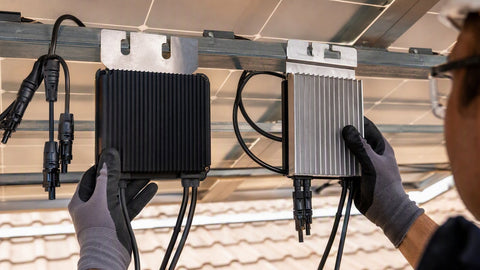
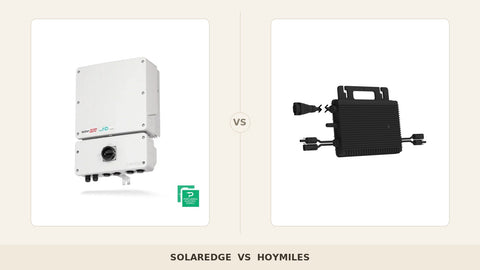
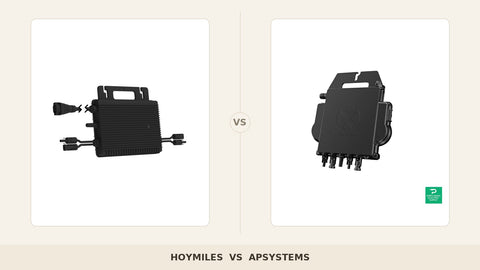
Hoymiles is the microinverter brand that made US contractors stop saying "Enphase or nothing." Chinese-engineered, globally deployed, priced like a value brand and specced like a premium one, the HMS and HM families have been landing on American roofs in serious volume since distribution matured. Enphase is the incumbent: IQ8 grid-forming silicon, the Enlighten platform, a 25-year warranty, and two decades of module-level electronics DNA. We move both lines across the counter every week, and this is the honest contractor-grade comparison — specs, labor, reliability, and the places where each brand quietly wins the bid.
The short version first, because trucks are waiting: Enphase buys you the deepest ecosystem in residential solar — grid-forming backup, batteries, monitoring, training, and bankability — at a premium price. Hoymiles buys you 80–90% of that capability at 60–75% of the price, with dual and quad architectures that slash device counts. If storage-readiness and fleet-grade monitoring matter, Enphase. If bid competitiveness and device-count economics matter, Hoymiles has earned its seat at the table.
Head-to-Head Specification Table
| Specification | Enphase IQ8 Series | Hoymiles HM / HMS Series |
|---|---|---|
| Architecture | One microinverter per module (IQ8/IQ8+/IQ8M/IQ8A/IQ8H classes) | Single, dual (HM-600/700/800 class), and quad (HMS-2000 class) options |
| Continuous output class | ~240–384 VA per unit | Duals ~600–800 VA class; quads up to ~2,000 VA class |
| Peak efficiency class | ~97% class | ~96.5–96.7% class published |
| Grid-forming / backup | Yes — IQ8 forms microgrids with IQ System Controller + IQ batteries; sunlight-only backup capable | Grid-following; backup via third-party AC-coupled storage |
| Communications | Power-line carrier to IQ Gateway | Sub-1GHz / 2.4GHz wireless to DTU gateway |
| Monitoring | Enlighten — category benchmark for depth and polish | S-Miles Cloud — capable, improving, lighter ecosystem |
| Rapid shutdown | Integrated, NEC 690.12 module-level | Integrated, NEC 690.12 module-level |
| Warranty class | 25-year limited on current line | 25-year class offered in US channel — verify registration terms |
| US support footprint | Deepest installer ecosystem in North America | Growing US team and distribution; responsive on our tickets |
| Price per watt class | Premium | Typically 25–40% below Enphase on comparable BOMs |
Where Hoymiles Actually Came From
Contractors over forty remember when "Chinese microinverter" meant a grey-market box with a manual translated by someone who'd never seen a roof. That era is over. Hoymiles has been shipping since 2012, holds proper UL 1741 listings and IEEE 1547 compliance for the US market, builds in serious automated factories, and supports the product through real US distribution — including us. The HM/HM S generations earned their reputation the slow way: installers tried a pallet on a rental property or a barn, watched it for two summers, then started speccing it on customer homes. That's exactly how trust gets built in this trade, and it's why the brand now shows up on bid sheets next to Enphase instead of next to no-name imports.
Enphase's origin story is the inverse: they invented the modern residential microinverter market, survived the brutal early years of M-series growing pains, and emerged with the IQ platform that defines the category. When a lender, an inspector, or a nervous homeowner asks "who makes it," Enphase is the answer that ends the conversation. That brand gravity is a real, monetizable feature — financed deals and referral-driven sales both close easier with the name customers already know from their neighbor's roof.
Architecture and Device-Count Economics
Same math as every microinverter shootout: Enphase commits to one device per module, Hoymiles gives you singles, duals, and quads. A 24-module roof is 24 IQ8s, 12 HM-800-class duals, or 6 HMS-2000-class quads. Fewer devices means fewer mounting points, fewer trunk drops, fewer serials to scan, and a lower statistical failure surface — at the cost of a bigger blast radius when a device does fail. Our field data across both brands says device-level reliability is close enough that the labor and BOM savings usually outweigh the blast-radius argument, except on mission-critical monitoring customers who want per-panel accountability forever.
| Line Item (24-module, ~10 kW roof) | Enphase IQ8 ×24 | Hoymiles dual ×12 | Hoymiles quad ×6 |
|---|---|---|---|
| Devices to mount/scan | 24 | 12 | 6 |
| Trunk/bus drops | 24 | 12 | 6 |
| Roof labor vs baseline | Baseline | −30 to −60 min | −60 to −90 min |
| Microinverter hardware cost class | Premium (100%) | ~65–75% of Enphase | ~60–70% of Enphase |
| Failure blast radius | 1 module | 2 modules | 4 modules |
| Storage/backup path | Native grid-forming ecosystem | Third-party AC-coupled storage | Third-party AC-coupled storage |
Run the full BOM, not the device sticker: microinverters, trunk cable, racking hardware, PV wire, and gateway hardware. On value-engineered jobs the Hoymiles savings fund an extra panel or two, which is a story customers understand instantly.
Performance in the Field
Spec efficiency within half a point is marketing; harvest is truth. Across our comparable installs, Hoymiles-equipped roofs produce within 1–2% of Enphase-equipped roofs on similar modules and orientations — inside the noise of soiling, azimuth error, and module binning. Both handle roof heat well; both wake up early and go to sleep late; both do per-input MPPT competently in shade. The differences that survive a year of data are systemic, not electrical: Enlighten's per-module visibility catches a dead panel or a soiling problem weeks earlier than a quarterly bill shock, and Hoymiles' S-Miles Cloud — while genuinely capable on production data and alarms — doesn't yet match that diagnostic depth.
Low-light and cold-morning behavior deserve a note for northern installers: both lines handle cold-voltage windows fine when matched per the compatibility tools, but check the module Voc at your record-low temperature against the micro's absolute max input — the arithmetic takes two minutes and the system size calculator plus manufacturer tools do most of it for you. Modern high-current modules (14A+ Imp) also need current-window verification on both brands; don't assume last year's pairing chart covers this year's panels.
The Backup Question, Settled Honestly
If the customer wants outage capability, the brands diverge completely. IQ8 microinverters are grid-forming: paired with an IQ System Controller and IQ batteries, the system islands the home, keeps the roof producing, and in sunlight-backup configurations runs critical loads from the array alone with no battery at all. It's the most elegant retrofit path in the industry — the micros you install today are the backup system you activate later. Hoymiles micros are grid-following: when the grid drops, they drop. Backup on a Hoymiles roof means a separate hybrid inverter or an AC-coupled battery like the ones in our solar batteries and energy storage systems categories — a perfectly good architecture we install constantly, but a second decision, a second vendor, and a second commissioning process.
So the qualifier we use at the counter: "Are batteries a when or an if?" When — buy Enphase and the storage conversation is already half finished. If — or honestly "probably never, we just want cheap clean power" — Hoymiles banks the savings today and the roof is none the worse. Customers who want outage protection on a value microinverter roof should read our battery bank sizing guide and battery buyer's guide to understand the AC-coupled path before dismissing it.
AC Trunk Math That Changes the Wire Size
Device count moves real money on the AC side too. Sum the continuous output, apply the 1.25 continuous-load factor, and the conductor and breaker fall out of NEC 310.16 — the exact charts are in our wire ampacity chart and NEC wire sizing guide. A worked example: a 20-module roof on IQ8-class singles lands near 7.4 kVA continuous — about 31A at 240V, 1.25× gets you a 40A breaker and 8 AWG copper. The same roof on quad-class devices at higher per-device VA can push a branch toward 50A and 6 AWG — or split into two branches, which is usually the cleaner answer. Either way, check the panel's 120% rule headroom under NEC 705.12 before promising a backfed breaker, and keep a supply-side tap in your back pocket for packed panels. Raceway planning runs through the conduit fill chart and the conduit types guide; the NEC 690 disconnect guide and grounding guide cover what the inspector will actually open.
Reliability, Warranty, and Support: What Our Logs Say
| Factor | Enphase | Hoymiles |
|---|---|---|
| Warranty term class | 25-year limited, current line | 25-year class via US channel — register at install |
| Observed failure rate | Low; mature product generations | Low; HM/HMS generations notably solid in our fleet |
| RMA experience | Benchmark portal, advance replacement common | Responsive through distribution; slightly longer logistics tail |
| Training / certification | Industry's deepest installer program | Growing program, good documentation |
| Bankability | US-listed, two decades, lender-recognized | Publicly listed (Shanghai), strong global shipments, rising US recognition |
| Monitoring data ownership | Full customer ownership, installer fleet tools | Customer access standard; fleet tooling lighter |
Two field notes that don't fit in a table. First: Hoymiles' US support has answered every ticket we've filed within a business day or two, and replacement hardware has arrived through distribution without drama — but Enphase's advance-replacement logistics remain the industry standard everyone else is measured against. Second: register every device at commissioning, photograph serials, and file the array map. Both brands honor warranties; neither can honor a claim you can't document.
Commissioning, Communications, and the Gateway Question
Enphase moves data over the power lines themselves — power-line carrier from each micro to the IQ Gateway, no radios, no pairing dance. Hoymiles talks wireless from each micro to the DTU gateway, which keeps the hardware simple and the trunk cable dumb. Both approaches work on normal residential roofs, and both have exactly one failure mode worth pre-empting. PLC can struggle on electrically noisy services — we've chased exactly two cases in years, both agricultural shops with big variable-frequency drives — and wireless has range and penetration limits on sprawling metal-clad buildings. The fix in both cases is boring and effective: put the gateway where the signal actually is, verify every device reports before the crew leaves the driveway, and build the array map in the app while the roof layout is fresh in your head. Thirty minutes of commissioning discipline prevents the two most common first-year service calls on either brand: "one panel not reporting," which is usually a mapping error, and "system offline," which is usually the customer's Wi-Fi password having changed after an ISP swap.
Grid profile selection is the other commissioning trap. Both brands ship with UL 1741 SB / IEEE 1547 regional ride-through profiles, and both make the installer pick the right one for the utility and state. Choose wrong and you get nuisance tripping in week one, a confused customer, and an awkward callback; choose right and you never think about that screen again for the life of the system. Slow down at that step, photograph the confirmation page, and file it with the permit packet. Two extra minutes at commissioning beats two hours of remote diagnostics next month, every single time, on every brand we sell.
Module Pairing and the Compatibility Discipline
The most expensive quiet mistake in microinverter work is a lazy pairing. A 550W module clipped against a micro's output ceiling throws away harvest the customer paid for every sunny afternoon; an oversized micro on a 400W panel burns budget on headroom that never gets used. The discipline takes minutes: match the module's realistic output — nameplate minus temperature and soiling losses, roughly 75–85% on a hot roof — against the micro's continuous rating, then verify the module's coldest-morning Voc sits inside the micro's absolute maximum input voltage and its Imp inside the input current window. Both brands publish compatibility calculators; use them, screenshot the result, and file it. That screenshot has settled more than one warranty conversation in our experience.
| Module Class | Enphase Pairing | Hoymiles Pairing | Field Note |
|---|---|---|---|
| 400–430W residential | IQ8+ / IQ8M class | HM dual class (2 modules/unit) | The volume pairing for both brands |
| 440–470W high-power | IQ8A / IQ8H class | HMS high-current dual class | Verify 14A+ input current support |
| 500W+ commercial format | IQ8H where listed | HMS-2000 quad class | Quad economics shine on big simple roofs |
| Mixed orientations | Singles keep panels independent | Duals only with same-orientation pairs | Never pair east+south on one dual input |
What a Year of Side-by-Side Roofs Taught Us
We service a neighborhood where two installers we supply put Enphase on one cul-de-sac and Hoymiles on the next — same module brand, same orientation mix, same utility, commissioned within a month of each other. Twelve months later the production difference across the two groups was under two percent, well inside what soiling and tree growth explain. The differences that showed up were everything around the electrons: the Enphase customers opened their app more, spotted a failing device within days of the alert, and referred two neighbors. The Hoymiles customers saved real money upfront, needed one gateway re-pairing after a router swap, and produced exactly the kWh the design promised. Both groups would buy the same system again. That's the cleanest real-world summary of this comparison we can offer: the physics is a near-draw; the ecosystem and the price are the decision.
If you're the contractor reading this, the practical play is the one most of our best customers have already adopted: master both platforms, lead with the brand the job actually calls for, and never let a line item decide the architecture. Your close rate goes up when the customer senses you'd install either one on your own mother's house — because with these two, we genuinely would.
The Distributor's-Eye Summary
Pull the camera back from the spec sheets and this is what the comparison looks like from behind our counter. Enphase is the system we recommend when the customer's five-year plan includes batteries, when the roof is complicated, when the buyer will judge the purchase by app screenshots, and when a lender or a cautious spouse needs a name they already trust. Hoymiles is the system we recommend when the roof is simple, the budget is real, and the goal is maximum clean kWh per dollar with a proper warranty behind it. The worst outcome in either direction is buying the wrong architecture for the plan: grid-following micros for a customer who adds batteries next spring, or premium grid-forming silicon for a rental property that will never see a battery. Ask the storage question first. It answers most of the rest.
Serviceability and the Ten-Year View
Microinverters live on roofs, and roofs are where labor costs go to multiply, so serviceability deserves its own honest paragraph. Swapping any modern micro is a lift-the-module job: two rail clamps, disconnect, swap, reconnect, scan, done — twenty minutes per device once the ladder is up. Where the brands differ is everything before the ladder: Enphase's Enlighten flags the failing device by serial, shows its production history, and the RMA portal typically has advance-replacement hardware moving before the truck rolls. Hoymiles' S-Miles Cloud identifies the device and the fault class reliably; replacement hardware flows through distribution, which in our experience adds days rather than weeks but does add days. Across a ten-year ownership window, both brands' failure curves are flat and low — the total expected service burden on a 24-device Enphase roof versus a 12-device Hoymiles dual roof is genuinely close, because the Hoymiles roof has half the devices that could ever fail. Do the actuarial math either way and the service reserve line on the quote barely moves. What moves it is documentation: register products, file array maps, photograph serials. The brand matters less than the paperwork.
Choose Enphase IQ8 If
- Storage or backup is anywhere in the customer's future — grid-forming silicon is the whole ballgame for retrofits.
- The sale is financed, referral-driven, or brand-sensitive; the name closes conversations.
- Per-module monitoring depth and fleet tooling matter to your service model.
- The roof is complex — multiple orientations, shade, or a demanding customer who will watch per-panel data.
Choose Hoymiles If
- The bid is price-competitive and 25–40% hardware savings wins the job without a quality apology.
- Device-count economics matter: big simple roofs, small commercial, budget multi-family.
- The customer wants grid-tied savings, period, and backup would be paid for and never used.
- You're comfortable supporting a second monitoring platform in exchange for margin.
We stock and stand behind both. Build the comparison BOM from live inventory — Enphase, Hoymiles, also cross-shop APSystems for a third bid — then complete the design with panels, kits, and monitoring hardware. Broader architecture guidance lives in the inverter buyer's guide and our top inverters roundup.
Frequently Asked Questions
Is Hoymiles as good as Enphase?
On electrical performance and current-generation reliability, the gap is small — our field data shows harvest within 1–2% and similarly low failure rates. Enphase leads on ecosystem: grid-forming backup, battery integration, monitoring depth, training, and brand bankability. Hoymiles leads on price and device-count economics. "As good" depends on which of those lists your project weights heavier.
Can Hoymiles microinverters provide backup power?
Not natively — HM/HMS units are grid-following and shut down with the grid. Backup requires a separate hybrid inverter or AC-coupled battery system. Enphase IQ8 micros are grid-forming and support outage operation with the IQ System Controller and batteries, including sunlight-only backup configurations.
How much cheaper is Hoymiles?
Microinverter hardware typically runs 25–40% below Enphase on comparable systems, with additional savings from dual and quad architectures that halve or quarter device counts, trunk drops, and roof labor. On a 10 kW residential system, total savings commonly reach four figures.
Do Hoymiles micros meet US code requirements?
Yes — US-market units carry UL 1741 SB listings with IEEE 1547 grid functions and provide NEC 690.12 module-level rapid shutdown. Inspectors across our service areas accept them routinely. Verify the specific model's listing for your jurisdiction, as with any brand.
Which warranty is stronger?
Both offer 25-year-class coverage in the US channel. Enphase's warranty is backed by a two-decade track record and the industry's most mature RMA logistics. Hoymiles' coverage is real and honored through distribution — register products at commissioning and keep serial documentation either way.
Can I mix Hoymiles and Enphase on one system?
No — each brand requires its own trunk cabling, gateway, and monitoring platform, and mixing brands on one array creates commissioning and service chaos without saving anything. If expanding an existing system, match the installed brand or design a clearly separated second array on its own gateway.
Sources & Standards
- Enphase IQ8-series datasheets; Enlighten and IQ System Controller documentation
- Hoymiles HM/HMS-series datasheets; S-Miles Cloud documentation
- UL 1741 SB / IEEE 1547 certification listings; NEC 2023 Articles 690, 705, 310.16
- Portlandia Electric Supply install records, RMA logs, and counter sales data, 2022–2026