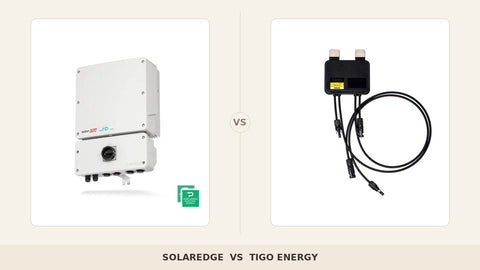
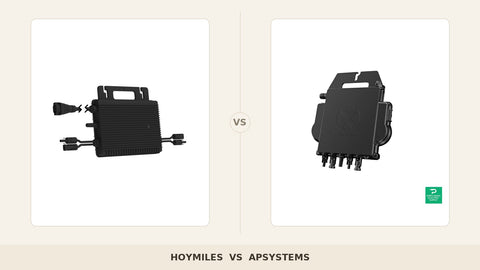
Two different answers to the same problem: how do you get module-level control without paying Enphase prices? SolarEdge says put a DC optimizer under every panel and keep one brain — the string inverter — on the wall. Hoymiles says put the brain on the roof too, but make one microinverter serve four panels. We've designed, sold, and serviced both architectures, and the right answer depends on your roof's shade, your storage plans, your appetite for roof work, and how you feel about single points of failure. This is the distributor-level teardown with real math.
Below: verified spec classes, NEC 690.12 rapid-shutdown comparison, branch-circuit breaker and wire sizing, shading yield math, reliability analysis, monitoring, battery paths, warranty fine print, and field notes from installs and service calls. Specs reflect the current North American lines — SolarEdge P/S-Series optimizers with Home Hub / HD-Wave inverters, and Hoymiles HMS-4T series — but confirm the exact model datasheet before permitting.
Why This Matchup Matters in 2026
Enphase owns the premium microinverter tier so completely that the real contest in module-level power electronics is for second place — and it's this one. SolarEdge pioneered the optimizer-plus-string architecture and still sets the pace on monitoring depth and ecosystem polish. Hoymiles built its name on 4-in-1 microinverters that slash per-watt hardware cost by quadrupling up the inputs, and the HMS-4T series has become the default value alternative to IQ8s across our residential kit business.
The 2026 context rewards both. Module-level rapid shutdown under NEC 690.12 is effectively universal, which means the "string inverters are cheaper" argument died — every architecture now buys module-level hardware. The residential tax credit expiring at the end of 2025 squeezed budgets, pushing value buyers toward Hoymiles' cost structure. And module-level monitoring went from luxury to expectation: insurers, financiers, and homeowners all want per-panel data now.
Side-by-Side Specification Table
| Specification | SolarEdge | Hoymiles |
|---|---|---|
| Architecture | DC optimizer per module + central string inverter (DC-to-DC at the panel) | AC microinverter — 4-in-1 design, four modules per unit with independent MPPTs |
| Current Lineup | P/S-Series optimizers + Home Hub or HD-Wave inverters (3.8–11.4 kW residential) | HMS-1600/1800/2000-4T-NA (1,600–2,000 VA peak, four inputs per unit) |
| System Efficiency (class) | ~97.5–99% combined (optimizer + string inverter) | Up to 96.7% CEC efficiency; 99.8% MPPT efficiency |
| Rapid Shutdown (NEC 690.12) | SafeDC — optimizers drop to ~1 V per module on shutdown | NEC 2017/2020 690.12 compliant (module-level shutdown inherent to micros) |
| Warranty | 12 years string inverter (paid extension to 20/25); 25 years optimizers | 25 years (NA-channel HMS-4T series) |
| Monitoring | SolarEdge portal/app — per-panel, built into inverter | S-Miles Cloud via DTU gateway (Sub-1G wireless) — gateway required |
| Grid-Down Operation (No Battery) | No daylight backup — requires battery to operate during an outage | No — grid-following microinverter, requires grid signal |
| Battery Integration | DC-coupled (SolarEdge Home Battery) or AC-coupled third party | AC-coupled third-party storage compatible |
| Single Point of Failure | String inverter failure takes the whole array down | One failed 4-in-1 micro costs up to four panels (vs one for 1-in-1 designs) |
| Typical Equipment Cost | ~$0.10–0.20/W below Enphase on typical residential BOM | Value tier — typically well below Enphase $/W on residential BOM |
The architecture row deserves a slow read because everything downstream follows from it. SolarEdge keeps high-voltage DC on the roof and converts to AC once, on the wall, at ~99% class inverter efficiency — the most electrically efficient module-level architecture available. Hoymiles converts to AC at the panel, four modules at a time, which eliminates the central inverter entirely and moves every failure domain onto the roof. Neither is wrong, and neither is going away. They optimize different things.
Architecture Deep Dive: Optimizers vs 4-in-1 Micros
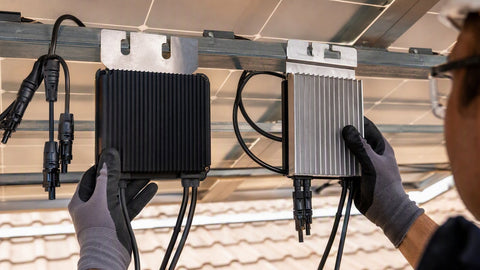
SolarEdge's optimizer does one job: maximum-power-point tracking at the module, then passing fixed-voltage DC down to the inverter. Because the inverter handles the actual grid conversion at wall-mounted scale, SolarEdge can build it bigger, more efficient, and more serviceable than any roof-bound electronics. Shade one panel and its optimizer re-tracks without dragging the string — the output penalty stays confined to the shaded module. When something fails, the part on the wall is a swap with two screws and a plug; the parts on the roof (optimizers) fail rarely and carry 25-year warranties.
Hoymiles' 4-in-1 micro does everything at the roof: four independent MPPTs, four DC-to-AC conversions, one enclosure. The efficiency penalty versus SolarEdge's combined ~98% class is real but modest — about a percent and change of harvest. The reliability trade cuts both ways: there's no wall unit to take the array down, but when a 4-in-1 fails, you lose four panels until the swap, and the swap happens on the roof under the modules, which means a crew, a lift, and racking work. On balance we've found Hoymiles failure rates low enough that the math works — but budget the roof access when it happens.
One design freedom worth naming: because micros don't need string voltage math, Hoymiles arrays handle weird roofs gracefully — one panel on a dormer, three on a garage, the rest on the main face. SolarEdge handles the same roofs with optimizer flexibility, but string-count minimums (typically 6–8 modules per string on residential units) still shape the layout. For genuinely fragmented roofs, micros win on simplicity.
NEC 690.12 Rapid Shutdown: Compared
| RSD Element | SolarEdge | Hoymiles |
|---|---|---|
| Shutdown mechanism | SafeDC — optimizers drop output to ~1 V per module on AC loss | Inherent — micros stop exporting on grid loss; DC conductors de-energize at the module |
| Initiation device | Inverter AC disconnect / dedicated initiator | AC branch disconnect |
| Listing path | UL 3741 PVRSS with listed optimizer pairs | UL 1741 / PVRSE microinverter compliance |
| Extra BOM cost | None — RSD is native to every optimizer | None — RSD is native to every micro |
| Inspector experience | Universally accepted; placard per 690.56(C) | Universally accepted; placard per 690.56(C) |
Both architectures treat rapid shutdown as a native feature rather than a bolt-on, which is why both dominate permit approvals while plain string systems scramble to add TS4s. If you're comparing either of these against a bare string inverter, remember to price the string system's RSD hardware into the BOM — it closes most of the apparent cost gap.
NEC Branch-Circuit and Breaker Sizing
The AC side for representative systems on 240 V service, per NEC 690.8's 125% continuous rule, NEC 240.6(A) standard breaker ratings, and 75 °C copper from Table 310.16.
| System | Max Continuous Current | × 1.25 | Breaker (240.6(A)) | Copper, 75 °C (310.16) |
|---|---|---|---|---|
| SolarEdge SE3800H (3.8 kW) | 15.8 A | 19.8 A | 20 A | 12 AWG (240.4(D) cap 20 A) |
| SolarEdge SE7600H (7.6 kW) | 31.7 A | 39.6 A | 40 A | 8 AWG (50 A @ 75 °C) |
| SolarEdge SE10000H (10 kW) | 41.7 A | 52.1 A | 60 A | 6 AWG (65 A @ 75 °C) |
| Hoymiles 3 × HMS-2000-4T (12 panels) | 25.0 A | 31.3 A | 35 A | 8 AWG (see note) |
| Hoymiles 5 × HMS-2000-4T (20 panels) | 41.7 A | 52.1 A | 60 A | 6 AWG (65 A @ 75 °C) |
Notes electricians ask us about: the Hoymiles rows assume 8.3 A max continuous per HMS-2000 unit on a shared AC branch — 3 units share 25.0 A, and while 10 AWG at 30 A tempts, 240.4(D)'s 30 A cap leaves no headroom above the 31.3 A requirement, so step to 8 AWG. And the same 120%-rule trap from every matchup applies: anything over a 40 A backfeed needs a derated main or line-side tap on a standard 200 A panel. Full conductor charts: NEC wire sizing guide.
Shade and Yield Math
Both architectures confine shade losses to the shaded module — that's the entire point of module-level electronics. Where they differ is harvest efficiency and granularity. Worked example: 8 kW array, 20 modules, one chimney shadow covering 2 modules for 2 hours/day (~10% of daily irradiance window on 10% of modules):
| Metric | SolarEdge | Hoymiles |
|---|---|---|
| Shade loss confined to | 2 shaded modules only | 2 shaded modules only |
| Daily harvest impact | ~1% of daily kWh | ~1.1% of daily kWh |
| Annual difference (8 kW, 1,400 kWh/kWp) | baseline | ~100–150 kWh less — efficiency-class gap |
| 25-yr cumulative difference | — | ~2.5–3.5 MWh (~$375–525 @ $0.15/kWh) |
Three megawatt-hours over 25 years is the honest price of Hoymiles' lower equipment cost — and on most quotes the upfront savings exceed it several times over. Heavy-shade roofs flip the framing: when 40% of modules see daily shade, module-level harvest dominates every other design variable and both of these brands bury any string-only alternative. Compare against the micro tier in Enphase vs SolarEdge and Enphase vs Hoymiles.
Reliability and the Single-Point-of-Failure Question
This is the argument that never dies on installer forums, so here's our service-desk data in plain terms. SolarEdge's wall inverter is a real single point of failure — when it dies, the array is dark until the swap. But the swap is a ground-level, one-tech, one-hour job with a part that ships domestically, and the optimizers themselves almost never fail. Hoymiles spreads risk across the roof: a dead micro costs up to four panels, the array keeps producing otherwise, but the repair needs roof access, racking disassembly, and two techs. Over a 25-year horizon, expect one to two service events on either architecture. SolarEdge's cost less per event; Hoymiles' cost less production per event. Neither outcome is scary, and both beat the old string-inverter-only world on visibility alone.
Monitoring and Data
SolarEdge's portal is the deepest residential monitoring in the business short of Enphase — per-panel production curves, fault alerts, consumption metering with the right hardware, and an installer fleet view we use daily. Hoymiles' S-Miles Cloud does the essentials through the DTU gateway (Sub-1G wireless to the micros): per-module data, alerts, and clean homeowner app. The gap is polish and ecosystem, not capability. Both satisfy insurers and financiers asking for module-level production data; both are in the monitoring collection with their gateways and meters.
Battery Paths
SolarEdge's DC-coupled Home Battery path keeps the solar-to-battery conversion losses low and integrates cleanly with the Home Hub inverter — the elegant option if storage is planned from day one. AC-coupled third-party batteries work fine too. Hoymiles micros are storage-agnostic: any AC-coupled battery — from the battery storage collection or energy storage lineup — pairs without touching the solar side, which makes Hoymiles the easy retrofit choice when the battery decision comes years after the array. Neither offers battery-free backup like Enphase's sunlight-backup or Fronius PV Point; during an outage without storage, both go dark. Size the storage side with the battery sizing guide and runtime calculator, and see the battery buyer's guide for the chemistry decisions.
Warranty Structures, Read Carefully
SolarEdge splits the warranty: 25 years on optimizers, 12 years on the string inverter with paid extensions to 20 or 25. Buy the extension — the wall unit is the serviceable part, and the extended term converts a mid-life failure into an RMA instead of an invoice. Hoymiles' NA-channel HMS-4T carries 25 years across the board, which on paper is the better document. The practical difference is service logistics: SolarEdge's US operation is larger and faster on parts; Hoymiles' support has matured rapidly and handles claims through the distributor channel — which, when you buy from us, means we handle it. Register either system at commissioning.
Grid Functions and Interconnection
Both brands carry the current smart-inverter listings — UL 1741 SB / IEEE 1547-2018 — with the volt-var and ride-through functions that Rule 21 and HECO territories require. SolarEdge exposes grid profiles through SetApp commissioning with clean US regional defaults; Hoymiles configures through the DTU and S-Miles toolkit, which took an extra firmware step on our early installs and has smoothed out considerably in current production. Both pass utility witness tests without drama in our territory. One practical note for AHJs that ask: bring the inverter's exact interconnection listing page to the inspection — both manufacturers publish model-specific certificates, and the five minutes it takes to download them beats a re-inspection fee.
Commercial and Scaling Notes
SolarEdge scales into light commercial with three-phase inverters and the same optimizer architecture — a genuine advantage for customers who might expand from a house array to a barn or workshop later. Hoymiles' 4-in-1 micros scale by addition: more panels, more micros, longer trunk runs, no central equipment to outgrow. For small commercial roofs with complex geometry, we've had good results with Hoymiles on the awkward faces and string inverters on the clean ones — architectures aren't religions, and mixing them across separate services is normal practice.
Field Notes: Installs and Service Calls
I've hung both architectures on roofs. SolarEdge installs feel conventional — rack, clamp, wire strings, hang the inverter, commission from the ground. The optimizer mapping step (scanning serials into the layout) takes twenty minutes and pays for itself the first time a panel underperforms. Hoymiles installs are faster electrically — trunk cable, no string math, no inverter wall — and the DTU gateway commissions from the kitchen. The HMS-4T units are compact enough to sit under the array without shading issues.
Service reality: our SolarEdge RMAs have been wall units, ground-level, quick. Our Hoymiles service events have been rare but roof-bound — budget a half-day with racking tools. One Hoymiles-specific note from a rainy Oregon install: torque the trunk-cable connectors and cap every unused port. Water in an AC trunk connector is a ground-fault hunt nobody enjoys. And on SolarEdge, keep the inverter's firmware current — several field quirks we've chased were fixed in firmware before we finished diagnosing them.
Cost and Availability in 2026
On a typical 8 kW residential BOM, Hoymiles lands in the value tier — clearly below SolarEdge, which itself sits $0.10–0.20/W below Enphase. The gap between Hoymiles and SolarEdge on equipment alone runs several hundred dollars at this size; SolarEdge claws some back with faster ground-level service and deeper monitoring. Both are in real US inventory with normal lead times — the 2026 tariff storm hit modules far harder than power electronics. Check the SolarEdge collection (including the SE3800H Home Hub unit and power optimizers) and the Hoymiles collection for live stock, or price a full BOM on the quote page.
Resale, Financing, and the Paperwork Angle
Module-level monitoring has quietly become a financing and resale asset. Lenders and insurers increasingly ask for per-panel production data when underwriting solar loans or homeowner policies, and both of these systems produce it from day one. Home buyers touring a house with solar ask two questions — "how much does it produce?" and "what happens when something breaks?" — and a monitoring link plus a 25-year warranty answers both better than any spec sheet. Keep the commissioning report, the registration confirmation, and the monitoring login with your closing documents; the house sells easier.
Choose SolarEdge If / Choose Hoymiles If
After years of commissioning and servicing both, our summary is short: SolarEdge concentrates complexity on the wall where service is cheap; Hoymiles distributes it across the roof where failures are rare but access costs. Both of these will produce module-level data, confine shade losses, and satisfy every inspector we work with. The choice is about where you want the complexity — on the wall or on the roof — and how much monitoring polish you value. Here's our counter framework.
Choose SolarEdge if: you want the deepest monitoring and the most serviceable failure domain (ground-level swaps); a DC-coupled battery is in the plan; the roof is large with clean string geometry; or you value the longest track record in module-level power electronics. The inverter buyer's guide frames it against the whole field.
Choose Hoymiles if: equipment budget rules; the roof is fragmented into odd faces and one-off panels; you want 25-year warranty across every component with no extension purchase; or the project is a retrofit where AC coupling keeps future storage simple. The micro vs string guide and inverter top picks add context, and both architectures drop into our complete kits.
Frequently Asked Questions
Which is more efficient, SolarEdge or Hoymiles?
SolarEdge. The optimizer-plus-string architecture converts DC to AC once at ~99% class inverter efficiency, for ~97.5–99% combined system efficiency. Hoymiles HMS-4T micros run up to 96.7% CEC. The gap is roughly a percent of harvest — about 2.5–3.5 MWh over 25 years on an 8 kW array — real, but smaller than the equipment price gap.
Do both meet NEC 690.12 rapid shutdown?
Yes, natively. SolarEdge optimizers drop to ~1 V per module on shutdown (SafeDC); Hoymiles micros stop exporting on grid loss, de-energizing module-level conductors. Neither requires additional rapid-shutdown hardware, unlike bare string inverters.
What happens when one fails?
SolarEdge: the wall inverter is a single point of failure — the array goes dark until a ground-level one-hour swap. Hoymiles: a failed 4-in-1 micro costs up to four panels, the rest of the array keeps producing, but the repair needs roof access and racking disassembly. Expect one to two service events over 25 years on either.
Which has the better warranty?
Hoymiles HMS-4T carries 25 years across the board in the NA channel. SolarEdge warrants optimizers for 25 years but the string inverter for 12, extendable to 20/25 for a fee — buy the extension. On paper Hoymiles wins; in practice SolarEdge's larger US service operation moves parts faster.
Can either work during a grid outage without a battery?
No. SolarEdge requires a battery for backup operation, and Hoymiles micros are grid-following — they need a grid (or a grid-forming battery) to produce. If battery-free daylight backup matters, look at Enphase sunlight backup or Fronius PV Point instead.
Which is cheaper?
Hoymiles, clearly — typically the lowest-cost path to module-level electronics on a residential BOM, running several hundred dollars below SolarEdge at 8 kW scale, which itself sits $0.10–0.20/W below Enphase. Factor SolarEdge's faster, ground-level service and deeper monitoring into the lifetime math.
Sources & Standards
- SolarEdge Home Hub / HD-Wave datasheets and US warranty terms (solaredge.com)
- Hoymiles HMS-4T-NA series datasheet and North America warranty (hoymiles.com)
- NEC 2023 Articles 690.8, 690.12, 690.56(C), 705.12, 240.4(D), 240.6(A) and Table 310.16
- UL 1741 / IEEE 1547-2018 interconnection standards; UL 3741 PV hazard control
- California Energy Commission inverter efficiency listings