Hoymiles vs APSystems (2026): Value Microinverter Platforms Compared
Multi-module microinverters head-to-head: MPPT architecture, monitoring hardware, warranty mechanics, rapid shutdown, and the per-watt math that's quietly reshaping residential solar economics.
Enphase invented the modern microinverter and still owns the premium tier, but a growing share of our residential and light-commercial quotes now come down to a different fight: Hoymiles versus APSystems. Both are bankable, globally deployed manufacturers offering multi-module microinverters — one unit serving two or four panels — at per-watt prices well below the premium incumbent. We've deployed both on real roofs, and the headline is that the reliability gap with the big brand has closed to the point where the decision rides on architecture, monitoring preferences, and installer familiarity, not fear.
This comparison covers the current single-phase residential platforms: Hoymiles' HMS series (the HMS-2000-4T four-module unit and its two-module siblings) against APSystems' DS3 and QS1 lines and the QT2 for 208V three-phase commercial work. We'll walk MPPT architecture, output and voltage compatibility, trunk cable and commissioning differences, monitoring ecosystems, rapid-shutdown compliance, warranty mechanics, and installed cost per watt — the six things that actually separate these platforms on a roof. Where a spec matters more than marketing, we say so; where the brands are truly interchangeable, we say that too.
| Category | Hoymiles HMS Series | APSystems DS3 / QS1 / QT2 |
|---|---|---|
| Flagship residential unit | HMS-2000-4T: ~2,000 VA, 4 module inputs | QS1: ~1,200 VA, 4 module inputs; DS3: ~880 VA, 2 inputs |
| Independent MPPTs | 4 (one per input on the 4T) | DS3: 2 independent; QS1: 2 independent shared across 4 inputs; QT2: 4 |
| Grid voltage | Single-phase 240V (split-phase) residential | DS3/QS1: 240V split-phase; QT2: 208V three-phase |
| Module compatibility | High DC input current per channel for modern 400–550W+ modules | DS3 series rated for high-current modules; check per-datasheet limits |
| Monitoring gateway | DTU (Sub-1G wireless to micros, Wi-Fi/Ethernet to cloud) | ECU (Zigbee to micros, Wi-Fi/Ethernet to cloud) |
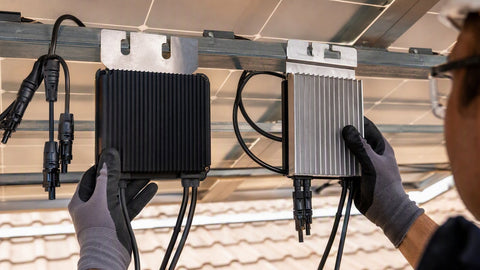
| Trunk cable | Proprietary daisy-chain trunk; compact connectors | Proprietary trunk; QS1/QT2 reduce unit count per string |
| Rapid shutdown | Module-level shutdown compliant with NEC 690.12 | Module-level shutdown compliant with NEC 690.12 |
| Warranty | 25 years on current HMS residential units | 25 years with registration (verify current terms) |
| Street price per watt (equipment) | ~$0.18–$0.24/W | ~$0.20–$0.28/W |
The MPPT row is the one to understand before anything else. Maximum power point tracking is the microinverter's job of extracting the most watts from each panel as shade, temperature, and soiling shift through the day. Four independent MPPTs (HMS-2000-4T) means each panel is tracked alone — a chimney shadow on panel two never touches panels one, three, and four. QS1's architecture shares two MPPTs across four module inputs, pairing modules under each tracker. In full sun on a clean roof, you'll never measure the difference. On a shaded or multi-orientation roof, independent per-module tracking is worth real kilowatt-hours over a year — typically a few percent on compromised roofs, nearly zero on unshaded ones.
We put an HMS four-module unit on a roof with a nasty 3 p.m. chimney shadow, and the monitoring told the story: three panels cruising at full output while the fourth dipped and recovered, no interaction. That's the architecture working as designed. On a wide-open south roof, we'd happily install either platform and expect identical production within measurement noise.
Multi-module micros change the design math versus one-per-panel systems. Fewer units means fewer trunk-cable taps, fewer roof penetrations, and faster installs — but it also means the unit count follows the panel count in fours, and a failed unit takes four panels offline instead of one. That last point cuts both ways: fewer units means fewer failure points statistically, but each point is four times bigger. In practice, with 25-year warranties on both brands, we treat it as a wash and design for layout efficiency.
| Array Size | Hoymiles Path | APSystems Path | Branch Circuit Notes |
|---|---|---|---|
| 8 panels (~3.6 kW) | 2× HMS-2000-4T | 2× QS1 or 4× DS3 | Single 20A 240V micro branch either way |
| 16 panels (~7.2 kW) | 4× HMS-2000-4T | 4× QS1 or 8× DS3 | Watch 20A branch limits; may split into two branches |
| 24 panels (~10.8 kW) | 6× HMS-2000-4T | 6× QS1 | Two or three branches; combine in a subpanel |
| Commercial 208V 3-phase (~25 kW) | Hoymiles three-phase solutions (verify current line) | QT2 native 208V three-phase | APSystems has the cleaner native 208V answer today |
Branch-circuit sizing follows NEC 690.8 and the platform's per-branch unit limits: microinverter output is continuous duty, so conductors and breakers size at 125% of maximum continuous output current. A 20A 240V micro branch (12 AWG copper, per NEC 310.16 and 240.4(D)) typically caps at a published number of units per string — respect the manufacturer limit, because it's the interaction of inrush and thermal behavior, not just arithmetic. Our wire ampacity chart and the solar wire and cable guide cover the conductor side; the NEC 690 disconnect and overcurrent guide covers the interconnection side, including the 120% busbar rule that sizes your backfeed breaker.
The 120% rule still applies to microinverter arrays
A 10.8 kW microinverter array backfeeds about 45 amps at 240V, needing a 60A breaker and a busbar with 60A of 120%-rule headroom. On a 200A panel that's usually fine; on a 100A or heavily loaded 125A panel, it can force a derate of the main breaker or a panel upgrade. We've watched micro-inverter quotes die at the panel schedule — check NEC 705.12 math before you order twenty-four panels of anything. Our NEC compliance guide walks the busbar arithmetic.
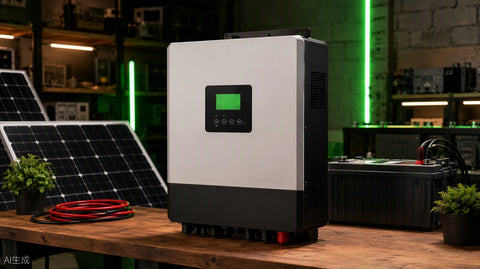
Both platforms ship a gateway that talks to the micros over a local radio link and to the cloud over your internet. Hoymiles' DTU uses Sub-1GHz radio — better wall penetration, longer range from roof to utility room. APSystems' ECU uses Zigbee at 2.4GHz — a mature mesh protocol, but 2.4GHz attenuates faster through stucco and foil-faced sheathing, so gateway placement matters more. Field rule we follow on both: put the gateway inside, near a window-facing wall below the array if possible, and verify per-unit signal strength during commissioning before the crew leaves the driveway.
Commissioning flow is similar: scan the unit serials into the installer app, map them to a virtual layout matching the roof, verify every unit reports, then confirm production at the panel level with a clamp meter against the gateway's claimed output. We clamp every new microinverter system before we call it done — a string reading 20% low on day one is a mapping or connectivity problem you fix for free that afternoon, or a truck roll you eat later. Both apps (Hoymiles S-Miles and APSystems EMA) give owners per-panel production, historical curves, and fault alerts; both are functional and neither is the reason to choose a platform. Enphase's Enlighten remains the polish benchmark if monitoring UX is your top priority — our Enphase collection serves that tier.
Microinverters live in the worst environment in the electrical world: bolted under a black panel, cycling 60°F to 150°F daily, for twenty-five years. Both brands eliminated electrolytic capacitors in their current generations — the component that killed first-generation micros — in favor of film capacitors and fully potted electronics. Field failure rates on current-generation units from both brands run low; the horror stories you read trace to pre-2019 hardware or install errors (water in connectors, usually — dielectric grease and fully seated trunk connections are religion on our jobs).
On warranty: both offer 25-year terms on current residential units, which matches the panels above them. The mechanics differ from the premium incumbent mainly in labor coverage — read whether the warranty includes labor reimbursement for the replacement truck roll, because the micro is $200 and the labor to swap it is $400. Register the system at commissioning; both brands tie full warranty terms to registration, and an unregistered system can default to a shorter base term. Keep the commissioning report with the per-unit serial map — the day a unit fails in year nine, that map turns a two-hour diagnostic into a twenty-minute swap.
One more reliability nuance worth knowing: thermal design. The four-module units run more silicon under one potting shell than two-module units, and both brands engineered for it — but unit placement on the roof still matters. A micro mounted per the installation manual (off the module backsheet, in the airflow gap the racking provides) runs measurably cooler than one strapped tight to a hot module. The manuals specify the mounting for a reason, and the reason is capacitor life. Follow the mounting diagram exactly and either brand's hardware will outlive most of the roofs under it.
| Cost Line (16-panel, 7.2 kW residential) | Hoymiles Path | APSystems Path | Premium 1-per-panel Tier (context) |
|---|---|---|---|
| Microinverters | ~$1,300–$1,700 (4 units) | ~$1,400–$2,000 (4× QS1) | ~$2,700–$3,200 (16 units) |
| Gateway (DTU / ECU) | ~$150–$250 | ~$200–$300 | Included in system pricing |
| Trunk cable + accessories | ~$150–$250 | ~$150–$250 | ~$300–$400 |
| Install labor delta (fewer units, faster) | Baseline | Baseline | +$300–$600 typical |
| Electronics subtotal | ~$1,600–$2,200 | ~$1,750–$2,550 | ~$3,300–$4,200 |
That's the value-platform case in one table: $1,500–$2,000 saved on a typical residential array, redeployable into a bigger array, better racking, or a battery down payment. The savings are why these two brands keep winning our quotes week after week. Shop both lines in our microinverter collection, Hoymiles catalog, and APSystems catalog.
Microinverter installs succeed or fail on connector discipline. Both brands' trunk systems use sealed connectors that must seat with a definitive click; a half-seated tap passes the commissioning test on a dry Tuesday and fails on the first rainy Friday. Our crews grease every connection with dielectric, seat until the click, and tug-test each one. Torque the module clamps to the racking manufacturer's spec — typically 10–15 ft-lb depending on the rail — and document the trunk routing so the next tech on the roof isn't guessing which cable feeds which unit.
Roof layout deserves one design pass before any hardware ships. Keep units off the ridgeline (hottest spot on the roof), maintain the fire-setback pathways your AHJ requires (IRC R324 and local amendments govern ridge and eave pathways), and think about the eventual service call: a micro under a panel three rows deep is a forty-minute swap; one under the middle of a six-row array is a morning. We've done both, and the layout sketch that takes ten minutes in design saves two hours in year nine. Neither brand changes this math — it's racking and layout craft, and it's free at design time.
| Field Check | Pass Criterion | Tool |
|---|---|---|
| Every unit reports to gateway | 100% of serials online before crew leaves | Installer app (S-Miles / EMA) |
| String output vs gateway claim | Clamp reading within ~5% of reported AC watts | True-RMS clamp meter |
| Signal strength per unit | Above the platform's marginal threshold at the gateway's final location | Gateway diagnostics page |
| Rapid shutdown function | Array de-energizes at module level when initiator opens | Physical test with meter verification |
| Serial map saved and registered | Warranty registration confirmed; map stored with homeowner docs | Manufacturer portal |
That five-row checklist is the difference between a system that reports healthy for twenty-five years and one that generates mystery tickets for a decade. It takes less than an hour on a residential roof, it costs nothing but attention, and it's exactly the same discipline for both platforms.
Module-level microinverters make NEC 690.12 rapid shutdown nearly automatic — kill the grid and every panel goes cold at the module boundary, no separate shutdown boxes required. Both brands comply, and both integrate cleanly with the array-level initiator (usually the main service disconnect or a dedicated initiation device, depending on AHJ interpretation). The code items that still require attention:
- NEC 690.8 conductor sizing: 125% continuous multiplier on micro output circuits — the branch math above.
- NEC 705.12 busbar limits: the 120% rule for backfed breakers; load-side taps need engineering.
- NEC 690.13/690.15 disconnects: a lockable AC disconnect within sight of the service in many jurisdictions — we stock options like the DU221RB safety disconnect.
- Grounding and bonding: trunk systems bond the frames through the EGC in the trunk cable; verify with the meter, not the eyeball. Our solar grounding and bonding guide covers NEC 250/690.43 details.
Permitting with either brand is routine — both carry the UL 1741 SA/SB listings and IEEE 1547 compliance documentation AHJs ask for, including grid-support functions (volt-var, frequency ride-through) now required in California, Hawaii, and a growing list of states. Bring the listing documents to plan review and both brands sail through.
Choose Hoymiles if...
Your roof has shade or mixed orientations and you want four fully independent MPPTs per unit, gateway placement is difficult (Sub-1G penetration wins), or the per-watt price difference on your quote is meaningful. The HMS-2000-4T is the most module-per-dollar architecture in residential micros right now.
Choose APSystems if...
You need native 208V three-phase for a light-commercial job (the QT2 is the cleanest answer in the class), your installer knows the ECU/EMA ecosystem, or QS1's proven field record in your market matters more than per-module MPPT granularity. Two-module DS3s also make small arrays and expansions tidy.
Consider the premium tier if...
Monitoring polish, installer network density, and the longest microinverter track record outweigh ~$1,500–$2,000 on a typical residential job. For complex roofs with heavy shade plus consumption monitoring plus battery integration plans, the premium ecosystem still earns its price. Our inverter top-picks roundup and inverter sizing calculator frame the full field, and the hybrid inverter guide covers the battery-ready alternative.
Are Hoymiles and APSystems as reliable as Enphase?
Current-generation units from both brands use film capacitors and potted electronics, and field failure rates have converged with the premium tier. Enphase retains the longest track record and deepest installer network; the value platforms close most of the reliability gap at meaningfully lower cost. Warranty terms are comparable at 25 years — verify labor coverage details either way.
What does "4 MPPT vs 2 MPPT" actually mean for production?
On an unshaded, single-orientation roof: nearly nothing — a percent or less annually. On roofs with shade, multiple orientations, or uneven soiling, four independent trackers (HMS-2000-4T) let each panel produce independently, typically recovering a few percent per year versus shared-tracker architectures. Buy MPPTs for compromised roofs; save the money on clean ones.
How many panels can one microinverter handle?
Hoymiles HMS-2000-4T serves four modules; APSystems QS1 serves four and DS3 serves two. Match module wattage to the unit's DC input current and voltage window on the datasheet — modern 400–550W residential modules pair fine with current units, but always verify the specific pairing, especially with high-current bifacial modules.
Do these work with batteries?
Yes, via AC coupling: microinverter arrays feed the home panel, and an AC-coupled battery (FranklinWH, Powerwall in AC mode, EG4-class systems) charges from that AC bus. This is the standard retrofit path and works with either brand. Our battery sizing and runtime guides cover the storage half of the design.
Who monitors the system — and what if the company disappears?
Both run cloud monitoring through their own apps (S-Miles and EMA) with free homeowner access. Both are large, globally deployed manufacturers — Hoymiles and APSystems each ship in the millions of units — so orphan risk is low by industry standards. Locally, the micros produce regardless of cloud status; monitoring is the only cloud-dependent piece.
Can I mix microinverter brands on one roof?
Electrically yes (they're all grid-following AC sources on the same bus), practically no — you'd run two gateways, two monitoring apps, and two trunk systems. Pick one platform per project. Expansion later with the same brand is trivially easy; that's one of the genuine joys of microinverter architecture.
Build the array around real numbers
Microinverters, panels, racking, trunk cable, and disconnects — with layout help from people who commission these roofs.
Shop microinvertersRelated reading
Sources & standards: manufacturer datasheets for Hoymiles HMS series and APSystems DS3/QS1/QT2 lines; UL 1741 SA/SB and IEEE 1547 listing documentation; NEC 2023 Articles 690, 705, 310.16, 240.4. Ratings and pricing verified against published documentation as of early 2026 — confirm exact module-pairing compatibility, gateway compatibility, and current warranty terms with your distributor before purchase.