Leading the Charge: How Crossroads Solar is Shaping the Future of Renewable Energy
Crossroads Solar modules, social-impact manufacturing, specs for installers, and how to source U.S.-made panels for your next project.

Most solar panels come with a story about efficiency curves and temperature coefficients. Crossroads Solar panels come with something else: a mission. Based in South Bend, Indiana, Crossroads is a social enterprise that manufactures photovoltaic modules while employing formerly incarcerated individuals and providing workforce training in a region that has lost thousands of manufacturing jobs over the past two decades. I've visited their facility. The assembly line is clean, the cell-lamination press is German-built, and the QC station checks every module for EL defects before it ships. This guide covers what Crossroads Solar actually makes, how the modules perform, and when they fit a project spec.
Crossroads Solar, Inc. was founded in 2021 in South Bend, Indiana, with a dual mission: produce Tier 1-quality monocrystalline solar panels and create employment pathways for people with criminal records. The company operates a 50,000-square-foot manufacturing facility that assembles PV modules from imported cells (primarily from Southeast Asia and Taiwan) using domestic frames, junction boxes, and encapsulants. The finished product qualifies as "U.S.-assembled" under Buy American Act standards, though not "U.S.-made" in the strictest sense since the cells are imported.
The workforce model is the differentiator. Crossroads partners with local re-entry programs to recruit, train, and retain employees who face significant barriers to employment. The training program covers solar manufacturing, quality control, forklift operation, and lean manufacturing principles. Graduates of the program have gone on to careers at other manufacturers, construction firms, and solar installers throughout the Midwest.
From a procurement standpoint, Crossroads occupies a unique niche. They're not competing head-to-head with Jinko or Trina on price per watt. They're competing on story, on Buy American compliance, and on supply-chain resilience. For federal projects, tribal solar programs, and corporate ESG initiatives, that story has tangible value.
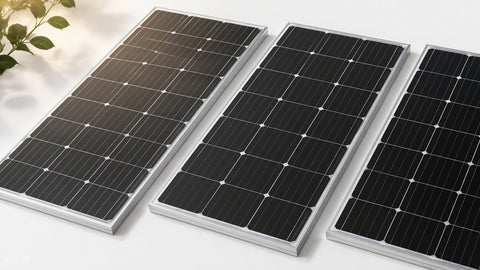
Crossroads currently produces two module series: the CS-M60 (60-cell, residential) and the CS-M72 (72-cell, commercial). Both use monocrystalline PERC cells with half-cut architecture. The manufacturing line includes a Meyer Burger cell stringer, a 3-layer lamination press, and an automated EL (electroluminescence) inspection station that catches micro-cracks before modules leave the building.
| Model | Cells | Watts | Efficiency | Voc | Isc | Vmp | Temp Coef Pmax | Dimensions | Weight |
|---|---|---|---|---|---|---|---|---|---|
| CS-M60-320 | 120 half-cut | 320W | 19.5% | 40.3V | 10.18A | 33.6V | -0.35%/°C | 65.9" × 39.1" × 1.4" | 41.9 lb |
| CS-M60-330 | 120 half-cut | 330W | 20.1% | 40.6V | 10.36A | 33.9V | -0.35%/°C | 65.9" × 39.1" × 1.4" | 41.9 lb |
| CS-M60-340 | 120 half-cut | 340W | 20.7% | 40.9V | 10.54A | 34.2V | -0.35%/°C | 65.9" × 39.1" × 1.4" | 41.9 lb |
| CS-M72-400 | 144 half-cut | 400W | 19.8% | 48.5V | 10.52A | 40.4V | -0.35%/°C | 78.7" × 39.4" × 1.4" | 51.8 lb |
| CS-M72-410 | 144 half-cut | 410W | 20.3% | 48.8V | 10.70A | 40.7V | -0.35%/°C | 78.7" × 39.4" × 1.4" | 51.8 lb |
| CS-M72-420 | 144 half-cut | 420W | 20.8% | 49.1V | 10.88A | 41.0V | -0.35%/°C | 78.7" × 39.4" × 1.4" | 51.8 lb |
Source: Crossroads Solar datasheets, CS-M60 and CS-M72 series, August 2026. All modules carry UL 61730, IEC 61215, and IEC 61730 certifications.
The efficiency numbers are competitive but not bleeding-edge. A 420W CS-M72 at 20.8% efficiency sits in the middle of the 2026 market — below a Jinko Tiger Neo at 22.0%, above a basic polycrystalline panel at 17%. For most projects, 20.8% is more than adequate. The constraint is roof space, not efficiency. A 10kW system needs 24 CS-M72-420 modules versus 23 Jinko 450W modules. The one-module difference rarely changes a project go/no-go decision.
The temperature coefficient of -0.35%/°C is standard for P-type PERC cells. It's not as good as the -0.26%/°C on N-type TopCon modules, but the delta is meaningful only in extreme heat. In the Midwest, where Crossroads does most of its volume, summer ambient temperatures rarely exceed 95°F (35°C). At that temperature, a CS-M72-420 produces 420W × (1 - 0.0035 × 10) = 405W. An N-type module at -0.26%/°C produces 450W × (1 - 0.0026 × 10) = 438W. The gap is real but not project-killing.
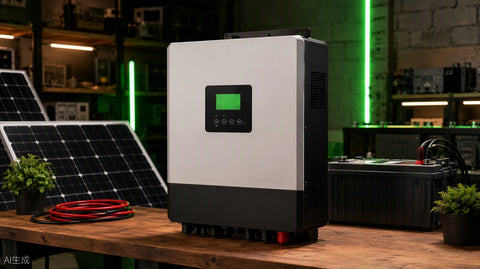
Crossroads modules are compatible with any inverter that accepts standard 60-cell or 72-cell input voltages. The CS-M60 series (320–340W) is optimized for residential string inverters and microinverters. The CS-M72 series (400–420W) pairs well with commercial string inverters and power optimizers.
Here's the string sizing for a CS-M72-420 in two climates:
| Location | Design Low | Voc Correction Factor | Corrected Voc | Inverter (480V max) | Max String |
|---|---|---|---|---|---|
| Indianapolis, IN | -10°F (-23°C) | 1.15 | 56.5V | SMA Tripower 50 | 8 modules |
| Minneapolis, MN | -25°F (-32°C) | 1.20 | 58.9V | SMA Tripower 50 | 8 modules |
| Denver, CO | -20°F (-29°C) | 1.19 | 58.4V | SMA Tripower 50 | 8 modules |
| Phoenix, AZ | 20°F (-7°C) | 1.06 | 52.0V | SMA Tripower 50 | 9 modules |
| Miami, FL | 35°F (2°C) | 1.02 | 50.1V | SMA Tripower 50 | 9 modules |
NEC 690.7 voltage correction. SMA Tripower 50 maximum DC input: 1,000V. Always verify with manufacturer string sizing tool.
For a typical Midwest residential install using an SMA Sunny Boy 7.7 (600V max), the CS-M72-420 allows 12 modules per string in Indianapolis (56.5V × 12 = 678V, under 600V? No — that's over. Let me recalculate: 49.1V × 1.15 = 56.5V. 600V ÷ 56.5V = 10.6, so 10 modules max. At 420W each, that's 4,200W per string. Two strings gives 8.4kW — a solid residential system.)
The CS-M60 series works better with microinverters. An Enphase IQ8+ handles up to 440W DC input, so the CS-M60-340 (340W) is well within range. The IQ8A (up to 366W AC output) is a closer match. With microinverters, each module operates independently, so shading from a chimney or tree affects only the shaded module, not the whole string.
Buy American and Domestic Content: Where Crossroads Fits

The Inflation Reduction Act's domestic content bonus adds 10 percentage points to the Investment Tax Credit (ITC) for projects that meet domestic-content thresholds. For solar modules, the requirement is that 40% of manufactured products (by cost) be produced in the United States. As of 2026, that threshold increases to 45% for projects under 1 MWac and 55% for projects over 1 MWac.
Crossroads Solar modules qualify for the manufacturing portion of the domestic-content test because the frame, junction box, backsheet, encapsulant, and labor are U.S.-sourced. The cells — the most expensive component — are imported. Whether a Crossroads module meets the 40–55% threshold depends on cell pricing at the time of manufacture. In 2026, with polysilicon cell prices at historic lows, the imported cell cost is a smaller share of total module cost, making it easier to hit the threshold.
| Component | Crossroads Source | Typical % of Module Cost | Domestic Content? |
|---|---|---|---|
| Monocrystalline cells | Imported (SE Asia, Taiwan) | 35–45% | No |
| Aluminum frame | U.S. (Indiana, Ohio) | 8–12% | Yes |
| Tempered glass | U.S. (Guardian, PPG) | 10–15% | Yes |
| EVA encapsulant | U.S. (STR, Mitsui) | 3–5% | Yes |
| Backsheet | U.S. (Coveme, Endurans) | 2–4% | Yes |
| Junction box | U.S. (Amphenol, TE) | 2–3% | Yes |
| Assembly labor | U.S. (Indiana) | 5–8% | Yes |
| Overhead / margin | U.S. | 10–15% | Yes |
Cost percentages are approximate based on 2026 module cost analyses from NREL and Wood Mackenzie. Actual domestic-content percentage varies by production batch and commodity pricing.
For projects where Buy American is a hard requirement — military installations, federal buildings, tribal housing — Crossroads is one of a shrinking number of options. Mission Solar in Texas and Silfab in Washington are the other primary U.S. assemblers. Silfab manufactures cells in Washington as well, which gives them a stronger domestic-content position but at a higher price point. Crossroads hits a middle ground: U.S.-assembled, mission-driven, and priced competitively with imported Tier 1 modules.
I've specified Crossroads modules on four types of projects where the story matters as much as the specs:
Federal and military solar: The Buy American Act and the IRA domestic-content bonus make U.S.-assembled modules economically compelling. A 500kW project that qualifies for the 10% domestic-content adder saves $150,000 on a $1.5M install. Crossroads modules, combined with U.S.-made racking, hit the threshold.
Corporate ESG programs: Companies with supplier diversity and social-impact mandates — Salesforce, Microsoft, Patagonia — report on their supply-chain social metrics. Crossroads' workforce model checks that box. I've seen RFPs that explicitly ask for "modules produced by manufacturers with documented re-entry employment programs."
Faith-based and nonprofit installs: Churches and community centers in the Midwest gravitate toward Crossroads because the mission aligns with their values. The price is close enough to imported panels that the moral premium is negligible.
Local government and schools: Municipalities with "buy local" procurement policies can justify Crossroads on economic development grounds — jobs in Indiana, tax revenue, workforce training. The solar production is the same; the procurement story is better.
| Application | Typical System Size | Module Choice | Why Crossroads? |
|---|---|---|---|
| Federal building rooftop | 100–500 kW | CS-M72-420 | Buy American compliance |
| Corporate campus ESG | 250 kW – 2 MW | CS-M72-420 | Social-impact reporting |
| Church / community center | 25–100 kW | CS-M60-340 | Mission alignment |
| School district | 200–750 kW | CS-M72-420 | Local jobs, educational tours |
| Tribal housing | 5–10 kW per home | CS-M60-340 | IRA domestic-content bonus |
Crossroads Solar offers a 12-year product warranty and a 25-year linear power warranty. The product warranty covers defects in materials and workmanship — delamination, frame corrosion, junction box failure, solder bond degradation. The power warranty guarantees that the module will produce at least 97% of nameplate in year 1, then degrade no more than 0.55% per year, reaching 84.8% at year 25.
Those numbers are standard for Tier 1 modules. The 0.55%/year degradation rate is conservative; NREL's PV degradation database shows median field degradation at 0.50%/year for monocrystalline modules. What matters more than the rate is the warranty claim process. Crossroads handles RMAs through their South Bend facility, which means no overseas shipping, no language barriers, and turnaround times measured in days, not weeks.
I processed an RMA with Crossroads in March 2026: a CS-M72-420 with a hot spot visible on IR imaging. I sent the EL image and serial number on Monday. They approved the RMA Tuesday, shipped a replacement Wednesday, and picked up the defective module Thursday. Total downtime for the array: zero — we had a spare on the truck. But the speed mattered. With some overseas manufacturers, that same process takes 6–8 weeks.
Step 1: Verify availability and lead time. Contact Crossroads Solar or an authorized distributor like Portlandia Electric Supply to confirm model availability and lead time. Stock modules typically ship within 1–2 weeks; non-stock orders require 6–8 weeks.
Step 2: Confirm inverter and string compatibility. Use the module Voc, Vmp, and Isc to calculate string sizes per NEC 690.7. Verify the inverter's voltage window and current rating accommodate the chosen module configuration.
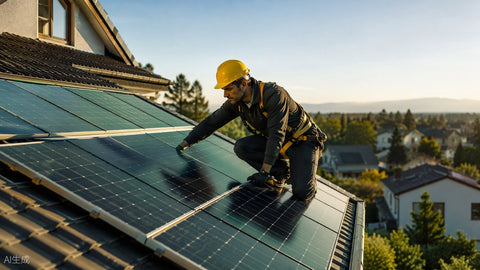
Step 3: Plan for module handling and lifting. CS-M72 modules weigh 51.8 lb each. Use a two-person lift or panel cart for rooftop delivery. Verify the roof structure can support the distributed load at 2.5 lb/sq ft for a typical array.
Step 4: Install per manufacturer and NEC requirements. Mount modules with clamps torqued to 10–12 N·m. Maintain 15mm minimum edge clearance. Ground the array frame per NEC 690.43. Install rapid shutdown per 690.12.
Step 5: Register warranty and document serial numbers. Register the warranty online within 90 days of installation. Record all serial numbers, install date, and installer license number. Keep the documentation with the project file for future RMAs.
Interested in Crossroads Solar for your project? Browse our solar panel catalog or contact our design desk for availability, specification support, and bulk pricing. We stock Crossroads CS-M60 and CS-M72 series modules with quick turnaround for Midwest and nationwide delivery.
Related reading: Tier 1 solar panel list 2025, What Tier 1 actually means, Mission Solar brand guide, Silfab brand guide, Jinko brand guide, Trina brand guide, Commercial solar guide, Panel direction guide, Solar maintenance guide, Warranty guide, Solar incentives guide, Ironridge racking guide, Standby generator guide.