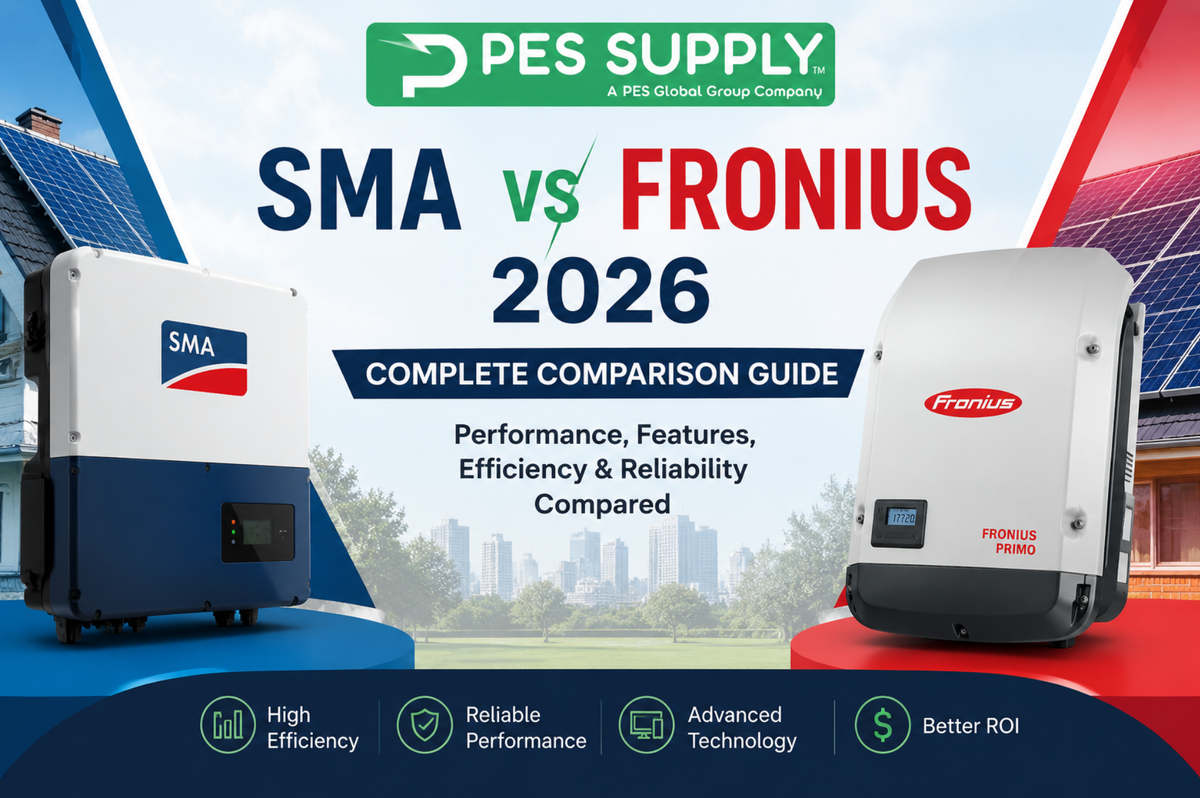
German engineering versus Austrian engineering, transformerless string versus transformerless string, and one decisive difference: Fronius will sell you daylight backup without a battery, and SMA won't. That's the headline in this matchup, but it's not the whole story. We've commissioned both brands on residential and light-commercial jobs for years — SMA Sunny Boy and Smart Energy units, Fronius Primo and GEN24 Plus — and both have earned their reputations as the string inverters that outlive the roof under them. The choice between them comes down to shade strategy, storage plans, heat, noise tolerance, and how much warranty you want to buy.
Below: verified spec classes, the NEC wire-and-breaker table we hand to electricians, a rapid-shutdown comparison, real string-sizing math, efficiency and thermal behavior in the field, warranty fine print, and notes from our own commissioning and service calls. Specs reflect the current residential classes; confirm the exact model datasheet before you permit, because both manufacturers revise quietly.
Why This Matchup Matters in 2026
The string-inverter market consolidated hard. Enphase owns the microinverter tier, SolarEdge owns the optimizer tier, and the premium string tier is essentially this fight — SMA and Fronius — with value challengers like Growatt and EG4 pressing from below. Meanwhile the rules changed underneath everyone: NEC 690.12 module-level rapid shutdown is now effectively universal across US jurisdictions, which means every string-inverter install carries module-level electronics anyway, and the old "string inverters are simpler" argument lost most of its force.
What didn't change: a well-designed string system is still the cheapest reliable way to convert DC to AC, still serviceable by any competent electrician, and still the architecture we recommend for unshaded roofs with simple geometry. Both of these brands do it superbly. They just do it with different philosophies — SMA bets on software and passive silence, Fronius bets on active cooling and backup flexibility.
Side-by-Side Specification Table
| Specification | SMA | Fronius |
|---|---|---|
| Topology | String inverter (transformerless), German engineering since 1981 | String inverter; GEN24 Plus adds native hybrid (battery-ready) |
| Output Range | Sunny Boy 3.0–6.0 kW single-phase class; Smart Energy hybrid 3.8–7.7 kW class; Tripower commercial | Primo 3.0–8.2 kW single-phase; Symo three-phase; GEN24 Plus hybrid 3.0–10.0 kW class |
| Peak Efficiency | Up to ~98.4% peak (Sunny Boy class) | Up to ~98.2% peak |
| Shade Management | ShadeFix — software shade management without per-module hardware | Dynamic Peak Manager (MPPT software); Tigo TS4 compatible for module-level |
| Battery Path | High-voltage battery via Smart Energy hybrid or AC-coupled third party | High-voltage battery via GEN24 Plus (BYD Battery-Box class) or AC-coupled |
| Backup Without Battery | No battery-free backup outlet on standard models | PV Point — up to ~3 kW daylight backup outlet without a battery (GEN24) |
| Cooling | Passive (silent) | Active fan cooling (audible; superior thermal derating in heat) |
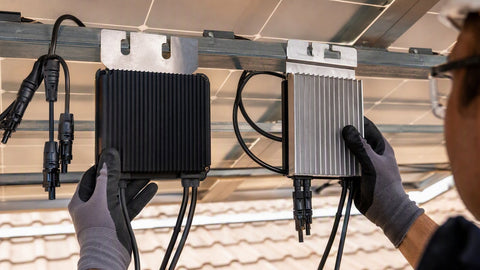
| Rapid Shutdown Path | SunSpec PLC via JMS-F-V2 module (600 W class) | NEC 690.12 via Tigo TS4-A-F/A-O pairing |
| Monitoring | Sunny Portal + Smart Connected proactive service | Solar.web portal/app |
| Warranty | 5 years standard (extendable to 10/15/20 paid) | 5–10 years standard by market (extendable to 20) |
| Typical Price | Mid-premium string tier | Premium string tier |
| Origin | Germany; long US channel presence via distributors | Austria (solar division since 1992) |
Four rows decide most purchases: backup without battery (Fronius wins), cooling and heat behavior (Fronius on output, SMA on silence), shade strategy (a draw with different mechanics), and warranty (both short standard, both extendable — buy the extension either way). The efficiency row is a rounding error; 0.2% of peak is invisible on a utility bill.
Shade Strategy: ShadeFix vs Dynamic Peak Manager
Both brands attack string-level shade with MPPT software rather than per-module hardware, and both work better than skeptics expect. SMA's ShadeFix tracks the global maximum power point through partial-shade conditions instead of settling on a local peak, and on lightly shaded strings — a chimney shadow crossing for an hour — it recovers most of what module-level electronics would. Fronius' Dynamic Peak Manager does the same job with a different algorithm, and in our monitored fleet the two land within a percent of each other on real shade events.
We've tested this claim against our own monitoring fleet, not just the marketing decks.
Here's the honest counter advice: for light, transient shade, both are fine and you save the cost of module-level electronics. For heavy, structural shade — a tree canopy over half the array — stop pretending software fixes physics. Add Tigo TS4 optimizers to the shaded modules (both brands support them; Fronius pairs natively), or go to microinverters from the microinverter collection and be done with it. Our micro vs string guide quantifies the crossover point.
NEC Wire and Breaker Sizing Reference
AC output circuits for the inverter classes in this matchup on 240 V service, per NEC 690.8's 125% continuous rule, NEC 240.6(A) standard breaker ratings, and 75 °C copper from Table 310.16. Match the row to the unit's nameplate maximum continuous output current.
| Inverter Class | Max Continuous @ 240 V | × 1.25 | Breaker (240.6(A)) | Copper, 75 °C (310.16) |
|---|---|---|---|---|
| SMA Sunny Boy 3.8 class | 15.8 A | 19.8 A | 20 A | 12 AWG (240.4(D) cap 20 A) |
| SMA Sunny Boy 6.0 class | 25.0 A | 31.3 A | 35 A | 10 AWG (240.4(D) cap 30 A) — see note |
| SMA Smart Energy / Fronius 7.7 class | 32.1 A | 40.1 A | 45 A | 8 AWG (50 A @ 75 °C) |
| Fronius GEN24 10.0 class | 41.7 A | 52.1 A | 60 A | 6 AWG (65 A @ 75 °C) |
Two notes electricians thank us for. First, the 6.0 kW row: 31.3 A of continuous-adjusted current exceeds the 30 A small-conductor cap in NEC 240.4(D) for 10 AWG, so step up to 8 AWG with a 35 A breaker — the table lists the practical pairing. Second, the 45 A backfeed from the 7.7 kW class breaks the 120% rule on a standard 200 A/200 A panel (40 A allowed); plan a 175 A main derate or a line-side tap. Full conductor charts live in our NEC wire sizing guide.
Rapid Shutdown: NEC 690.12 Paths Compared
| RSD Element | SMA | Fronius |
|---|---|---|
| Architecture | SunSpec PLC transmitter + JMS-F-V2 module-level devices | Tigo TS4-A-F (shutdown) or TS4-A-O (shutdown + optimization) |
| Module-level hardware | One JMS-F per module (600 W class) | One TS4 per module (or per pair, by model) |
| Initiation | AC loss / dedicated initiator | AC loss / dedicated initiator |
| Certified listing | UL 3741 / PVRSS with listed pairs | UL 3741 / PVRSE with Tigo |
| Added BOM cost (8 kW class) | ~$600–900 | ~$700–1,000 |
Both paths pass inspection across our service territory. SMA's SunSpec PLC approach keeps the shutdown signaling inside SMA's ecosystem and commissions cleanly; Fronius' Tigo pairing doubles as an optimization and monitoring upgrade path, which is why we lean Fronius-plus-TS4 on anything with even moderate shade. Either way, budget the module-level devices — 690.12 isn't optional anywhere we install anymore.
String Sizing Math: A Worked 8 kW Example
Assumptions: 430 W class modules, Voc ~49.5 V, Vmp ~41 V, design low temperature −10 °C (Voc correction ≈ +10%), inverter MPPT window roughly 90–550 V class on both brands. Verify against the exact inverter datasheet — the MPPT range and max input current vary by model.
| Design Step | Calculation | Result |
|---|---|---|
| Modules for 8 kW DC | 8,000 ÷ 430 | 19 modules (8,170 W) |
| String split (2 MPPTs) | 10 + 9 | Two balanced strings |
| Cold-corrected Voc, 10-module string | 10 × 49.5 V × 1.098 | ~543 V — under 600 V residential cap |
| Hot-derated Vmp check | 9 × 41 V × ~0.90 (hot) | ~332 V — comfortably inside MPPT window |
| DC/AC ratio vs 7.7 kW inverter | 8.17 ÷ 7.7 | 1.06 — minimal clipping, ideal for value |
That last row is where we see DIY designs go wrong in both directions. Oversizing the array to 1.4:1 on a premium string inverter buys you clipping losses at noon and voids nothing, but it wastes panel money; undersizing to 1.0:1 in a cloudy climate leaves inverter capacity idle. For most US sites, 1.1–1.3:1 is the sweet spot, and both SMA and Fronius tolerate it happily. Model it in the system size calculator before you commit, and cross-check the production estimate against the kits buyer's guide BOM math.
Heat, Noise, and the Garage Wall Question
SMA cools passively — no fan, no moving parts, no noise, ever. Mount it next to a bedroom wall and nobody knows it's there. The tradeoff is thermal: under sustained high heat, passively cooled inverters derate earlier. Fronius runs an active fan, holds full output deeper into hot afternoons, and makes a audible hum doing it — roughly refrigerator-class noise that you will notice in a quiet garage.
Our field rule after years of both: hot-climate installs in ventilated garages or exterior walls favor Fronius' thermal headroom; bedroom-adjacent or living-space-adjacent installs favor SMA's silence. Both derate gracefully and both log the event; neither cooks itself. We've replaced exactly zero of either brand for thermal failure.
Storage and Backup: Where Fronius Pulls Ahead
The GEN24 Plus is a native hybrid: add a high-voltage battery (BYD Battery-Box class) at install or years later, and the backup path is already built in. PV Point deserves special mention — a dedicated outlet that delivers up to ~3 kW of daylight power during a grid outage with no battery at all. For a homeowner who wants to keep the fridge and the internet alive through a daytime outage without spending $10,000 on storage, PV Point is the only feature like it in the string-inverter business.
SMA's Smart Energy line answers with its own hybrid path and pairs with high-voltage batteries including the BYD class, and SMA's Sunny Island lineage gives it the deepest off-grid DNA of any brand here — but on standard grid-tied residential units, there's no battery-free backup outlet. If daylight backup matters, that's the decision. For full storage sizing, use the battery sizing guide and backup runtime calculator, and browse the battery storage collection.
Efficiency, Yield, and Real Money
Peak efficiency: ~98.4% SMA, ~98.2% Fronius. CEC weighted numbers sit even closer. Over 25 years on an 8 kW system, the difference between these two inverters is on the order of a few hundred kWh total — call it $50 of electricity. Nobody should pick between these brands on efficiency. Pick on backup capability, noise tolerance, shade strategy, warranty length, and installed price. Both brands' DC-to-AC conversion is as good as string technology gets, and both embarrass the value-tier hybrids we test in the same rack.
Warranty Structures, Read Carefully
Both brands ship with standard terms that are shorter than the panels above them: SMA 5 years standard, Fronius 5–10 by market. Both sell extensions to 15 or 20 years. Our standing advice: buy the extension. An inverter is the one component in the system statistically likely to need service inside 25 years, and a 20-year warranty converts that service call from a $2,000 surprise into an RMA. Both manufacturers' US service operations have answered every claim we've filed — SMA through its Smart Connected proactive monitoring (which often flags a fault before the homeowner notices), Fronius through fast parts logistics. Register the unit at commissioning, whichever brand you choose; unregistered units default to the shortest term. One gotcha we enforce internally: extension pricing in some programs jumps if you buy after the first year of operation, so we quote the 20-year term at the original sale and tell customers to treat it as part of the system price, not an upsell.
Grid Behavior and Interconnection
Both brands carry the full current interconnection listings — UL 1741 SB / IEEE 1547-2018 with the smart-inverter functions (volt-var, frequency ride-through) that utilities in California, Hawaii, and increasingly everywhere require. Rule 21 and HECO approvals are table stakes and both brands hold them. Where they differ is configuration workflow: SMA exposes grid-code settings through the commissioning wizard with sensible US defaults, while Fronius gives the installer more granular control — welcome on tricky weak-grid rural services where voltage rise forces curtailment tuning. On a rural Washington feed last spring, a Fronius unit's volt-var tuning kept an array exporting through afternoon voltage sag that had been tripping the previous inverter weekly.
Field Notes: Commissioning and Service
I've commissioned both, in attics and on garage walls, in July and in January. SMA's commissioning flow is the fastest in the business — the unit self-discovers, the app walks the sequence, and Smart Connected starts watching immediately. Fronius' commissioning wants a few more minutes and a firmware check, but the Solar.web portal gives installers the deeper diagnostic data, and their support line has talked our techs through a grid-voltage anomaly at 4:45 on a Friday more than once.
One installation note that saves callbacks: both brands need clearances. Passive SMA units want their convection airflow — don't bury them in a cabinet. Fronius wants the fan intake unblocked and away from dryer vents; lint-clogged fans are the number-one Fronius service call we see, and they're preventable with thirty seconds of siting thought. Torque the DC terminals to the datasheet spec with an actual torque screwdriver — the number of "inverter faults" that turn out to be a loose MC4 or an under-torqued terminal would embarrass the industry.
Monitoring and Software Ecosystems
SMA's Sunny Portal and Fronius' Solar.web both deliver production dashboards, alerts, and fleet views for installers. The practical differences: SMA's Smart Connected is the more proactive service layer — it watches for fault signatures and opens cases before the homeowner calls — while Solar.web exposes deeper per-string diagnostics that installers love for remote troubleshooting. Both integrate with third-party monitoring hardware in the monitoring and communications collection, and both produce the production reports utilities and SREC aggregators ask for. Neither locks you into a subscription for basic monitoring, which deserves mention in an era when some competitors paywall the dashboard.
Commercial and Three-Phase Notes
Both brands scale past residential. SMA's Tripower line and Fronius' Symo cover three-phase light-commercial roofs, and both support multi-inverter plants with combined monitoring. For small commercial buyers, the deciding factors shift to service response and parts availability rather than backup features — and both brands' US operations stock parts domestically. If the project chases Section 48E domestic-content or FEOC documentation, request the compliance packets with the PO; both manufacturers publish them, and neither German nor Austrian origin trips the FEOC wire.
Availability and the 2026 Supply Picture
Both brands maintain real US inventory through distribution — no container roulette, no tariff chaos of the sort hammering the module market (inverters ride a different tariff schedule, and both companies planned around it). Lead times to our dock run 1–4 weeks for standard residential units. Replacement units and parts ship domestically. In a year when panel procurement turned into a lottery, the inverter wall has been the calm corner of the warehouse.
Choose SMA If / Choose Fronius If
Two premium string inverters, two decades-long track records, and a decision that usually comes down to one feature. After commissioning and servicing both for years, we can count our combined warranty replacements on one hand — whichever you pick, you're buying the boring reliability that makes solar invisible. Here's the counter framework we use when customers ask us to choose for them.
Choose SMA if: silence matters (bedroom-adjacent or living-space mounting); you want the simplest commissioning and proactive fault monitoring; your roof is unshaded and your storage plans are AC-coupled or years away; or you value the deepest off-grid lineage in the business. Browse the SMA collection.
Choose Fronius if: you want battery-free daylight backup via PV Point; a hybrid storage path from day one (GEN24 Plus); superior thermal derating in hot climates; or native Tigo TS4 pairing for shade. See the Fronius collection and the wider inverter lineup.
Adjacent reading: our earlier SMA vs Fronius notes, the inverter top picks roundup, the solar inverter buyer's guide, and Enphase vs SolarEdge for the module-level fight. Both brands drop into our complete solar kits — get a system number on the quote page.
Frequently Asked Questions
Is SMA or Fronius more reliable?
Both are top-tier: decades of field history, US service operations, and failure rates low enough that we replace almost none of either. SMA's passive cooling eliminates the fan as a wear item; Fronius' active cooling eliminates thermal derating. Choose on features, not reliability anxiety.
Can I add a battery later to either inverter?
Yes to both. Fronius GEN24 Plus adds high-voltage batteries natively (BYD Battery-Box class); SMA Smart Energy does the same, and both brands accept AC-coupled third-party storage. The cheapest time to go hybrid is at install; the second-cheapest is with a hybrid-ready unit already on the wall.
What is Fronius PV Point?
A dedicated backup outlet on GEN24 units that delivers up to ~3 kW of solar power during a grid outage — with no battery installed — whenever the sun is shining. It keeps a fridge, router, and a few circuits alive through daytime outages and is unique in the string-inverter class.
Do SMA and Fronius work with microinverters or optimizers?
They're string inverters, so they don't mix with microinverters on the same array. Both pair with Tigo TS4 module-level devices for rapid shutdown and selective optimization; Fronius pairs natively, SMA via its SunSpec PLC ecosystem.
Which is cheaper?
SMA typically lands in the mid-premium string tier, Fronius in the premium tier — a few hundred dollars apart on a residential BOM before the module-level devices both now require under NEC 690.12. The warranty extension, which we recommend on both, narrows the real difference further.
How long do these inverters last?
Field experience says 12–20 years for premium string units with basic care — clear airflow, clean intakes, correct torque on terminals. Both brands sell warranty extensions to 20 years, which is the cheapest insurance in the system given the inverter is the most serviceable component.
Sources & Standards
- SMA Sunny Boy / Smart Energy datasheets and US warranty terms (sma-america.com)
- Fronius Primo / GEN24 Plus datasheets and warranty terms (fronius.com)
- NEC 2023 Articles 690.8, 690.12, 705.12, 240.4(D), 240.6(A) and Table 310.16
- UL 3741 PV Hazard Control and SunSpec rapid-shutdown specifications
- California Energy Commission inverter efficiency listings