Generac vs Cummins Commercial Standby (2026): Liquid-Cooled 36–60 kW Compared
Small-business and estate-scale standby power: engines, enclosures, service networks, paralleling, and the true cost of keeping the lights on when the grid drops.
Once you step past the 26 kW air-cooled class, you leave the residential world behind. Liquid-cooled standby in the 36–60 kW band is where small businesses, medical offices, farms, and large estates live — three-phase options, bigger alternators, real enclosures, and engines designed to run for days, not hours. Two names dominate the quote stack at this size: Generac's Protector and commercial gaseous lines, and Cummins' QuietConnect and C-series liquid-cooled units. We've specced both for customers who literally cannot afford a dark hour — a veterinary surgery and a cold-storage farm among them — and at this wattage the conversation changes from "which is cheaper" to "who answers the phone at 3 a.m."
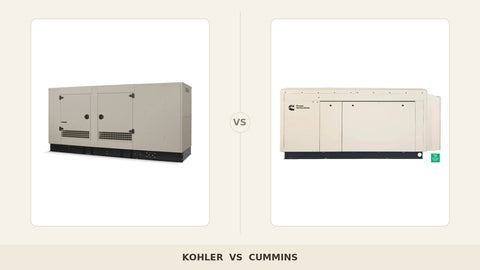
This guide compares the 36–60 kW liquid-cooled gaseous (natural gas / propane) offerings from both brands on the criteria that decide commercial purchases: engine pedigree, electrical performance, sound attenuation, service infrastructure, permitting reality, and ten-year cost of ownership — including the maintenance and load-bank testing line items most quotes conveniently leave out. If you're actually shopping residential air-cooled, our Generac vs Kohler or Generac vs Champion comparisons fit better — this one is for the big pads.
Both manufacturers cover this band with multiple engine options, so the table below reflects representative current models — Generac's gaseous Protector/commercial series and Cummins' QuietConnect/C-series gaseous units. Verify the exact datasheet for your model and fuel before ordering; derates on natural gas versus propane are real at this scale.
| Category | Generac (36–60 kW gaseous) | Cummins (36–60 kW gaseous) |
|---|---|---|
| Engine | Purpose-built Generac inline engines, ~4.5L–6.8L class, turbocharged options | Cummins B-series derived industrial engines, legendary truck/industrial lineage |
| Voltage configurations | Single and three-phase, multiple voltages, field-selectable on many models | Single and three-phase, broad voltage reconnectability |
| Alternator | Brushless, permanent magnet excitation options, <5% THD | Brushless Stamford-type ends, utility-grade regulation |
| Controller | Generac commercial controllers with remote monitoring | PowerCommand control family — the industry benchmark for genset controls |
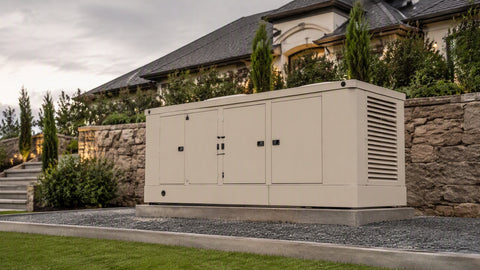
| Enclosure | Aluminum, sound-attenuated levels by package | Sound-attenuated Level 1/2 packages, galvanized or aluminum |
| Sound @ 23 ft (no load) | ~65–72 dB depending on package | ~63–70 dB; QuietConnect packages are genuinely quiet |
| Fuel | NG or LP, field convertible | NG or LP, field convertible |
| Warranty (base) | Typically 2–5 years, extended plans available | Typically 2 years base, extended to 5–10 via plans |
| Equipment street price (48 kW class) | ~$22,000–$30,000 | ~$26,000–$36,000 |
The engine row deserves a pause. Cummins' B-series lineage is the same engine family that powers a generation of Ram trucks and industrial equipment — parts exist on every continent, and any diesel shop on earth can work on one. Generac builds its own engines at this scale too, and their gaseous engines have matured into solid industrial units, but the global parts ubiquity of the Cummins block is a genuine moat. We've sourced a water pump for a Cummins B-series in a farm town on a Saturday morning; the same Saturday for a lesser-distributed engine can turn into a freight order.
The controller row matters more than most buyers realize. Cummins' PowerCommand family comes from the mission-critical world — hospitals and data centers run on it — and its diagnostics, event logging, and paralleling logic reflect that pedigree. Generac's commercial controllers have closed much of the gap for standard standby duty and are arguably friendlier for facilities without a dedicated engineer. If your site has an existing building-management system, both brands offer Modbus/BACnet integration options; have your controls contractor confirm the gateway before ordering, because retrofitting comms cards after delivery adds cost and weeks.
Commercial sizing starts from measured load, not square footage — NEC 220 Article calculations plus actual demand data where the utility provides it. Here's what these wattages mean in practice, and where the sizing decision usually lands:
| Facility Type | Typical Peak Demand | Recommended Class | Notes |
|---|---|---|---|
| Large estate home (6,000–10,000 sq ft, dual HVAC, pool, guest house) | 25–40 kW | 36–48 kW | Single-phase 240V; load-manage HVAC staging |
| Small retail / office (5,000–8,000 sq ft) | 30–45 kW | 48 kW | Three-phase if the service is 208V; verify refrigeration loads |
| Medical/dental office with imaging | 35–55 kW | 48–60 kW | Motor-start kVA on compressors drives the size, not running load |
| Farm shop + residence + well pumps | 30–50 kW | 48–60 kW | Well pump LRA and three-phase motors need headroom |
| Restaurant with walk-in refrigeration | 40–60 kW | 60 kW | Never undersize refrigeration — spoilage dwarfs genset cost |
The motor-start problem is the one that bites at this scale. A 10 HP three-phase compressor pulls six times running current at lock-rotor; if the genset's alternator can't absorb that kVA spike, voltage dips and the whole facility stutters. Both brands publish motor-starting kVA figures per alternator option — check them against your largest motor with everything else already running. Our generator sizing guide covers the residential end of this logic; the commercial version of the math adds NEC 220 demand factors and three-phase balancing.
There's a second sizing trap unique to gaseous commercial units: altitude and temperature derate. Naturally aspirated gaseous engines lose roughly 3–4% of output per 1,000 feet of elevation and additional capacity in extreme heat. A 48 kW nameplate installed at 5,000 feet in a mountain town behaves more like a 40 kW machine on a July afternoon. Both manufacturers publish derate curves, and both brands' quoting tools apply them — but we've seen competing quotes that mysteriously ignored them, making an undersized unit look adequate on paper. If your site sits above 3,000 feet, put the derated capacity in writing on the quote. Turbocharged options from both brands recover much of the altitude loss and are worth the premium at elevation.
Three-phase is a one-way door
If your service is 208Y/120V three-phase, your generator must match it — you cannot feed a three-phase panel from a single-phase unit, and converting later means replacing the genset. We see this mistake on farm jobs where the residence is single-phase and the shop is three-phase: the right answer is usually a three-phase genset with a load calculation proving the single-phase loads balance, not two generators. Confirm the service voltage with the utility in writing before the quote goes out.
Commercial installs cost more per kW than residential because everything scales: bigger feeders, bigger transfer switches (often 400–800A), engineered pads, seismic anchoring in some jurisdictions, and permits with plan review. Here's the honest stack:
| Cost Line | Generac Path | Cummins Path |
|---|---|---|
| Genset, 48 kW gaseous, sound package | $22,000–$30,000 | $26,000–$36,000 |
| Transfer switch, 400–600A SE-rated | $4,000–$9,000 | $4,000–$9,000 |
| Engineered pad, anchoring, siting | $2,500–$6,000 | $2,500–$6,000 |
| Gas service upgrade + piping (large BTU load) | $3,000–$12,000 | $3,000–$12,000 |
| Electrical labor, feeders (350–500 kcmil class), controls | $8,000–$18,000 | $8,000–$18,000 |
| Engineering, permits, utility coordination | $1,500–$5,000 | $1,500–$5,000 |
| All-in installed | ~$41,000–$80,000 | ~$45,000–$86,000 |
Generac typically undercuts Cummins by 10–18% on equipment at this class. Cummins claws some of that back in fuel efficiency and resale value — Cummins-branded gensets hold used-market value noticeably better, the way Cummins trucks do. The feeder and transfer gear don't care about the badge: a 400A ATS is a 400A ATS. We stock 400A+ transfer switches, 200A-class units, and the full ATS range; feeder sizing follows NEC 310.16 with the usual 75°C terminations, and our wire sizing guide covers the ampacity logic if you want to check your electrician's homework.
A 48 kW gaseous genset at half load burns roughly 400–550 ft³/hr of natural gas or 4.5–6 gal/hr of propane — verify your model's published curve. That translates to real money on long outages:
| Load | NG (ft³/hr) | Propane (gal/hr) | 72-hr outage, NG @ $1.20/therm |
|---|---|---|---|
| 25% (12 kW) | ~280–350 | ~3.2–4.0 | ~$240–$300 |
| 50% (24 kW) | ~420–550 | ~4.8–6.2 | ~$360–$475 |
| 75% (36 kW) | ~600–750 | ~6.8–8.5 | ~$520–$650 |
| 100% (48 kW) | ~750–900 | ~8.5–10.5 | ~$650–$780 |
At this scale, natural gas is almost always the right fuel if it's available — a 72-hour outage on propane means a 1,000-gallon tank working hard. Liquid-cooled engines of both brands are rated for continuous duty, so multi-week runs are legitimate with mid-outage oil checks. We had a farm customer run a liquid-cooled unit 11 days straight after an ice storm; the only drama was an oil top-off at day six and a fuel company that knew the route by heart.
Cummins' service organization is the strongest in the genset industry, full stop — factory branches and authorized dealers with 24/7 dispatch, nationwide, with techs who do commercial power for a living. Generac's commercial network is good and improving, built on the deepest residential dealer base in the country, but at the commercial tier the depth advantage swings to Cummins. If your facility loses money by the hour during outages — refrigeration, medical, data, livestock — the service contract and response-time guarantee matter more than the equipment delta. Negotiate the service agreement before you sign the equipment PO; that's where response times actually get set.
Maintenance at this scale is not DIY territory: oil and filters every 250–500 hours or annually, coolant analysis, valve adjustments, battery systems (these units often run dual starting batteries), belt and hose inspection, and full load-bank testing annually to keep wet stacking and injector fouling at bay. Budget $1,200–$2,500 a year on a proper commercial service plan for either brand. Browse current inventory in our Cummins collection and Generac lineup.
On load-bank testing specifically — it's the most-skipped line item in commercial maintenance and the single best predictor of outage performance. Running a gaseous genset at 30% load for its weekly exercise tells you the engine starts; it tells you nothing about whether the alternator, voltage regulator, and cooling system hold up at 90% load for six hours. A load bank applies artificial full load to the unit once a year and flushes the carbon, proves the cooling, and surfaces weak components while the grid is still up. Both manufacturers require or strongly recommend it in their commercial maintenance schedules. If your service quote doesn't include it, ask why.
Residential standby permits close in days. Commercial 48 kW jobs run on a different calendar, and both brands' customers get surprised by it equally. Budget the real sequence: load study and one-line drawings (1–2 weeks with an engineer), plan review with the AHJ (2–6 weeks depending on jurisdiction backlog), gas utility capacity letter (2–8 weeks — often the long pole), equipment lead time (4–16 weeks depending on configuration), installation (1–2 weeks), inspection and utility sign-off (1–3 weeks). End to end, a commercial liquid-cooled project realistically runs three to six months from signed quote to first transfer test. We tell every commercial customer the same thing: the best time to start this project was before hurricane season, and the second-best time is this week. Anyone promising a three-week turnaround on a permitted 48 kW commercial install is either skipping steps or hasn't talked to your gas utility yet.
One more scheduling trap: the gas utility capacity letter. A 48 kW gaseous unit can draw 700,000–900,000 BTU/hr at full load — beyond what many commercial meters deliver without an upgrade, and upgrades trigger utility engineering review. Start that conversation on day one of the project, not after the genset ships. We've watched a finished, inspected genset sit idle for five weeks waiting on a meter swap. The hardware was Generac; the delay would have been identical with Cummins on the pad.
Businesses grow, and the genset that fits today can be undersized in five years. Both brands offer paralleling options — two 36 kW units running as a managed pair instead of one 60 kW — and the architecture is worth considering for critical loads: N+1 redundancy means a maintenance day doesn't leave you dark, and staged capacity runs each unit closer to its efficient load band. Cummins' PowerCommand paralleling is the more mature platform with decades of hospital and data-center pedigree; Generac's modular power systems bring the same concept at a lower entry price and have proven out well in agricultural and light commercial duty.
Even if you never parallel, plan the pad and the gas line for the next size up. Trenching a bigger gas line and pouring two extra feet of pad costs hundreds now; retrofitting either costs thousands later. We spec the conduit run one trade size over on every commercial job for the same reason — pulling 500 kcmil through a conduit sized exactly for 350 kcmil is a lesson in friction nobody enjoys twice. The ampacity chart and NEC compliance guide cover the feeder side of that planning.
Choose Generac if...
Capital cost is the binding constraint, your application is standby-rated rather than mission-critical-continuous, and your region has a strong Generac commercial dealer. The 10–18% equipment savings funds the gas service upgrade or a better sound package — both of which you'll appreciate more than a badge.
Choose Cummins if...
Downtime is measured in dollars per hour, you want the deepest 24/7 service network in the industry, engine parts ubiquity matters (rural sites, farms, remote facilities), or resale value in 10–15 years is part of the financial model. PowerCommand controls are the benchmark your facility engineer probably already knows.
Do this regardless...
Get the service voltage from the utility in writing. Size off measured demand plus motor-start kVA, not square footage. Negotiate the service contract with response times before signing. Load-bank test annually. And if backup runtime at lower cost is an option for part of your load, hybrid battery-plus-generator designs are worth a look — our battery buyer's guide and battery bank sizing guide cover the storage half of that equation.
Is Cummins worth the premium over Generac at 48 kW?
It depends on your downtime cost. Cummins offers the stronger 24/7 commercial service network, the more globally supported engine family, and better resale. Generac offers 10–18% lower equipment cost with a mature product. If an outage costs you thousands per hour, Cummins' service infrastructure usually pencils. If outages are rare inconveniences, Generac's price advantage is real money kept.
Can a 48 kW generator run a small business?
Yes — 48 kW covers most small retail, offices, and farm operations at typical demand, including modest three-phase loads. Size from measured peak demand plus motor-start kVA, not guesses. Refrigeration-heavy operations like restaurants should step to 60 kW or verify compressor starting carefully.
Natural gas or propane at this size?
Natural gas wherever it's available — unlimited runtime and lower fuel cost. A 48 kW unit at half load burns roughly 420–550 ft³/hr, so verify meter and service capacity with the utility. Propane works but plan tankage: a 72-hour outage at half load consumes roughly 350–450 gallons of LP.
How loud is a liquid-cooled 48 kW unit?
With sound-attenuated packages, expect roughly 63–72 dB at 23 feet depending on brand and enclosure level — conversation-level at property line distances in most cases. Cummins' QuietConnect-style packages and Generac's upgraded enclosures both pass typical commercial noise ordinances; verify against your local ordinance before siting.
Do I need three-phase?
Match the generator to your service — if the utility feeds you 208Y/120V or 480V three-phase, the genset must match. Mixed sites (single-phase residence plus three-phase shop) usually run one three-phase genset with a balanced load calc. Confirm the service configuration in writing before quoting.
What does annual maintenance cost on a commercial unit?
Budget $1,200–$2,500 per year on a proper commercial plan: oil and filters annually or every 250–500 hours, coolant analysis, batteries every 3–4 years, and an annual load-bank test. Skipping the load-bank test is the most common cause of mid-outage failures we get called about.
Spec a commercial system with real numbers
Gensets, transfer gear, and feeder hardware — with sizing help from people who've commissioned these in the field.
Shop commercial standbyRelated reading
Sources & standards: manufacturer specification documents for Generac commercial gaseous and Cummins QuietConnect/C-series gaseous gensets; NEC 2023 Articles 220, 702, 310.16; NFPA 37, NFPA 54, NFPA 110 (emergency and standby power systems, where applicable). Ratings and pricing verified against published documentation as of early 2026 — confirm exact model datasheets, current derate curves, and warranty documents with your dealer before purchase, as commercial configurations change frequently.