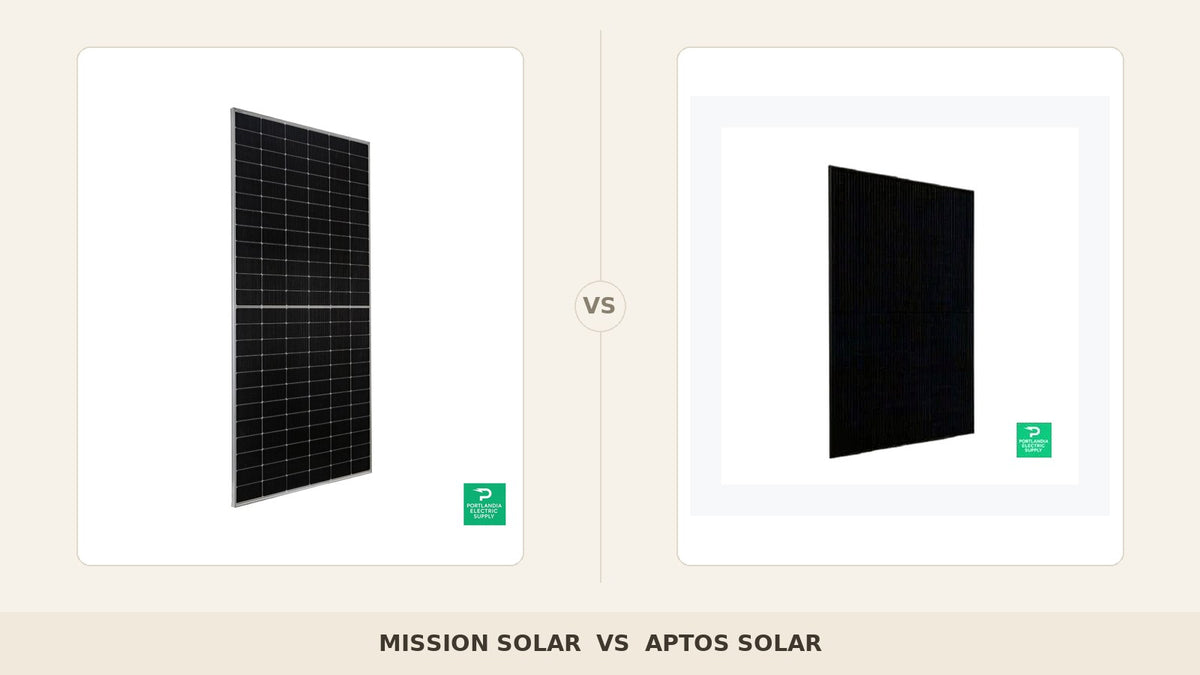
Mission Solar and Aptos Solar both pitch the same flag — American solar panels — and both show up in our quotes to customers who want their array's dollars staying onshore. But they are very different companies wearing similar colors. Mission Solar is a San Antonio manufacturer with its own cell-and-module line and a decade of Texas production history. Aptos is a California design-and-brand house whose panels are built to its spec. We've quoted, shipped, and warranty-supported both. Here's the honest side-by-side.
The Short Verdict
Mission Solar if genuine U.S. manufacturing is the point — domestic content adders, procurement rules, or simply values — and you want a proven PERC-lineage panel from a factory you can tour. Aptos if you want newer split-cell N-type-class designs at aggressive pricing, with a warranty and spec sheet that compete head-to-head with the imports. Both are legitimate; the "made where, exactly" question deserves a precise answer, and we give it below.
The Shared Platform: What Both Have in Common
Both brands sell residential-format monocrystalline modules in the 400–440W class with 25-year product and performance warranties, both use half-cut cell architecture, both carry UL 61730 listings, and both target the same customer: a homeowner or small commercial buyer who wants a premium panel without paying the absolute top of the market. Both are distributed through real supply chains with real warranty support — not marketplace mystery brands. And both sit a step below the Maxeon/REC price tier while competing on the same roof space. If you're cross-shopping the field, our REC vs QCells comparison and QCells vs Silfab comparison frame the broader premium segment.
Side-by-Side Comparison Table
| Specification | Mission Solar | Aptos Solar |
|---|---|---|
| Cell Technology | Mono (PERC heritage; N-type on current lines) | Split-cell N-type class (DNA series) |
| Wattage Class | ~400–430W residential class | ~370–450W class (DNA-120/144 families) |
| Module Efficiency | ~20–21.5% class | ~21.8% class |
| Degradation | Standard class | Enhanced class (30-yr performance warranty) |
| Warranty | 25 yr product / 25 yr performance class (verify per series) | 30 yr performance class; product term per series (verify) |
| Origin | San Antonio, Texas, USA — domestic content play | US-headquartered brand; global manufacturing |
| Price Class | Mid-range NA-made pricing | Mid-range — premium specs at mid-range price class |
What "US Panel" Actually Means Here
This is the section most comparison articles skip, and it's the one that decides eligibility for real money. The IRA's domestic content bonus — a 10-percentage-point adder on the Investment Tax Credit for qualifying projects — uses a manufactured-products test with escalating domestic-cost percentages, and "assembled in the USA with imported cells" and "cells and modules made in the USA" are not the same thing under it. Mission Solar's San Antonio line has historically produced both cells and modules domestically, which gives it the stronger domestic-content story — verify current production configuration with the manufacturer, because supply chains shift. Aptos designs in California and has used contract manufacturing; confirm the current country-of-origin documentation for the exact SKU you're buying. For residential buyers, the domestic-content adder mostly matters on commercial projects, but Buy American provisions, utility program requirements, and personal preference all still count. Ask for the BOM origin statement in writing. Any supplier who can't produce one doesn't know what they're selling.
Spec-for-Spec: Efficiency, Temperature Behavior, and Degradation
Numbers that matter on the roof, using representative current-class modules from each line (always confirm against the exact datasheet for the SKU you buy):
| Metric | Mission Solar (representative 400–420W class) | Aptos (representative 400–440W class) |
|---|---|---|
| Module efficiency | ~19.9–20.9% | ~20.5–21.5% |
| Cell architecture | Mono PERC lineage, half-cut | Split-cell, N-type class designs |
| Temp coefficient (Pmax) | ~ -0.36 to -0.38 %/°C | ~ -0.30 to -0.35 %/°C |
| First-year degradation | ~2% | ~1–2% |
| Annual degradation after | ~0.5%/yr | ~0.4–0.5%/yr |
| Product warranty | 25 years | 25–30 years by model |
| Performance warranty (yr 25) | ~84–85% of nameplate | ~85–87% of nameplate |
The temperature coefficient row deserves translation. On a 175°F cell temperature day — a black-shingle roof in August — a -0.38%/°C panel loses roughly 19% of nameplate output from its 25°C rating, while a -0.31%/°C panel loses about 15.5%. On a 10 kW array, that's a ~350W difference in peak-summer harvest. Hot-climate buyers should weight this spec; cloudy-climate buyers can mostly ignore it. N-type cells also degrade slower and shrug off light-induced degradation entirely, which is why Aptos' newer architecture shows better year-25 performance guarantees.
Roof-Space Math: How Many Panels for 10 kW?
The practical question every homeowner asks. Using representative module wattages and standard residential footprints (~21–22 sq ft per panel):
| Module option | Panel wattage | Panels for 10 kW (DC) | Roof area required | Notes |
|---|---|---|---|---|
| Mission 400W class | 400W | 25 | ~525–550 sq ft | Proven PERC-lineage reliability |
| Mission 420W class | 420W | 24 | ~505–530 sq ft | Fewer clamps, less racking |
| Aptos 400W class | 400W | 25 | ~525–550 sq ft | — |
| Aptos 440W class | 440W | 23 | ~485–505 sq ft | Best for tight roofs |
Higher wattage per panel isn't free power — it's the same energy in fewer frames. It matters when roof area is the binding constraint (dormers, vents, setbacks) or when balance-of-system cost per panel (racking, clamps, microinverter channels) is meaningful. On an open rectangle of a roof, chase $/W; on a chopped-up roof, chase W/panel. Our system size calculator and whole-house solar guide help you figure out whether 10 kW is even the right target before you pick the panel.
Real-World Harvest: Nameplate vs the Meter
Either brand's 10 kW array, decently sited, produces roughly 12,000–15,000 kWh per year in the sunbelt and 9,000–11,000 kWh in the Pacific Northwest or Northeast. The brand difference inside that range is a few percent at most — siting, shading, inverter pairing, and soiling each swing more than the panel choice between these two. Put your engineering energy into the layout and the inverter selection; pick the panel on warranty, price, and origin preference. I say that as someone who has pulled production data on hundreds of arrays: the roof and the installer decide more than the module badge, every single time.
Warranty Service: The Part You Hope Never to Test
Both brands write 25-year warranties, and both have honored claims through our counter without drama. The practical differences: Mission's Texas operation makes RMA logistics simple for southern and central states; Aptos' California base serves the west efficiently. Either way, the installer's labor for a panel swap is the real cost of a warranty claim — panel warranties cover the module, not the ladder time. Buy through a channel (like ours) that will still answer the phone in year nine, keep your invoice and serial list in a safe folder, and photograph the array labels at install. Fifteen minutes of documentation in June saves a miserable paper-chase a decade later.
Price Positioning and When Each Wins the Quote
Street pricing fluctuates with the market, but the pattern holds: Mission typically quotes a modest premium reflecting domestic manufacturing cost — worth it when domestic content is the requirement or the point. Aptos typically quotes closer to import pricing while carrying a premium-format spec sheet — worth it when dollars-per-watt leads and origin is a preference rather than a requirement. Compare both against our Mission Solar collection and Aptos collection, and benchmark the broader field with the solar panel kit buyer's guide and Canadian Solar vs Trina for import pricing context.
Choose Mission Solar If / Choose Aptos Solar If
Choose Mission Solar if: documented U.S. manufacturing is a requirement or a core value; your project pursues domestic-content incentives or Buy American provisions; you want a manufacturer with its own factory and a decade of continuous production history; or supply-chain transparency matters to you on principle.
Choose Aptos if: you want newer N-type-class cell architecture and stronger temperature coefficients per dollar; the 25–30 year warranty terms on current models beat the alternatives in your quote stack; aggressive $/W pricing matters and origin is a preference, not a mandate. Either way, pair the panels with a quality inverter and racking from our solar panel collections, and sanity-check the bill of materials against the racking systems guide.
25-Year Harvest Math: What Degradation Does to Your Energy
Degradation guarantees translate directly into lifetime energy. Running the numbers on a 10 kW array producing 13,000 kWh in year one, using each brand's typical warranted degradation:
| Milestone | Mission Solar (2% yr-1, 0.5%/yr after) | Aptos (1.5% yr-1, 0.45%/yr after) |
|---|---|---|
| Year 1 output | 12,740 kWh | 12,805 kWh |
| Year 10 output | ~12,167 kWh | ~12,286 kWh |
| Year 25 output | ~11,260 kWh (86.6%) | ~11,420 kWh (87.9%) |
| Cumulative 25-year energy | ~299,000 kWh | ~303,500 kWh |
Call it a ~1.5% lifetime-energy edge to the newer cell architecture — roughly 4,500 kWh over 25 years, worth perhaps $600–$900 at typical rates. Real but not decisive. Panel pricing differences between the brands on any given quote week routinely exceed that, which is why we tell customers: get both quotes, then decide on warranty support, origin values, and dollars.
Cell Technology: PERC Lineage vs N-Type, in Plain Terms
Mission's line descends from PERC (passivated emitter rear cell) architecture — the industry's workhorse since roughly 2015, mature, proven, with every failure mode mapped and understood. Aptos' newer designs use N-type-class cells (TOPCon-family), which dope the silicon differently and gain two practical advantages: better temperature coefficients and no light-induced degradation (the 2–3% first-weeks power dip that PERC panels experience). Neither is exotic; both are mainstream. The choice mirrors the auto market — a proven platform versus the newer platform with better paper specs. For harsh-hot climates the N-type edge is worth real watts; for temperate roofs it's mostly a spec-sheet talking point. Our TOPCon vs HJT explainer goes deeper into the N-type family tree.
Supply Chain, Tariffs, and Why Availability Swings
Both brands' pricing dances with U.S. trade policy — AD/CVD duties on imported cells and modules, Section 201/301 actions, and the domestic-manufacturing incentives in the IRA have reshuffled sourcing repeatedly in recent years. Domestic producers gain shelter from import duties; brands with contract-manufactured product face the tariff roulette directly. For buyers, the practical effect is quote volatility and occasional stockouts: the module on last month's quote may not be the module available this month. Lock pricing with a deposit when you find the panel you want, confirm the exact SKU and its datasheet revision on the purchase order, and accept that lead times for specific models can stretch. Working with a distributor holding real inventory — rather than drop-shipping from a container schedule — is the difference between a two-week install and a two-month wait.
Installation Considerations Your Installer Will Care About
Both brands ship standard-format residential modules that work with every major racking system — IronRidge, Unirac, SnapNrack — using standard mid and end clamps. Check two details on the exact SKU: frame depth (35mm versus 40mm frames change clamp selection) and maximum system voltage (1,000V versus 1,500V ratings affect string lengths on larger residential and small commercial designs). Both brands' current residential lines use MC4-compatible connectors — never mix connector brands on the same string, a rule from NEC 110.3(B) and every module manual, and one of the most common inspection failures we hear about. Weight runs 45–55 lbs per panel either brand; one installer handles them on a ladder, two on a steep pitch. The panel wiring basics guide covers series/parallel string planning.
How They Handle Shade and Mismatch
Half-cut architecture — which both brands use — splits the module into two parallel halves, so a shaded bottom row (chimney shadow, vent pipe, the neighbor's growing maple) costs you roughly half the panel's output instead of most of it. Beyond that, shade performance is a system-design question, not a panel-brand question: string inverters with good MPPT algorithms, module-level power electronics, or microinverters each handle shade differently. If your roof has meaningful shade, spend the optimization budget on the electronics — Enphase vs SolarEdge is the relevant comparison — rather than hunting for a magic panel. Either Mission or Aptos modules behave identically behind an optimizer; that's the point of module-level electronics.
Permitting, Inspection, and the Paperwork Side
Both brands make permitting easy because both publish complete documentation: UL 61730 listing certificates, full datasheets with temperature coefficients and series-fuse ratings, and engineering letters when an AHJ asks. Your plan set will need module model numbers, the exact racking system with its own listing, string calculations showing voltage and current against NEC 690.7/690.8 limits, and rapid-shutdown compliance per 690.12 — which is handled at the electronics level, not the panel level. Inspectors in solar-mature jurisdictions breeze through; inspectors in newer markets may want the listing certificates printed. Either brand's documentation package satisfies the request. Where panel choice does touch code: maximum system voltage ratings (check the SKU) and the series fuse rating that caps how many parallel strings you can combine before fusing is required.
Pairing With Batteries and the Whole-Home Picture
Panels are the start of the system, not the end. If backup power is in the plan, the panel choice is nearly independent of the storage choice — any quality module pairs with any modern hybrid inverter or AC-coupled battery. What matters more is total array size against your outage loads: our battery sizing guide and battery-vs-generator comparison frame that decision. For grid-tied buyers, the panel decision closes when the quote does; for off-grid and hybrid builders, leave headroom in the roof plan — every customer we've ever had wished they'd sized for the loads they added three years later, not the loads they had at signing.
The Honest Limitations of Both Brands
Balance requires the negatives. Mission's efficiency trail behind the N-type leaders is real — on a space-constrained roof, that 1–1.5 percentage point gap costs you a panel position or two. Aptos' contract-manufactured model means the "American solar panel" story is thinner than the marketing implies, and buyers who care about domestic manufacturing as a value (not just an incentive) should weigh that honestly. Both brands sit in a crowded middle price tier where QCells, Silfab, and Canadian Solar's premium lines compete hard. Neither is the cheapest way to make a watt, and neither claims to be. What you're buying with either is a warranty that will still have a company behind it in 2045 — which, after watching the module market churn through two decades of bankruptcies and brand exits, is not a small thing.
Buying Checklist: Getting the Exact Panel You Quoted
Panel purchases go wrong in the paperwork, not on the roof. Confirm the exact model number and wattage bin on the purchase order — "Mission 400-class" is not a SKU. Match the datasheet revision to what's actually shipping; specs change between revisions. Record serial numbers at install (photograph every label before the panels go up — the labels live on the back where you'll never see them again). Confirm the warranty registration process and complete it within the manufacturer's window. And buy through a channel that holds inventory and will handle the RMA logistics if a panel ever fails, because a warranty is only as good as the supply chain standing behind it. One last field note: order one spare panel with the job if the budget allows. Hail, a slipped ladder, a falling branch — module damage happens over 25 years, and having an exact-match spare in the garage beats hunting for a discontinued model in year twelve. The spare costs one panel now; the mismatch costs aesthetics and sometimes an optimizer channel later. Finally, schedule the install around your roof, not the other way around: if the shingles are past mid-life, re-roof first. Pulling and resetting an array to reroof under it costs thousands and occasionally breaks modules — the most avoidable expense in residential solar. Whichever brand lands on your roof, the last step is the one that protects everything else: register the warranties within the manufacturer's window, file the serial photos with your homeowner records, and set an annual reminder to compare production against the projection. Panels this good rarely fail — but the ones that do are almost always caught by an owner who was watching the numbers.
Frequently Asked Questions
Is Mission Solar really made in the USA?
Mission Solar manufactures at its San Antonio, Texas facility and has historically produced both cells and modules domestically — one of the stronger domestic-content stories in the U.S. market. Verify the current production configuration for your specific SKU with the manufacturer, as supply chains evolve.
Where are Aptos panels made?
Aptos Solar is a California-based design and brand company; its modules have been produced through contract manufacturing arrangements. Request the country-of-origin and BOM documentation for your exact SKU before purchase, especially if domestic content matters to your project.
Which is more efficient?
Current Aptos models typically edge Mission on nameplate efficiency (~20.5–21.5% vs ~19.9–20.9% in the 400–440W classes) and carry better temperature coefficients thanks to newer N-type-class cell designs. The real-world harvest difference is a few percent at most.
Which has the longer warranty?
Mission offers 25-year product and performance warranties. Aptos offers 25 years standard with some current models extending to 30 years. Compare the year-25 performance guarantee too: Aptos' newer cell architecture typically warrants ~85–87% of nameplate versus Mission's ~84–85%.
Do these qualify for domestic content incentives?
It depends on the specific SKU's manufactured-content percentage under the IRA's rules. Mission's domestic cell-and-module production historically gives it the stronger position. Request written origin documentation from your supplier and confirm qualification with your tax professional — the rules are detailed and the stakes are real money.
Are US-made panels worth the premium?
When domestic content is required or incentivized, yes — the ITC adder can exceed the price premium. As a pure performance purchase, premium imports and US-made panels overlap heavily; decide on warranty support, origin values, and total quoted cost rather than the flag alone.
Sources & Standards
- Manufacturer datasheets and warranty documents: Mission Solar MSE series; Aptos DNA series — verify current revisions and origin statements
- IRS / Treasury guidance on the IRA domestic content bonus; UL 61730 listing requirements
- Related reading: REC vs Silfab 2026, QCells vs Canadian Solar 2026, TOPCon vs HJT solar panels, 300–399W panels, solar system components overview