TOPCon vs HJT Solar Panels 2026: N-Type Cell Technology Compared
Both are n-type. Both beat PERC. One wins on factory economics and availability; the other wins on lab efficiency and temperature behavior. Here's which one wins on your roof.
Two years ago this comparison was theoretical. Now roughly every other pallet that crosses our dock is n-type, and the PERC shelf keeps shrinking — our PERC collection is legacy stock while n-type panels own the new arrivals. The two technologies fighting for that shelf are TOPCon (Tunnel Oxide Passivated Contact) and HJT (Heterojunction), and buyers ask us weekly which one to put on the roof. The honest answer: for 90% of residential and small commercial buyers, the winner is whichever quality-branded module has the better warranty and price-per-watt on the day you order. For the other 10% — hot climates, space-constrained roofs, bifacial ground mounts — the differences are real and worth money. This article separates the two cases.
Quick definitions, no jargon dive: both TOPCon and HJT are ways to reduce electron recombination losses in a silicon cell, which is where efficiency comes from. TOPCon adds an ultra-thin tunnel oxide layer plus doped polysilicon on the rear of an n-type wafer — an upgrade path bolted onto existing PERC production lines, which is why it scaled so fast. HJT sandwiches crystalline silicon between layers of amorphous silicon — a fundamentally different, lower-temperature process with the best passivation in mass production. Different factories, different cost curves, slightly different performance envelopes. That's the whole fight.
| Attribute | TOPCon (n-type) | HJT (n-type) |
|---|---|---|
| Mass-market module efficiency (2026) | ~22.0–23.0% | ~22.5–23.5% |
| Temperature coefficient (Pmax) | ~ -0.29 to -0.30%/°C | ~ -0.24 to -0.26%/°C |
| Bifaciality factor | ~80% | ~85–95% |
| First-year degradation | ~1% | ~1% |
| Annual degradation (typical warranty) | ~0.40%/yr | ~0.25–0.375%/yr |
| Typical product/performance warranty | 15–25 yr / 30 yr | 15–25 yr / 30 yr |
| Manufacturing cost position | Lower — PERC-line upgrades | Higher — dedicated lines, silver paste use falling |
| US market availability | Excellent — most brands' flagship | Limited — fewer brands, premium pricing |
| UV sensitivity notes | Robust | Early-gen UV degradation addressed in current production |
Figures reflect current mainstream production modules from tier-1 manufacturers as published on 2025–2026 datasheets — always spec against the datasheet of the exact SKU on your pallet, because both technologies are improving quarter by quarter. Our 2026 panel roundup tracks which specific models we're recommending this quarter.
PERC did something heroic: it took commodity solar from ~17% to ~21.5% module efficiency over a decade and bankrupted everyone who couldn't keep up. But p-type PERC carried two structural problems — boron-oxygen light-induced degradation (LID) and a passivation ceiling — and by 2023 the roadmap was tapped out around 23% cell efficiency in volume. N-type wafers (phosphorus-doped instead of boron-doped) eliminate the boron-oxygen LID mechanism entirely and tolerate higher carrier lifetimes, which is the physics that lets both TOPCon and HJT exist. The practical result you'll actually notice: n-type modules degrade slower, lose less on hot afternoons, and their bifacial versions harvest meaningfully more from the rear side. Our monocrystalline lineup is now majority n-type for exactly these reasons.
Cell temperature on a roof runs 25–35°C above ambient on a sunny day, and every degree costs you the temperature coefficient. The math on a 10 kW array at a 65°C cell temperature (40°C above the 25°C rating point):
| Module class | Temp coefficient | Loss at 65°C cell temp | Output from 10 kW array |
|---|---|---|---|
| Legacy PERC (reference) | -0.35%/°C | -14.0% | ~8.6 kW |
| TOPCon | -0.30%/°C | -12.0% | ~8.8 kW |
| HJT | -0.25%/°C | -10.0% | ~9.0 kW |
In Portland, that 200 W gap between TOPCon and HJT shows up on the handful of 90°F afternoons we get — rounding error on the annual bill. In Phoenix, where cell temps kiss 70°C for months, HJT's coefficient is worth roughly 2% of annual yield, every year, for 30 years. Compounded across degradation differences, a hot-climate buyer can justify HJT's price premium on math alone. A Pacific Northwest buyer cannot — we tell our own customers to spend the delta on two extra panels instead. Shade design still dominates everything, by the way: the best coefficient in the world doesn't help a module under a chimney shadow, which is why our SolarEdge vs Tigo MLPE guide matters more than cell chemistry for shaded roofs.
Bifaciality is the ratio of rear-side to front-side output, and it's where HJT's structural advantage is largest: ~85–95% versus TOPCon's ~80%. On a rooftop with modules racked 4 inches off dark shingles, rear-side gain is 1–3% and neither number matters. On a ground mount over light gravel or snow, or a commercial carport, rear-side contribution runs 8–15% of total yield — and a 10-point bifaciality edge on a 10% rear contribution is a real 1% of system lifetime energy. Our bifacial collection and dual-glass shelf are where these modules live, and the racking systems guide covers the mounts that actually let rear light in.
| Mounting scenario | Rear-side gain | Technology verdict |
|---|---|---|
| Residential roof, flush mount, dark shingles | 1–3% | Irrelevant — buy on warranty and $/W |
| Ground mount, grass | 5–8% | Slight HJT edge |
| Ground mount, gravel/snow, elevated | 8–15% | HJT edge is worth real money |
| Commercial flat roof, white membrane | 5–10% | HJT edge offsets ballast-era layout losses |
| Vertical / fence mounting (snowbelt niche) | High — bifacial is the point | HJT strongly favored |
Warranted degradation on current n-type flagships: ~1% first year, then 0.40%/year for TOPCon and 0.25–0.375%/year for HJT, landing at roughly 87.4% versus 89–92.5% of nameplate at year 30. On a 10 kW system producing 12,000 kWh in year one, that year-30 gap is roughly 300–600 kWh annually — worth $40–$90 at retail rates in year 30. Discount that back 30 years and it's a rounding error against today's $/watt delta. Degradation curves matter at utility scale where bankers model them; on a residential roof they're a tiebreaker, not a decider. What does matter on a residential roof is the warranty entity behind the curve — a 30-year performance warranty from a manufacturer that will answer the phone in year 17. Brand stability is a spec. Our USA-made collection exists partly for buyers who weight that heavily.
| Metric (10 kW residential, 2026 street) | TOPCon flagship | HJT flagship |
|---|---|---|
| Module price, per watt | ~$0.30–$0.40/W | ~$0.40–$0.55/W |
| Modules for 10 kW (25 × 400 W class) | ~$1,200–$1,600 | ~$1,600–$2,200 |
| Module efficiency → roof area needed | 22.5% → ~44.4 m² | 23.0% → ~43.5 m² |
| Year-1 yield advantage (mild climate) | baseline | ~+0.5–1% |
| Year-1 yield advantage (hot climate) | baseline | ~+1.5–2.5% |
| Payback on the premium (mild climate) | — | decades — buy TOPCon |
| Payback on the premium (hot, space-limited) | — | often justified |
The roof-area row is the sleeper: when the roof is the constraint — a small south face, offset by code-required fire setbacks — a point of module efficiency is worth more than its $/W suggests, because it buys capacity the roof otherwise can't hold. On an unconstrained roof or ground mount, area is free and $/W rules. Check your own layout with the system size calculator before paying an efficiency premium.
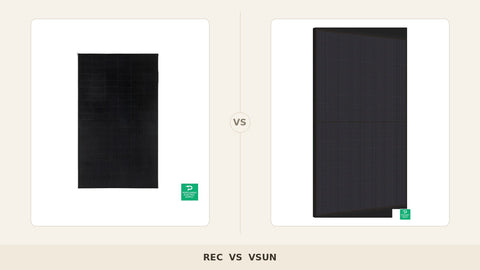
Our shelf tells the market's true story: TOPCon dominates volume because every tier-1 factory retooled for it — JA Solar, Jinko, Trina, Canadian, and the value brands all lead with TOPCon flagships, which is why our JA Solar, Jinko, and Trina collections are TOPCon-led, alongside premium TOPCon like the Silfab Elite 370 W all-black. HJT remains the connoisseur's pick — REC built its reputation there, and our REC shelf plus the HJT collection serve buyers who want the temperature and bifacial edge and will pay for it. I've put both on customer roofs and would put either on my own; the jobs where I insist on HJT are hot-climate ground mounts, and the jobs where I insist on TOPCon are the ones where the budget buys more watts for the same dollars.
Whichever cell you choose, the electrical layer doesn't care: string sizing follows the same NEC 690.7 cold-Voc math, conductors follow the same ampacity tables, and grounding follows the same grounding rules. N-type modules do tend to ship with higher Voc and Imp than the PERC they replace, so re-run the string math — don't assume last year's layout survives this year's module.
Understanding why TOPCon is everywhere and HJT is premium requires one supply-chain fact: TOPCon was engineered to retrofit onto the industry's existing PERC production lines. A manufacturer could add the tunnel-oxide and polysilicon steps to a line it already owned and ship n-type product within a year. HJT demands a purpose-built, low-temperature line with different deposition equipment — higher capex, slower ramp, but a structurally better cell on the other side. The industry voted with its balance sheets: virtually every tier-1 maker scaled TOPCon first, which is why 2026's volume, price competition, and brand diversity all live there. HJT stayed with fewer, more committed manufacturers — which is precisely why its buyers pay more and get a slightly better cell. Neither path is finished; TOPCon keeps squeezing toward 24% cell efficiency in volume while HJT works its silver-consumption problem down. Buy the module, not the roadmap.
Current n-type flagships run Voc around 49–52 V and Imp around 10–14 A per module depending on format, and the string math follows NEC 690.7 with the module's temperature coefficient of Voc. Worked example, 25-module residential job with a 49.6 V / 13.1 A module, record low -10°C, Voc coefficient -0.25%/°C: cold Voc = 49.6 × [1 + 0.0025 × (25 - (-10))] = 49.6 × 1.0875 ≈ 53.9 V per module. On a 600 V string inverter input: 600 ÷ 53.9 = 11.1, so 11 modules maximum per string — 25 modules means 3 strings, and the MPPT count on your inverter just became a design constraint. Check that the string current also fits the inverter's per-input rating, especially if you parallel two strings (26.2 A combined needs a 26+ A input). The full method is in our panel wiring basics, and conductor sizing for the home runs uses the PV wire guide.
| String math checkpoint | Calculation | Result |
|---|---|---|
| Cold Voc per module (-10°C, -0.25%/°C) | 49.6 × 1.0875 | 53.9 V |
| Max modules per 600 V string | 600 ÷ 53.9 | 11 modules |
| Strings for 25 modules | 25 ÷ 11 | 3 strings (11 + 11 + 3 or 9 + 8 + 8) |
| Hot-day Vmp check (cell 65°C, ~0.87 factor) | 41.2 × 0.87 × 11 | 394 V — above MPPT floor |
| Home-run conductor (Isc 13.1 A) | 13.1 × 1.56 | 20.4 A → 10 AWG PV wire |
- Datasheet efficiency — compare like-for-like module efficiency, not cell efficiency marketing.
- Temperature coefficient of Pmax — only if your climate or mounting runs hot.
- Bifaciality — only if rear light exists on your mount.
- Warranty pair — product years and warranted year-30 output, plus who backs it.
- Price per watt on the pallet — delivered, for the exact SKU, from a supplier who will exist in year 17.
Run those five against every quote and the TOPCon-vs-HJT question answers itself on your specific roof. If you want our current read on specific models — what we'd buy this month with our own money — the best panels roundup is updated each quarter, and the full shelf is in the panel catalog with all-black options for the curb-appeal crowd. Questions on a specific BOM: call the counter. We answer with numbers, not slogans.
After years of warranty intake, here's what the failure stack actually looks like, in order: shipping and handling damage (corner chips, frame dents — inspect the pallet before the driver leaves), junction box and connector faults (brand-agnostic, usually installation torque), PID-style system-voltage issues on legacy gear (largely solved in modern n-type BOMs), and glass breakage from handling or hail events beyond rating. What we essentially never see on n-type product: the boron-oxygen LID fade that quietly stole 2–3% from first-year PERC arrays, and the early UV-driven backsheet yellowing that dated a decade of modules. HJT's early UV-sensitivity stories were real on first-generation product and are engineered out of current production — if someone quotes you 2022 forum posts as current fact, check the manufacturing date on what they're actually selling. Buy current-production modules from brands with a service desk, install them per the manual's clamping zones, and either chemistry will outlast the mortgage paperwork.
Module chemistry interacts with the rest of the BOM in three places. First, inverter MPPT current: the highest-power n-type formats (590 W+ utility panels in our utility collection) push Imp past 15 A — residential string inverters with 12.5–14 A inputs will clip them on cool bright days, so match format to inverter class. Second, MLPE pairing: optimizers and microinverters carry per-module wattage and current ceilings; 550 W-class modules need the high-power device variants, which our optimizer shelf labels clearly. Third, physical: residential-format n-type modules run slightly larger than legacy 60-cell frames — verify racking compatibility and fire-setback layout before ordering, especially on roof mount kits quoted against older module footprints. None of this is hard; all of it is cheaper to check at quote time than at install time.
And the evergreen reminder from the design desk: a 5% module-efficiency difference is smaller than a 5% shade, soiling, or orientation error. Pick the module with the five checklist numbers in your favor, then spend your remaining energy on layout, tilt, and keeping the fir tree trimmed. Physics rewards the boring decisions.
To make the coefficient differences concrete, we modeled the same 10 kW array at 1,300 / 1,500 / 1,800 kWh-per-kWp annual specific yield (Pacific Northwest / national average / desert Southwest), applying each technology's temperature and degradation behavior as annual-yield multipliers:
| Climate (specific yield) | TOPCon year-1 kWh | HJT year-1 kWh | HJT edge |
|---|---|---|---|
| Cool/marine, 1,300 kWh/kWp | ~12,900 | ~13,000 | ~0.7% — noise |
| Temperate average, 1,500 kWh/kWp | ~14,800 | ~15,000 | ~1.2% |
| Hot desert, 1,800 kWh/kWp | ~17,500 | ~17,900 | ~2.3% — real money over 30 years |
Multiply the edge by your retail rate and your module-price delta and the decision falls out: at $0.15/kWh the desert case returns roughly $60–$100/year in year one and grows as degradation curves diverge — which covers HJT's typical $400–$600 pallet premium in a reasonable horizon. The marine case returns about $15/year and never pays back. Climate is the variable; run your own numbers before believing anyone's blanket recommendation, including ours.
Last note from the module desk, because it generates more confused phone calls than any spec: "n-type" on a datasheet is the wafer, not the warranty. There is mediocre n-type and excellent n-type on the market right now, often from the same factories. The checklist above — efficiency, coefficient, bifaciality, warranty pair, and price per watt from a durable brand — is how you tell them apart without a materials degree. When two modules tie on those five numbers, buy the one that's in stock, on a full pallet, with a label you can read. Logistics is a spec too.
One more practical buying pattern we've watched work well: mixed pallets. On a 40-module commercial job, put the premium high-bifaciality modules on the rows with the best rear-light exposure and the value TOPCon rows where parapet shadows kill the rear gain anyway. The design software won't suggest it; the yield model will justify it. That's the kind of ten-dollar detail this article exists for — and it's the kind of call our counter makes every day if you bring us the layout.
Is HJT better than TOPCon?
On the spec sheet, slightly: HJT leads in temperature coefficient (~-0.24 to -0.26%/°C vs ~-0.29 to -0.30%/°C), bifaciality (~85–95% vs ~80%), and warranted degradation (as low as 0.25%/yr vs ~0.40%/yr). TOPCon leads in availability, brand choice, and price per watt. In mild climates TOPCon's value usually wins; in hot climates and bifacial ground mounts, HJT's performance edge can pay for itself.
Are TOPCon and HJT both n-type?
Yes — both build on n-type silicon wafers, which eliminate the boron-oxygen light-induced degradation that limited p-type PERC. The difference is the passivation architecture: TOPCon uses a tunnel oxide plus doped polysilicon layer on the cell rear, while HJT sandwiches crystalline silicon between amorphous silicon layers. Both beat PERC on degradation and temperature behavior.
Which technology degrades slower?
HJT, on current warranties: typically 1% first year then 0.25–0.375% per year, reaching ~89–92.5% of nameplate at year 30. TOPCon warranties typically run 1% then 0.40%/year, reaching ~87.4% at year 30. Both are major improvements over legacy PERC; the difference between them matters financially mainly at commercial scale.
Is TOPCon being replaced by newer technology?
Not on any near-term horizon that matters to a 2026 buyer. TOPCon is the industry's volume leader and still improving; back-contact (BC) variants and TOPCon-plus-tandem research are the next steps, but mass-market availability of anything beyond TOPCon and HJT remains limited. Buying either technology today gets you current-generation performance with a 30-year warranty behind it.
Do I need special racking or inverters for n-type panels?
No — n-type modules use the same frames, connectors, and voltage classes as the PERC modules they replace. Racking, string inverters, and MLPE all work unchanged. Do re-run string sizing math, since modern n-type modules often carry higher Voc and Imp than older models; our panel wiring basics guide covers the calculation.
Which should I buy for a hot climate like Arizona or Texas?
HJT earns its premium there. At 65°C+ cell temperatures for months per year, HJT's ~-0.25%/°C coefficient preserves roughly 2% more annual yield than TOPCon, compounded by a slower degradation curve over 30 years. If the roof is space-constrained as well, the case strengthens further. In mild climates, buy TOPCon and spend the savings on more capacity.