Updated September 2026 — refreshed against the live PES catalog; product pricing verified 2026-09-26.
I've commissioned enough air-cooled standby units to fill a parking lot, and the Kohler-versus-Briggs question lands in my inbox every single hurricane season. Both brands build a solid machine. Both will carry a house through a week-long outage if you size and install them right. But they are not the same machine, and the differences that matter — fuel behavior on natural gas, warranty fine print, dealer depth in your county — don't show up on the glossy brochure. This shootout is the version I'd give you across the tailgate.
Quick disclosure of bias: we sell parts and equipment for both lines at Portlandia Electric Supply, and we've got no factory spiff pushing us either direction. What follows is spec-sheet data, NEC code references, and twenty years of field notes from our counter crew and the contractors who buy from us.
The Short Verdict for People in a Hurry
If you want the whole answer in one paragraph: Kohler wins on dealer network depth, enclosure fit-and-finish, and the OnCue/RFB remote monitoring ecosystem. Briggs & Stratton wins on upfront price, full-rated natural gas output on several models (no derate where Kohler gives up 2 kW), and a warranty structure that's gotten aggressive since the brand's power products line reorganized. Everything below is the evidence for those three sentences.
The Shared Platform: What Both Have in Common
Before the fight, the truce. In the 14–26 kW air-cooled residential class, both brands give you the same skeleton: a purpose-built overhead-valve V-twin (or inline twin on smaller units) spinning at 3,600 RPM, an aluminum enclosure with automotive-grade paint, a solid-state automatic transfer switch pairing, weekly self-exercise cycles, and 2-wire start compatibility with any ATS that follows the standard. Both run on natural gas or propane with a field-selectable fuel configuration. Both carry UL 2200 listing, which is the listing your inspector and your insurance company actually care about.
Both also share the same physical install realities. You need a composite or poured pad, 18 inches minimum clearance to the structure (3 feet is what we tell customers so the inspector never blinks), a gas line sized per the installation manual's BTU table — not per the plumber's gut — and a permit. I've seen more failed inspections from undersized gas runs than from every other cause combined, and that's true no matter whose badge is on the enclosure.
Side-by-Side Comparison Table
| Specification | Kohler | Briggs & Stratton |
|---|---|---|
| Output (20-26 kW class) | 20 kW: 20 LP / 18 NG · 26 kW: 26 LP / ~24 NG class | PP22: full 22 kW on NG via NGMax (no NG derate) · PP26: 26 kW class — most starting power in class |
| Engine | Kohler Command PRO 999cc-class V-twin; 3,600 RPM air-cooled | Briggs & Stratton Vanguard-class engine; 3,600 RPM air-cooled; ~39% smaller footprint (PP13) |
| ATS & Load Management | 200A SE-rated RDT ATS, load control modules | Symphony Choice power management (load-shedding) |
| Enclosure | Corrosion-resistant aluminum/composite | Aluminum enclosure class; compact footprint (PP13 ~39% smaller) |
| Sound | ~63–69 dBA at 23 ft class | ~64–66 dBA class at 23 ft |
| Monitoring | OnCue Plus (WiFi standard) | WiFi monitoring via app (info hub) |
| Warranty | 5-year / 2,000-hour limited (extended plans available) | 7-year comprehensive (parts, labor, travel) standard on PowerProtect; 10-year on DX class |
| Service Network | Smaller residential network; deep industrial/commercial channel | Smaller standby dealer network than Generac; century of engine manufacturing (since 1908) |
| Price Class | 20 kW ~$5,500–6,300 · 26 kW ~$6,900–7,800 (unit only) | Value-to-mid tier per kW (strong cost-per-kW on PP26) |
Fuel Consumption and Runtime: The Math Nobody Prints on the Box
Fuel burn is where real-world operating cost lives, and it's where I see the most homeowner confusion. Manufacturer-published figures for the 20 kW class (always verify against the current spec sheet for your exact model, because these drift year to year) land in these ranges:
| Fuel / Load | Kohler 20 kW class (typical published) | Briggs & Stratton 20–22 kW class (typical published) |
|---|---|---|
| Natural gas, 50% load | ~203–228 ft³/hr | ~185–210 ft³/hr |
| Natural gas, 100% load | ~281–306 ft³/hr | ~245–290 ft³/hr |
| Propane, 50% load | ~2.1–2.4 gal/hr | ~1.9–2.3 gal/hr |
| Propane, 100% load | ~3.3–3.8 gal/hr | ~3.1–3.6 gal/hr |
Now the runtime math people actually need. A 500-gallon propane tank holds about 400 usable gallons (tanks are filled to 80% for thermal expansion). At full-load burn of roughly 3.5 gal/hr, that's about 114 hours — call it 4.7 days of continuous full-load operation. At a realistic average load of 50–60%, you're looking at 7–9 days. A 250-gallon tank (200 usable gallons) halves that. If your outage history includes week-long events — ice storms, hurricanes, wildfire PSPS shutoffs — tank sizing matters more than the generator badge. We've walked customers through this arithmetic after they've already bought the unit, and retrofitting a bigger tank is a much worse day than speccing it up front.
On natural gas, runtime is effectively unlimited, but check the gas meter. A 20 kW unit at full load pulling ~300 ft³/hr needs a meter and service line that can deliver it alongside your furnace and water heater. Your gas utility will upsize the meter, usually free, sometimes with a wait. Schedule that before the electrician shows up, not after.
Load Sizing: Will 20 kW Actually Carry Your House?
Here's the tally we run at the counter when someone asks whether they need a 20 kW or should step to a 26 kW. Typical running/surge numbers for common loads:
| Load | Running watts (typical) | Surge / starting watts | Notes |
|---|---|---|---|
| Refrigerator (modern, 21 cu ft) | 150–400 | 1,200–2,200 | Compressor start is the spike |
| 3-ton central A/C (13 SEER2 class) | 3,000–3,600 | 6,000–9,000+ | Soft-start kit cuts surge ~60% |
| Gas furnace blower (¾ hp) | 600–875 | 1,800–2,350 | Runs whenever heat runs |
| Well pump (½ hp, 240V) | 1,000–1,200 | 2,400–3,600 | Rural homes: non-negotiable |
| Electric water heater | 4,000–5,500 | same (resistive) | Load-manage or go gas |
| Electric range (one oven + 2 burners) | 3,000–5,000 | same (resistive) | First thing we shed |
| Lighting + receptacles + electronics | 1,000–2,500 | — | LEDs made this cheap |
| Sump pump (⅓ hp) | 800–1,000 | 1,300–2,900 | Never put this on a shed list |
Add the running watts of everything you refuse to live without, then add the single largest surge on top. For a 2,400 sq ft all-gas-appliance home with one 3-ton A/C, that math usually lands at 12–15 kW — comfortably inside a 20 kW unit on propane, and inside an 18 kW natural-gas-derated Kohler with a load-managed automatic transfer switch shedding the A/C and water heater. All-electric homes push past 20 kW fast. Our whole-house generator sizing guide walks the full worksheet, and the 2026 update covers heat-pump loads, which change the math because a cold-climate heat pump at 5°F can pull 4,500W continuous with a nasty start surge.
Natural Gas Output: The Derating Question
This is Briggs & Stratton's honest-to-goodness technical edge in this class. Natural gas carries less energy per cubic foot than propane, so most air-cooled engines lose output on NG — Kohler's 20 kW unit is typically rated 20 kW on LP and 18 kW on NG. Several Briggs & Stratton PowerProtect models are rated full output on both fuels. If your home is on natural gas and your load tally sits right at the edge of 18 kW, that 2–4 kW of NG headroom is the difference between carrying the second A/C and shedding it. Don't gloss this row of the spec sheet. I've had exactly one customer ever complain about too much generator capacity, and he was joking.
Warranty Structures, Compared Honestly
Kohler's standard residential standby warranty runs 5 years / 2,000 hours, covering parts and labor, and it's honored through one of the deepest dealer networks in North America — in most metro counties you can find two or three authorized Kohler service outfits. Briggs & Stratton's warranty terms have shifted with the brand's ownership changes; current PowerProtect models have carried up to a 6-year limited warranty promotionally, but the dealer bench is thinner in many regions. The practical question isn't the years on the certificate — it's who answers the phone in year four when the unit throws a low-oil-pressure fault at 2 a.m. in an ice storm. Ask your installer who services the brand locally before you sign. If there's no authorized tech within an hour's drive, the longer warranty is wallpaper.
Install Realities: Transfer Switch, Wire, and Code
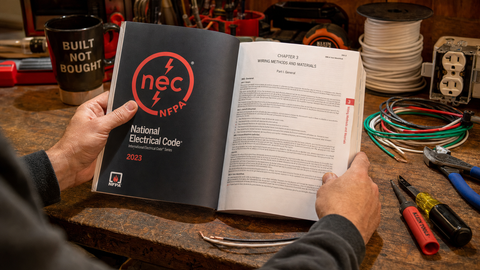
Both brands ship in service-entrance-rated packages or as generator-only with a separate ATS. On a typical 200A service, you'll pair with a 200A service-rated ATS; on smaller sub-panel setups, a 100–125A transfer switch handles essential circuits. NEC 702.5 requires the transfer equipment to prevent inadvertent interconnection of normal and standby sources — every UL 1008 listed ATS from either brand satisfies this. If the generator can't carry the whole load, NEC 702.4(B) permits load management; that's your legal basis for the shedding modules.
Wire sizing for the generator feed follows NEC 445.13 — conductors sized at 115% of the generator's nameplate rating — landed on NEC 310.16 ampacities:
| Generator class | Output amps @ 240V | 115% design amps | Min. copper THHN (75°C) | Typical breaker (NEC 240.6) |
|---|---|---|---|---|
| 14 kW | 58.3A | 67A | 4 AWG (85A) | 70A |
| 20 kW | 83.3A | 96A | 2 AWG (115A) | 100A |
| 22 kW | 91.7A | 105A | 1 AWG (130A) | 110A or 125A |
| 26 kW | 108.3A | 125A | 2/0 AWG (175A) | 125A or 150A |
Those ampacities come straight from NEC 310.16's 75°C copper column, and the breaker sizes land on NEC 240.6(A) standard ratings with the next-size-up allowance of 240.4(B) where applicable. Your installer's mileage will vary with conduit fill and ambient temperature — our NEC wire sizing guide and conduit fill chart cover the adjustment factors. If you're also weighing solar-plus-battery against a generator, our battery backup vs generator comparison prices both paths honestly, and the runtime calculator does the battery-side math.
Choose Kohler If / Choose Briggs & Stratton If
Choose Kohler if: you want the deepest service network and aren't gambling on warranty response; you value the OnCue remote monitoring your kids can check from their phones; you're on propane where the NG derate doesn't touch you; or your local inspector and HVAC contractor already know the RCL/RCA line cold. Browse our Kohler collection and the 20–28 kW standby generator lineup.
Choose Briggs & Stratton if: upfront price is the binding constraint; you're on natural gas and the full-rated NG output closes your load math; or you have a strong local Briggs dealer — brand loyalty from a good local tech beats a longer warranty from a distant one. Check the Briggs & Stratton collection and compare against all standby generators before you commit.
Whichever way you go, the generator is the cheap half of the project. The install — pad, gas plumbing, ATS, permits, startup — runs $3,500–$7,000 in most markets and determines whether the unit actually starts when the neighborhood goes dark. Hire the electrician who pulls permits without being asked. That's the tell.
Ten-Year Ownership Cost: The Numbers That Actually Decide This
Sticker price is the smallest check you'll write. Here's the decade-long arithmetic we walk through with customers, using a 20 kW class unit on propane in a storm-prone region:
| Line item (10-year window) | Kohler 20 kW (est.) | Briggs & Stratton 22 kW (est.) |
|---|---|---|
| Unit + ATS package | $5,200–$6,300 | $4,600–$5,600 |
| Install (pad, gas, electrical, permits) | $3,500–$7,000 | $3,500–$7,000 |
| Annual maintenance plan (10 yrs @ $250–$400) | $2,500–$4,000 | $2,500–$4,000 |
| Fuel, 60 hrs/yr avg outage use (propane @ ~$2.50/gal) | $4,900–$5,700 | $4,600–$5,400 |
| Battery replacement (x2 @ $90–$140) | $180–$280 | $180–$280 |
| 10-year total | $16,300–$23,300 | $15,400–$22,300 |
Two lessons from that table. First, the brand premium — roughly $600–$1,000 — is under 5% of the decade cost. Choose on service coverage, not sticker. Second, fuel is the sleeper line: if your outage profile is heavy (rural feeder, 100+ hours a year), propane burn doubles and the natural-gas conversion case gets strong. We keep both fuels' fittings in stock because about a third of our generator customers switch fuel within the first five years — usually LP to NG after the gas utility finally extends the line.
Service and Parts: The Year-Four Test
Every generator works on day one. The question that matters is who fixes it in year four. Kohler's network is the benchmark — authorized dealers in nearly every metro, parts distribution that can overnight a voltage regulator or control board. Briggs & Stratton's network is adequate in the Midwest and South, thinner in parts of the West, and it went through a rough patch during the brand's 2020 bankruptcy and subsequent reorganization of the standby line into the PowerProtect series. The parts pipeline has stabilized, but ask your installer a pointed question: "If the control board dies in January, how many days until it's fixed?" A Kohler answer is usually 2–5 days. A Briggs answer depends heavily on your zip code. Neither answer is a reason to panic — both machines are fundamentally simple small-block engines — but you should hear the answer before you buy, not during an outage.
On the DIY side: both brands use standard 12V Group 51 or 26R batteries, automotive-style oil filters, and NGK/Champion plugs that any parts counter stocks. Annual service is genuinely within reach of a careful homeowner — oil, filter, plug, air filter, battery test, exercise-log review. Budget $60–$90 in parts if you do it yourself, $250–$400 for a dealer visit. I do my own unit's service every October, and the whole job takes 40 minutes including the coffee.
Common Mistakes We Watch People Make
After two decades of counter conversations, the failure modes repeat. Undersizing to save $800, then discovering the well pump and the A/C can't start together. Putting the unit too close to a bedroom window and hating the exercise cycle forever. Skipping the gas-line upsize and watching the generator stumble every time the furnace lights off. And the classic: no maintenance for three years, then surprise when the battery is dead the night the ice storm hits. A standby generator is a car that sits in your yard waiting for the worst day of the year. Treat the battery and the oil like you would for a vehicle you actually depend on — because that's exactly what it is.
Monitoring: OnCue vs the Briggs InfoHub
Kohler's OnCue Plus platform is the more mature of the two — generator status, exercise history, fault codes, and run hours on your phone, with dealer-side diagnostic access if you grant it. Briggs & Stratton's InfoHub covers the same core ground (status, alerts, history) at a lower subscription cost. Both will text you when the unit faults, which is the feature that actually matters: the worst sentence in this industry is "the generator didn't start and nobody knew." Set up the alerts on day one. I have mine pinging me, my wife, and our service company — redundant notification paths are free insurance.
Cold Weather, Altitude, and the Specs Nobody Reads
Two environmental factors quietly eat output. Cold: below 40°F, battery cranking power drops and oil thickens — both brands offer cold-weather kits (battery warmer, oil warmer) that we consider mandatory north of the Mason-Dixon line and cheap insurance anywhere that frosts. Altitude: engines lose roughly 3–4% of output per 1,000 feet above sea level. At 5,000 feet in Denver or Santa Fe, your 20 kW unit is an honest 17–18 kW. Run your load tally with the altitude haircut applied, or step up a size. This one catches mountain-region buyers constantly, and neither brand puts it on the brochure cover.
Permits, Timeline, and What the Inspector Actually Checks
Budget four to ten weeks from deposit to commissioning in most markets — the generator arrives in days, but the permit, the gas work, and the inspection queue take the time. Inspectors check the same five things everywhere: pad stability and clearances, gas line sizing against the manual's BTU table (they will look up the table), transfer switch listing and location, bonding/grounding per NEC 250, and conductor sizing per 445.13. Neither brand passes or fails more often — install quality decides that. Get the gas utility meter capacity letter early; it is the single most common schedule slip we see.
Exercise Cycles and Weekly Behavior
Both brands self-exercise weekly for 12–20 minutes at reduced speed or no load. Set the exercise for mid-morning midweek — never Sunday at 7 a.m., which is the factory default on too many units and the cause of most neighbor complaints. If your unit supports load-bank exercise, use it; unloaded wet-stacking is a diesel problem but light-load running does neither small gas engine any long-term favors either.
Frequently Asked Questions
Is Kohler better than Briggs & Stratton for standby generators?
Kohler edges ahead on dealer network depth and enclosure refinement; Briggs & Stratton counters with lower upfront cost and full-rated natural gas output on key models. For most homes on propane with a 20 kW load, both perform equivalently. Decide on local service availability first, specs second.
Which has the longer warranty?
Kohler's standard residential coverage is 5 years/2,000 hours. Briggs & Stratton PowerProtect models have carried promotional terms up to 6 years limited. Verify current terms on the serial-specific warranty document — promotional terms change, and the certificate that ships with your unit is the one that counts.
Which is quieter?
Both brands rate their 20 kW class enclosures in the mid-60s dB at 23 feet during exercise — roughly conversation volume. Under full load both climb into the low 70s. In practice, siting (away from bedroom windows, off property lines) matters more than the 1–2 dB between spec sheets. Check local noise ordinances for exercise-time restrictions.
Do both derate on natural gas?
Kohler's 20 kW air-cooled units typically drop to 18 kW on NG. Several Briggs & Stratton models hold full rating on both fuels. Always read the NG column of the spec sheet, not the marketing headline, and size your load tally against the NG number if that's your fuel.
Which costs less?
Briggs & Stratton typically lists $400–$900 lower than Kohler in the same kW class, before installation. Installation cost is identical for both, so the percentage gap narrows on the total project. Get installed quotes on both — local dealer competition often erases the list-price difference.
How long will a 500-gallon propane tank run a 20 kW generator?
At full load (~3.5 gal/hr), roughly 114 hours — about 4.7 days — from the ~400 usable gallons in a 500-gallon tank. At a realistic 50–60% average load, expect 7–9 days. Size the tank to your region's longest historical outage, not the average one.
Sources & Standards
- Manufacturer spec sheets: Kohler RCL/RCA 20–26 kW series; Briggs & Stratton PowerProtect 18–26 kW series (verify current revisions)
- NFPA 70 (NEC): Articles 445, 700, 701, 702; Tables 240.6(A), 310.16
- UL 2200 (stationary engine generators) and UL 1008 (transfer switch equipment) listing requirements
- Related reading: standby generator basics, the complete guide to 26 kW generators, what you need to know about 22 kW generators, how many watts to power a home
Need pricing or availability on anything in this guide?
Portlandia Electric Supply dropships direct from the manufacturer — most items Ship Direct with lead times stated up front, no surprises.
Get a quote from PESBulk, pallet and contractor pricing available.