TOPCon vs HJT vs Tandem in 2026: Efficiency, Temperature Coefficients, and Real ROI
Three cell technologies, one roof budget. We compare measured efficiency classes, heat behavior, degradation schedules, cost premiums, and payback math by roof size — with the string-sizing and NEC context your design actually needs.

Every couple of years the industry anoints a new cell architecture and the sales decks declare everything before it obsolete. TOPCon replaced PERC as the volume standard. HJT holds the efficiency crown on production lines you can actually buy from. Tandem perovskite-silicon cells own the conference circuit and exactly zero volume in US residential distribution. We install what we can warranty, source, and replace — so this comparison weights shipped product over press releases, and dollars per kWh over lab-cell records.
The short version: TOPCon is the 2026 value default, HJT is the premium pick for tight or hot roofs, and tandem is a 2028-plus conversation. The long version — with the temperature math and roof-size ROI tables — is below. For module-level shopping, cross-reference our HJT panels, the Silfab Elite n-type TOPCon panel, and the broader solar panel kit buyer's guide.
TOPCon (Tunnel Oxide Passivated Contact) adds an ultra-thin oxide layer and doped polysilicon film to the rear of an n-type wafer, cutting recombination losses where PERC cells bled efficiency. It won the volume war because it retooled existing PERC lines cheaply — manufacturers could flip a factory in months, not years. That is why your distributor's shelves are full of it at $0.28–$0.36/W wholesale.
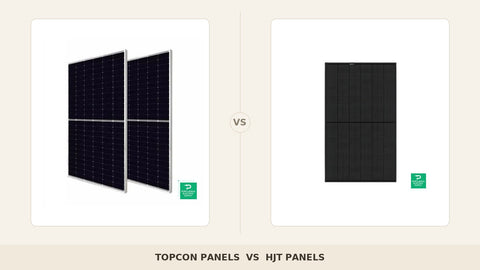
HJT (Heterojunction) sandwiches a crystalline wafer between layers of amorphous silicon, producing the best passivation in production and naturally bifacial construction. It runs cooler (the -0.24 to -0.26%/°C class coefficient), degrades slower, and costs more because the deposition equipment never amortized the way TOPCon lines did. REC's Alpha series and the HJT modules we stock define the category.
Tandem (perovskite-on-silicon) stacks a perovskite absorber tuned to blue light on top of a silicon cell tuned to red, pushing past silicon's ~29% single-junction theoretical ceiling. Lab cells have crossed 33%. Production panels you can buy with a 25-year warranty and a US claims office? Not yet. Long-term perovskite stability under damp heat and UV remains the engineering problem, and nobody financing a residential roof wants to be the field trial.
Efficiency only pays when roof area constrains system size. On an unconstrained ground mount, a cheaper, less efficient module wins on pure $/W. On a 900-square-foot residential roof with setbacks eating a third of it, every point of efficiency is roughly 22 W per panel — and per panel is how systems hit net-metering caps and offset targets.
Production-module classes as of early 2026. Tandem has no volume residential SKU to price or square-foot against — that is the point.
| Technology | Residential module efficiency class | Watts on a standard 54/60-cell-class frame | Space needed for 10 kW |
|---|---|---|---|
| PERC (legacy baseline) | ~20.5–21.5% | ~400–425 W | ~470–500 sq ft |
| TOPCon (n-type) | ~21.5–23.0% | ~420–460 W | ~440–470 sq ft |
| HJT | ~22.5–24.0% | ~440–480 W | ~415–445 sq ft |
| Tandem (pilot/pre-commercial) | — | — | — |
On that 10 kW example, HJT buys back roughly 30–55 square feet versus TOPCon. Whether that matters depends entirely on whether your roof plan was already feasible. I have redesigned exactly two jobs in the last year where the efficiency jump from TOPCon to HJT was the difference between passing the customer's offset target and not — both were hip roofs with brutal setback geometry. Everywhere else, TOPCon's price advantage carried the ROI table.
Cell temperature on a dark comp roof in August runs 60–70°C, 35–45 degrees above the 25°C rating condition. Multiply that delta by the Pmax coefficient and you get the output haircut your production model must carry:
P(T) = P_STC × [1 + coeff × ΔT]. At a 65°C cell temperature, HJT holds ~4.4 points over PERC and ~2.0 over TOPCon.
| Cell temp vs 25°C | PERC (-0.35%/°C) | TOPCon (-0.29%/°C) | HJT (-0.24%/°C) |
|---|---|---|---|
| +20°C (45°C cell) | 93.0% of nameplate | 94.2% | 95.2% |
| +30°C (55°C cell) | 89.5% | 91.3% | 92.8% |
| +40°C (65°C cell) | 86.0% | 88.4% | 90.4% |
Two percentage points of midday output on a 10 kW system is 200 W during the hours that matter most for self-consumption. Across a Phoenix summer that compounds into real money — roughly 3–5% more annual kWh for HJT over PERC in hot climates, with TOPCon splitting the difference. In Seattle, the gap compresses toward irrelevance. Climate, not hype, should set the technology pick. We have watched a customer's monitoring app on a 100°F day show an HJT string holding voltage where the neighboring PERC roof sagged — the coefficient is not theoretical, it is on the screen.
Degradation schedules determine what year-15 production looks like, which is what financed systems are actually underwritten on:
Published warranty classes; confirm the exact SKU's terms. HJT's slower linear rate is its quiet premium justification.
| Technology | Year-1 degradation class | Linear annual degradation | Warranted output at year 25 | Typical product warranty |
|---|---|---|---|---|
| PERC | ≤2.0% | ≤0.55%/yr | ≥84.8% | 12–15 yr (legacy lines) |
| TOPCon | ≤1.0% | ≤0.40%/yr | ≥89.4% | 25 yr (dual-glass class) |
| HJT | ≤1.0% | ≤0.25–0.375%/yr | ≥90.0–92.0% | 25 yr class |
| Tandem | no fielded schedule | no fielded schedule | — | — |
Run HJT's 0.25%/yr best-case against TOPCon's 0.40%/yr across 25 years and the HJT array warrants about 2.6 points more output — call it 260 W on a 10 kW system in year 25. Real, but modest. The warranty that matters operationally is the product term and the claims desk behind it; a 25-year product warranty from a manufacturer with US infrastructure beats a 30-year promise from a brand with no stateside office. Pair any of these with proper longevity practices from our system maintenance guide.
Wholesale class ranges from recent transactions; live pallet pricing moves weekly with tariff posture and volume.
| Technology | Wholesale $/W class (2026) | Availability in US channels | Representative product |
|---|---|---|---|
| TOPCon | $0.28–$0.38/W | Deep — every major distributor | Silfab Elite TOPCon, Canadian TOPHiKu6, Trina Vertex S+ |
| HJT | $0.38–$0.52/W | Selective — premium lines | REC Alpha class, HJT collection |
| Tandem | not purchasable at volume | pilot lines only | — |
The TOPCon premium over remaining PERC stock has compressed to almost nothing, which is why we no longer quote PERC for new residential designs. HJT's $0.10–$0.14/W premium is the real decision: on a 10 kW pallet that is $1,000–$1,400 of module cost. Everything below is about whether the roof pays that back.
Model three 25-year scenarios at $0.17/kWh effective utility rate, 1,400 kWh/kWp base yield, hot-climate coefficient behavior included. Module cost deltas only; labor and BOS are roughly constant across technologies in the same form factor:
Simplified but directionally honest: HJT pays only when watts-per-square-foot or heat derate is the binding constraint.
| Scenario | TOPCon economics | HJT economics | Verdict |
|---|---|---|---|
| Big roof, no area constraint (10 kW easy fit) | +$0 module premium baseline; full 10 kW either way | +$1,200 module cost for ~3% kWh gain ≈ +$210/25yr net value per year... total ≈ break-even at best | TOPCon — spend the difference elsewhere |
| Constrained roof (7 kW fits in PERC/TOPCon class; 7.7 kW fits in HJT class) | 7.0 kW × 1,400 = 9,800 kWh/yr | 7.7 kW × 1,400 × 1.02 ≈ 11,000 kWh/yr → +1,200 kWh ≈ +$205/yr | HJT — pays the premium in ~5–6 years, then pure gain |
| Hot climate + constrained roof (Southwest, setback-heavy) | 9,800 kWh/yr less heat derate ≈ 9,500 | 11,000 kWh/yr less smaller derate ≈ 10,800 → +$220/yr | HJT — strongest case: coefficient + density stack |
| Ground mount, cheap land | Lowest $/W wins | Premium never pays back | TOPCon or commercial large-format |
This is the analysis we run on every quote where a customer asks for "the best panel." The best panel is the one whose premium your roof can actually monetize. On a sprawling ranch roof, that is never HJT. On a Portland hip roof with three dormers, it frequently is. Size your array first with the system size calculator, then pick the cell technology.
String Sizing: Does Cell Type Change the Electrical Design?

Marginally. HJT modules in the same wattage class typically carry a slightly lower Voc than TOPCon equivalents, which can buy one extra module per string under the NEC 690.7 600 V dwelling ceiling. Worked example with a −5°C design low:
NEC Table 690.7(A) method. One extra panel per string ≈ 450 W of nameplate on the same wire run and conduit.
| Module class | STC Voc | Correction factor (−5°C) | Corrected Voc | Max string (600 V) |
|---|---|---|---|---|
| TOPCon 450 W class | 49.5 V | 1.12 | 55.4 V | 10 (554 V) |
| HJT 450 W class | 47.8 V | 1.12 | 53.5 V | 11 (589 V) |
That tenth-to-eleventh-panel difference occasionally flips a design from three strings to two, saving a homerun, a conduit body, and an hour of labor. Check it on your actual module datasheets with the ampacity chart and conduit fill chart beside you, and keep the grounding sequence per NEC 690.43 no matter whose cells are in the frame.
Every technology cycle, someone asks whether to wait for the next thing. The math is brutal for waiting: a 10 kW TOPCon system installed this year produces ~14,000 kWh before a volume tandem panel could plausibly ship with bankable warranty terms. At $0.17/kWh, that is $2,400 of production you cannot recover by waiting for a module that might save 15% roof space you may not need. Buy proven technology with a claims office; let utility-scale developers beta-test tandem with someone else's capital. We said the same thing about waiting for HJT prices to fall in 2021, and the customers who bought quality PERC then are still ahead of the customers who waited three years for a price that never quite arrived.
Choose TOPCon for the default residential and commercial job: best $/W in a bankable n-type package, deep inventory across the 400–459 W and 460–549 W classes, and compatibility with every inverter platform from hybrid inverters to micros.
Choose HJT when roof area or heat is the binding constraint: small high-value roofs, hot climates, or customers who value the slower degradation schedule and bifacial construction enough to fund the premium. Start at the HJT collection.
Choose tandem in 2028 at the earliest, after bankability data, warranty infrastructure, and at least one full damp-heat field cycle exist. Revisit this article then — we will.
Whichever direction you go, the electrical backbone stays constant: right-sized PV wire, code-compliant disconnects per NEC 690, and surge protection that keeps the electronics alive through storm season. Cells get the headlines; the BOS decides whether the system is still producing at year 25.
Installers sometimes over-credit premium modules for savings they do not create. Racking, attachments, wire, conduit, disconnects, monitoring, and permitting cost the same whether the frame holds PERC, TOPCon, or HJT cells. On a 10 kW residential job, non-module costs run $8,000–$14,000 depending on region and roof complexity; the module line item is $2,800–$5,200 of the total. Moving from TOPCon to HJT changes maybe 8% of the all-in number. Moving from a sloppy design to a good one changes 20% of lifetime production. Prioritize accordingly.
Where cell technology does touch labor: module weight and frame stiffness. Dual-glass HJT and TOPCon glass-glass product runs a few pounds heavier than mono-facial equivalents, and large-format commercial modules change two-person carry ergonomics entirely. We track install hours per kW by module family in our job-costing system; the spread between the fastest and slowest residential modules we use is about 15 minutes per panel across a full crew day. That is real money at scale and invisible on any cut sheet.
Lab datasheets agree with each other because they are all measured at the same STC point. Fleets in the field disagree, and the disagreement is instructive. Across the monitored systems in our service territory — a mix of PERC legacy installs, recent TOPCon, and a handful of HJT arrays — the pattern matches the coefficient math with one addition: HJT's bifacial construction picks up measurable rear-side gain even in flush-mount residential, where light reflected off light-colored shingles and attic-vented gaps contributes a percent or two the mono-facial models never predicted.
The second field observation is degradation clustering. Early PERC fleets show wider module-to-module spread by year eight than the warranty curve implies; the n-type fleets are too young to prove their curves but are tracking tight so far. We flag any module drifting more than two standard deviations from its string peers for warranty documentation while the paper trail is easy. That discipline matters more than the 0.15%/yr difference between TOPCon and HJT linear schedules. A warranty claim you cannot document is a warranty you do not have.
Third: inverter pairing dominates everything above. The best module on a mismatched string inverter with chronic clipping loses to mid-tier modules on a properly sized hybrid. Cross-check the pairing against the 2026 inverter picks and the charge controller sizing guide for off-grid and battery-coupled designs before blaming the cells.
Abstract comparisons stall. Here are the four roof archetypes we quote weekly, with the technology pick our estimators land on and why:
The pick follows the binding constraint, never the brochure.
| Roof archetype | Constraint | Pick | Reasoning |
|---|---|---|---|
| Suburban gable, 1,200 sq ft usable, mixed trees | Moderate shading, no area bind | TOPCon + micros/optimizers | Density premium buys nothing; spend on shade mitigation |
| Urban hip roof, 550 sq ft usable | Severe area bind, 100% offset target | HJT | Only architecture that hits the kWh target inside setbacks |
| Southwest tile, hot, 900 sq ft usable | Heat derate dominant | HJT (or TOPCon if budget-bound) | Coefficient gap worth ~3% annual yield at 65°C cell temps |
| Rural ground mount, open field | Zero area constraint | TOPCon or large-format commercial | Lowest $/W wins; bifacial TOPCon class adds rear gain |
Notice what does not appear in that table: tandem, brand tribalism, and efficiency-record chasing. Notice what does: the constraint analysis we run before any panel gets named. If your project does not match one of these archetypes, the system size calculator and a fifteen-minute call with our design desk will tell you which row you are in. And if the project includes storage — increasingly, they all do — the battery bank sizing guide and the battery storage collection carry the other half of the design.
Two supply-side currents matter for buyers this year. First, TOPCon capacity is now so large that module pricing tracks polysilicon and wafer costs almost tick-for-tick; expect continued soft pricing on mainstream wattage classes and periodic fire sales on orphan SKUs as manufacturers rotate product lines. Second, HJT capacity is expanding but stays premium-positioned — the technology's cost curve has not collapsed the way TOPCon's did, and we do not expect parity this year. Buy HJT for the performance case, not in anticipation of a price slide.
On tandem, watch for two milestones before adjusting any procurement plan: a bankable product warranty from a manufacturer with US claims infrastructure, and independent damp-heat field data past 1,000 cycles. Until both exist, tandem remains a conference topic. Our buying desk re-reviews the landscape quarterly; the panel kit guide and the commercial cost breakdown get updated as pricing moves.
Is HJT worth the extra cost over TOPCon?
Only when roof area or heat is your binding constraint. HJT's higher efficiency (~23–24% class) and cooler temperature coefficient (~-0.24%/°C) deliver roughly 2–5% more annual kWh on tight or hot roofs, which pays back the typical $0.10–$0.14/W premium in five to eight years. On an unconstrained roof or ground mount, TOPCon's lower $/W wins the ROI table outright.
Should I wait for tandem panels instead of buying TOPCon or HJT now?
No. Tandem perovskite-silicon has no volume residential product with bankable 25-year warranty terms as of 2026, and a system installed today produces thousands of kWh — worth thousands of dollars — before tandem could realistically ship. Waiting forfeits production you can never recover; buy proven technology with real warranty infrastructure.
How much does the temperature coefficient actually matter?
In hot climates, significantly: at a 65°C cell temperature, PERC holds ~86% of nameplate, TOPCon ~88%, HJT ~90%. On a 10 kW array, HJT's two-point edge over TOPCon is about 200 W during peak hours, compounding to roughly 3–5% more annual energy in hot regions. In cool marine climates, the gap shrinks toward irrelevance.
What is the difference between n-type and P-type cells, and why did the industry switch?
N-type wafers are doped with phosphorus, P-type with boron. N-type cells avoid light-induced degradation (the boron-oxygen defect), achieve higher efficiency ceilings with TOPCon and HJT architectures, and degrade slower. Manufacturing costs converged by 2024–2025, so n-type TOPCon simply took over volume production — P-type PERC is now legacy stock.
Are TOPCon and HJT panels backed by the same warranty length?
Current dual-glass TOPCon residential lines carry 25-year product and 30-year performance warranty classes with ≤0.40%/yr linear degradation. Premium HJT lines typically offer 25-year product terms with slower ≤0.25–0.375%/yr schedules, warranting about 2–3 points more output at year 25. The manufacturer's claims infrastructure matters as much as the written terms.
Do these technologies work with any inverter?
Yes — all three use standard DC electrical windows. Match Voc and Isc to the inverter's input limits, run NEC 690.7 cold-temperature voltage correction, and any major string inverter, microinverter, or hybrid platform (Sol-Ark, EG4, SolarEdge, Enphase) accepts TOPCon or HJT modules. Cell chemistry never appears on an inverter compatibility list.
Do TOPCon and HJT panels need different racking or wire?
No. Both ship in standard residential frame dimensions with the same clamp zones, and their electrical windows fall within every major inverter's input range. Dual-glass variants from either technology weigh a few pounds more per panel, which matters for crew fatigue on big arrays but not for structural calculations on a code-compliant roof. Confirm clamp compatibility with the racking approved-module list before release.
Source both technologies at wholesale through PES Supply: Silfab Elite TOPCon, HJT panels, and value n-type lines in the Canadian Solar and Trina collections. Design support is part of the pallet price.