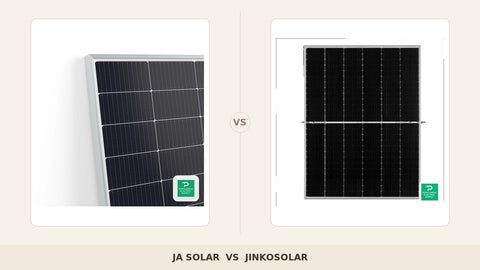
Two years ago this was a simple conversation: Qcells cost more, VSUN cost less, pick your budget. Then 2026 happened. The Section 201 safeguard expired in February, the August Section 232 proclamation dropped a $0.38/W minimum import price on foreign modules, and the final AD/CVD determinations on Vietnam landed at 56–272% depending on the shipper. VSUN builds in Vietnam. Qcells builds in Dalton, Georgia. The math that used to favor the value import now has a tariff stack sitting on top of it, and any honest comparison has to start there.
We stock both lines, and we've kitted both for residential jobs across the Pacific Northwest. This is the distributor-level breakdown: verified spec classes, the real landed-cost math after tariffs, string design numbers, warranty terms side by side, and the jobs where each brand is the right call. No brochure language — just what we'd tell you across the counter.
Why This Matchup Matters in 2026
Qcells' Q.TRON line is the volume king of US-assembled residential modules: N-type TOPCon, 400–440 W class, up to roughly 22.5% efficiency, backed by Hanwha's massive Georgia investment. VSUN — Japan-headquartered with Fuji Solar backing and BNEF Tier-1 bankability status — sells the Vesta N TOPCon series as its current line, a legitimate N-type product at value-tier pricing. On paper the panels compete directly. The 2026 trade environment is what separates them.
For a cash residential buyer, the question is brutally simple: after duties, freight, and the import price floor, does VSUN still undercut Qcells by enough to matter? For a commercial buyer chasing the domestic-content adder, the question answers itself — only one of these panels has a pathway. Let's run the numbers.
Side-by-Side Specification Table
Figures reflect the residential classes we actually move: Qcells Q.TRON BLK M-G2 class versus VSUN Vesta N residential class. Confirm SKU-level numbers on the current datasheets before you permit.
| Specification | Qcells (Q.TRON class) | VSUN (Vesta N class) |
|---|---|---|
| Cell Architecture | N-type TOPCon (Q.ANTUM NEO) | Mono PERC heritage; Vesta N = N-type TOPCon current line |
| Residential Wattage Class | ~400–440 W residential (commercial siblings to ~500 W+) | ~360–450 W residential class; utility bifacial siblings higher |
| Max Module Efficiency | Up to ~22.5% | ~20.4–21.5% class by series |
| Temperature Coefficient (Pmax) | ~−0.30%/°C class | Standard N-type class (~−0.30%/°C); verify per series |
| Degradation / Long-Term Output | ≤1% class first year, ~0.33–0.40%/yr — ≥86–90.5% at year 25 by series | Standard Tier-1 class linear power warranty; verify per series |
| Product / Performance Warranty | 25 yr product / 25 yr performance; Q.PARTNER labor reimbursement up to $250/claim (≤25 kW) | 12 yr product class; 25–30 yr performance by series |
| Manufacturing / Bankability | Assembled in Dalton, Georgia, USA — largest fab in the Western Hemisphere (Hanwha-owned) | Japan-headquartered (Fuji Solar investment); BNEF Tier-1 listed; Vietnam production base |
| Load / Corrosion Rating | Standard premium class | Certified wind 2400 Pa / snow 5400 Pa; salt & ammonia corrosion resistant |
| Typical Price Position | +$0.15–0.30/W over commodity; best-value premium tier | Value-to-mid Tier-1 pricing before tariff stack |
Notice how many VSUN rows carry "verify per series." That's not laziness — it's the reality of a multi-factory value brand whose datasheet revisions lag production changes by a quarter or two. We verify the exact warranty term and degradation schedule on every VSUN PO we place, and you should too. Qcells, by contrast, publishes one of the most consistent warranty documents in the industry.
The Tariff Math: What "Value Import" Means in 2026
Here's the calculation our purchasing desk runs weekly. The August 2026 Section 232 program sets a minimum import price of $0.38/W on modules measured at first arm's-length US sale, plus a 15% ad valorem duty for most origins — and it stacks on top of the Vietnam AD/CVD rates finalized earlier. Pre-August, US-delivered Tier-1 imports ran $0.27–0.32/W. That world is gone.
| Landed Cost Factor (module, US-delivered) | Qcells (US-made) | VSUN (Vietnam import) |
|---|---|---|
| Base factory price class | US production cost | SE Asia FOB ~$0.10–0.12/W class |
| Section 232 module MIP floor | Not applicable | $0.38/W minimum |
| Section 232 ad valorem duty | Not applicable | +15% (most origins) |
| Vietnam AD/CVD (supplier-specific) | Not applicable | +56–272% — depends on the exact shipping entity |
| Freight & handling | Domestic truck/rail | Ocean + port + drayage |
| Realistic landed band | Distributor sheet price | Often at or above US-made pricing after stack |
Read the bottom row again. Contracts signed before August 6, 2026 were grandfathered, so the market still has pockets of pre-MIP VSUN inventory clearing at old prices — that's the one window where the value import still wins on sticker price. Once that inventory burns through, the price advantage that justified this comparison largely evaporates for new orders. We tell contractors: if you see legacy VSUN stock priced right and the warranty paperwork checks out, buy it. Just know it's the last of an era, and confirm the AD/CVD exposure was settled by the importer of record, not passed to you downstream.
Technology: Q.ANTUM NEO vs Vesta N
Strip the tariffs away and these are both N-type TOPCon panels — the same technology family that dominates global shipments in 2026. TOPCon's passivating-contact cell design beats the old PERC generation on first-year degradation, bifaciality, and low-light response. VSUN deserves credit: the Vesta N line is a genuine N-type product, not a rebadged PERC panel, and its salt-mist and ammonia certifications make it a legitimate choice for coastal and agricultural installs.
Where Qcells separates is execution at scale. The Georgia fab turns out Q.TRON modules with binning tight enough that our kitting crew stops checking flash reports on mixed pallets — every panel in a residential string performs like its neighbor. VSUN's binning is fine for the price class, but we've seen slightly wider spread on multi-pallet commercial orders. For a 20-panel house array, you'll never notice. For a 500-panel carport, model it.
Temperature coefficients land in the same class (~−0.30%/°C), so hot-climate output is a wash between these two. The efficiency gap — ~22.5% versus ~20.4–21.5% — is the real differentiator, worth roughly one extra panel of roof space per 20 on the value side.
On reliability testing, Qcells submits to Kiwa PVEL's scorecard regimen — thermal cycling, damp heat, mechanical stress, PID, UVID, and the hail sequence — and the Q.TRON family has performed in the top cohort in recent editions. VSUN publishes third-party certification data for its load and corrosion claims, which is more than most value brands can show. When we evaluate a value-tier line for stocking, PVEL participation is the first filter; a panel that survives the hail stress sequence survives the Midwest, and one the manufacturer won't submit to testing tells its own story.
System Design Math: An 8 kW Residential Array
| Design Figure | Qcells Q.TRON 430 W | VSUN Vesta N 400 W class |
|---|---|---|
| Panels for ~8 kW DC | 19 × 430 W = 8,170 W | 20 × 400 W = 8,000 W |
| Approx. roof area @ ~1.95 m²/panel | ~37.1 m² (~399 ft²) | ~39.0 m² (~420 ft²) |
| Strings of 10 (Voc ~49–50 V class) | 2 strings (10 + 9) | 2 strings (10 + 10) |
| Panel count delta | — | +1 panel, +1 attachment set |
| BOS impact (racking + labor) | — | ~$50–80 incremental |
One extra panel barely registers on a house job — a rail section, two mid-clamps, twenty minutes. The design difference that matters more is roof geometry: Qcells' higher power density buys you layout flexibility on chopped-up roofs with vents and skylights. When we model tight roofs in the system size calculator, denser panels rescue designs that otherwise drop a whole string.
NEC 690.7 String Voltage: A Worked Example
Residential one- and two-family dwellings cap system voltage at 600 V. With modern 54/60-cell-class modules running Voc around 49–50 V, cold mornings decide your maximum string length. NEC 690.7 requires temperature-corrected Voc; here's the worked math for a −10 °C design morning with a typical −0.28%/°C Voc coefficient (ΔT = −35 °C → correction factor ≈ 1.098):
| String Length | STC Voc (×49.5 V) | Cold-corrected (×1.098) | 600 V Verdict |
|---|---|---|---|
| 10 modules | 495 V | ~543 V | Pass |
| 11 modules | 544.5 V | ~598 V | Pass — barely |
| 12 modules | 594 V | ~652 V | Fail — exceeds 600 V |
Twelve-module strings are the classic permit rejection we see from DIY designs. Keep residential strings at 11 max for this module class in cold climates, and always re-run the correction with the exact Voc and coefficient from your SKU's datasheet — a 52 V Voc panel changes the answer. Our NEC wire sizing and ampacity guide covers the conductor side of the same design.
Warranty and Bankability, Side by Side
| Warranty Element | Qcells | VSUN |
|---|---|---|
| Product warranty | 25 years, current residential lines | 12-year class (verify per series) |
| Performance warranty | 25 years linear | 25–30 years linear by series |
| Labor reimbursement | Q.PARTNER: up to $250/claim (≤25 kW) | Not standard |
| Claim servicing | US support desk, Georgia | Through distributor/importer channel |
| BNEF Tier-1 bankability | Yes (Hanwha Qcells) | Yes (listed) |
| Counterparty geography | South Korea / USA | Japan HQ / Vietnam production |
The product-warranty gap — 25 years versus a 12-year class — is the sleeper issue in this comparison. Panels rarely die in year 3, but when one does, Qcells ships a replacement under warranty with labor money attached. A 12-year product term on a panel you'll own for 30 leaves years 13–30 exposed on the hardware itself. We say this as a distributor who profits either way: warranty length is cheap to buy upfront and expensive to wish for later.
Field Notes: What We See on the Dock
I've personally inspected inbound pallets of both. Qcells arrives in clean, consistent packaging with serial lists that match the paperwork — boring, which is exactly what you want. VSUN packaging is solid too, but we've had two shipments over the years where the flash reports arrived a week after the modules did. Not a functional problem, but if you're the type who verifies binning before install day, order early.
On roofs, both rack up normally with standard hardware from our racking and mounting collection. VSUN's 5400 Pa snow and salt-mist certifications are genuinely useful in coastal Oregon and Washington jobs where corrosion eats cheap frames — we've recommended Vesta N specifically for a cranberry-farm install where ammonia resistance mattered. Qcells' all-black residential aesthetics photograph better for the homeowner's resale listing, and yes, people ask about that.
25-Year Energy Yield Math
Assumptions for a planning-grade comparison: 8 kW DC array, 1,400 kWh/kWp first-year yield, warranted degradation applied linearly from the published warranty classes. Qcells Q.TRON class: ≤1% year one, ~0.33–0.40%/yr after, ≥90.5% warranted at year 25 on current lines. VSUN Vesta N: standard Tier-1 N-type linear warranty class — we model 1% first year and ~0.40%/yr thereafter (~89–90% at year 25), and we re-verify the exact schedule on the SKU datasheet at quote time because VSUN's terms vary more by series than the big US brands.
| Metric | Qcells Q.TRON class | VSUN Vesta N class |
|---|---|---|
| Year-1 production | ~11,200 kWh | ~11,200 kWh |
| Year-25 warranted fraction | ≥90.5% | ~89–90% (verify per series) |
| Year-25 production | ~10,140 kWh | ~10,030 kWh |
| 25-yr cumulative (approx.) | ~267 MWh | ~265 MWh |
| Cumulative difference | ~2 MWh over 25 years — roughly $300 at $0.15/kWh. Not decisive. | |
The yield fight between these two is nearly a draw — same technology family, same tempco class, one warranty class apart on degradation. That pushes the decision back to warranty depth, tariffs, and content eligibility, which is exactly why the 2026 trade stack looms so large in this matchup. If the numbers land within $300 over 25 years, buy the warranty and the supply chain.
Climate and Site Fit
Hot inland sites — the San Joaquin Valley, central Texas, the Gulf Coast — treat these two almost identically, since both sit in the ~−0.30%/°C temperature class. Where VSUN earns specific recommendations is corrosion country: certified salt-mist resistance for oceanfront installs and ammonia resistance for dairy and poultry operations. Those certifications cost real testing money, and plenty of premium brands skip them. We've specced VSUN on two Oregon coast jobs for exactly that reason, where blowing salt haze pits lesser frames inside a decade.
Cold-climate buyers should weight the warranty side instead. Panels love cold — voltage and efficiency rise as temperature drops — so the hardware stress in snow country is mechanical, not electrical. VSUN's 5400 Pa snow rating handles most of it; Qcells' premium-class ratings handle the rest with margin. Either way, spend the savings on rail and attachment upgrades before you spend them on panel brand. A 5400 Pa panel on undersized rail is a kite waiting for March.
Availability, Kitting, and Lead Times
From our dock: Qcells residential classes restock on 1–3 week cycles out of Georgia, and replacement panels for warranty swaps move fast because the supply chain is continental. VSUN lead times swing with ocean freight and customs — 4–10 weeks is a normal band, longer when tariff paperwork snarls a container. For a contractor scheduling crews, that variance is a hidden cost: a slipped module delivery idles a three-person crew at $1,500+ per day. We pad VSUN timelines in every project schedule and suggest you do the same, or take delivery to your own shop before the roof date.
Both brands kit cleanly into residential packages. When we build complete solar kits, Qcells is the default panel because the warranty registration and serial paperwork flow straight through; VSUN is the value swap when a customer finds verified legacy stock or needs the corrosion certifications. For DIY buyers, the kits buyer's guide explains what else goes in the BOM besides panels.
Permitting and Inspection Notes
Both brands carry the listings inspectors actually ask for: UL 61730 certification and California CEC listing, which keeps California incentive-eligible designs clean. Where they differ in the field is paperwork retrieval. Qcells' US support portal puts datasheets, warranty documents, and certification letters one search away — we've emailed them to plan checkers mid-review more than once. VSUN documentation flows through the distributor channel, which is fine when you order through a house that keeps the paperwork organized (we do), and frustrating when the modules came from a gray-market pallet with no paper trail.
That gray-market point deserves emphasis in 2026. As the tariff stack squeezed import margins, we've watched more transshipped and mislabeled inventory float around the value end of the market. Before you buy any value-tier import panel this year, confirm three things: the importer of record, the settled AD/CVD rate for the shipping entity, and that the serial prefixes match the manufacturer's published format. Ten minutes of diligence beats discovering at inspection time that your "Tier-1" panels have no valid US warranty behind them. If a deal looks wildly cheaper than everything else in this comparison, that's not a bargain — it's a flag.
For module-level electronics pairing and rapid-shutdown design, our microinverter vs string inverter guide covers the NEC 690.12 side of the layout, and the monitoring and communications collection has the gateways both panel brands report through.
Choose Qcells If / Choose VSUN If
After two decades of watching panel brands come and go, our counter advice boils down to this: the cheapest watt is only cheap if the company and the paperwork survive the life of the roof. Here's how each brand earns its place on a quote.
Choose Qcells if: you want 25/25 warranty coverage with labor reimbursement; your roof is space-constrained; the job is commercial and chasing domestic-content points; you're buying after the pre-MIP inventory clears; or you simply want the panel with the deepest US supply chain behind it. Browse current stock in our Qcells collection, including the XL G11S commercial class and the 440 W residential class.
Choose VSUN if: you find verified pre-tariff inventory at legacy pricing; the install is coastal or agricultural and the salt/ammonia certifications carry weight; the project is a large open ground mount where panel density doesn't pay; or your financing specifically values BNEF Tier-1 listing over warranty length. Check availability in the VSUN collection and cross-shop the 400–459 W class.
For the broader field, the best panels of 2026 roundup ranks both against REC, Silfab, and the import majors; the Qcells vs Trina vs JA comparison covers the other big import fight; and our Qcells vs Silfab breakdown handles the all-North-American matchup. Both brands drop into our complete solar kits and grid-tied systems, pair with anything in the microinverter lineup, and we quote both daily on the quote page. New to system planning? Start with the panel kits buyer's guide.
Frequently Asked Questions
Is VSUN a Tier-1 panel?
Yes — VSUN holds BloombergNEF Tier-1 bankability listing, which is a financing metric based on bank-funded projects using the brand. It's a real signal of manufacturer scale, though Tier-1 says nothing about warranty length or degradation class by itself.
How do the 2026 tariffs affect VSUN pricing?
VSUN's Vietnam production faces the Section 232 minimum import price of $0.38/W plus a 15% ad valorem duty, stacked on Vietnam-specific AD/CVD rates of 56–272%. Contracts signed before August 6, 2026 are exempt, so remaining legacy inventory is the only place pre-tariff pricing survives.
Which panel is more efficient?
Qcells Q.TRON tops out around 22.5% module efficiency; VSUN's residential Vesta N class runs roughly 20.4–21.5% by series. On an 8 kW array that's about one extra panel of roof space for the value side.
Which warranty is better?
Qcells: 25-year product and 25-year performance, plus Q.PARTNER labor reimbursement up to $250 per claim. VSUN: roughly 12-year product class with 25–30 year linear performance by series. Qcells wins this row clearly.
Can either brand qualify for the domestic content bonus?
Qcells' Georgia-assembled modules offer a domestic-content pathway for commercial 48E projects, subject to BOM cost-share verification. Vietnam-made VSUN modules do not. For commercial buyers chasing the 10-point adder, that alone usually settles the comparison.
Are both panels compatible with microinverters?
Yes. Both use standard MC4-compatible connectors and pair with Enphase, Hoymiles, and APsystems micros or SolarEdge/Tigo optimizers. No proprietary electronics required for either brand.
Sources & Standards
- Qcells Q.TRON BLK M-G2 datasheet and limited warranty (us.qcells.com)
- VSUN Vesta N series datasheet and warranty terms (vsun.com)
- US Section 232 polysilicon/solar proclamation and MIP program (August 2026)
- Final AD/CVD determinations on SE-Asia solar modules (supplier-specific rates)
- NEC 2023 Articles 690.7, 690.8 and Table 310.16
- BloombergNEF Tier-1 module manufacturer list (Q2 2026)