Victron vs Morningstar 2026: MPPT Charge Controllers Compared
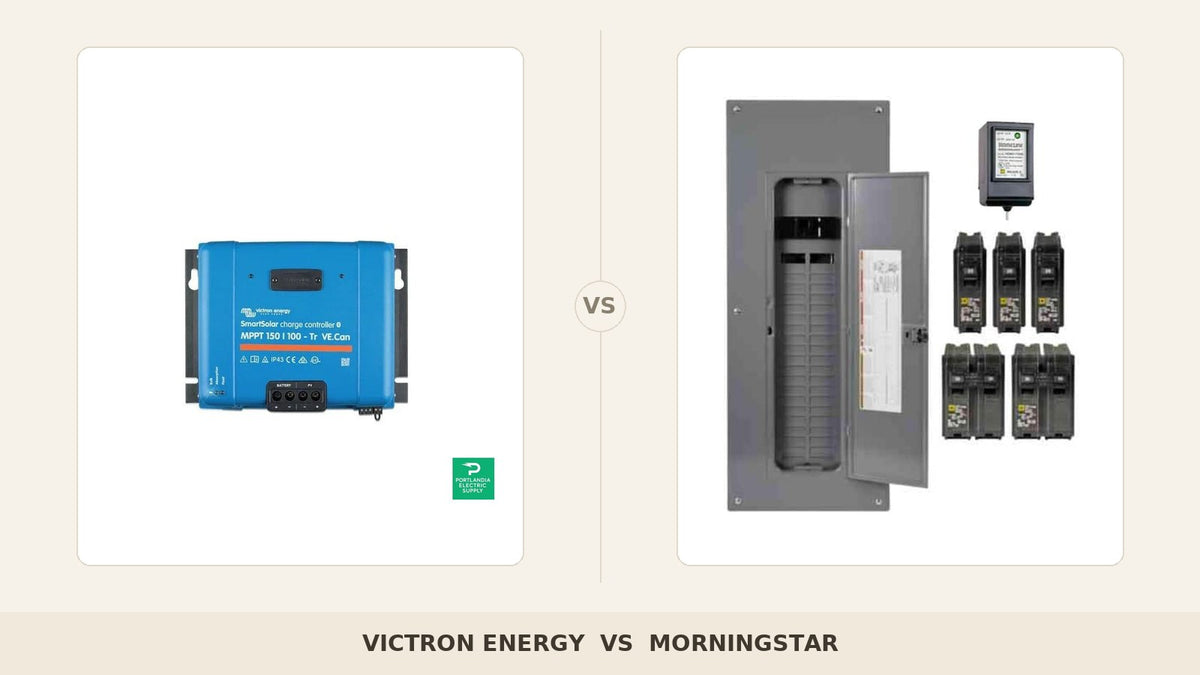
The two charge-controller brands our off-grid customers actually cross-shop. One is the connected ecosystem king; the other is the set-it-and-forget-it tank. Which one belongs on your battery room wall?
Charge controllers are the most under-thought purchase in off-grid solar. People agonize over panels and inverters for weeks, then grab whatever controller fits the budget — and then wonder why the batteries died young. We've rebuilt enough murdered battery banks to have feelings about this. The two brands that survive our counter scrutiny are Victron Energy (SmartSolar line) and Morningstar (TriStar and ProStar MPPT lines), and they win for opposite reasons: Victron built the best-connected, most-configurable controller ecosystem in the business; Morningstar built the most indestructible one. This article picks between them with real math.
If you need the fundamentals first — what MPPT actually does, why it beats PWM by 20–30% on real arrays — read our MPPT vs PWM explainer and the controller sizing guide, then come back for the brand fight.
| Dimension | Victron SmartSolar MPPT | Morningstar TriStar / ProStar MPPT |
|---|---|---|
| System voltages | 12/24/48 V (model-dependent) | 12/24/48 V (model-dependent) |
| Charge current range | 10–100 A classes | 25–60 A classes |
| Max PV input voltage | 75–450 V by model (RS line to 450 V) | 120–600 V (TriStar 600 V class available) |
| Connectivity | Bluetooth built-in, VE.Direct, VE.Can; full GX/VRM integration | Optional MeterBus/Ethernet; MSView software |
| Monitoring depth | Best-in-class: app, VRM cloud, local APIs, history | Basic without add-ons; solid meters available |
| Charge profile programming | Fully custom + presets; closed-loop BMS integration | Custom setpoints via software; DIP/jumper simplicity on smaller units |
| Environmental toughness | Good (conformal-coated boards; vented metal cases) | Legendary — the brand off-grid old-timers trust in deserts and mines |
| Fan cooling | Passive on most models (derating at high temp) | Passive across the line |
| Warranty | 5 years | 5 years (lifetime reputation earned in the field) |
| Price position (60 A class) | ~$400–$650 | ~$600–$900 |
Specs reflect current production models at writing; both brands publish exhaustive datasheets, and the exact voltage ceiling matters enormously to string design — check the SKU, not the family name. Current stock lives in our charge controller collection, with the 60 A and 100 A shelves carrying most of the volume.
Before any brand debate, size the controller. Two limits bind: charge current (array watts ÷ battery voltage, with headroom) and PV input voltage (cold-weather string Voc must stay under the controller's ceiling, per NEC 690.7 logic). Worked example — the most common cabin build we sell: 1,200 W of array on a 24 V bank.
| Step | Calculation | Result |
|---|---|---|
| Charge current required | 1,200 W ÷ 24 V = 50 A nominal; battery-side reality ~28.8 V boost | ~42–50 A → 50–60 A controller class |
| Headroom rule | Size at 125% of expected max current | 50 × 1.25 = 62.5 A → 60 A class acceptable at moderate temps |
| String Voc check (3 × 49.6 V modules, -10°C, factor 1.12) | 3 × 55.6 V | 166.8 V → needs 200 V-class input (Victron 250/xx or Morningstar high-V) |
| Alternative string (2 in series) | 2 × 55.6 V = 111.2 V | Fits 150 V-class controllers — cheaper box, more parallel strings |
| Home-run conductor (Isc 13.1 A, 2 parallel strings) | 2 × 13.1 × 1.56 | 40.9 A → 8 AWG PV wire |
| Battery-side conductor (60 A charge) | 60 × 1.25 = 75 A | 4 AWG Cu, 80 A class-T or ANL fuse |
That fourth row is the quiet cost lever: choosing 2-in-series strings instead of 3-in-series can drop you from a 250 V-class controller to a 150 V-class controller, saving $100–$300 on the box at the cost of one more pair of home-run conductors. On a 30-foot run, the wire wins almost every time. Cross-check conductors on the ampacity chart and pulls on the conduit fill chart.
SmartSolar controllers are nodes in an ecosystem. Bluetooth on every unit means your phone is the display — no $200 meter accessory required to see what the array did yesterday. VE.Can networking lets multiple controllers share a synchronized charge state, so four controllers on one bank absorb and float in lockstep instead of fighting. Closed-loop BMS integration via a Cerbo GX means a lithium bank's own brain can throttle the charging directly. And VRM logging gives you harvest history per controller, forever, for free. For systems that grow — and off-grid systems always grow — that telemetry is how you know when to add the next string. I've diagnosed a failing panel string from 200 miles away because VRM showed one controller's harvest diverging from its twin; the customer thought the weather changed. That capability simply doesn't exist in this price class anywhere else. Specific workhorses on our shelf: the SmartSolar 250/60 class and the 150/100 class cover most cabin and homestead builds.
Morningstar's reputation was forged in places with no service network: telecom sites, mining camps, research stations, water pumping in the Sahel. Conformal-coated boards, conservative thermal design, passive cooling with honest derating curves, and firmware that does exactly what it did the day it left the factory. The TriStar MPPT 60 and the 600 V-class variants will run for fifteen years in a hot, dusty shed and never ask for a firmware update. There is no cloud dependency because there is no cloud — for a water pump 40 miles from pavement, that's not a limitation, it's the spec. If your site has no internet and your tolerance for electronics fuss is zero, Morningstar is the answer and has been for three decades. Pair it with their meter or just read the battery voltage like our grandfathers did. The MidNite Solar line is the other American tank worth considering at the high end, but that's a different article.
| Project profile | Our pick | Why |
|---|---|---|
| Off-grid cabin, owner visits weekends | Victron SmartSolar | Remote monitoring tells you the system is alive without driving there |
| Full-time homestead, technically engaged owner | Victron + Cerbo GX | Closed-loop lithium integration and per-controller harvest history |
| Remote water pumping / telecom, no connectivity | Morningstar TriStar | Zero cloud dependency, fifteen-year field record |
| RV / marine house bank | Victron (compact 75/15–100/30 classes) | Bluetooth setup in a cramped bay is worth the whole price delta |
| High-voltage long-run array (500 ft to the array) | Morningstar 600 V or Victron RS 450 V | Both field high-V options; long runs kill voltage, so check both lines' current stock |
| Budget build, lead-acid bank, simple needs | Either — buy on price that week | Both outlast the batteries they'll charge |
This is the section that pays for the article. A controller's real job is executing the charge profile your battery chemistry demands: absorb voltage, absorb time, float voltage, temperature compensation, and equalization policy for flooded lead. Get these wrong and a $3,000 battery bank dies in three years; get them right and the same bank does eight. Both brands ship sane presets and allow full custom profiles — Victron through the app (gloriously easy), Morningstar through MSView (functional, dated, works). For lithium banks, both support the low-temperature charge cutoff that LiFePO4 demands below freezing — Victron via its Smart Battery Sense/BMS integration, Morningstar via remote temperature sensor logic. Our battery life guide and the 20/80 rule explainer cover the chemistry side; the 12 V 100 Ah charge-time math shows what undersized charging does to a bank in the field.
| Bank type (24 V example) | Absorb | Float | Equalize | Temp comp |
|---|---|---|---|---|
| Flooded lead-acid (Trojan/Rolls class) | 28.8–29.6 V | 27.0 V | 31.0 V monthly, supervised | -30 mV/°C essential |
| AGM | 28.6–28.8 V | 27.0 V | Per manufacturer only | -24 mV/°C |
| LiFePO4 (EG4/Pytes class) | 28.4–28.8 V, short absorb | 27.0–27.2 V or disabled | Never | Low-temp cutoff mandatory |
Battery-side wiring on either brand follows the same rule as everything 48 V and below: fuse within 7 inches of the bank, size conductors at 125% of controller max output, torque to spec. The wire guide has the conductor picks, and our bank sizing guide keeps the whole system proportional.
- Total your array watts and divide by battery voltage for nominal charge amps.
- Multiply by 1.25 for the controller's continuous rating.
- Compute cold-weather string Voc (module Voc × temp correction × modules in series) and confirm it sits under the controller's input ceiling with margin.
- Choose the string configuration that puts you in the cheapest controller voltage class that clears step 3.
- Size and fuse the battery-side conductors at 125% of controller max output, then wire it and set the charge profile for your exact battery model on day one.
Do those five things and either brand will serve you for a decade or three. Skip step 5 and the fanciest controller on the market will still cook your bank by 2029. If your project outgrows a single controller — or you're weighing a component build against an all-in-one hybrid — our Victron MultiPlus vs Sol-Ark comparison is the next read. Live stock: Victron and Morningstar.
MPPT conversion efficiency on both brands peaks at 96–99% depending on the voltage step-down ratio — smaller steps convert cooler. What separates field survivors from warranty claims is thermal behavior at rated current: both lines are passively cooled, which means both derate in hot enclosures. A 60 A controller in a 40°C battery shed with no airflow is not a 60 A controller; it's a 45 A controller with ambitions. Our install standard: mount controllers vertically on a non-combustible backer, leave the manufacturer's clearance (6 inches above and below is the minimum we accept), and never put one in a sealed box with the batteries — flooded banks off-gas hydrogen, and electronics plus hydrogen plus a spark is a story you only tell once. These are NEC 480/690-adjacent ventilation realities your inspector cares about, and our disconnect and OCPD guide covers the protective hardware around the controller.
| Install condition | Effective capacity vs nameplate | Field guidance |
|---|---|---|
| 25°C, open wall mount, vertical | 100% | The datasheet condition — aim for it |
| 35°C shed, vertical, clear airflow | ~90–95% | Fine; check manual derating table |
| 40°C+ enclosed cabinet | ~70–80% and falling | Add ventilation or upsize the controller |
| Sealed battery box (never do this) | N/A | Hydrogen + electronics: absolute prohibition |
Controller economics are simple: the box is cheap, the batteries are expensive, and the controller's job is to protect the batteries. A $500 controller that executes a correct profile doubles a lead-acid bank's life versus a $150 special that doesn't — we've autopsied both outcomes. Victron ownership adds monitoring value daily and firmware-update discipline occasionally; Morningstar ownership adds nothing at all, which is precisely its charm. Failure modes we've actually processed: Victron — a handful of units after lightning-adjacent surges on unprotected arrays (fit the SPDs; the surge protection guide exists for exactly this), zero thermal failures on correctly mounted units. Morningstar — essentially none that weren't installation-inflicted. Both brands' five-year warranties have been honored without drama in our claims file. Budget one spare controller in your off-grid kit if the site is remote — whichever brand you run, a week without charging is harder on the bank than the spare is on the shelf.
The ecosystem question worth asking before you buy the first controller: will this system grow an inverter, more arrays, and a monitoring habit? If yes, starting inside Victron's ecosystem (controller → MultiPlus → Cerbo GX) saves re-buying later; our MultiPlus vs Sol-Ark piece maps that growth path. If the answer is "it runs the pump, forever, alone," buy the Morningstar and go fishing.
| Build | Array / bank | Controller pick | Why it won |
|---|---|---|---|
| Weekend cabin, owner monitors from town | 1,600 W / 24 V 200 Ah LiFePO4 | Victron SmartSolar 150/60 | Bluetooth + VRM history; low-temp lithium cutoff via Smart Battery Sense |
| Stock-water pumping site, no internet, 100°F summers | 2,400 W / 48 V flooded | Morningstar TriStar MPPT 60 | Passive cooling, no cloud, temperature-compensated flooded profile, decade-plus record |
| Full-time homestead, expanding yearly | 5,000 W growing / 48 V 30 kWh | 2 × Victron SmartSolar 250/100 + Cerbo GX | Synchronized multi-controller charging, closed-loop BMS, per-string harvest data guides the next expansion |
Notice the pattern: connectivity and growth point at Victron; isolation and hostility point at Morningstar. Most real systems contain a little of both, which is why the honest answer to "which brand?" is usually "which site?" Bring us the site description — array size, bank chemistry, distance, climate, and whether anyone will ever look at an app — and the pick takes about ninety seconds. The battery calculator and off-grid storage guide get your bank numbers ready for that conversation.
Final field habit, free with purchase of this article: write the charge-profile setpoints on a label inside the controller door at commissioning. Batteries get replaced, owners forget, and the next tech — possibly you, three years older — should never have to guess what voltage this bank was told to absorb at. The controller brands fight over features; the label fights entropy, and entropy is undefeated without it.
- Sizing to array watts alone. A 1,200 W array on a 12 V bank needs ~100 A of controller, not the 40 A unit that "matches the panels." Battery voltage is the divisor that decides everything.
- Ignoring cold Voc. Three 50 V modules in series are 150 V in July and 168 V on a January dawn. On a 150 V controller, that's a warranty-denied paperweight. Run the math with the record low, not the average low.
- Lithium on lead presets. The bank "works" for two years, then dies at 40% of rated cycle life. Set the profile on day one; both brands make it easy.
- No temperature compensation on flooded banks. A $30 remote sensor is the cheapest battery-life insurance either brand sells.
- Under-fused battery connections. The controller's battery-side conductor needs a fuse within 7 inches of the bank, sized at 125% of max output. This is the connection that starts fires when skipped.
Avoid those five and the brand question becomes what it should be: a preference, not a gamble.
One last thought from the design desk before you order: the controller is the only component in an off-grid system that touches every watt you'll ever harvest. Panels get the glory and batteries get the budget, but the quiet box on the wall decides, every single day, whether that harvest becomes stored energy or waste heat. Buy it deliberately, mount it with airflow, fuse it properly, and set its profile like the battery bank's life depends on it — because it does. Both brands in this article will honor that care with a decade or more of silent service. The ones in the bargain bin won't. Current stock and pricing: Victron Energy and Morningstar, with the broader shelf in charge controllers.
If you're pairing this controller decision with panels, the TOPCon vs HJT comparison and our 2026 panel roundup cover the array side, and the portable panel shelf serves the small mobile builds these controllers often anchor. And if the project is really an inverter question in disguise, the inverter sizing calculator settles that first.
Either way, welcome to the last brand argument in your off-grid build. Charge controllers are where the forums and the field agree: buy one of these two, size it honestly, and spend your remaining worry on the batteries. We'll see you at the counter when the array grows — it always does.
Is Victron or Morningstar more reliable?
Morningstar has the longer indestructibility record in harsh, unattended industrial sites — telecom and mining deployments measured in decades. Victron's SmartSolar line has an excellent record in residential, marine, and RV service with far more units in the field. Both will outlive the batteries they charge when sized and ventilated correctly; the real reliability difference is cloud dependency (Victron's features assume connectivity you'll want; Morningstar assumes none).
What size MPPT controller do I need for my array?
Divide array watts by battery voltage, multiply by 1.25, and that's your charge-current class. Then verify cold-weather string Voc against the controller's input voltage ceiling — that second check is the one people skip, and it's the one that kills controllers on the first cold morning. Our sizing guide walks both calculations with worked examples.
Can Victron and Morningstar controllers charge lithium batteries?
Yes, both fully support LiFePO4 profiles. Victron integrates closed-loop with smart BMS platforms through a Cerbo GX and offers low-temperature charge cutoff via Smart Battery Sense. Morningstar supports custom lithium setpoints and low-temp cutoff via remote temperature sensing. Never run lithium on a lead-acid preset — float behavior and temperature rules differ.
Do I need a display or meter for these controllers?
Victron builds Bluetooth into every SmartSolar unit, so your phone is the display — no extra hardware required. Morningstar's meters are optional add-ons; without one, smaller units communicate through status LEDs. For unattended remote sites, the Morningstar approach is fine; for systems you'll actually monitor, Victron's built-in connectivity is a genuine cost advantage.
Can multiple charge controllers share one battery bank?
Yes — it's standard practice as arrays grow. Victron VE.Can-networked controllers synchronize their charge states through a GX device, which is the cleanest multi-controller behavior available. Morningstar controllers share a bank fine with matched setpoints; they just don't talk to each other. Either way, fuse each controller's battery connection independently.
What's the difference between 150V, 250V, and 600V controller classes?
The input voltage ceiling sets how many modules you can series into a string: 150V-class fits 2–3 residential modules in series, 250V-class fits 4–5, and 600V-class takes long commercial strings or serves arrays hundreds of feet from the battery room where high voltage tames wire loss. Higher ceilings cost more per amp, so choose the string configuration before the controller, not after.