Generac vs Kohler Home Standby Generators (2026): 22–26 kW Compared
The two premium badges in residential standby, head-to-head on engines, enclosures, warranty, monitoring, and ten-year ownership cost — with the install details that actually decide which one you want on your pad.
This is the heavyweight fight of residential standby power. Nobody wins it in one round. Generac is the volume king — the orange-and-gray Guardian is the best-selling home standby generator in North America by a wide margin, and its dealer network reaches nearly every county. Kohler is the prestige challenger: a 100-plus-year-old engine and power company whose residential units carry commercial DNA, and whose dealers tend to be full-service electrical contractors rather than generator-only shops. We've commissioned both brands on 200-amp services, and the first thing we'll tell you is that both are excellent machines — the differences are in ecosystem, support structure, and about $1,000 of installed cost, not in whether the lights come on.
This comparison covers the air-cooled lines where the two brands fight for the same driveway: Generac's Guardian series 22 kW and 26 kW (including the popular Generac 7291 26 kW Guardian with 200A service-entrance ATS) against Kohler's 20RESC/26RCA-class air-cooled units. We'll walk specs, fuel, transfer ecosystems, noise, warranty structure, service networks, and the full installed-cost math — then finish with the decision framework we use when customers put both quotes on our counter.
Both brands publish detailed datasheets, and in this class the numbers land close. The table normalizes representative current models — verify your exact model number's sheet before ordering, because both brands revise output ratings and fuel curves between model years.
| Category | Generac Guardian 22/26 kW | Kohler 20–26 kW air-cooled |
|---|---|---|
| Engine | G-Force 999cc air-cooled V-twin, purpose-built for standby | Kohler Command PRO CH1000-class V-twin, commercial-grade lineage |
| Output (NG / LP) | 22 kW both fuels on the 22; 26 kW LP with modest NG derate on the 26 | 20–26 kW class; NG derate similar in magnitude |
| Alternator | Brushless, <5% THD | Brushless, Fast-Response excitation, strong motor-start kVA reputation |
| Transfer switch | 200A SE Smart Switch + Smart Management Modules | 200A SE-rated RXT ATS + OnCue load control modules |
| Controller / monitoring | Evolution + Mobile Link Wi-Fi | RDC2/DC2 controller + OnCue Plus remote monitoring |
| Enclosure | Aluminum, RhinoCoat powder coat; corrosion-resistant | Corrosion-resistant composite/aluminum; Kohler's coastal reputation is earned |
| Sound @ 23 ft | ~65–67 dB under load; quiet exercise | ~64–69 dB; comparable in the field |
| Warranty | 5-year limited | 5-year / 2,000-hour limited premium warranty |
| Equipment street price (26 kW + ATS) | ~$6,000–$7,200 | ~$6,500–$7,800 |
Two rows deserve real attention. First, the alternator: Kohler's Fast-Response excitation has a decades-long reputation for absorbing motor-start transients gracefully — the 4-ton compressor starts, the lights don't blink. Generac's current brushless units are also strong here, but Kohler's motor-start kVA per nameplate kW tends to run a touch higher, which matters on compressor-heavy homes. Second, the enclosure: Kohler's corrosion engineering (they've built marine gensets forever) gives it a genuine edge in coastal and salt-air environments. We've pulled covers on five-year-old coastal installs of both brands; the Kohler housings consistently show less fastener corrosion. Inland, the difference is cosmetic. On the coast, it's longevity.
A 22 kW generator delivers about 91 amps at 240 volts; a 26 kW unit about 108 amps. Whether that runs your house depends on your big motor loads and how the transfer switch manages them. Here's the working load table we use when customers ask if 22 kW is enough:
| Load | Running Watts | Starting Surge | Management Strategy |
|---|---|---|---|
| 4-ton central AC (soft-started) | 3,500–4,800 | 2–3× without soft start | Managed module — staged first |
| Second AC (3-ton) | 2,800–3,800 | 2–3× without soft start | Managed — runs only when capacity allows |
| Electric water heater | 4,500 | None | Managed — shed during AC calls |
| Electric range | 4,000–6,000 in use | None | Behavioral — don't bake during outages |
| EV charger (32A) | 7,700 | None | Locked out on 22 kW; managed on 26 kW |
| Furnace blower + fridge + lights + internet | 1,200–2,000 | Modest | Unmanaged baseline |
Run the arithmetic: a 2.5 kW evening baseline plus one managed 4-ton AC cycling at half duty averages about 4.5–5.5 kW — a 22 kW unit cruises at 25% load. Add a second compressor and an electric water heater without management, and you're past comfort on a 22 kW and into 26 kW territory. This is why we never size from square footage. We've put 22 kW units on 3,200 sq ft homes that never broke 40% load, and we've seen 1,800 sq ft all-electric condos that needed 26 kW. The panel schedule tells the truth; the floor plan doesn't. Our whole-home sizing guide, the what-size-do-I-need walkthrough, and the 26 kW complete guide run this math in full detail.
Unlike the Generac-vs-value-brand comparisons, there's no bargain here — Kohler typically prices at or slightly above Generac. The installed stack for a 26 kW whole-home job:
| Cost Line | Generac 26 kW Path | Kohler 26 kW Path |
|---|---|---|
| Generator unit | $5,200–$6,300 | $5,700–$6,900 |
| 200A SE transfer switch + load modules | $800–$1,400 | $900–$1,500 |
| Pad and siting (NFPA 37 clearances) | $300–$900 | $300–$900 |
| Gas line work and meter verification | $800–$2,500 | $800–$2,500 |
| Electrical labor, feeders, connections | $2,200–$4,200 | $2,200–$4,200 |
| Permits and inspection | $300–$900 | $300–$900 |
| All-in installed | ~$9,600–$16,200 | ~$10,200–$16,900 |
The labor, gas, and pad lines are identical because the work is identical — the badge doesn't change NEC 702 or NFPA 54. Kohler's ~$500–$800 premium on equipment translates to roughly 5% on the total ticket. Given that gap, the brand decision should be made on ecosystem fit, dealer quality, and environment (coastal vs inland), not price. If budget is the actual driver, our Generac vs Champion and Generac vs Briggs & Stratton comparisons cover the value tier honestly.
Don't skip the gas meter math at 26 kW
A 26 kW air-cooled unit at full load pulls roughly 350–400 cubic feet of natural gas per hour — 350,000–400,000 BTU/hr. Many residential meters deliver 250–400 CFH total, and the furnace and water heater want their share. We have personally seen a commissioned 26 kW unit sag and fault at full load because nobody upsized the meter. The utility will usually upgrade the meter for free or cheap, but only if someone calls before the install. Make the call.
Same displacement class, same physics — the fuel curves overlap within a few percent. Representative published figures for the 26 kW class:
| Load | Natural Gas (ft³/hr) | Propane (gal/hr) | Cost per 24 hr, NG @ $1.20/therm |
|---|---|---|---|
| 25% (~6.5 kW) | ~170–200 | ~1.9–2.2 | ~$50–$60 |
| 50% (~13 kW) | ~250–300 | ~2.8–3.3 | ~$72–$86 |
| 75% (~19.5 kW) | ~320–370 | ~3.5–4.1 | ~$92–$107 |
| 100% (26 kW) | ~380–430 | ~4.2–4.8 | ~$110–$124 |
Natural gas is the play where available — unlimited runtime and roughly a third of propane's cost per hour. LP customers should do tank math honestly: a 500-gallon tank (400 usable gallons) carries a 26 kW unit at half load for about five days. After one particular ice storm we watched a customer's 250-gallon tank hit vaporization limits on day three of a hard cold snap — the tank couldn't boil off propane fast enough at 5°F, and the generator starved. The fix was a bigger tank, not a different generator brand. Cold-climate LP installs need vaporization-rate math, not just gallon-count math. The runtime calculator adapts to fuel budgeting if you want to model your own loads.
Both brands ship service-entrance-rated 200A automatic transfer switches with load-management accessories, and both ecosystems work well. Generac's Smart Switch plus Smart Management Modules is the most deployed residential ATS system in the country — every standby electrician has landed conductors on one, and parts sit on shelves everywhere. Kohler's RXT plus OnCue load control does the same job with a slightly more contractor-grade feel; Kohler dealers tend to be full-service electrical firms, so the install quality distribution skews favorable.
On monitoring, Mobile Link and OnCue Plus both push exercise confirmations, fault alerts, and outage notifications to your phone. Generac's app ecosystem is broader; Kohler's is perfectly functional. Neither matters as much as the weekly exercise actually completing — an alert about a missed exercise is only useful if someone reads it, and we tell every customer of both brands to be within earshot of the weekly run occasionally. The machine you hear is the machine that works.
Feeder sizing is brand-agnostic: NEC 310.16 ampacity at 75°C terminations, typically 4–6 AWG copper for these units depending on the breaker and run length, with NEC 240.6 standard breaker sizes governing the OCPD choice. Our NEC wire sizing guide and ampacity chart carry the tables, and we stock automatic transfer switches plus 200A-class gear for both ecosystems.
Both brands warranty their air-cooled lines at five years, with tiered parts/labor coverage — read the actual documents, because labor coverage steps down in later years on both. The service-network difference is structural: Generac's authorized network is the deepest in the industry, including generator-only dealers in most metros. Kohler's network is thinner but arguably more consistently credentialed — many Kohler dealers are licensed electrical contractors who do the whole job in-house rather than subbing the electrical.
Our field rule: the brand with the better local dealer wins, full stop. In most counties that's Generac by density. In markets with a strong Kohler electrical-contractor dealer, the Kohler experience can be better end-to-end. Before you choose either, make two phone calls: the Generac dealer and the Kohler dealer nearest you. Ask their current install backlog and their warranty-claim turnaround. The answers will tell you more than this article or any other.
Maintenance is identical in kind: annual oil and filter (synthetic 5W-30, ~2 quarts), plugs and air filter on interval, valve lash every few years, starting battery every 3–4 years. Dealer plans run $250–$450 a year; DIY parts run $60–$120. Over ten years, budget $2,800–$4,500 dealer-serviced either way. And let the weekly exercise run — a disabled exercise clock is how a failed starter relay hides for three years until an ice storm exposes it. The weekly twelve minutes of noise is the cheapest insurance either brand sells: it circulates oil, dries the crankcase, keeps the battery on a proper charge curve, and proves the machine starts while the grid is still up to forgive a failure. Browse current inventory in the Generac lineup and Kohler collection.
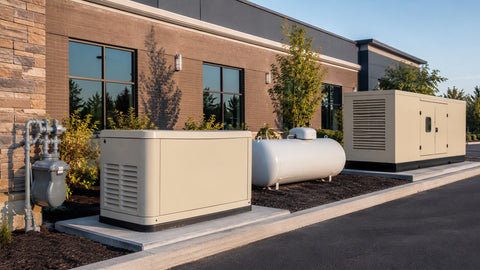
The installation sequence is identical for both brands because code writes the script: NFPA 37 clearances fix the pad location (five feet from operable openings is the rule inspectors actually measure), the gas branch gets sized off meter capacity, the ATS lands beside the main panel, and the generator feeder — commonly 4 to 6 AWG copper in conduit for these units, verified against NEC 310.16 at 75°C — runs out to the pad. Pressure test, first start, exercise clock, loaded transfer test, walkthrough. Two working days for a clean job either way. We've supervised this sequence on both badges and the swap changes maybe twenty minutes of the day — the Kohler control wiring lands a little differently, the Generac Wi-Fi provisioning takes five minutes longer, and that's the whole difference.
Because the hardware difference is that thin, we push every customer at this tier to run what we call the two-dealer test before signing anything. Call the nearest Generac dealer and the nearest Kohler dealer on the same afternoon. Ask three questions: How far out is your install schedule right now? Who performs warranty work, and what's your typical claim turnaround? Will you put a first-year maintenance visit in the quote? The dealer who answers crisply, quotes completely, and calls back when promised is telling you what the next ten years of service will feel like. A great Kohler dealer beats a mediocre Generac dealer, and vice versa — at the premium tier, you're buying a service relationship with a generator attached.
One more field note on siting both brands: think about the exhaust and the neighbors, not just the clearances. These units run weekly exercise cycles for the next decade-plus. A pad placed under a bedroom window or two feet from the property line facing the neighbor's patio creates a slow-motion dispute that costs goodwill every Sunday morning. We've moved exactly zero generators after install because it's expensive — which is why the tape-measure conversation happens before the pour. Face the exhaust away from gathering spaces, keep the mandated clearances with margin, and both brands will be quiet neighbors for years.
Choose Generac if...
You want the deepest service and parts network in the category, the most electrician-familiar transfer ecosystem, the broadest monitoring platform, and the slightly lower equipment price. Rural buyers especially should weight the dealer-density advantage — a tech within an hour beats a marginally nicer enclosure every time the power's out.
Choose Kohler if...
You're in a coastal or corrosive environment (the enclosure engineering is real), your home is compressor-heavy and you value the motor-start reputation, or your local Kohler dealer is a strong full-service electrical contractor. The ~5% installed premium buys a machine with commercial power DNA and a dealer network that skews toward licensed electricians.
Do this either way...
Verify gas meter capacity before the pad. Size from the panel schedule, not square footage. Register the warranty on time and keep maintenance receipts. Interview both local dealers and let their responsiveness pick the brand — at the premium tier, support quality is the product. If outages under ~12 hours are your main concern, also price a battery alternative via our solar battery buyer's guide before committing to combustion.
Is Kohler better than Generac for home standby?
Both are excellent premium machines. Kohler edges ahead on enclosure corrosion resistance (relevant on coasts) and motor-start alternator reputation; Generac leads on service network density, parts availability, monitoring ecosystem maturity, and price. The better local dealer should decide it — at this tier, support quality is the real product.
Why is Kohler slightly more expensive?
Equipment pricing runs about $500–$800 higher in the 26 kW class, compressing to roughly 5% on the installed ticket. You're paying for Kohler's enclosure engineering, alternator design, and a dealer network that skews toward full-service electrical contractors. Whether that's worth it depends on your environment and local dealer quality.
Is 26 kW worth the upgrade over 22 kW?
If your home has two AC compressors, electric water heat plus range, or an EV charger you refuse to lock out, yes — the extra 17 amps of capacity is the difference between managed inconvenience and true whole-home normalcy. For a single-AC home with gas heat, 22 kW with load management is usually sufficient and noticeably cheaper to buy and fuel.
Which brand is quieter?
Both rate in the mid-to-high 60s dB at 23 feet under load, and both run quieter weekly exercise modes. Field-perceived noise is dominated by siting — distance from windows, barriers, and which side of the house — not by the 1–2 dB between brands. Spend your noise budget on placement, not badge.
How long do these generators last?
With annual maintenance, air-cooled units of both brands routinely deliver 12–15 years of standby service; we've serviced examples of both past that mark. The killers are skipped oil changes, dead starting batteries, and disabled exercise cycles — all owner-behavior items, not brand items.
Can either brand run on propane long-term?
Yes — both are field-convertible NG/LP and run happily on either. The constraint is tank sizing and cold-weather vaporization: plan ~400 usable gallons for a week-long outage at half load, and in cold climates verify the tank's vaporization rate at low temperature, not just its gallon count.
Price the premium tier with real numbers
We stock both badges and the transfer gear to match — with sizing help from people who commission these weekly.
Shop Kohler standbyRelated reading
Sources & standards: manufacturer specification documents for Generac Guardian 22/26 kW and Kohler air-cooled 20–26 kW residential standby lines; NEC 2023 Articles 702, 310.16, 240.6; NFPA 37 and NFPA 54. Ratings and pricing verified against published documentation as of early 2026 — confirm current model-year datasheets and warranty documents before ordering.