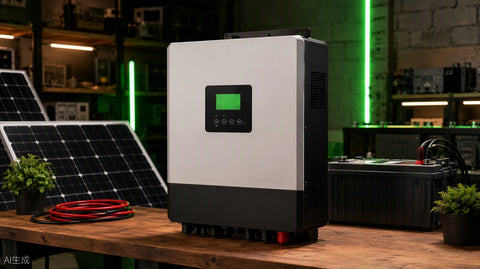
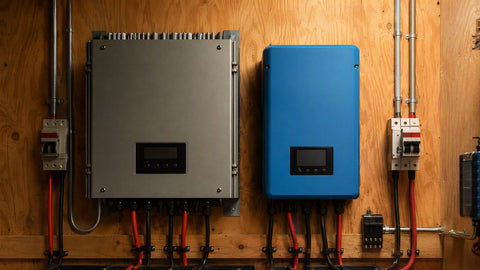
Two names dominate the premium off-grid inverter conversation, and both earned it the hard way: OutBack Power and Schneider Electric's Conext line. I've commissioned systems on both, swapped boards on both, and fielded the 2 a.m. calls on both. They're more alike than the forums admit — same engineering ancestry, same 48V split-phase architecture, same installer-grade build quality — but they diverge on system philosophy, charge controller design, and where each company is heading in 2026. That divergence is what this guide is about.
We'll compare the flagship 48V platforms — OutBack's FXR/Radian family against Schneider's Conext XW Pro and SW lines — on specs, architecture, scaling, battery integration, and support reality. Prices are street figures; specs come from published datasheets; opinions come from the field.
The Shared Bloodline: Why These Two Feel Related
Both product families descend from the same Pacific Northwest inverter school. OutBack's founders came out of Trace Engineering, the company that practically invented the North American off-grid inverter market in the 1990s. Schneider's Conext XW line descends from Xantrex — which absorbed Trace's inverter technology and was itself absorbed by Schneider Electric. When you open both boxes you see the same philosophy: a heavy low-frequency transformer, a big surge rating, conservative thermal design, and firmware written by people who have actually been to an off-grid site. OutBack is now backed by EnerSys; Schneider is, well, Schneider — a global electrical giant. Neither is a Kickstarter brand, and both have parts pipelines measured in decades.
Side-by-Side: The Flagship 48V Platforms
| Attribute | OutBack Radian GS8048A | Schneider Conext XW Pro 6848 |
|---|---|---|
| Continuous output | 8,000W | 6,800W |
| Surge (motor starting) | ~2× continuous, short duration | ~1.75× continuous (12kW-class surge) |
| Topology | Low-frequency transformer, 120/240V split-phase | Low-frequency transformer, 120/240V split-phase |
| Battery voltage | 48V nominal (44–64V window) | 48V nominal (40–64V window) |
| Peak efficiency | ~93% | ~94–95% |
| Built-in charger | ~115A DC class | ~140A DC class |
| AC inputs | Grid + generator, with advanced generator support (AGS) | Grid + generator, programmable AGS |
| Grid-interactive sell | Yes (GridZero and sell modes) | Yes (grid-support and sell modes) |
| System controller | MATE3s (required for full config) | InsightHome / InsightFacility (gateway) |
| Street price (unit) | ~$4,500–5,500 | ~$4,000–5,000 |
| Pre-wired panel option | FLEXpower Radian (pre-wired, faster install) | Conext XW Pro distribution panels via partners |
Read the continuous-output row twice. The Radian's extra 1,200W of continuous capacity is the difference between starting a 4-ton AC compressor comfortably and managing load order carefully. The XW Pro's bigger charger (140A class) flips the advantage the other direction for generator-heavy systems: it can stuff 7kW of charging into the bank while the generator runs, shortening generator hours. Which row matters depends on whether your bottleneck is surge loads or recharge time.
System Architecture: MATE vs Insight
OutBack's MATE3s is a physical system controller with a screen on the wall — every device on the network (inverters, FLEXmax controllers, battery monitors) reports through it, and configuration happens in deliberately plain-language menus. It feels like industrial gear: no cloud dependency required for local control, and a tech at the panel can change absorb voltage with gloves on. FLEXnet DC battery monitoring gives honest state-of-charge from shunt data rather than voltage guesswork.
Schneider's Insight platform is gateway-plus-cloud: InsightHome for residential, InsightFacility for larger sites, with local web pages and remote fleet views. The cloud tooling is slicker — firmware pushes, email alerts, multi-site dashboards — and installers managing twenty customer systems will live in it. The trade is dependency: when the gateway or its network is unhappy, remote visibility degrades, and Schneider's configuration depth hides behind more menu layers. Both ecosystems work; OutBack feels like a well-equipped shop, Schneider feels like enterprise software. Pick the one your installer knows cold, because configuration errors cause more off-grid failures than hardware ever has.
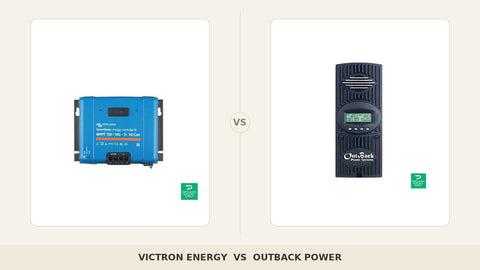
Charge Controllers: 150V vs 600V — A Real Philosophical Split
This is the spec that actually changes system design:
| Controller | Max PV Input | Output | Battery Range | Design Consequence |
|---|---|---|---|---|
| OutBack FLEXmax 60 | ~150V (corrected Voc must stay under) | 60A | 12–60V | Strings of 2–3 residential modules max |
| OutBack FLEXmax 80 | ~150V | 80A | 12–60V | Same string limit, more current |
| Schneider Conext MPPT 80 600 | 600V | 80A @ 48V | 48V only | Strings of 8–12 modules; residential-style string design |
| Schneider Conext MPPT 100 600 | 600V | 100A @ 48V | 48V only | Full-size arrays, long wire runs at low current |
Schneider's 600V input is the single biggest differentiator in the whole comparison. It means you wire the array like a grid-tie system — strings of ten 40V-class modules, home-run on 10 AWG at 10A, nearly zero voltage drop over 100+ feet. With OutBack's 150V ceiling, the same array breaks into three or four short strings in parallel, each pulling real current, each needing fatter combiner wire. On compact builds the difference is cosmetic; on a barn-array-to-house-bank run of 150 feet, the Schneider architecture can save a thousand dollars of copper. We ran this exact math in our NEC wire sizing guide — drop scales with current squared's first cousin, and high-voltage strings are the cheat code.
Stacking and Scaling: The Growth Math
| Scaling Step | OutBack Radian | Schneider XW Pro |
|---|---|---|
| Single unit | 8kW / 120-240V | 6.8kW / 120-240V |
| Two units stacked (split-phase) | 16kW | 13.6kW |
| Four units | 32kW (2×2 split or paralleled) | 27.2kW |
| Three-phase configs | Documented 3-unit / multi-unit 208V wye builds | Documented multi-unit three-phase builds |
| Charge controller add-on ceiling | FLEXmax units network freely — practical limit is busbar size | MPPT 600s network via Xanbus/Insight — same story |
Both scale past what any sane residence needs. Where scaling actually bites customers is the step from one unit to two: budget the second inverter, the stacking kit or cabling, a bigger battery busbar, and panel space — realistically $6,000–8,000 all-in either ecosystem. Design for your year-five loads, not your year-one loads. If that roadmap includes a shop building, a well, and an EV charger, start with the Radian's extra headroom or plan the stack from day one. Our off-grid system guide covers whole-system sizing, and the battery bank sizing guide keeps the storage side honest — a 16kW inverter pair on a 10kWh bank is a sports car with a lawnmower tank.
Battery Compatibility in the LFP Era
Both platforms predate lithium and both adapted well. The practical matrix for the batteries we actually ship:
| Battery | OutBack Integration | Schneider Integration |
|---|---|---|
| Flooded lead-acid / AGM | Full support, decades of charge profiles, FLEXnet shunt monitoring | Full support, mature FLA/AGM profiles |
| LFP, open-loop (voltage-based) | Works well; set conservative absorb/float per battery vendor | Works well; same voltage-profile approach |
| LFP, closed-loop (CAN comms) | Verify per battery brand and current firmware — support varies | Verify per battery brand; Schneider has certified integrations with select LFP vendors |
| Pylontech rack batteries | Common pairing in open-loop | Common pairing; check compatibility list |
Closed-loop CAN communication — where the battery's BMS tells the inverter exactly what current and voltage it wants — is the polished path, but firmware compatibility lists shift every quarter. Before you commit, confirm your exact inverter firmware and battery model appear on the same compatibility document. Open-loop with conservative voltage setpoints (absorb ~56.0–56.8V, no equalize, float ~54.4V) has run flawlessly for years on thousands of systems and remains our default recommendation for remote sites where simplicity beats elegance. The lithium vs lead-acid guide covers why those setpoints are what they are.
Longevity, Parts, and Support Culture
OutBack gear from 2005 still runs in the field, and EnerSys has kept boards and repair channels alive — we've sourced replacement FET boards for fifteen-year-old FX units without drama. The FLEXmax line has been in continuous production so long that "FLEXmax 80" is practically a generic noun, like "Crescent wrench." OutBack's support culture is installer-first: tech support answers with people who know the difference between absorb and float without a script.
Schneider brings global scale — parts depots on multiple continents and a distributor in every metro. The caution for 2026 buyers: Schneider's North American off-grid portfolio has been in transition, with product-line availability shifting as the company re-focuses on grid-tied and commercial segments. The XW Pro remains a superb platform with a huge installed base, but confirm current stock and roadmap with your distributor before designing a new build around it, and buy critical spares while supply is certain. That isn't a knock — it's procurement discipline we apply to every brand, including the ones in our Victron guide and MidNite Solar guide.
Common Mistakes We See With Both
- Skipping the system controller. A Radian without a MATE3s or an XW Pro without Insight is a half-configured system — default charge voltages on a $5,000 lithium bank is how expensive lessons start. Budget the controller; it's not optional.
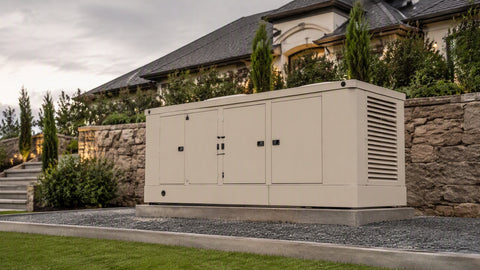
- Generator undersizing. Both inverters can charge at 100+A DC. Feed the XW Pro's 140A charger from a 5kW generator and it'll throttle or fault. Size generators at 1.5–2× the charger's AC draw; our 22kW generator guide shows what whole-system backup looks like when the generator is the primary.
- String voltage over the FLEXmax ceiling. Three 49V-Voc modules in series read 147V at STC and 168V at −10°C. FLEXmax units are 150V-class controllers — two in series, or parallel strings. NEC 690.7's cold correction is not advisory.
- Buying inverter before battery. The bank sets the system. Size storage first with the battery sizing calculator, then pick the inverter the bank can actually feed (48V LFP wants ~100A+ discharge capability per 5kW of inverter).
What a Complete System Actually Costs
Unit prices mislead because neither inverter works alone. Here's a realistic bill of materials for a complete 8kW-class off-grid power room in each ecosystem, street pricing, 2026:
| Component | OutBack Build | Schneider Build |
|---|---|---|
| Inverter | Radian GS8048A — ~$5,000 | XW Pro 6848 — ~$4,500 |
| System controller | MATE3s — ~$550 | InsightHome — ~$400 |
| Charge controllers (4.8kW array @ 48V → ~100A needed) | 2× FLEXmax 80 — ~$1,300 | 1× Conext MPPT 100 600 — ~$1,400 |
| Distribution (breakers, busbars, surge, enclosure) | FLEXpower pre-wired panel — ~$1,800 | Partner distribution panel — ~$1,600 |
| Battery monitor | FLEXnet DC — ~$450 | Battery monitor via gateway — ~$300 |
| Combiner + array wiring (120-ft array run) | Higher — multiple 150V strings, more copper | Lower — single 600V string on 10 AWG |
| Power-room subtotal | ~$9,100+ | ~$8,200+ |
The totals land within ten percent of each other — the Radian costs more per box, the Schneider gives some back in wiring. The real cost difference shows up in labor: OutBack's pre-wired FLEXpower panels save a day of power-room assembly, while Schneider's 600V strings save a day on the array run. Which day you'd rather skip depends on your site geometry, not the spec sheet.
Generator Integration: The Feature Off-Grid Lives By
Every serious off-grid system is a generator system wearing solar panels. Both platforms do advanced generator support (AGS) — auto-start on low battery, quiet hours, exercise schedules — but the personalities differ. OutBack's AGS logic lives in the MATE3s with deep per-event triggers (voltage, SOC via FLEXnet, load, temperature, time), and it will babysit cantankerous two-wire-start diesels patiently. Schneider's implementation ties charger current and load support together elegantly: the XW Pro can supplement a small generator with inverter power during surge events ("generator support" mode), letting a 7kW generator behave like a 10kW for load peaks. If your design brief is "smallest possible generator," Schneider's load-support trick is genuinely valuable. If your brief is "start the genny when the bank hits 48.2V after three cloudy days, no exceptions," OutBack's trigger depth wins. Either way, size the generator at 1.5–2× charger draw — the 26kW generator guide and 35kW guide cover the serious-diesel end if you're building prime power.
Idle Draw and Efficiency: The Spec That Taxes You Nightly
Low-frequency transformer inverters burn meaningful power just staying awake — typically 25–40W at idle for units in this class, with search/sleep modes cutting that substantially when loads drop away. Over a night, 35W of tare loss is roughly 300–400Wh stolen from the bank, which on a 10kWh lithium bank is 3–4% of capacity gone before anyone makes coffee. Both platforms offer search modes that pulse the AC output looking for loads; both work well until someone installs a device with a standby draw below the search threshold, which then never turns on. Field fix: raise the search sensitivity, or exempt circuits. It's a five-minute configuration either ecosystem — but only if your installer knows the setting exists, which loops back to our earlier point about hiring platform experience over brand loyalty.
A Tale of Two Installs
Two jobs from last year crystallize the choice. Job one: a mountain cabin, array mounted 40 feet from the power shed, two freezers, a well pump, and an owner who never wants to see a cloud login. That build went OutBack — Radian, MATE3s on the wall, FLEXnet watching a 900Ah AGM bank, generator auto-start on voltage. The owner operates it with gloves on and a printed cheat sheet. Five years from now a tech will still be able to buy boards for it.
Job two: a ranch headquarters with the array 180 feet from the equipment barn, three seasonal worker cabins on subpanels, and a manager who checks four properties from his phone. That build went Schneider — one MPPT 100 600 sipping from a single long string, XW Pro supplementing a modest propane generator during milking-pump surges, InsightFacility emailing weekly yield reports. The wire savings alone on that 180-foot run covered the gateway and a year of monitoring. Same budget class, opposite geometry, opposite right answer. That's the entire OutBack vs Schneider question in two stories: it's a site-engineering decision wearing a brand-name costume.
Choose OutBack Power If
- You want maximum continuous watts per box (8kW vs 6.8kW) and the strongest surge behavior in the class.
- You prefer local, screen-on-the-wall control with no cloud dependency — true for remote and security-minded sites.
- Your array is close to the power room, where 150V strings cost nothing extra.
- You value the deepest bench of field-repairable legacy hardware in North America.
Choose Schneider Electric If
- The array sits far from the batteries — the 600V MPPT input pays for itself in wire savings alone.
- You manage multiple sites and want fleet-level cloud monitoring (InsightFacility is genuinely good).
- Big charger current matters: 140A-class charging shortens generator runtime meaningfully.
- You're in a market where Schneider distribution is strong and you can confirm parts roadmap before committing.
Bottom Line
There's no wrong answer here, only mismatched applications. OutBack's Radian/FLEXmax ecosystem wins on per-unit muscle, local control, and repairable longevity; Schneider's XW Pro/MPPT 600 platform wins on high-voltage array design, charger throughput, and fleet software. Both trace to the same engineering tradition and both will outlive cheaper gear by a decade. Match the architecture to your site geometry — array distance, surge loads, generator hours — confirm parts availability for 2026, and hire an installer who has commissioned at least five systems on whichever platform you pick. Do those three things and either badge will still be humming when your mortgage is paid off. For alternatives worth cross-shopping, see Sol-Ark's hybrid platform, the EG4 vs Schneider comparison, and Victron vs OutBack charge controllers.
Frequently Asked Questions
Which brand has more installers who actually know it?
Both have deep benches, but the flavor differs by region. OutBack-certified installers cluster in the off-grid heartland — mountain West, Alaska, rural anywhere. Schneider's network rides the broader electrical-distribution channel, so metro-adjacent and commercial-savvy shops more often carry XW experience. Ask any candidate installer how many systems they've commissioned on your chosen platform specifically; five or more is our rule of thumb, and the answer matters more than which logo is on the inverter.
How long do these inverters actually last?
Fifteen to twenty-five years is the honest range for both, with fans, capacitors, and relays as the wear items. OutBack's field-repairable design means boards get swapped rather than units scrapped; Schneider's global depot network handles RMAs at scale. The killers are heat and dust, not brand — mount either unit in a cool, clean, ventilated space and it will outlive the roof under the array.
Is Schneider discontinuing the XW Pro?
Schneider's North American off-grid lineup has been in transition, with availability shifting by region and quarter as the company emphasizes grid-tied and commercial segments. The XW Pro has a massive installed base and Schneider continues to support it, but verify current stock and roadmap with your distributor before designing a new system around it, and consider buying critical spares with the initial order.
Can OutBack and Schneider components be mixed in one system?
At the AC level, partially — any inverter can feed any panel. But charge controllers, battery monitors, and system controllers are brand-networked (OutBack's HUB/MATE network vs Schneider's Xanbus/Insight), so mixing controllers across brands loses coordinated charging and monitoring. Pick one ecosystem for DC control.
Which is better for starting a well pump or AC compressor?
OutBack's Radian, on paper and in practice — 8kW continuous with roughly 2× short-duration surge versus the XW Pro's 6.8kW and ~1.75× class surge. A 4-ton compressor with a hard-start kit sits comfortably on the Radian; on the XW Pro, use soft-starts and stagger loads. Both crush any high-frequency (transformerless) inverter on surge.
How do the charge controllers really differ in the field?
Voltage ceiling. FLEXmax units cap at ~150V PV input — strings of two or three modules — while Schneider's MPPT 80/100 600 accept 600V, enabling 8–12 module strings. Long array-to-battery runs favor Schneider heavily; compact arrays see no practical difference. Both track accurately and run 96%+ conversion efficiency.
What battery works best with these inverters?
Both handle flooded, AGM, and LFP. For lead-acid, both have decades of mature profiles. For LFP, open-loop voltage-based charging with conservative setpoints works reliably on both; closed-loop CAN integrations exist for select battery brands — verify your exact models against current compatibility documents before purchase.
Are these overkill for a grid-tied home with occasional outages?
Honestly, yes. A hybrid inverter or AC-coupled battery system serves outage-backup duty at lower cost and complexity — see battery backup vs generator and AC vs DC coupling. OutBack and Schneider earn their premium where off-grid autonomy, heavy surge loads, or generator integration are core requirements, not conveniences.