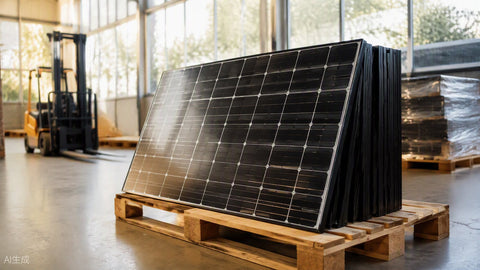
The 500-watt solar panel went from commercial curiosity to the default residential format in about four years. In 2026, if you request a residential quote from any serious installer, the panel on the proposal is almost certainly a 480–520W N-type TOPCon module — and the 500W class now anchors everything from 5 kW starter systems to multi-megawatt C&I rooftops. This guide covers what a 500W panel actually is in 2026, real dimensions and weights, live model pricing from our shelves, efficiency and degradation numbers that matter, the trade-policy layer that moves landed cost, and how to size a system around the format.
We stock and ship this class daily, and the pattern in the order book tells the story: two years ago the 500W pallet was the special order. Now the 400W pallet is. The market has moved, and the pricing has followed the volume.
What Is a 500-Watt Solar Panel in 2026?
A 500W panel is a module whose STC (Standard Test Conditions: 1,000 W/m² irradiance, 25°C cell temperature, AM1.5 spectrum) nameplate output lands at or near 500 watts. That number is a laboratory rating, not a field promise — expect 75–85% of nameplate on a hot summer afternoon and occasional excursions above nameplate on cold, bright spring mornings with edge-of-cloud effects.
The 2026 generation shares a common anatomy: 182mm-class (M10) half-cut monocrystalline cells, predominantly N-type TOPCon architecture, dual-glass or glass-backsheet construction, and multi-busbar interconnection. The wattage jump from the 400W class came from three places at once — larger cell format, higher cell efficiency (TOPCon's passivating contact structure), and tighter packing density. None of those changes make the panel fragile or exotic; the install hardware, connectors, and electrical rules are the same ones the trade has used for a decade.
How Big Is a 500W Solar Panel?
Size depends on cell count and format. The four format families you will actually encounter:
| Format | Typical Wattage | Length × Width | Thickness | Weight | Cell Count |
|---|---|---|---|---|---|
| Compact 120-cell | 480–500 W | ~1,750 × 1,134 mm | 30 mm | 21–23 kg | 120 half-cut |
| Standard 144-cell | 500–520 W | ~1,961 × 1,134 mm | 30–35 mm | 23–26 kg | 144 half-cut |
| Extended 144-cell | 525–540 W | ~2,100 × 1,100 mm | 35 mm | 26–28 kg | 144 half-cut |
| Legacy commercial (reference) | 500–550 W | ~2,279 × 1,134 mm | 40 mm | 32+ kg | 144 half-cut dual-glass |
For planning: a standard 144-cell 500W module covers about 2.22 m² (23.9 ft²). Two installers carry and set it without mechanical assist on residential roofs. The extended and legacy commercial formats want three people or a lift on anything above a single story.
500W Solar Panel Specs Comparison — Models PES Stocks
Real models, real shelf pricing. Prices below are per-panel, single-unit, and move with the market — volume pricing runs lower:
| Brand | Model | Wattage | Price | Cell Type | Est. Efficiency |
|---|---|---|---|---|---|
| Kodak | FBBI AM+ PPE2 | 500 W | $87.30 | Mono, Bifacial | ~21.5% |
| Ronma | RM-500W-182M/120TB | 500 W | $87.30 | Mono | ~21.5% |
| FHE | 500W BVN MASTER | 500 W | $87.30 | Mono | ~21.5% |
| Guocheng | GC-132M-500W | 500 W | $87.30 | Mono | ~21.5% |
| Guocheng | GC-132M-510W | 510 W | $89.05 | Mono | ~22.0% |
| Weihang | VH-MO 500HGDB | 500 W | $87.30 | Mono | ~21.5% |
| Weihang | VH-MO 490W | 490 W | $85.55 | Mono | ~21.0% |
| VDS Renewable | VDS-S120/M10N-BG | 480 W | $83.81 | Mono | ~21.0% |
| Amerisolar | AS-7M144-HC-520W | 520 W | $90.79 | Mono | ~22.0% |
| Ruihuang | 520W | 520 W | $90.79 | Mono | ~22.0% |
| JA Solar (Juncess) | JAM72D30-525/MB | 525 W | $112.03 | Mono | ~22.5% |
| JA Solar (Juncess) | JAM72D30-540/MB | 540 W | $115.24 | Mono | ~23.0% |
| Trina Solar | Vertex N 500W | 500 W | $132.26 | Mono, TOPCon N-Type | ~22.5–23.5% |
Read the table this way: the $83–91 band is value-tier product, serviceable for budget commercial and ground-mount work where the warranty administrator is you. The $112–132 band is Tier 1 product — JA Solar and Trina — with bankable warranties, tighter binning, and the name recognition that keeps financing and inspection conversations short. For brand-level deep dives, see our JA Solar brand guide, Jinko Tiger Neo guide, LONGi Hi-MO guide, and Trina Vertex guide. For the class below, our 400W vs 500W comparison settles the format question.
Efficiency, Temperature & Degradation
Three datasheet lines decide long-term production, and none of them is the wattage:
| Spec | 2026 500W-Class Typical | Why It Matters |
|---|---|---|
| Module efficiency | 21.0–23.5% | kW per square meter of roof — the binding constraint on small roofs |
| Temperature coefficient (Pmax) | −0.29 to −0.34%/°C | Hot-climate output; N-type TOPCon beats legacy PERC by ~0.05%/°C, worth ~2% annual energy in the Southwest |
| First-year / annual degradation | 1–2% / 0.40–0.55% | Year-25 output; top N-type lines warrant ~87.4% at year 30 |
| NOCT/NMOT | 42–45°C | Real operating temperature; combined with ambient, sets your field output |
| Bifaciality (dual-glass models) | 70–80% | Ground-mount and flat-roof gain from rear-side irradiance — 5–15% real-world boost with proper height and albedo |
The broader cell-technology context — TOPCon's dominance, where perovskite tandems actually stand, why 500W became the standard — is in our 2026 panel technology report, and the efficiency leaders across all classes are ranked in the most efficient panels of 2026.
Certifications & Code Compliance
Every module on a permitted U.S. job needs UL 61730 listing (the modern replacement for UL 1703) — verify the listing card, not the brochure. Beyond that baseline: IEC 61215/61730 for international jobs, California CEC listing for any project claiming state incentives, and NEC 690 for the installation itself. Watch the series fuse rating (typically 20–25A on this class) when paralleling strings, and respect the 1,500V system-voltage limit with cold-weather Voc correction per NEC 690.7. Our series-wiring guide and inverter matching guide cover the string math in detail.
Trade Reality — Section 232 MIP & Landed Costs
Solar pricing in 2026 carries a trade-policy layer that changes landed cost by origin. Minimum import price structures and tariff actions on cells and modules from specific origins mean the FOB price is not the delivered price. Practical consequences:
| Factor | Effect on 500W-Class Pricing | Buyer Action |
|---|---|---|
| Origin-dependent duties/MIP | Same-nameplate panels differ $0.03–0.08/W by factory origin | Ask for origin documentation on pallet orders |
| Tariff-rate adjustments | Spot prices step up when quotas fill mid-quarter | Lock pricing in writing for projects >30 days out |
| Domestic content adders | IRA-linked projects pay premiums for qualifying content | Price both paths; the ITC adder can flip the math |
| Freight and pallet minimums | 31–36 panels per pallet; LTL freight adds $0.01–0.03/W | Buy full pallets; consolidate with other BOS |
We handle the import side so customers see one landed price — but on large orders, ask us to show the origin options. I have watched a $0.05/W origin difference become a $7,500 swing on a single commercial container order. That is real money for the same nameplate.
How Many 500W Panels Do You Need?
| Target System Size (DC) | 500W Panels Needed | Approx. Roof Area | Typical Use Case |
|---|---|---|---|
| 2 kW | 4 | ~9 m² (97 ft²) | Small cabin, RV pad, workshop |
| 5 kW | 10 | ~23 m² (248 ft²) | Compact residential (1,000 kWh/mo) |
| 8 kW | 16 | ~37 m² (398 ft²) | Average U.S. home (1,500 kWh/mo) |
| 10 kW | 20 | ~46 m² (495 ft²) | Large home or small commercial |
| 15 kW | 30 | ~69 m² (743 ft²) | Commercial flat roof, small C&I |
| 25 kW | 50 | ~115 m² (1,238 ft²) | C&I rooftop, agricultural |
| 100 kW | 200 | ~460 m² (4,950 ft²) | Commercial/industrial rooftop |
Sizing from consumption: divide annual kWh by your local production factor (1,300–1,800 kWh/kW-year across most of the U.S.), then divide by 0.5 kW per panel. A 12,000 kWh/year home in a 1,500-factor climate wants an 8 kW array — sixteen 500W panels. Run your exact numbers through the solar system calculator before ordering.
Buyer Impact by Use Case
Residential Rooftops
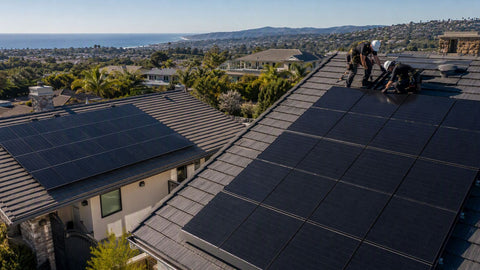
The 500W class fits residential roofs well: 16–20 panels cover most homes, fewer attachments than the 400W class means less roof penetration and faster installs, and N-type degradation rates protect the 25-year production model that financing rests on. Watch panel length on chopped-up roofs — 2.0–2.1m modules need clear rectangles. Heavier per-panel weight (24–28 kg) is a two-person lift by design; crews adapt in a morning.
Commercial & Industrial (C&I)
This is where the format was born. Ballasted flat-roof systems live and die by watts per square meter and positions per kW; 500W-class modules beat smaller formats on both. Dual-glass bifacial variants on high-albedo membrane roofs add measurable rear-side gain. Pallet math: 31–36 per pallet, ~17–20 pallets per container, and landed-cost optimization on origin that we handle at quote time.
Off-Grid & Battery Backup
High-wattage modules pair naturally with modern MPPT controllers at 48V: a 5.5 kW array is eleven panels and two 60A controllers. Check Voc against controller input limits in cold weather — a 10-panel string of 50V Voc modules at −20°C design temperature runs past 600V; most residential controllers cap at 450–500V input, so split into two strings. For the storage side, our battery sizing guide handles the kWh math.
EPCs & Installers (Volume / Pallet)
Volume buyers should quote by the pallet, lock origin and price in writing, and standardize on two SKUs per class to keep spare-panel stock sane. Mixed-SKU roofs are a commissioning headache and a warranty-documentation mess. Our panel catalog shows live pallet availability, and the inverter catalog covers the matching electronics. Dealer and volume programs run through my.pesdistribution.com.
Anatomy of the 2026 500W Class: What's Inside the Frame
Understanding why this class performs the way it does helps you read any datasheet in ninety seconds. The stack, from glass to backsheet:
- Cells: 182mm × 182mm-class (M10) N-type monocrystalline, cut in half. Half-cutting halves cell current, which cuts resistive (I²R) losses and improves shade tolerance because each half-panel operates as an independent zone.
- Architecture: TOPCon — a tunnel oxide passivating contact on the rear of the cell that reduces recombination. This is where the extra 1–1.5 efficiency points over PERC come from, and why the class holds output better in heat.
- Interconnection: 9–16 round multi-busbars (MBB) per cell instead of 4–5 wide flat ribbons. Shorter current paths, lower series resistance, better micro-crack tolerance.
- Glass/encapsulant: 2.0–3.2mm tempered glass; POE or EPE encapsulant on N-type product (POE resists the potential-induced degradation that N-type cells are sensitive to with cheaper EVA).
- Frame: anodized aluminum, 30–35mm, with drainage and grounding holes per the install manual — use the manual's hole pattern or the load warranty is void.
- Junction box: IP68, three bypass diodes splitting the panel into thirds. A shaded third costs you a third, not the panel — that is the diode's whole job.
Reading a 500W Datasheet: The Lines That Matter
Typical 500W-class N-type TOPCon electrical characteristics (STC) cluster in tight ranges — verify the exact model, but this is the neighborhood:
| Parameter | Typical 500W-Class Value | Design Use |
|---|---|---|
| Pmax (STC) | 480–520 W | Nameplate for system sizing |
| Voc | ~46–53 V | String length and cold-weather maximum input voltage (NEC 690.7) |
| Isc | ~12.5–14 A | Conductor and fuse sizing (NEC 690.8, ×1.56 rule) |
| Vmp | ~38–43 V | MPPT window check |
| Imp | ~11.5–13.5 A | MPPT current limit check |
| Temp coefficient of Pmax | −0.29 to −0.34 %/°C | Hot-day production modeling |
| Temp coefficient of Voc | −0.22 to −0.26 %/°C | Cold-weather Voc correction |
| Series fuse rating | 20–25 A | Parallel string rules (NEC 690.9) |
| Max system voltage | 1,500 V (1,000 V on some residential SKUs) | Commercial string length ceiling |
| Mechanical load (test) | 5,400 Pa snow / 2,400 Pa wind typical | Racking and attachment engineering; check local ASCE 7 requirements |
Two traps to avoid: never design strings from STC Voc without the cold correction, and never parallel more strings than the series fuse rating allows. Both are one-line checks that prevent the two most common field failures we get called about.
String Sizing: Worked Examples
Example 1 — Residential, 1,000V micro/optimizer architecture avoided, string inverter 600V MPPT ceiling, design low −10°C. Take a module with Voc 49.5V and Voc coefficient −0.24%/°C. Temperature delta from STC: 25 − (−10) = 35°C. Correction: 1 + (0.0024 × 35) = 1.084. Corrected Voc: 49.5 × 1.084 ≈ 53.7V. Max modules per string: 600 ÷ 53.7 ≈ 11.2 → 11 modules (5.5 kW per string).
Example 2 — Commercial, 1,500V inverter, design low −20°C. Same module: correction 1 + (0.0024 × 45) = 1.108; corrected Voc ≈ 54.9V. Max string: 1,500 ÷ 54.9 ≈ 27.3 → 27 modules (13.5 kW per string). Long strings like this are the commercial case for the class: fewer strings, fewer homeruns, less trench and wire.
Example 3 — Off-grid 48V, controller 500V input, design low −15°C. Correction 1.096; corrected Voc ≈ 54.2V. Max 500 ÷ 54.2 ≈ 9.2 → 9 modules per string, and at 12–13A Imp a single string is well within a 60A MPPT. A 5.4 kW array on one controller — clean.
Degradation Over Time: What the Warranty Actually Promises
| Year | N-Type TOPCon 500W Class (1% first-year, 0.40%/yr) | Legacy PERC Reference (2% first-year, 0.55%/yr) |
|---|---|---|
| 1 | 99.0% | 98.0% |
| 5 | 97.4% | 95.8% |
| 10 | 95.4% | 93.1% |
| 15 | 93.4% | 90.3% |
| 20 | 91.4% | 87.6% |
| 25 | 89.4% | 84.8% |
| 30 | 87.4% (30-yr warranty endpoint on top lines) | 82.1% |
On a 10 kW system producing 14,500 kWh in year one, the gap at year 25 is roughly 670 kWh annually. At $0.16/kWh that is about $107 a year in year 25 — and the cumulative 25-year gap clears 8,000 kWh. Degradation rate is a financial spec. Treat it like one.
Warranty Terms by Tier
| Warranty Element | Value Tier ($83–91 panel) | Tier 1 ($110–135 panel) |
|---|---|---|
| Product/workmanship | 12–15 years typical | 25 years on current flagship lines |
| Power output | 25 years at ~80–84% endpoint | 30 years at ~87.4% endpoint |
| Claim process | Through seller; documentation burden on buyer | Manufacturer network with established RMA channels |
| Bankability | Not financeable for most commercial debt | Tier 1 lists support project financing |
| Who answers in year 12 | Uncertain | Much more certain — this is what the premium buys |
I've handled warranty claims on both sides of this table. The Tier 1 claim with serial numbers and commissioning photos closes in weeks. The value-tier claim on a brand that left the market closes never. On a financed 25-year asset, that difference is the entire premium.
Mechanical, Mounting, and Roof Logistics
- Racking compatibility: the class uses standard 30–35mm frames — every major rail system clamps it. Check the manual's approved clamp zones; mid-clamps outside the zone void the mechanical-load warranty.
- Attachment spacing: at 5,400 Pa test load with standard clamp zones, typical residential attachments at 48" spacing pass in most wind zones; high-wind and high-snow regions need the racking manufacturer's engineering letter with the exact module listed.
- Handling: 23–28 kg panels are a two-person carry per OSHA-friendly practice and common sense on ladders. Stage pallets on the roof side of the build; double-handling a pallet of 31 panels costs a crew an hour.
- Roof penetration count: a 10 kW array at 500W needs about 20 panels and ~40 attachments; at 400W it needs 25 panels and ~50. Every attachment you eliminate is a leak path you never create.
- Fire setbacks: NEC/IFC residential setback rules (36" from ridge on both sides for the fire pathway in most jurisdictions) constrain layout — the longer 500W format needs a clean rectangle to be efficient. Sketch the layout before ordering the pallet.
Logistics: Pallets, Containers, and Freight
| Metric | Typical 500W-Class Value | Buying Note |
|---|---|---|
| Panels per pallet | 31–36 | Buy full pallets; partial pallets get re-handled and scratched |
| Pallet weight | ~800–1,000 kg | Confirm forklift or liftgate at delivery — residential drop sites often lack both |
| Pallets per 40' container | ~17–20 | ~280–370 kW per container; the unit of serious commercial buying |
| LTL freight adder | $0.01–0.03/W typical | Consolidate modules with racking and BOS on one truck |
| Damage claim window | Usually 5–15 days, carrier-dependent | Photograph pallets at delivery before signing the BOL — every time |
The receiving discipline matters more than people expect: count pallets, photograph the shrink wrap and corners, note damage on the bill of lading before the driver leaves. I have watched a customer eat three cracked panels because the BOL was signed clean. Five minutes with a phone camera is the cheapest insurance in the supply chain.
The Buying Checklist We Run Before Any 500W Order
- Datasheet for the exact SKU: efficiency, Voc, temp coefficients, series fuse, mechanical loads.
- UL 61730 listing verified on the listing card, plus CEC listing if incentives apply.
- Warranty documents: product years, power endpoint, claim process, and who administers it.
- Origin documentation if the project carries domestic-content or tariff exposure.
- String design checked against inverter limits at design-low temperature.
- Roof layout sketched with real module dimensions, fire setbacks, and attachment count.
- Freight terms in writing: pallet count, delivery method, damage claim window.
- Spares: one extra panel per 20–40 on commercial orders — matching a bin five years later is not guaranteed.
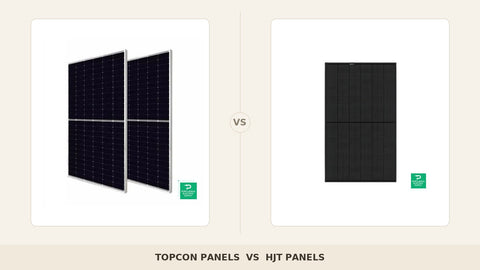
TOPCon vs HJT vs Back Contact at the 500W Level
Three cell architectures compete at this wattage in 2026. All are real products; the differences are efficiency, temperature behavior, and price position:
| Architecture | Typical Module Efficiency | Pmax Temp Coefficient | Price Position | Notes from the Field |
|---|---|---|---|---|
| N-type TOPCon | 21.5–23.3% | −0.29 to −0.32 %/°C | Volume sweet spot | The default 500W-class cell; deepest supply, sharpest pricing |
| HJT (heterojunction) | 21.8–23.0% | −0.24 to −0.26 %/°C | Premium | Best hot-climate coefficient; thinner supply at 500W formats |
| Back contact (HPBC/IBC-class) | 22.5–24.8% | −0.26 to −0.29 %/°C | Premium | Highest watts per m², all-black front; warranty terms vary by maker |
Honest guidance from the order book: TOPCon is the value answer for almost every roof; HJT earns its premium in the hottest climates; back contact earns its premium where roof area or aesthetics bind. We stock across all three and sell each where it fits — the architecture question is a site question, not a brand loyalty question.
Temperature Derating: Worked Example
A 500W module with −0.31%/°C Pmax coefficient on a roof at 40°C ambient. Cell temperature runs roughly 25–30°C above ambient on a flush mount — call it 67°C. Delta from STC: 42°C. Output: 500 × (1 − 0.0031 × 42) ≈ 435W. That is normal, expected, and already inside any competent production model. The mistake to avoid is comparing a competitor's STC marketing number against your field reading — compare model to model, both at NOCT or both modeled.
Landed Cost Math on a Pallet
What a residential buyer actually pays beyond the sticker, per pallet of 33 × 500W (16.5 kW):
| Line | Value Tier | Tier 1 |
|---|---|---|
| Modules (33 × unit price) | $2,881 (at $87.30) | $4,365 (at $132.26) |
| LTL freight (typical residential lane) | $350–$600 | $350–$600 |
| Liftgate / residential delivery | $75–$150 | $75–$150 |
| Delivered cost per watt | ~$0.20–0.22/W | ~$0.29–0.31/W |
Freight is the line first-time buyers forget. A $90 panel with $500 of freight on a half pallet costs more than a $95 panel shipped on a full one. Consolidate the order — modules, racking, and BOS on one truck — and the per-watt freight cost drops by half.
Install-Day Walkthrough: What Good Crews Do
For homeowners watching their 500W-class install, the marks of a professional job: attachment layout chalked and verified against rafters before a single hole; torque wrench on every clamp, not impact-driver feel; wire management clipped and UV-rated with nothing touching the roof; strings tested for Voc and polarity before landing on the inverter; commissioning photos of every nameplate and serial number. I've audited installs where skipping the string test cost a full day of troubleshooting after the crew left — the five-minute test exists because reversed polarity happens to everyone eventually.
Common Myths About 500W Panels
- "They're commercial panels, not for houses." The residential 500W class (108–132 cell, 21–26 kg) is designed for houses. The 2.28m, 32 kg+ legacy commercial format is the one to keep off steep residential roofs.
- "Higher wattage means more degradation." Degradation tracks cell architecture and build quality, not nameplate watts. Current N-type 500W lines carry the best degradation warranties in the industry.
- "They need special inverters." Standard string inverters and properly-rated microinverters handle the class; the checks are string Voc at design-low temperature and MPPT current limits — same as any module.
- "Bifacial doubles output." Rear-side gain is 5–15% with height and albedo, and near zero on flush residential mounts. It is a real but bounded effect.
- "500W panels are fragile because they're bigger." Same glass, same frame standards, same 5,400 Pa snow test loads as smaller modules. Size does not change the certification bar.
From Nameplate to Reality: The Production Derate Chain
A 500W panel never delivers 500W to your meter at 2 p.m. in August — and a competent proposal models the whole chain. The standard derate stack for a residential rooftop:
| Derate Factor | Typical Value | Driver |
|---|---|---|
| Irradiance & orientation | 0.80–0.95 | Roof azimuth/tilt vs ideal; local weather |
| Temperature | 0.85–0.92 | Cell temp above STC; the Pmax coefficient at work |
| Soiling | 0.95–0.98 | Dust, pollen, debris between cleanings |
| Mismatch & wiring | 0.97–0.98 | Module binning spread, resistive losses |
| Inverter efficiency | 0.96–0.98 | CEC weighted efficiency of the inverter |
| Availability & shading | 0.97–0.99 | Downtime, tree and vent shadows |
| System total | ~0.68–0.80 | Multiplicative — this is why field output ≠ STC sum |
Worked example: 16 × 500W (8 kW DC) in a mid-Atlantic climate at 0.76 total derate yields ~6.1 kW AC-equivalent and roughly 10,600–11,500 kWh per year depending on sun hours. If a proposal shows 8 kW × full sun hours with no derate, the production estimate is fiction — we've reviewed hundreds of competitor proposals and the inflated-production quote remains the most common trick in residential solar.
500W vs 600W+ Formats: When to Step Up Again
Above the 500W class sit the 600–670W utility formats (78-cell, 2.4m+ class). The step-up makes sense in a narrow band: ground mounts and commercial flat roofs with mechanical handling, where module count per MW drives labor. On residential roofs the 600W+ formats are too long and too heavy for safe two-person handling, and their per-watt price advantage evaporates against residential labor reality. Stay at 500W-class for rooftops; look at 600W+ only when a crane or telehandler is already on site.
Procurement Timing: How the Price Moves Through the Year
| Period | Market Behavior | Buying Move |
|---|---|---|
| Q1 | Manufacturers reset prices; new model years land | Quote early; prior-year SKUs clear at discounts |
| Q2 | Install season ramps; distributor volume programs open | Lock pallet pricing for summer projects |
| Q3 | Peak demand; tariff/quota thresholds can step spot prices up | Written price locks matter most here |
| Q4 | Inventory flush ahead of year-end; ITC-deadline demand spikes | Best clearance hunting; confirm warranty documents on flushed SKUs |
The pattern holds most years: the same 500W module can swing 10–15% between a Q1 clearance pallet and a Q3 spot buy. Contractors with warehouse space buy Q1 and Q4; contractors without it should at least quote against the cycle.
For EPCs: The Pallet Program Basics
- Standardize two SKUs per class per season — spares, racking letters, and crew familiarity all get cheaper.
- Lock origin and price in writing for anything shipping beyond 30 days; mid-quarter tariff steps are real.
- Spec spares at 1 per 20–40 modules and store them flat, indoors, in packaging.
- Document at receiving — pallet photos, serial ranges, BOL notes — before the truck leaves the dock.
- Ask about container programs once quarterly volume clears ~250 kW; the per-watt delta versus pallet pricing funds real margin.
End of Life and Recycling
A 500W module is roughly 75% glass and aluminum by weight, and both streams recycle cleanly. Solar-panel recycling infrastructure in the U.S. has scaled up sharply since 2024, with dedicated processors recovering glass, aluminum frames, copper, and silicon; several states now regulate disposal, and Washington state requires manufacturer takeback programs. For decommissioning projects, budget $10–$25 per panel for removal and recycling logistics — and never landfill modules, both for the environmental reason and because an increasing number of jurisdictions make it illegal.
Roof Layout Math: A Worked 16-Panel Example
Take a south face of 10m × 5.5m (55 m² gross) on a typical two-story home. Fire setbacks remove a 36" (0.9m) strip at the ridge and code pathways at the edges, leaving roughly 8.2m × 4.6m of usable field. A standard 144-cell 500W module at 1.961 × 1.134m in portrait: four across = 7.84m (fits inside 8.2m), four rows = 4.54m (fits inside 4.6m). Sixteen panels, 8 kW, clean rectangle — that is the ideal case, and it is exactly why the 16-panel 8 kW system shows up on so many proposals: the format and the typical American roof face were made for each other. Now subtract two plumbing vents and a skylight and the same face can lose four positions — which is when the shorter 400W-class module sometimes wins back the layout. Measure first, order second.
DC/AC Ratio: How Much Panel per Inverter
Pairing 500W modules to inverter capacity is a ratio decision, not a matching exercise:
| DC/AC Ratio | Behavior | When to Use It |
|---|---|---|
| 1.0–1.1 | Almost no clipping; inverter oversized relative to array | Hot climates with expensive demand charges, or when expansion is planned |
| 1.2–1.35 | Clips a few spring-noon hours per year; maximizes kWh per inverter dollar | The residential sweet spot — most 8 kW arrays pair with 6–6.5 kW inverters |
| 1.4+ | Meaningful midday clipping in cool bright seasons | Commercial with interconnection limits capping AC export |
The intuition: panels spend most of their life below nameplate, so a slightly undersized inverter wastes little and saves real money. A slightly oversized inverter costs money every day to protect against a few clipped hours a year. The modeling tools quantify both; the 1.2–1.35 band wins the majority of residential cases we run.
Hail, Wind, and Insurance Realities
Every listed module passes the UL 61730 hail impact test — a 25mm ice ball at 23 m/s — and Tier 1 product routinely tests beyond it, with some lines rated for 35–45mm class impacts. Field experience tracks the lab: modern tempered-glass modules survive hail that totals roofs and cars. The insurance angle matters more than the glass: tell your carrier when the system goes in, confirm the array is covered under the dwelling policy (most are, as permanent attachments), and keep the install photos and serial list in the same folder as the policy. After a storm claim, that folder is the difference between a check and an argument. We have helped customers through enough hail claims in hail country to be firm on this one.
Commissioning: The Hour That Protects 25 Years
- String Voc and polarity verified before landing on the inverter.
- Insulation resistance test on arrays where the inverter or AHJ requires it.
- Torque marks on every clamp and lug, photographed.
- Serial numbers recorded per position on the array map.
- Monitoring configured and the first production day baselined against the model.
- Permit card, inspection sign-off, interconnection approval, and warranty registrations filed in one folder — the folder the next owner, the insurer, and the warranty claim will all want.
Comparing Two 500W Quotes Line by Line
When two quotes both say "500W panels," the comparison that protects you:
| Line to Compare | What Good Looks Like | Red Flag |
|---|---|---|
| Exact model + datasheet | Full model number with linked datasheet | "500W Tier 1 panel" with no model |
| Efficiency | Stated, 21.5%+ on current N-type | Missing or rounded marketing number |
| Product / power warranty | 25 yr product / 30 yr power, documents attached | "25-year warranty" with no documents |
| Production estimate | Modeled with derate chain and local weather | STC watts × sun hours, no losses |
| Origin / tariff status | Documented, price locked in writing | "Subject to market adjustment" clauses |
| Freight & delivery terms | Pallets, liftgate, damage window stated | Freight TBD |
I've reviewed hundreds of these side by side. The quote that wins on transparency almost always wins on execution — a seller who shows you the derate chain and the warranty documents is a seller whose installation paperwork survives the first claim.
500W Panels in Small and Mobile Systems
A fair question: does the class make sense under 2 kW? For RVs, boats, and vans, usually no — roof geometry on vehicles favors 100–200W modules that fit between fans and racks, and a single 23 kg residential panel is awkward and hard to secure at highway vibration. For cabins and workshops with real roof or ground space, one or two 500W-class modules on a 60A MPPT is the cleanest 1–2 kW you can build: fewer mounts, one string, minimal wiring. Match the format to the mounting surface, not the wattage to the ego.
What Changes in 2027 and Beyond
The format is stable — 182mm-class cells in 108–144 half-cell layouts have years of runway — but three shifts are underway: efficiency drifting toward 24% as TOPCon matures and back-contact variants spread; bifacial dual-glass becoming the default commercial configuration; and per-watt pricing continuing its slow structural decline interrupted by trade-policy steps. For a buyer today the lesson is boring and true: buy current-generation product from a brand that will answer the phone in 2035, at a fair price, with documentation. The panel you install this year will still be producing when its replacement generation hits the market, and that is fine — solar rewards installation, not waiting.
The Installer's Perspective on the Class
Talk to crews and a consistent picture emerges. The 500W class changed residential install economics more than any single product of the last five years: a 10 kW roof that used to mean 27 panels now means 20, and every eliminated position is an attachment not drilled, a clamp not torqued, a wire not managed, and fifteen minutes of labor returned to the schedule. Multiply that across an install season and the class explains itself. The counterweight is handling: at 23–28 kg these are deliberate two-person lifts, and on steep pitches or long ladder carries, crews feel the extra five kilograms by Friday. Good shops solve it with staging — pallets split at ground level, panels floated to the roof in sequence, never a stack balanced on a ladder. If your installer's plan does not mention staging, ask about it.
From the distributor side, we would add one more observation: warranty registration discipline on this class is excellent precisely because the product is valuable enough to matter. The serial list gets recorded, the photos get taken, the claim files get built at commissioning. Cheap panels get sloppy paperwork; good panels get folders. Buy the class that makes everyone careful.
Sizing Recap: From Bill to Pallet
The full path, one more time, because it is the part that pays: pull twelve months of kWh from your utility, divide by your local production factor (1,300–1,800 kWh/kW-year for most of the U.S.), divide by 0.5 kW per panel, sanity-check the count against your usable roof area at ~2.3 m² per panel including walkways, verify the string math against your inverter at design-low temperature, and then — only then — order the pallet. Every step has a tool or table in this guide, and our team runs this exact sequence with customers daily.
Care and Cleaning
The class needs less attention than its reputation suggests. Rain handles most soiling at residential tilts; in dusty or agricultural corridors, one or two cleanings a year with water and a soft brush at cool morning temperatures recovers the 2–5% that soiling costs. Never pressure-wash, never clean hot glass with cold water, and never walk on modules — microcracks from foot traffic are invisible for months and permanent. While you are up there, look at the wire management: anything touching the roof or hanging in UV gets clipped back before it becomes a service call.
The Short Version of This Whole Guide
A 500W panel in 2026 is a ~2 m², 23–28 kg, N-type TOPCon module producing 480–520W at STC, warranted by Tier 1 makers to deliver ~87% of that at year 30, and priced on our shelf from $83.81 to $132.26 per panel depending on tier. It fits residential roofs, works with standard inverters and racking, and wins its class on installed cost per watt in most configurations. Size from your bills, derate honestly, buy from a channel that documents origin and serials, and register the warranties the day the inspector signs off. That is the entire discipline — the technology has become the easy part.
Questions on a specific model, a pallet, or a project bill of materials — that is the conversation we have all day. Bring the load list and the roof measurements, and we will bring the math.
A closing note from the warehouse floor: the buyers who get the best outcomes on this class share three habits — they order by exact model number rather than by wattage, they document receiving before the driver leaves, and they register every warranty within a week of commissioning. None of those habits costs anything. Together they decide whether a 25-year asset actually performs and stays protected for 25 years. Bring us your bill, your roof measurements, and your target — the rest of the math is the easy part, and we do it every day.
The 500W class earned its place as the 2026 standard by making the math work on more roofs than any format before it — and the math, done honestly, is still the whole game from first quote to final inspection.
For installers and EPCs reading this far: the pallet programs, origin documentation, and dealer pricing tiers all run through one conversation with our team — bring the project list and we will build the supply plan around it, quarter by quarter, SKU by SKU.
Do it right once, document it fully, register everything on day one, and the array will quietly outwork the mortgage paperwork it rode in on for decades.
Frequently Asked Questions
What is the warranty on a 500W solar panel?
Tier 1 500W-class modules typically carry 25-year product warranties and 30-year power warranties guaranteeing roughly 87% of nameplate output at year 30. Value-tier modules run 12–15 years product and 25 years power at a lower endpoint. Read the warranty document for the exact SKU, and register the product at install.
Can I mix 500W panels with my existing 300W array?
Not on the same string or MPPT — mismatched modules drag the string down to the weaker module's current. The clean path is a separate string on a spare MPPT input or a dedicated microinverter zone. Electrically it works fine when separated; physically, check that the racking accepts both frame sizes.
Is a 500W panel too big for residential roofs?
No. Modern 500-watt residential modules weigh 21–28 kg and measure roughly 2.0–2.1 meters in length. Two installers can carry and position them without mechanical equipment, and the format fits standard residential racking. The exceptions are heavily obstructed roofs where a shorter module solves the layout, and very steep walk-up pitches where crews prefer lighter panels.
How much does a 500W panel cost in 2026?
Single-unit pricing on our shelf runs $83.81 to $132.26 depending on brand and tier — value-tier product at the bottom, Tier 1 JA Solar and Trina at the top. Per-watt, that is $0.17–0.26/W at retail, with pallet and container pricing below that. Tariff and origin effects move landed cost month to month, so lock pricing on large orders.
How many 500W panels do I need for my house?
Divide your annual kWh by your local production factor — 1,300 to 1,800 kWh per kW-year across most of the U.S. — then divide by 0.5 kW. A 12,000 kWh/year home in an average-sun state wants about 8 kW, or sixteen 500W panels covering roughly 400 square feet of roof.
Are 500W panels compatible with my inverter?
With string inverters, verify string Voc at your coldest design temperature against the inverter's maximum input and check Imp against MPPT current limits. With microinverters, confirm the unit's continuous output — a 300W micro under a 500W module will clip on peak hours. Most modern residential electronics are designed around exactly this module class.
Do 500W panels work for off-grid systems?
Yes — they are the natural choice for 48V off-grid arrays. Plan string length against controller input-voltage limits with cold-weather Voc correction, and size the controller at array watts ÷ battery voltage × 1.25. Two 60A MPPTs comfortably manage a 5.5 kW array of eleven 500W modules.
What is the difference between mono-facial and bifacial 500W panels?
Bifacial dual-glass modules harvest light on the rear side, adding 5–15% real-world energy on ground mounts and bright flat roofs with adequate clearance and albedo. On flush residential rooftop mounts the rear gain is near zero — pay the bifacial premium only where the geometry can use it.
Live 500W-class inventory, pallet pricing, and freight quotes: browse the solar panel catalog, check the Trina Vertex N 500W listing, or request a quote with your target system size. Dealer accounts at my.pesdistribution.com.