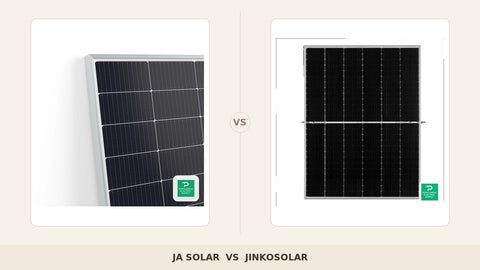
We've unloaded trucks full of both brands. Qcells arrives on pallets stacked out of Dalton, Georgia. Silfab shows up from Washington State and South Carolina with a maple leaf in the paperwork and a snow-load rating that makes northern installers smile. If you want a North American-made residential panel in 2026 and you've already ruled out the import-value tier, this is the fight: Qcells Q.TRON versus Silfab Elite. Both assemble on this continent, both carry real warranties, and both qualify for the domestic-content bonus on commercial work. They get there differently, and the differences matter on the roof.
This comparison is written from the distributor side of the counter. We sell both lines, we've handled warranty claims on both, and we've watched both survive — and occasionally fail — real installs from Portland rain to Carolina heat. Below: verified specs, string and breaker math you can hand to your electrician, 25-year yield numbers, and the situations where each brand wins outright.
Why This Matchup Matters in 2026
Two forces collided this year. First, the tariff stack: with the Section 201 safeguard expired and the August 2026 Section 232 minimum-import-price program putting a hard floor under imported modules, the old "buy whatever's cheapest from Southeast Asia" playbook got expensive fast. AD/CVD duties on Vietnamese, Thai, Malaysian, and Cambodian modules run from 9% to nearly 300% depending on the supplier. Second, the domestic-content ITC bonus still rewards commercial projects that source American-made equipment, and FEOC rules push buyers toward factories owned by friendly jurisdictions.
Qcells and Silfab sit in the sweet spot. Qcells — owned by Hanwha, a South Korean major — runs the largest module assembly plant in the Western Hemisphere in Dalton, Georgia, and has been pouring money into a fully integrated Georgia supply chain. Silfab is the scrappier player: a Canadian-founded manufacturer with lines in Burlington, Washington and Fort Mill, South Carolina, plus its original Ontario facility. Both dodge the import floor. Both ship on short lead times to US distributors like us.
The practical question for a homeowner or installer isn't "which is made here" — both are. It's which panel gives you more watts per square foot of roof, which warranty actually pays out, and which one your electrician can get permitted without drama. Let's get into it.
Side-by-Side Specification Table
Numbers below come from current manufacturer datasheets for the residential lines we actually stock: Qcells Q.TRON BLK M-G2 class and Silfab Elite / SIL series. Always confirm the exact SKU on the datasheet before you stamp a design.
| Specification | Qcells (Q.TRON class) | Silfab (Elite / SIL class) |
|---|---|---|
| Cell Architecture | N-type TOPCon (Q.ANTUM NEO) | Half-cut mono; N-type TOPCon on current Elite lines |
| Residential Wattage Class | ~400–440 W residential (commercial siblings to ~500 W+) | ~370–430 W residential (Elite ~410–430 W class); 570 W+ commercial bifacial |
| Max Module Efficiency | Up to ~22.5% | ~20–22% by series (Elite ~21.4–21.5%) |
| Temperature Coefficient (Pmax) | ~−0.30%/°C class | Average class (~−0.35%/°C) |
| Degradation / Long-Term Output | ≤1% class first year, ~0.33–0.40%/yr — ≥86–90.5% at year 25 by series | ~0.50%/yr class; ≥82.6–89% at year 30 by series |
| Product / Performance Warranty | 25 yr product / 25 yr performance; Q.PARTNER labor reimbursement up to $250/claim (≤25 kW systems) | 12–25 yr product (25 with registration on current lines); up to 30 yr linear performance |
| Manufacturing Origin | Assembled in Dalton, Georgia, USA — largest module fab in the Western Hemisphere (Hanwha-owned) | Manufactured in Washington State, South Carolina, and Ontario, Canada |
| Load / Durability Rating | Standard premium class | 5400 Pa snow-load rated class; half-cut cell shade tolerance |
| Typical Price Position | +$0.15–0.30/W over commodity; best-value premium tier | Mid-range (comparable to other NA-made brands) |
Read the efficiency row twice. A 22.5% panel and a 21.4% panel don't sound far apart, but on a space-constrained roof that gap decides whether you fit 8 kW or 7.2 kW. If roof area is cheap — barns, ground mounts, big ranch roofs — Silfab's lower $/W often wins the math. If every square foot counts, Qcells' TOPCon density earns its premium.
Manufacturing, Tariffs, and Domestic Content
This is where 2026 is genuinely different from 2024. The Section 232 minimum import price program sets floors of $0.38/W on imported modules plus a 15% ad valorem duty for most origins, stacked on top of existing AD/CVD. Modules assembled in the US from imported cells still capture most of that advantage, and both brands do exactly that today.
| Trade / Content Factor | Qcells | Silfab |
|---|---|---|
| US assembly plant | Dalton & Cartersville, Georgia | Burlington, WA and Fort Mill, SC |
| Subject to Section 232 module MIP ($0.38/W floor) | No (US-made) | No (US/Canada-made) |
| Subject to SE-Asia AD/CVD stack | No | No |
| Domestic-content ITC bonus (commercial 48E) | Eligible pathway — verify BOM cost share with your tax counsel | Eligible pathway — verify BOM cost share with your tax counsel |
| FEOC exposure | Low (Hanwha / South Korea ownership) | Low (Canadian ownership) |
| Typical distributor lead time (our dock) | 1–3 weeks | 2–5 weeks by series |
One caution we give every commercial buyer: "assembled in USA" and "domestic content qualified" are not the same sentence. The bonus calculation looks at manufactured-product cost share, and cells matter. Ask us for the current domestic-content documentation packet on either line before you promise the bonus in a proposal — we've seen projects lose the 10-point adder over a BOM assumption nobody verified.
Technology: TOPCon Scale vs Half-Cut Craft
Qcells' Q.ANTUM NEO is N-type TOPCon — the technology that now carries roughly four-fifths of global Tier-1 shipments. TOPCon's advantages over the old PERC generation are real: higher bifaciality on commercial glass-glass variants, lower first-year degradation, and better low-light behavior. In residential all-black format, what you actually notice is the wattage class: 420–440 W panels are standard issue now, where three years ago 370 W was premium.
Silfab's story is different. Their Elite line moved to N-type TOPCon as well, but the company's DNA is half-cut mono construction with conservative electrical design. The Silfab Elite 370 W N-type TOPCon all-black is a good example of their approach: not the biggest number on the spec sheet, but tight binning, a 5400 Pa snow rating, and a frame that doesn't oil-can when a 220-pound installer steps near it. I've personally torqued Silfab mid-clamps in a February sleet storm outside Spokane — the frames are genuinely stiffer than most value imports.
Where Qcells pulls ahead on paper is temperature coefficient: roughly −0.30%/°C versus Silfab's ~−0.35%/°C class. On a 75°C cell temperature day — a dark roof in Texas in August — that's about 1.75% more power from the Qcells array versus nameplate relative loss. Not huge. But over 25 years of summers, it compounds into real kWh, as the yield table below shows.
System Design Math: An 8 kW Residential Array
Here's the math we run at the counter when a homeowner asks "how many panels is 8 kW?" Assumptions: nameplate watts only, roof area estimated at ~1.9–2.1 m² per modern residential panel, string inverter with a 600 V residential limit. Verify exact Voc and dimensions on the SKU-level datasheet before permitting.
| Design Figure | Qcells Q.TRON 430 W | Silfab Elite 370 W |
|---|---|---|
| Panels for ~8 kW DC | 19 × 430 W = 8,170 W | 22 × 370 W = 8,140 W |
| Approx. roof area @ ~1.95 m²/panel | ~37.1 m² (~399 ft²) | ~42.9 m² (~462 ft²) |
| Strings of 10 (typical Voc ~49–50 V class) | 2 strings (10 + 9) | 2 strings (11 + 11) |
| Cold-corrected string Voc (−10 °C, ~+10%) | ~539 V — OK under 600 V | ~600 V — check exact Voc; may need 10/12 split |
| Relative efficiency class | ~22.5% | ~19–21% (370 W class) |
Three extra panels for Silfab means three more rails-attachments, three more clamps, three more sets of flashings. At roughly $3–5 per attachment point installed, plus racking at about $0.10–0.15/W, the "cheaper" panel claws back some of Qcells' premium in BOS labor. On a simple comp shingle roof the difference is maybe $150–250 — worth knowing, rarely decisive.
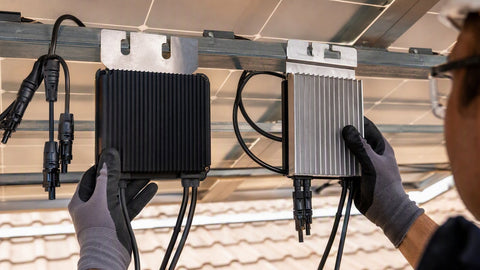
If you're pairing either brand with module-level electronics, our microinverter lineup and the microinverter vs string inverter guide walk through that decision. Both brands play fine with Enphase, Hoymiles, and SolarEdge gear; neither requires proprietary electronics.
NEC Wire and Breaker Sizing for the 8 kW Example
One table we hand to every electrician who calls in: the AC side of that 8 kW array on a 240 V service, sized per NEC 690.8 continuous-duty rules with 125% overcurrent, matched to NEC 240.6(A) standard breaker sizes and 75 °C copper ampacities from NEC 310.16.
| Item | Calculation | Result |
|---|---|---|
| Inverter max continuous output (7.7 kW class) | 7,700 W ÷ 240 V | 32.1 A |
| Continuous-duty multiplier (NEC 690.8/705.28) | 32.1 A × 1.25 | 40.1 A |
| Standard breaker (NEC 240.6(A)) | Next size up from 40.1 A | 45 A |
| Copper conductor, 75 °C (NEC 310.16) | Must carry ≥ 40.1 A | 8 AWG THHN/THWN-2 (50 A @ 75 °C) |
| Load-side 120% rule check (705.12) | 200 A bus × 1.2 − 200 A main | 40 A backfeed allowed — 45 A breaker may need a line-side tap or derated main; verify panel schedule |
That last row bites people weekly. A 45 A backfeed breaker does not fit the 120% rule on a standard 200 A/200 A panel. Either derate the main to 175 A, tap the line side, or step the inverter down to a 7.0 kW unit (35 A breaker class). For deeper wire and ampacity charts, see our NEC wire sizing guide with ampacity charts.
Warranty Structures, Read Carefully
Qcells offers 25-year product and 25-year performance coverage on current residential lines, and their Q.PARTNER program reimburses labor up to $250 per claim on systems ≤25 kW when a registered partner does the swap. That labor piece matters — a warranty that covers the panel but not the truck roll leaves the homeowner holding $300–500 of ladder time.
Silfab's product warranty runs 12–25 years depending on series and registration; current North American lines register to 25 years, and linear performance coverage extends to 30 years on several SKUs (≥82.6–89% at year 30 depending on series). Read the registration window: miss the deadline and some lines fall back to the shorter term. We register every Silfab system we kit the day it ships — it takes four minutes and there's no excuse not to.
25-Year Energy Yield Math
Assumptions: 8 kW DC array, 1,400 kWh/kWp first-year yield (good-but-not-Phoenix US sun), warranted degradation applied linearly. These are planning numbers, not production guarantees.
| Metric | Qcells Q.TRON (1% yr-1, 0.33%/yr after) | Silfab Elite (1% yr-1, ~0.50%/yr class) |
|---|---|---|
| Year-1 production | ~11,200 kWh | ~11,200 kWh |
| Year-25 warranted output | ~91% → ~10,190 kWh | ~87% → ~9,750 kWh |
| 25-yr cumulative (approx.) | ~268 MWh | ~259 MWh |
| Cumulative advantage | — | Qcells ahead ~9 MWh (~$1,350 @ $0.15/kWh) |
| Hot-climate bonus (tempco difference) | +~1.5–2% in high-heat regions | — |
Nine megawatt-hours over 25 years is real money but not life-changing money — about one year's consumption for an efficient home. If Silfab quotes $0.20/W less on a given week, that price gap ($1,600 on 8 kW) beats the yield gap. Watch the weekly price sheet, not the brochure. You can check current panel pricing in our 400–459 W panel collection and 430 W class collection, or get a firm number through the quote page.
Field Notes: Handling, Racking, and Real Installs
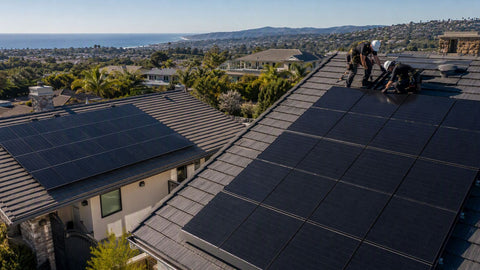
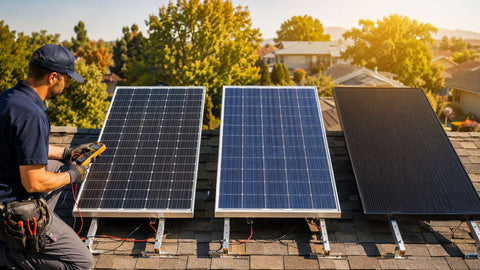
We've racked thousands of both panels. Qcells Q.TRON modules come out of the box with a clean all-black backsheet and a frame profile that seats predictably in IronRidge and Unirac clamps — no surprises, no weird mid-clamp clearances. The one handling note: the 440 W class panels run about 47 × 84 inches and change, and two-person sets are mandatory on anything above a single-story roof. Don't let a green crew solo-carry them up a ladder; that's how corners get bent and microcracks happen before the panel ever sees sun.
Silfab's half-cut layout pays a quiet dividend on partial-shade roofs. Split the module into two independent halves and a chimney shadow that would gut a conventional panel's output only costs you part of one half. On a west-facing roof in Beaverton with a big fir tree the owner refused to cut, we watched a Silfab array hold measurably higher afternoon output than the string modeling predicted — the shade never took the whole panel offline at once. Pair that with module-level electronics and the effect multiplies.
One more from the service side: we've processed a handful of warranty claims on each brand over the years, and both manufacturers answered the phone. Qcells routed through their US support desk and paid labor without a fight on a registered Q.PARTNER job. Silfab asked for photos, serials, and a flashed IV curve, then shipped a replacement panel inside three weeks. Neither experience was the horror story you hear about offshore value brands, where "warranty" means an email address that stops answering.
Climate Fit: Where Each Panel Shines
Hot-climate buyers — Texas, Arizona, the inland Southeast — should weight the temperature coefficient heavily. Cell temperatures on a dark comp roof run 30–35 °C above ambient on still summer afternoons. At a 32 °C delta, Qcells' ~−0.30%/°C class gives up about 9.6% of nameplate power; a ~−0.35%/°C panel gives up about 11.2%. On an 8 kW array that's roughly 130 W of extra real power at peak, every hot afternoon, for decades. It doesn't show up in the sticker price, so buyers miss it.
Cold and snow country flips the script. Silfab's 5400 Pa snow-load rating is the kind of number you want in Vermont, the Upper Peninsula, or the Washington Cascades, where a wet March snowfall can park 40 pounds per square foot on a racked array. Cold temperatures also boost voltage and module efficiency for everyone, so the tempco gap shrinks in winter. For mountain installs we also spec heavier rail and tighter attachment spacing regardless of brand — the panel rating is only half the load path. Our solar mounting systems collection carries the rail options for high-snow designs.
Both brands submit to third-party reliability testing, and that's the tiebreaker most shoppers never see. Kiwa PVEL's scorecard punishes panels with thermal cycling, damp heat, mechanical stress, PID, and a hail sequence that fires ice balls at the glass. When we stock a line, we ask for the latest scorecard results first — a panel that survives PVEL's hail stress sequence survives Oklahoma. Ask us for the current test summary on any SKU we quote; if a brand can't produce one, that tells you something too.
The Domestic-Content Tiebreaker
For commercial and community solar chasing the 10-point domestic-content adder under Section 48E, both brands offer a viable pathway — and both require paperwork. Qcells' Georgia fab plus Hanwha's announced US cell production gives them the deepest integrated US supply chain of the two. Silfab counters with North American content across two countries and a long CEC listing history for California work. For pure residential cash deals where the residential credit has expired, content bonuses don't apply — buy on watts per dollar and roof fit instead.
Browse the live catalogs here: Qcells panels (including the Qcells XL G11S commercial class) and Silfab panels (also under Silfab Solar). If you're cross-shopping the premium tier, our REC vs Qcells residential comparison and the Qcells vs Trina vs JA page add the import-premium context, and the best solar panels 2026 roundup ranks the full field.
Choose Qcells If / Choose Silfab If
Choose Qcells if: your roof is tight and every watt per square foot matters; you want the deepest US manufacturing footprint and the shortest lead times; you're in a hot climate where the −0.30%/°C class tempco pays for itself; or you value 25/25 warranty coverage with a labor reimbursement program behind it.
Choose Silfab if: roof area is plentiful and $/W rules the decision; you're in snow country and want the 5400 Pa rating without paying premium-tier prices; you prefer supporting a smaller North American manufacturer; or your installer is already set up in Silfab's registration program and can lock the 25-year product term for you.
Either way, both pair cleanly with the racking in our racking and mounting collection, drop into our complete solar kits and grid-tied systems, and pencil out with the system size calculator. For full-project planning, the solar panel kits buyer's guide is the next read.
Frequently Asked Questions
Are Qcells and Silfab both made in the USA?
Qcells modules for the US market are assembled in Dalton and Cartersville, Georgia — the largest module fab in the Western Hemisphere. Silfab manufactures in Burlington, Washington and Fort Mill, South Carolina, plus its original Ontario, Canada plant. Both qualify as North American-made and sidestep the 2026 import price floors.
Which is more efficient?
Qcells' current residential TOPCon line tops out around 22.5% module efficiency; Silfab's Elite class runs roughly 21.4–21.5%. On a space-limited roof, Qcells fits more kW. On an open roof or ground mount, the efficiency gap rarely justifies a big price gap.
Which has the better warranty?
Qcells offers 25-year product and 25-year performance coverage standard on current residential lines, plus Q.PARTNER labor reimbursement up to $250 per claim. Silfab reaches 25-year product coverage with registration on current lines and pushes linear performance coverage to 30 years on several SKUs. Qcells wins on simplicity; Silfab's 30-year performance term wins on paper if you register on time.
Which is cheaper?
Week to week it moves. Qcells typically prices $0.15–0.30/W above commodity imports; Silfab prices in the mid-range band alongside other North American-made brands. When Silfab discounts, it often undercuts Qcells by $0.10–0.20/W — enough to beat Qcells' 25-year yield advantage on an 8 kW system.
Do both qualify for domestic content incentives?
Both offer eligible pathways for the Section 48E domestic-content bonus on commercial projects, but qualification depends on the full BOM cost share — cells, frames, glass. Request the current domestic-content documentation for the exact SKU before writing the bonus into a proposal.
Can I mix these panels with microinverters or optimizers?
Yes. Both brands carry standard MC4-compatible connectors and work with Enphase, Hoymiles, APsystems micros and SolarEdge or Tigo optimizers. Neither requires proprietary electronics.
Sources & Standards
- Qcells Q.TRON BLK M-G2 series datasheet and limited warranty (us.qcells.com)
- Silfab Elite / SIL series datasheets and North America warranty terms (silfabsolar.com)
- NEC 2023 Articles 690.7, 690.8, 705.12, 240.6(A), and Table 310.16
- US Section 232 polysilicon/solar proclamation and MIP program (August 2026)
- California Energy Commission Solar Equipment Lists (module eligibility)
- Kiwa PVEL PV Module Reliability Scorecard (recent editions)