I've commissioned, troubleshot, and warrantied hundreds of EG4 systems across the Pacific Northwest and into the mountain West since the brand first gained traction in 2022. What started as a budget curiosity — could a sub-$1,500 inverter really run a home? — has matured into a legitimate ecosystem that now competes with brands costing three times as much. The 18kPV hybrid, the XP off-grid family, three battery lines, the Chargeverter, and the GridBOSS MID form a modular platform that scales from a weekend cabin outside Bend to a 200A service home in the suburbs. This guide is the field reference I wish I'd had on my first EG4 commissioning: real specs, verified math, common failure modes, and the pairing rules that keep systems running instead of faulting at 2 a.m.
The EG4 value proposition is straightforward: North American voltage (split-phase 120/240V), UL 1741-SA compliance on current models, massive PV input headroom relative to output rating, and battery pricing that undercuts premium LFP by roughly 40%. The trade-off is documentation depth and a support model that leans on community knowledge rather than a 1-800 line. Installers who treat EG4 like a plug-and-play appliance have bad outcomes; installers who read the manuals, run the voltage math, and commission methodically get systems that perform for years.
EG4 Inverter Lineup: Specs Compared
EG4's inverter portfolio splits cleanly into hybrid (grid-interactive with battery backup) and off-grid (islanded) architectures. Choosing the wrong category for the application is the most expensive mistake I see — a homeowner who wants net metering and backup buys an XP series, then discovers it cannot sell to the grid. Below is the full current lineup with the electrical data that matters for system design.
| Model | Architecture | Output (continuous) | PV Input (max) | MPPT Range | Max PV Isc | Battery Voltage | Max Charge Current |
|---|---|---|---|---|---|---|---|
| 18kPV (12LV) | Hybrid split-phase | 18 kW | 18 kW | 200–850 VDC | 26 A per MPPT (2 trackers) | 48V | 250 A |
| 12000XP | Off-grid split-phase | 12 kW | 24 kW | 150–500 VDC | 22 A per MPPT (2 trackers) | 48V | 180 A |
| 6000XP | Off-grid split-phase | 6 kW | 8 kW | 150–500 VDC | 18 A per MPPT (2 trackers) | 48V | 120 A |
| 3000EHV-48 | Off-grid all-in-one | 3 kW | 5 kW | 90–450 VDC | 12 A per MPPT (1 tracker) | 48V | 60 A |
The MPPT voltage range is the single most critical number for array design. On the 12000XP, a string of six 400W modules with a Voc of 49.5V produces 297V at standard test conditions — well inside the 150–500V window. But at -10°F, that same string's open-circuit voltage climbs to roughly 49.5 × 6 × 1.18 = 350V (using a typical temperature coefficient of -0.28%/°C), still safe. A string of seven modules at -10°F hits 409V, also safe. Eight modules push 468V — still inside spec, but with only 32V of headroom at design low temperature. I've seen installers try ten modules in series on a 6000XP; at cold morning temps they trip the 500V ceiling and the inverter faults out until the sun warms the array. Check the math every time.
Battery Family Deep Dive: LL, LiFePower4, and PowerPro
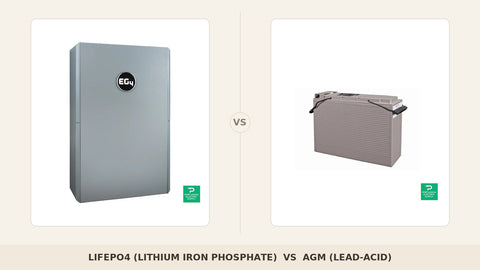
EG4 offers three distinct 48V LiFePO4 battery platforms. They share chemistry and nominal voltage but differ in form factor, capacity per enclosure, communication protocol, and outdoor rating. The wrong pairing — or mixing families on the same bus without verification — produces fault codes, imbalanced charging, and shortened cycle life.
| Battery Model | Capacity | Form Factor | Weight | Outdoor Rating | Max Parallel | Comm Protocol |
|---|---|---|---|---|---|---|
| LL-S 48V 100Ah | 5.12 kWh | 19" rack-mount (2U) | 114 lb | Indoor only | 16 units | CAN/RS485 |
| LiFePower4 48V 100Ah V2 | 5.12 kWh | 19" rack-mount (2U) | 114 lb | Indoor only | 16 units | CAN/RS485 |
| PowerPro WallMount AllWeather | 14.3 kWh (280Ah) | Wall-mount sealed cabinet | 315 lb | IP65 / outdoor | 4 units | CAN/RS485 |
The rack-mount units (LL-S and LiFePower4 V2) are mechanically identical at 5.12 kWh per cabinet and stack in standard server racks. The PowerPro WallMount delivers 2.8× the energy per enclosure, which matters in installations where rack space or indoor floor space is limited. I've mounted PowerPro units on exterior garage walls in coastal Oregon where indoor humidity and salt air would destroy a rack battery in two seasons — the IP65 rating is not marketing, it's a necessity.
A critical but under-discussed spec: maximum charge and discharge current per battery. The 5.12 kWh rack modules are typically rated for 50A continuous discharge. Paralleling four units gives 200A of battery discharge capacity. A 12000XP inverter pulling 12 kW at 48V draws 250A from the battery bus (12,000 ÷ 48 = 250). That means four rack batteries can just barely feed a fully loaded 12000XP — and only if they're healthy and above 50% state of charge. Below 50%, voltage sag reduces available current. The PowerPro, at 280Ah, can sustain higher continuous discharge rates per unit, but verify the exact BMS limit in EG4's current compatibility sheet before designing around it.
System Sizing: Three Real Designs
Theory is fine; real loads and real budgets matter more. Below are three EG4 systems I've either commissioned personally or quoted in the last twelve months, with full electrical math shown.
Design A: Off-grid cabin, 12 kWh/day, 4 kW peak
Load profile: LED lighting, propane cooking, 12VDC refrigeration, a small well pump, and a modest inverter mini-split for summer cooling. Daily consumption averages 12 kWh with a 4 kW simultaneous peak. Three days of autonomy desired.
Battery sizing: 12 kWh/day × 3 days = 36 kWh of storage. Using 80% depth of discharge (DOD) as the practical operating floor for cycle-life preservation: 36 ÷ 0.80 = 45 kWh gross. Three PowerPro WallMount 14.3 kWh units = 42.9 kWh gross — slightly short on paper, but the cabin's loads are modest and a generator backup (via Chargeverter) covers extended dark periods. Alternatively, nine LL-S 5.12 kWh modules = 46.1 kWh gross, which hits the target exactly but requires a full server rack indoors.
Inverter: 6000XP (6 kW continuous, 12 kW surge). At 4 kW peak load, the 6000XP runs at 67% of continuous rating — healthy headroom. The 8 kW PV input ceiling supports 16–20 modules in the 400W class, producing roughly 28–36 kWh on a good summer day and 10–14 kWh in winter.
Array sizing for winter recovery: In the Pacific Northwest, December solar insolation runs roughly 1.5–2.0 peak sun hours. To replace 12 kWh in a December day at 2.0 PSH with system losses of 15% (wiring, inverter, soiling): 12 ÷ (2.0 × 0.85) = 7.06 kW of array. A 8 kW array (20 × 400W) provides margin. Total hardware cost before modules, racking, and BOS: roughly $7,500 (6000XP at $1,492 + three PowerPro at $3,692 each = $12,568 — or nine LL-S at $1,499 each = $13,491 + $1,492 inverter).
Design B: Grid-tied whole home with backup, 200A service
Home: 2,800 sq ft, all-electric kitchen, gas heat, central AC (3-ton), EV charger (32A). Desired backup coverage: essential loads only during outage — HVAC, refrigerator, lighting, well pump, modem/router.
Inverter: 18kPV hybrid + GridBOSS MID 200A. The GridBOSS handles service-entrance interconnection, islanding, and generator input. The 18kPV sells excess solar to the grid and provides 18 kW of backup output — enough for the essential load list above with margin.
Battery: Four LL-S 5.12 kWh rack batteries = 20.5 kWh gross, roughly 16.4 kWh usable at 80% DOD. At an average essential load of 3–4 kW during an outage, that's 4–5 hours of runtime. For overnight coverage, six units (30.7 kWh gross) is the safer sizing. The Chargeverter adds generator backup for multi-day outages.
PV array: 14 kW of modules (35 × 400W) on two roof planes. At 18 kW PV input, the 18kPV has headroom for future expansion. Annual production in a 4.5 PSH climate: 14,000W × 4.5 hours × 365 days × 0.78 system efficiency = ~17,900 kWh/year. Against a 14,000 kWh annual consumption, the home is net-positive with surplus for the EV.
Design C: Shop and ADU, split-phase 240V tools
Workshop with 240V table saw, welder, and compressor; adjacent ADU with standard residential loads. Total simultaneous peak: 8 kW. Daily consumption: 18 kWh.
Inverter: 12000XP (12 kW continuous). Two units in parallel would deliver 24 kW — overkill. One 12000XP at 12 kW handles the 8 kW peak with 50% headroom. The 24 kW PV input supports a massive array for fast recovery: 20 kW of modules (50 × 400W) produces 60–80 kWh on a summer day, fully recharging a 30 kWh battery bank by early afternoon with surplus for loads.
Battery: Six LL-S rack modules = 30.7 kWh gross, 24.6 kWh usable. At 18 kWh/day, that's 1.37 days of autonomy — light, but the Chargeverter and a 7,500W portable generator provide the dark-week insurance.
The Chargeverter: What It Actually Does
The Chargeverter GC is not an inverter, and calling it one confuses every customer I've explained it to. It's a 100A, 48V battery charger that accepts 120/240VAC input from any source — generator, grid, or even another inverter — and outputs regulated DC charge current to the battery bus. In a generator-backed off-grid system, it decouples power quality from charging: a contractor-grade generator with dirty waveform output feeds the Chargeverter, which produces clean DC to the batteries. The inverter then inverts that stored DC to perfect split-phase AC for the house.
The math is simple but powerful. At 100A and 48V nominal, the Chargeverter delivers 4,800W of charge power (100 × 48 = 4,800). A 30.7 kWh battery bank (six LL-S units) at 20% state of charge needs 24.6 kWh to reach full. At 4.8 kW charge rate: 24,600 ÷ 4,800 = 5.1 hours of generator runtime to fully recharge. A 5,000W generator running at 96% load for five hours consumes roughly 5 gallons of propane at typical consumption rates — about $15–20 of fuel to restore a full day of stored energy. That's the economics that make off-grid living practical.
The GridBOSS MID: Service Entrance Simplified
The GridBOSS MID is not an inverter either — it's a 200A microgrid interconnection device (MID) and smart service-entrance switchgear. Think of it as the brain that decides where power comes from and where it goes. In normal operation, grid power flows through the GridBOSS to the main panel. During an outage, the GridBOSS islands the home, starts the 18kPV, and routes solar and battery power to critical loads. When the grid returns, it re-synchronizes and transfers back.
The MID also integrates generator input: the Chargeverter (or a standalone generator) feeds the battery bus through the GridBOSS's coordination logic. A complete system — grid + solar + battery + generator — has four power sources managed by one box. The alternative is a separate transfer switch, manual interlock, and a rat's nest of wiring that takes an extra day to commission. I've installed both approaches; the GridBOSS saves roughly 4–6 hours of labor and eliminates three potential failure points.
Common EG4 Commissioning Failures (And How to Avoid Them)
After troubleshooting dozens of systems, the failure modes cluster into five categories. Every one is preventable with methodical commissioning.
| Failure Mode | Root Cause | Prevention |
|---|---|---|
| PV over-voltage fault (Error 01 or similar) | String Voc at record low temperature exceeds MPPT max | Calculate cold-weather Voc using module temp coefficient; keep 10% margin below inverter ceiling |
| Battery communication fault | Incorrect CAN/RS485 dip-switch settings; mixed battery families | Verify all batteries use identical protocol; check EG4 compatibility matrix before paralleling |
| Inverter overload shutdown under motor start | Battery discharge current insufficient for surge load | Size battery bank for 1.5× expected continuous inverter load; verify BMS current limits |
| Generator not charging batteries | Chargeverter AC input wiring reversed or breaker undersized | Verify L1/L2/N/G at Chargeverter terminals; size breaker per 125% of 100A charge current (125A) |
| Grid-tie 18kPV not selling to utility | Export limit set to zero; GridBOSS not configured for sell mode | Check inverter export settings and GridBOSS mode configuration during commissioning |
The PV over-voltage fault is the most common DIY mistake. I walked a customer through this over the phone last winter: he had ten 440W modules in series on a 6000XP with a 500V max MPPT. Each module had a Voc of 49.2V. At -5°F, the temperature-corrected Voc = 49.2 × 10 × 1.20 = 590V — 90V over the limit. The inverter threw a fault at dawn on the first cold morning. Dropping to eight modules in series (472V corrected) solved it permanently. The NEC 690.7 voltage correction formula exists for exactly this reason, and EG4 inverters are no exception.
NEC Compliance for EG4 Installations
EG4 systems must meet the same National Electrical Code requirements as any solar-plus-storage installation. The code articles that come up on every EG4 job:
PV source and output circuits (NEC 690). PV conductors from the array to the inverter are required to be listed PV wire (USE-2 or PV1-F) with proper ampacity per NEC 310.16. For a 12000XP with 24 kW of PV input at 400VDC: 24,000 ÷ 400 = 60A per MPPT (two trackers). Using the 90°C column for PV wire (since PV wire is rated 90°C wet/dry), 10 AWG is rated 55A — undersized. 8 AWG is rated 80A, providing margin. If both MPPTs run in separate conduit, 8 AWG suffices. Combined in one conduit, derating applies per 310.15(C)(1).
Battery circuit sizing (NEC 706). Battery interconnect conductors must carry the maximum charge or discharge current, whichever is greater. A 12000XP charging at 180A DC requires: 180A × 1.25 (continuous) = 225A. 4/0 AWG copper is rated 230A at 75°C — the minimum. Many installers use dual 2/0 runs in parallel (each rated 195A at 75°C, 390A combined) for flexibility, but this requires identical lengths and proper parallel-conductor terminations per NEC 310.10(H).
Grounding and bonding (NEC 690.43, 250). All EG4 inverters require equipment grounding conductors sized per NEC 250.122 based on the largest ungrounded conductor. For a 4/0 battery circuit, Table 250.122 calls for a 6 AWG equipment ground minimum. PV arrays require grounding per module manufacturer instructions and NEC 690.43. Rapid shutdown compliance (NEC 690.12) is achieved through module-level rapid-shutdown devices or string-level RSD boxes — verify compatibility with the specific EG4 inverter's DC input configuration.
Field Notes: What Three Years of EG4 Service Calls Taught Me
I've replaced exactly two EG4 inverter units under warranty in three years — both were early-production 6000XP units with a known batch capacitor issue that EG4 resolved in subsequent firmware. The hardware is more durable than the price suggests. What fails is almost always installation practice, not product quality.
First: firmware updates matter. EG4 releases meaningful firmware revisions that fix grid-interaction quirks, improve MPPT tracking algorithms, and add features. The 18kPV shipped with a default export limit of 0W in some early firmware versions — installers who didn't check sold power back to the grid at zero watts and wondered why their production meter never moved. Five minutes of firmware update during commissioning prevents hours of phone support.
Second: torque specs on battery terminals are real. The M8 bolts on LL-S and PowerPro terminals require 12–15 N·m. Loose terminals arc, heat-cycle, and eventually melt the busbar. I've seen three battery BMS faults traced to a single loose terminal that heated to 180°F before the thermal sensor caught it. Use a torque wrench. Write the torque value on the installation checklist.
Third: ventilation is not optional. A 12000XP in a 100°F equipment shed in eastern Washington derated its output by roughly 15% until we added a thermostatic exhaust fan. Inverter efficiency drops with temperature, and thermal shutdown is the last line of defense, not the operating plan. Give these units breathing room — minimum 12 inches clearance on all sides, more in hot climates.
EG4 vs. Premium Brands: The Honest Comparison
| Factor | EG4 | Sol-Ark / Schneider / Victron |
|---|---|---|
| Cost per kW inverter | $250–400 | $800–1,500 |
| Cost per kWh battery | $290–360 | $500–800 |
| Support model | Documentation + community forums | Phone support + dealer network |
| Installer learning curve | Moderate — requires self-study | Shorter — formal training available |
| UL listing | UL 1741-SA (current models) | UL 1741-SA |
| Warranty | 5 years inverter, 10 years battery | 5–10 years inverter, 10 years battery |
| Parallel capability | Up to 6 units (XP series) | Varies by model — 2 to 12+ |
The comparison is not "cheap vs. good." It's "hands-on installer vs. turnkey buyer." If you want a dealer to design, install, and warrantee everything, premium brands with certified installer networks are the right fit. If you're a capable DIYer or an electrical contractor who reads datasheets and owns a torque wrench, EG4 delivers comparable electrical performance at 40–60% lower hardware cost. The savings on a 20 kWh system can exceed $8,000 — enough to fund a professional electrician's labor for the installation and still come out ahead.
Portlandia Electric Supply EG4 Inventory
We stock the full EG4 ecosystem for same-day or next-day shipment from our Portland warehouse. Current availability includes the 18kPV hybrid inverter, 12000XP off-grid inverter, 6000XP off-grid inverter, 3000EHV-48 all-in-one, LL-S 48V 100Ah rack batteries, LiFePower4 48V 100Ah V2 batteries, PowerPro WallMount AllWeather 14.3 kWh, Chargeverter GC, and GridBOSS MID V2.
Volume pricing and project kitting are available for installer partners. We can configure complete off-grid or hybrid packages with inverter, batteries, Chargeverter, and racking quoted as a single line item with one delivery date. Call the counter or submit a project brief through our quote request page for custom system design support.
Frequently Asked Questions
Is EG4 a good brand for off-grid solar?
For value-driven off-grid and hybrid systems, EG4 is one of the strongest price-to-performance ratios in the North American market in 2026. Current-generation hardware carries UL 1741-SA listing, the battery ecosystem is deep, and the installer community is active. Support is documentation-driven rather than phone-based — plan accordingly.
What is the difference between the 18kPV and 12000XP?
The 18kPV is a hybrid inverter: it connects to the utility grid, sells excess solar, and provides battery backup during outages. The 12000XP is an off-grid inverter: it island-powers your home from solar and batteries but cannot export to or import from the grid. Grid-tied with backup → 18kPV. True off-grid → 12000XP.
How many EG4 batteries do I need?
Calculate daily kWh consumption × desired days of autonomy ÷ usable DOD. For example: 15 kWh/day × 3 days ÷ 0.80 DOD = 56.25 kWh gross. That equals eleven LL-S 5.12 kWh rack modules (56.3 kWh) or four PowerPro WallMount 14.3 kWh units (57.2 kWh). Verify that your chosen inverter's charge current and the battery bank's maximum discharge rate match your load profile.
Can the 6000XP run a whole house?
A modest home with gas appliances and no central AC — yes. The 6000XP delivers 6 kW continuous, which covers lighting, refrigeration, electronics, and a gas furnace blower. Central AC, electric cooking, or a well pump pushes you toward the 12000XP or paralleled 6000XP units.
What does the Chargeverter do?
The Chargeverter is a 100A, 48V DC battery charger. It converts 120/240VAC from a generator or grid source into regulated DC charge current for your battery bank. In off-grid systems, it lets any generator — even one with poor power quality — charge your batteries cleanly and efficiently.
Can I mix EG4 battery types?
Mixing LL-S, LiFePower4, and PowerPro batteries on the same DC bus requires explicit verification against EG4's current compatibility documentation. They share chemistry but may use different BMS communication profiles. Confirm compatibility before paralleling — mixing without verification is the leading cause of battery communication faults.
How do I size PV strings for an EG4 inverter?
Use the module's Voc and temperature coefficient to calculate the maximum cold-weather open-circuit voltage: Voc × number of modules × (1 + (T_min - 25°C) × temp coefficient). This value must remain below the inverter's maximum MPPT voltage with at least 10% margin. NEC 690.7 provides the standard method.
What wire size do I need for the battery bank?
Size for the inverter's maximum DC charge or discharge current × 1.25 (continuous load factor). A 12000XP at 180A charge requires 225A conductor ampacity: minimum 4/0 AWG copper at 75°C. Many installers use dual 2/0 in parallel for flexibility, but NEC 310.10(H) parallel conductor rules must be followed exactly.
Related Guides and Tools
- Battery Backup Runtime Calculator — size your bank for the loads that matter
- Solar Battery Sizing Guide — off-grid storage math explained
- EG4 Brand Guide — full product family overview
- Home Battery Bank Sizing Guide — residential storage design
- Solar System Size Calculator — array sizing for your location
- Solar Panel Kits Buyer's Guide — pre-configured system packages
- NEC Wire Sizing Guide — ampacity tables for solar and battery circuits
- Conduit Fill Chart — EMT and PVC fill limits for DC and AC runs
- Solar Grounding and Bonding Guide — NEC 690.43 and 250 compliance
- Off-Grid Solar System Design Guide — system architecture from load analysis to commissioning