SolarEdge vs Tigo 2026: Full Optimizer Systems vs Selective MLPE
One platform puts an optimizer under every panel. The other lets you spend electronics dollars only where shade actually lives. Here is how we spec both on real roofs.
I have commissioned more SolarEdge systems than I can count on two crews' hands, and I have retrofitted enough shaded arrays with Tigo gear to know exactly where each approach earns its money. This is not a spec-sheet regurgitation. This is what we actually quote when a homeowner calls with a chimney on the south face, or when a commercial flat roof has a condenser farm throwing afternoon shadows.
The short version: SolarEdge sells you a complete, tightly integrated DC-optimized architecture — one optimizer per module, a simplified string inverter with no DC disconnect inside, and module-level monitoring out of the box. Tigo sells you module-level power electronics (MLPE) you deploy selectively, behind whatever string inverter you already like. Both satisfy NEC 690.12 rapid shutdown. Both give you module-level data. They differ wildly in upfront cost, design freedom, and who owns the risk twenty years from now.
If you are still choosing an inverter topology at all, start with our solar inverter buyer's guide and the inverter sizing calculator, then come back here for the optimizer layer.
At a Glance: SolarEdge vs Tigo


| Dimension | SolarEdge (full optimizer system) | Tigo (selective MLPE) |
|---|---|---|
| Architecture | One optimizer per module, mandatory | TS4 units only on shaded/problem modules |
| Inverter pairing | SolarEdge Home Hub / HD-Wave only | Any major string inverter (SMA, Fronius, Sungrow, EG4, Sol-Ark) |
| Rapid shutdown (NEC 690.12) | Built into every optimizer | Built into TS4-A-F / TS4-X family |
| Module-level monitoring | Standard, every module | Available on TS4-A-O and TS4-X deployed units |
| Optimizer cost per module (street) | ~$55–$75 per module | ~$40–$60 per deployed module |
| Battery path | SolarEdge Home Battery ecosystem | Whatever your inverter supports — open |
| Best roof | Uniform shade across the array, or premium all-in-one want | Partial shade from one chimney, vent, or tree line |
SolarEdge's bet is simple: panels are dumb diodes in series, and series strings are only as strong as the weakest module, so put intelligence under every single one. It works. We've pulled monitoring curves from 8-year-old SolarEdge sites where a bird-soiled module sits 4% below its neighbors and the rest of the string never notices. The optimizer maximums the harvest of each module independently, and the inverter just inverts — it runs at a fixed, high DC bus voltage, which is why SolarEdge inverters post some of the best weighted efficiencies in the residential class.
Tigo's bet is the opposite: most roofs don't need electronics under all thirty modules, because most roofs don't have uniform shade. Put a TS4-A-O optimizer under the six modules that eat chimney shade from 2 p.m. onward, leave the other twenty-four as a plain string, and pocket the difference. Tigo calls this selective deployment, and it is the single biggest lever in the cost math below.
Here's my field rule, learned the expensive way on a Portland two-story with a fir tree the customer refused to trim: if shade touches fewer than a third of the modules, Tigo selective deployment wins on dollars with almost no production penalty. If shade is everywhere — dormers, two chimneys, a second-story shadow sweeping the array — go full SolarEdge or go microinverters. The middle ground is where bids get sloppy.
Let's run the numbers the way we do on a quote sheet. Assume 25 × 400 W modules (10.0 kW DC), a single-story comp shingle roof, and one plumbing vent plus a small chimney shading roughly 6 modules for part of the day. Street pricing, installed-labor included for the MLPE layer only — racking, wire, and permitting are identical across both designs, so they drop out of the comparison.
| Line item | SolarEdge full system | Tigo selective (6 units) | Tigo full (25 units) |
|---|---|---|---|
| Inverter (10 kW class) | SE10000H-class Home Hub, ~$2,900 | String inverter, ~$1,900 | String inverter, ~$1,900 |
| Optimizers | 25 × ~$65 = $1,625 | 6 × ~$50 = $300 | 25 × ~$50 = $1,250 |
| Rapid-shutdown adders | $0 (built in) | $0 (built into TS4) | $0 (built into TS4) |
| MLPE labor (est. 8–10 min/module) | ~$500 | ~$120 | ~$500 |
| Monitoring gateway / CCA | Included (SetApp) | ~$450 (Tigo CCA + TAP) | ~$450 |
| MLPE-layer subtotal | ~$5,025 | ~$2,770 | ~$4,100 |
Read that last row twice. On a partially shaded roof, selective deployment saves roughly $2,250 against the full SolarEdge build — real money that buys half a battery or covers the panel upgrade. On a fully shaded roof, Tigo full deployment narrows the gap to under $1,000 but keeps your inverter options open, which matters if you want a hybrid inverter SolarEdge doesn't make. Browse current hardware on our SolarEdge and Tigo Energy collection pages, and compare against microinverter pricing if you want the third topology.
Every optimizer pitch leans on shade recovery, so let's quantify it honestly. On a traditional string without MLPE, a shaded module drags its whole string down toward the shaded module's current — bypass diodes help, but you still lose the shaded module plus a haircut on its neighbors. Optimizers decouple modules so each one runs its own maximum power point.
| Scenario (25-module, 10 kW array) | Plain string inverter | SolarEdge (25 optimizers) | Tigo selective (6 optimizers) |
|---|---|---|---|
| No shade, cool clear day | 100% baseline | ~100–101% (matching gains marginal) | 100% baseline |
| 6 modules at 40% shade, 3 hrs/day | ~88–91% of daily yield | ~95–96% | ~95–96% |
| 12 modules at 50% shade, 4 hrs/day | ~75–82% of daily yield | ~90–93% | ~85–89% (unoptimized modules still string-limited) |
| Heavy uniform shade, whole array | ~60–70% of daily yield | ~85–90% | Full deployment required to match |
These are modeled figures from shading simulations we run in design software, cross-checked against production data from our own monitored fleet — your roof will differ, and a proper shade study with a SolarAccess measurement beats any table. The pattern that matters: when shade is localized, six Tigo units recover essentially everything SolarEdge recovers. When shade is diffuse, only full deployment (SolarEdge, full Tigo, or Enphase microinverters) captures the whole gain.
I made this mistake once, early on: quoted selective Tigo on a roof where a neighbor's second story swept shadow across the entire west half of the array every winter afternoon. Six units did nothing for the twelve unoptimized modules sitting in that shadow. We ate the change order. Do the shade study.
Both platforms solve rapid shutdown cleanly, which is why we stock both. NEC 690.12 (2020/2023 cycles) requires conductors inside the array boundary to drop to 30 V within 30 seconds of initiation. Module-level devices are the simplest path to compliance, and inspectors in our jurisdiction now expect to see an MLPE or microinverter on essentially every residential roof.
| Code / install item | SolarEdge | Tigo |
|---|---|---|
| NEC 690.12 initiation | Loss of AC at inverter triggers optimizer shutdown | PLC signal loss from CCA/transmitter triggers TS4 shutdown |
| Controlled conductors | Optimizer output ≤ 1 V in shutdown | TS4 output off; string open-circuited at module |
| 690.31 wiring methods | Standard PV wire in conduit where required | Identical — no difference |
| Placarding | RSD placard at service equipment | RSD placard plus CCA location note (best practice) |
| AHJ acceptance (our experience) | Never questioned | Questioned once in a rural county; resolved with datasheet |
Wire sizing, OCPD, and grounding don't change between the two — the DC side is still a string either way. Our NEC wire sizing guide, the PV wire vs USE-2 vs THHN breakdown, and the grounding and bonding guide cover that layer. For disconnects and rapid-shutdown labeling, see the NEC 690 disconnect guide.
SolarEdge optimizers carry a 25-year warranty; their inverters carry 12 years, extendable to 20 or 25. Tigo TS4 units carry a 25-year warranty on the optimizer functions, and your string inverter carries whatever its own brand offers — SMA, Fronius, and Sungrow typically run 10 years standard with paid extensions. The uncomfortable truth either way: the box on the wall will likely need service before the electronics on the roof do. We've swapped exactly two SolarEdge optimizers in nine years and both were lightning-adjacent; we've swapped more string inverters of every brand than optimizers of every brand combined.
The strategic difference is lock-in. A SolarEdge site is a SolarEdge site — replacement inverters, expansion, batteries, and monitoring all stay in one ecosystem, which is genuinely convenient until you want something they don't sell. A Tigo site keeps the inverter layer fungible: when the string inverter dies in year 14, you bolt on whatever the best string or hybrid inverter is that year. With the market moving toward hybrid everything — see our solar inverter catalog and string inverter lineup — that flexibility has real value.
- Choose SolarEdge when shade is widespread, when the customer wants one app and one warranty call, or when the design already leans SolarEdge Home Battery.
- Choose Tigo selective when a shade study shows a defined shadow source touching a minority of modules, or when pairing with a non-SolarEdge inverter like a Sol-Ark or EG4 hybrid.
- Choose Tigo full deployment when you want module-level everything but refuse ecosystem lock-in.
- Skip MLPE entirely on shade-free ground mounts and unshaded commercial tilt-ups — put the money in modules instead. Our 2026 panel picks and panel catalog are the better spend.
Whichever direction you go, size the conductors and check the fill before you order — the NEC ampacity chart and conduit fill chart keep the rough-in honest, and our crew uses them on every job.
The DC design math is identical for both platforms until the optimizer layer, and this is where we see the most rookie errors. Module Voc rises as temperature falls — roughly 0.28–0.35%/°C for modern n-type modules — and NEC 690.7 makes you size strings for the record low temperature at the site. In Portland we design to -10°C; in Bend we design to -25°C. Get this wrong and a January cold snap overvolts the inverter input or the optimizer, and the warranty conversation gets unpleasant fast.
| Design step (25 × 400 W modules, Voc 49.6 V, Vmp 41.2 V) | Plain string + Tigo | SolarEdge |
|---|---|---|
| Cold Voc at -10°C (factor ~1.12) | 49.6 × 1.12 = 55.6 V per module | Optimizer-rated; inverter sees fixed bus (~350–400 V) |
| Max modules per 600 V string | 600 ÷ 55.6 = 10.8 → 10 modules | Set by optimizer string rules (8–25 typical residential) |
| String count for 25 modules | 3 strings (10 + 10 + 5) | 1–2 strings, far more layout freedom |
| Hot-day Vmp check (cell 65°C, factor ~0.87) | 41.2 × 0.87 = 35.8 V; 10 modules = 358 V, above MPPT floor | Not applicable — optimizers hold the bus |
| Odd-shaped roof fit | String count forces layout compromises | Mix orientations and tilts on one string |
That last row is SolarEdge's quiet killer feature on chopped-up roofs: because optimizers hold a fixed bus voltage, you can mix east and west faces, different tilts, even different module models on one string. With Tigo on a plain string inverter, the string math rules stay in force — every module in a string shares current, so orientations must match within a string. We run every layout through the system size calculator and then hand-check the voltage math before we quote. Never trust the design software alone on a record-low day.
Same job, AC side now. A 10 kW inverter at 240 V pulls about 41.7 A continuous. NEC 690.8 treats inverter output as continuous, so multiply by 125% and you land at 52.1 A — which means 60 A conductors and a 60 A breaker per NEC 240.6 standard sizes, using the 75°C column of Table 310.16 for terminations.
| Circuit segment | Load calc | Conductor (THHN-2, 75°C) | OCPD (NEC 240.6) |
|---|---|---|---|
| Inverter AC output to interconnection | 10,000 W ÷ 240 V = 41.7 A × 1.25 = 52.1 A | 6 AWG Cu (65 A) | 60 A / 2-pole |
| DC string home run (Imp ~10.5 A) | Isc 13.1 A × 1.56 = 20.4 A | 10 AWG PV wire (40 A @ 90°C, derated) | 15 A if required by module series-fuse rating |
| Supply-side tap, 200 A service, 120% rule (705.12) | 200 A bus × 1.2 = 240 A − 200 A main = 40 A backfeed limit | 60 A breaker exceeds 40 A → derate main to 175 A or use line-side tap | |
Note that third row — it kills more 10 kW designs than any shading issue. On a 200 A service with a 200 A main, the 120% rule caps your solar breaker at 40 A, which only covers a 7.7 kW inverter. Our crews carry the NEC ampacity chart printed in the truck, and the service-panel math lives in the bus bar guide. Sort the interconnection method before you fall in love with an inverter size.
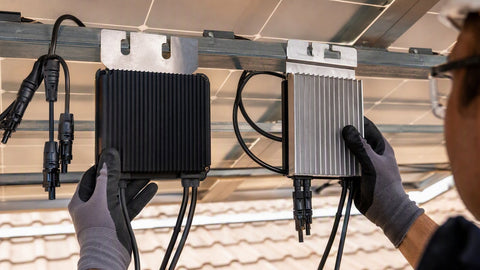
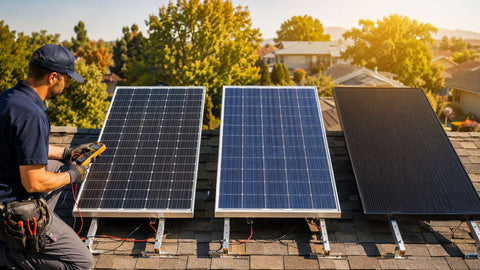
On a Tigo selective job, the optimizer work is nearly invisible: six TS4s bolt to module frames with the same hardware as the junction of the leads, the CCA mounts by the inverter, and the TAP transmitters go within about 35 feet line-of-sight of the array. Commissioning is a phone app and a barcode scan per unit. Total added roof time on our example job: about an hour for a two-person crew, and most of that is the barcode bookkeeping.
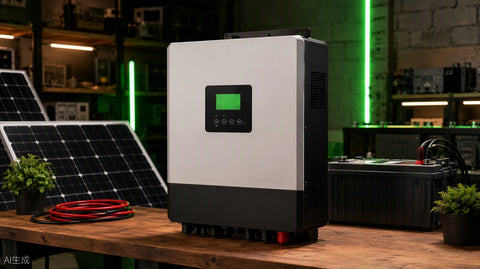
A SolarEdge job puts twenty-five optimizers up there instead of six. Figure 8–10 minutes per unit including frame attachment and lead management — call it three to four crew-hours — plus the inverter swap is simpler because there's no DC disconnect and no string fusing inside. Commissioning happens through SetApp over Bluetooth, and the inverter maps the array automatically once every optimizer reports in. Where jobs go sideways is wireless: optimizers that can't pair during commissioning are almost always a firmware mismatch or a dead unit, and we stock two spares on the truck for exactly that reason.
One more field note, free of charge: label the optimizer serial-to-module-position map on paper before you leave the roof. Both platforms let you remap in software, but the day a monitoring portal shows module 14 underperforming, the tech with the roof map finds it in one trip instead of two.
Five years in is when architecture choices show their character. Expanding a SolarEdge system means staying in the family: matching optimizers, a compatible inverter, ideally a firmware generation that still talks to the old gear. Expanding a Tigo-plus-string system means adding another string to spare MPPT inputs or swapping the string inverter for a bigger hybrid — the Tigo layer doesn't care. If the customer is already talking about batteries next year, say so at design time; the hybrid path through 48 V hybrid inverters and a stack from our battery storage lineup changes which MLPE decision makes sense today. The battery bank sizing guide is where we start that conversation.
Storm season is the other long-tail test. Both platforms survive surge events far better than the inverters they're attached to, but we've documented two sites where a nearby strike cooked the inverter and left every roof device alive — cheap insurance either way, and a reminder to spec proper SPDs per our surge protection guide.
If you want a straight answer on your own roof, send us the address and last year's power bill. We will run the shade study, quote both architectures line by line, and tell you which one we'd put on our own house — because around here, that's the only quote standard that means anything. You can also price the hardware yourself in the power optimizers collection and sanity-check the whole design with the solar system calculator.
Frequently Asked Questions
Can I add Tigo optimizers to an existing string inverter system?
Yes — that is Tigo's core retrofit market. TS4-A-O units clamp onto the module frames, land between the module leads and the string, and work with virtually any string inverter. You will need the Tigo CCA gateway and TAP transmitters for monitoring and rapid shutdown signaling. It is one of the cleanest retrofits we do, typically a half-day on a residential roof.
Does SolarEdge work with batteries from other brands?
The SolarEdge Home Hub inverter is designed around the SolarEdge Home Battery, with LG and a short list of approved third-party batteries supported historically. If you want open battery choice — EG4, Pytes, Fortress, or a DIY 48 V bank — a Tigo-plus-hybrid-inverter design gives you far more room. Check our battery storage collection for what we currently stock.
Which system produces more power per year?
On a shade-free roof, the difference is within measurement noise — both topologies harvest within a percent or two of a plain string inverter. On shaded roofs, full MLPE deployment (SolarEdge or full Tigo) recovers 5–15% of annual yield depending on severity, and selective Tigo recovers nearly the same when the shade is localized to the optimized modules.
Do both systems meet NEC 690.12 rapid shutdown?
Yes. Both are module-level rapid shutdown solutions listed for NEC 690.12 compliance. SolarEdge initiates on AC loss at the inverter; Tigo initiates on loss of the keep-alive PLC signal. Both bring array conductors below 30 V within 30 seconds, which is what your inspector will verify.
What happens if one optimizer fails?
With SolarEdge, a failed optimizer takes its one module out of production and flags in monitoring; the rest of the string keeps producing normally. With Tigo selective deployment, a failed TS4 similarly drops one module. Either way it is a single-module service call, not a system-down event — one of the genuine advantages of MLPE over a single-point-of-failure string design.
Is module-level monitoring worth paying for?
For residential customers who will actually look at the app, yes — it catches soiling, diode failures, and shade changes months before a bill spike does. For commercial sites with a performance guarantee, it is effectively mandatory. If nobody will ever open the app, selective deployment captures the production benefit at lower cost and you can skip per-module data.