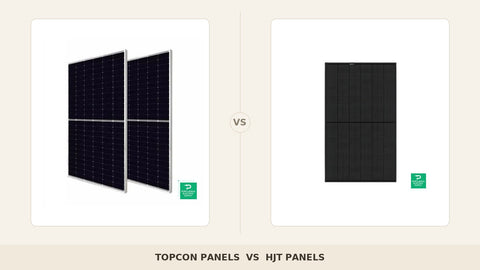
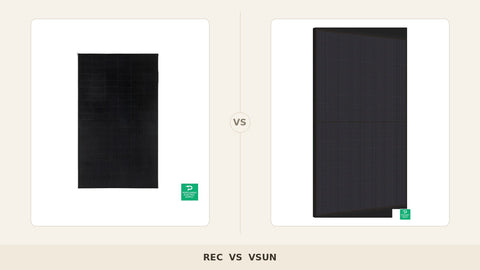
This is the comparison we have with quality-obsessed homeowners every week. REC's Alpha Pure-RX is the premium residential panel that wins the engineering arguments: heterojunction cells, lead-free construction, a −0.24%/°C temperature coefficient, and 92% guaranteed output at year 25. Canadian Solar's TOPHiKu6 is the best-value Tier-1 answer: N-type TOPCon, real US assembly in Mesquite, Texas, and an installed cost per watt that consistently undercuts the premium tier. One of these panels costs more because it does more. The other costs less because it does enough. Your roof decides which sentence applies to you.
We distribute both, we've racked both, and we've processed warranty claims on both. What follows is the counter-level breakdown: verified spec classes, hot-roof output math, a full NEC wire-and-breaker table, 25-year yield numbers, and the specific jobs where each brand wins. Specs reflect the residential classes we actually stock — confirm SKU-level figures on current datasheets before permitting.
Why This Matchup Matters in 2026
Canadian Solar is a volume giant — NASDAQ-listed, bankable across six continents, and one of the first Tier-1 majors to stand up US module assembly. Their 3rd-generation TOPCon platform hit mass production in August 2026, and while the company slipped out of the InfoLink top-11 shipment ranking in 1H26, that ranking measures volume, not module quality. REC is the opposite animal: a premium boutique owned by Reliance Industries, manufacturing in Singapore, deliberately low-volume, and absent from the BNEF Tier-1 list simply because banks don't finance gigawatt projects with boutique panels. Absence from Tier-1 is not a quality signal — PVEL participation and warranty depth are, and REC has both.
The 2026 tariff environment matters here too. Canadian Solar's Texas-assembled modules dodge the Section 232 import price floor and the SE-Asia AD/CVD stack that hammers its own import siblings — the same brand can arrive as a tariff-free Texas module or a duty-stacked import depending on which factory filled the order, so the factory of origin belongs in your PO. REC's Singapore origin sits outside the worst of the AD/CVD crossfire but inside the Section 232 MIP floor — premium pricing makes the floor mostly academic. Buy the factory, not the logo.
Side-by-Side Specification Table
| Specification | REC (Alpha Pure-RX class) | Canadian Solar (TOPHiKu6 / HiKu N class) |
|---|---|---|
| Cell Architecture | HJT (heterojunction), lead-free | N-type TOPCon (TOPHiKu/HiKu N) + HJT (HiHero) on premium lines |
| Residential Wattage Class | ~450–470 W residential class | ~420–450 W residential class (utility siblings to 715 W) |
| Max Module Efficiency | Up to ~22.6% (Pure-RX) | ~22.5% (HiHero); ~21–22.3% (TOPHiKu6 class) |
| Temperature Coefficient (Pmax) | ~−0.24%/°C (class-leading) | N-type TOPCon class (~−0.29%/°C); HJT (HiHero) better |
| Degradation / Long-Term Output | ≤1% first year, ~0.25%/yr thereafter — ≥92% guaranteed at year 25 | 84.8% at yr 25 (HiKu6); 87.4% at yr 30 (TOPHiKu6) |
| Product / Performance Warranty | 20 yr product / 25 yr performance standard; 25/25/25 (incl. labor) via REC ProTrust certified installer | HiKu6: 12 yr product class; TOPCon lines up to 25 yr product by market — verify per SKU |
| Manufacturing / Bankability | Singapore manufacturing; owned by Reliance Industries | NASDAQ: CSIQ; US plant in Mesquite, Texas + global fabs |
| Typical Price Position | +$0.25–0.40/W premium over commodity Tier-1 | Best-value Tier-1 — lower installed $/W than the premium class |
The two numbers to carry out of that table: −0.24%/°C and 92%. REC's temperature coefficient is the best in the residential business, and the 92% year-25 guarantee is the strongest warranted output figure we stock. Everything else on the sheet is close enough that price and roof geometry make the call.
Technology: HJT vs TOPCon, Without the Hype
Heterojunction is genuinely different physics. REC sandwiches a crystalline wafer between ultra-thin amorphous silicon layers, which passivates the surface so well that the cell loses less energy to recombination — hence the efficiency and the temperature coefficient. HJT also degrades more slowly because there's no boron-oxygen light-induced degradation mechanism in the N-type wafer, and REC's lead-free construction sidesteps a materials concern that's coming for the rest of the industry as regulations tighten. The Alpha Pure-RX's gapless cell layout and high-rigidity frame aren't marketing garnish either; the panels arrive dead flat and stay that way on the roof.
TOPCon is the industry's workhorse technology — passivating-contact N-type cells that now carry the overwhelming majority of global shipments. Canadian Solar's TOPHiKu6 executes it well: half-cut cells, multi-busbar, solid bifaciality on the glass-glass variants, and degradation figures that close most of the gap to HJT in the first decade. The honest summary: HJT is better technology, TOPCon is good technology built by the gigawatt, and the real-world output difference on a typical roof runs a few percent, not a revolution.
Where we've actually seen the difference: hot, still afternoons. On a Gulf Coast install we monitor, the HJT array holds its peak measurably flatter through 95 °F days than the TOPCon array down the street. Physics doing what physics does. In Portland's marine climate, that advantage shrinks to a rounding error.
One more technology note that rarely makes the brochures: degradation mechanisms. Early PERC panels suffered light-induced degradation that cost a couple percent in the first weeks of sun exposure. Both of these N-type platforms have effectively engineered that out — REC through HJT's structure, Canadian Solar through N-type TOPCon wafers — so the year-one "settling" that plagued 2018-era arrays is mostly history. What remains is the slow annual fade, and that's where REC's 0.25%/yr class earns the premium over a 0.40%/yr class: after year ten, the gap starts compounding in REC's favor and never stops.
System Design Math: An 8 kW Residential Array
| Design Figure | REC Alpha Pure-RX 470 W | Canadian Solar TOPHiKu6 425 W class |
|---|---|---|
| Panels for ~8 kW DC | 17 × 470 W = 7,990 W | 19 × 425 W = 8,075 W |
| Approx. roof area @ ~1.95 m²/panel | ~33.2 m² (~357 ft²) | ~37.1 m² (~399 ft²) |
| Roof area advantage | ~3.9 m² (~42 ft²) saved | — |
| Strings of 10 (Voc ~49–50 V class) | 2 strings (9 + 8) | 2 strings (10 + 9) |
| Racking / attachment sets | 17 | 19 (+2 sets, ~$60–100 BOS) |
Two fewer panels means two fewer flashings to seal, two fewer clamps to torque, and — on the tight roofs where this matchup usually comes up — the difference between fitting the design and not. We've rescued more than one hip-and-valley roof layout by switching the BOM to 470 W class panels. On a big open ranch roof, none of this matters; buy the cheaper watt.
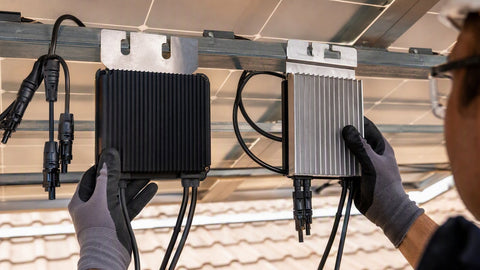
Both brands pair cleanly with module-level electronics from our microinverter collection and drop into complete solar kits without proprietary hardware. For string sizing and voltage math, keep reading — the NEC table below is the one we hand to electricians.
NEC Wire and Breaker Sizing Reference
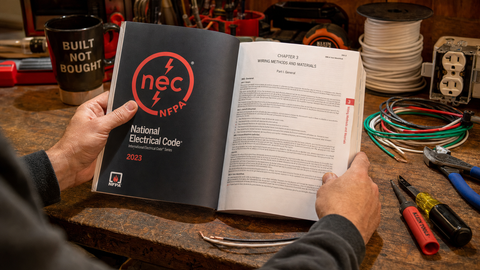
AC output circuits for three common residential inverter sizes on 240 V service, sized per NEC 690.8's 125% continuous-duty rule, matched to NEC 240.6(A) standard breaker ratings and 75 °C copper ampacities from Table 310.16. Verify against the actual inverter's nameplate maximum continuous output current.
| Inverter Class | Max Continuous Current | × 1.25 (NEC 690.8) | Breaker (240.6(A)) | Copper, 75 °C (310.16) |
|---|---|---|---|---|
| 3.8 kW (SE3800H class) | 15.8 A | 19.8 A | 20 A | 12 AWG (cap 20 A per 240.4(D)) |
| 5.0 kW | 20.8 A | 26.0 A | 30 A | 10 AWG (cap 30 A per 240.4(D)) |
| 7.7 kW | 32.1 A | 40.1 A | 45 A | 8 AWG (50 A @ 75 °C) |
| 11.4 kW | 47.5 A | 59.4 A | 60 A | 6 AWG (65 A @ 75 °C) |
Two traps we see weekly: first, the 45 A backfeed from a 7.7 kW inverter doesn't fit the 120% rule on a standard 200 A/200 A panel (40 A allowed) — derate the main to 175 A or tap the line side. Second, 12 AWG on a 25 A breaker because "the ampacity table says 25" — NEC 240.4(D) caps small conductors at 20 A (12 AWG) and 30 A (10 AWG) for overcurrent protection regardless of the table value. Full conductor charts live in our NEC wire sizing guide.
Hot-Roof Output: The Tempco Math
Cell temperature on a dark comp roof runs 30–35 °C above ambient on a still summer afternoon. At a 32 °C delta: REC at −0.24%/°C loses ~7.7% of nameplate; a −0.29%/°C TOPCon panel loses ~9.3%. On an 8 kW array, that's roughly 130 W of extra real power at peak for REC, every hot afternoon, for the life of the system. Annualized in a hot climate it's a few hundred kWh; in a marine climate, maybe a hundred. Price it against the premium honestly for your own latitude.
25-Year Energy Yield Math
Planning assumptions: 8 kW DC, 1,400 kWh/kWp year-one yield, warranted degradation applied linearly. REC: ≤1% year one, 0.25%/yr after, ≥92% at year 25. Canadian Solar TOPHiKu6 class: ~1% year one, ~0.40%/yr class after — warranted 87.4% at year 30, which interpolates to roughly 89–90% at year 25.
| Metric | REC Alpha Pure-RX | Canadian Solar TOPHiKu6 class |
|---|---|---|
| Year-1 production | ~11,200 kWh | ~11,200 kWh |
| Year-25 warranted fraction | ≥92% | ~89–90% |
| Year-25 production | ~10,300 kWh | ~10,030 kWh |
| 25-yr cumulative (approx.) | ~268 MWh | ~262 MWh |
| Cumulative difference | ~6 MWh ≈ $900 @ $0.15/kWh — plus a hot-climate bonus for REC where applicable | |
Six megawatt-hours is the honest size of REC's yield advantage. If the REC premium on your quote exceeds about $1,000–1,200 on 8 kW, the value panel wins the pure arithmetic; below that, you're buying the stronger warranty, the lead-free build, and the hot-day performance for free. Quotes move weekly — check the 450 W class and 430 W class collections or get firm numbers on the quote page.
Warranty Structures, Read Carefully
REC's standard warranty is 20-year product / 25-year performance, and registering the system through a certified REC ProTrust installer extends it to 25/25/25 — product, performance, and labor. That labor term is the part competitors quietly omit; a panel warranty without labor coverage still costs the homeowner a truck roll. We've run ProTrust claims: documentation in, replacement panel and labor money out, no knife fight.
Canadian Solar's warranty varies more by line and market — 12-year product class on HiKu6, with newer TOPCon lines carrying longer terms in North America. Verify the exact SKU. The counterparty itself is as solid as they come: NASDAQ-listed, decades of bankability, and a US factory that makes domestic service logistics simple. This is not a brand that disappears in year 9.
Field Notes: Handling and Installs
I've personally torqued mid-clamps on both. REC frames are the stiffest in our warehouse — the Pure-RX's two-piece frame design shrugs off the handling abuse that puts microcracks in flimsier panels, and the all-black gapless face is the best-looking module we stock, full stop. Homeowners notice. Realtors notice.
Canadian Solar panels are the Toyota Camry of our panel room: unremarkable to handle, utterly dependable, and available when everything else is backordered. During the 2026 tariff crunch, when import lead times blew out across the industry, the Mesquite, Texas line kept shipping. We filled two school projects with Texas TOPHiKu while competitors waited on containers. Availability is a feature, and in 2026 it's a big one.
Both rack normally on standard rail from the racking and mounting collection and the solar mounting systems lineup. Neither needs proprietary hardware. Both report through standard monitoring gear in the monitoring collection.
Climate and Site Fit
Hot climates are REC's home turf, and it's not close. Phoenix, Dallas, Fresno — anywhere cell temperatures spend months above 60 °C — the −0.24%/°C coefficient and HJT's slow degradation stack into the largest real-world yield gap in the residential business. We modeled a Scottsdale roof last spring where the REC array's lifetime projection beat the value-tier alternative by nearly 9% once tempco and degradation compounded. That's the extreme case, but it shows the direction.
Mild and marine climates compress the gap to almost nothing. Here in the Pacific Northwest, our design team prices both and lets the homeowner pick on aesthetics and warranty preference, because the kWh difference over 25 years barely buys a Thanksgiving turkey. Cold northern sites favor both brands equally on output — panels love cold — so the decision there shifts to mechanical specs and what your installer can get fastest. Snow-load and wind ratings on both lines handle standard residential zones; for high-snow mountain roofs, upgrade the rail and attachment spacing before you upgrade the panel brand.
Availability and the 2026 Supply Picture
The unglamorous truth about 2026 procurement: the panel you can actually get beats the panel you can't. Canadian Solar's Texas assembly line has been the most reliable supply in our panel room this year — domestic freight, no customs, no container roulette. REC's Singapore supply line runs longer lead times (4–8 weeks is a normal band to our dock) and occasionally allocates during peak season, so we tell REC buyers to order at contract signing, not at permit approval.
Replacement availability matters too, because panels occasionally die in year 12 no matter whose logo is on the glass. REC's US distributor network stocks replacement residential modules; Canadian Solar's sheer scale means an equivalent-or-better replacement is almost always available within weeks. Both are fine. The brands to worry about are the ones that won't exist in year 12 — which is precisely why we stock these two and not the seventeen fly-by-night labels that pitch us monthly.
One practical note on mixed BOMs: don't mix REC and Canadian Solar on the same string or the same MPPT. Different voltage curves and tempcos mean the string performs to its weakest link. Mixing across separate MPPT inputs or separate microinverter branches is fine and we do it on phased expansions regularly.
Permitting and Inspection Notes
Both brands carry UL 61730 listing and current California CEC listing, so plan checkers see familiar paperwork either way. REC's documentation portal is excellent — datasheets, installation manuals, and certification letters in one place — and Canadian Solar's North America team answers engineering letters quickly, which matters when an AHJ wants a load-rating document with a specific revision date. We've turned both around inside a week.
The inspection trap that catches DIYers with premium panels is usually not the panel at all — it's the rapid-shutdown declaration and the placards. NEC 690.12 module-level shutdown, 690.56(C) labeling, and a correct directory at the service equipment fail more final inspections than any module spec. Pair either brand with listed module-level electronics, label the system per the AHJ's handout, and either panel passes. For the electronics side of that layout, see our microinverter vs string inverter guide.
Choose REC If / Choose Canadian Solar If
By now the pattern should be clear: this isn't a good-panel-versus-bad-panel fight, it's a density-and-durability-versus-value fight. We've sold both for years and watched both perform on real roofs; the wrong choice here is rare, but the right choice saves real money. Here's how we frame the final call across the counter.
Choose REC if: the roof is small, shaded, or hot and you need maximum watts per square foot; you want the strongest warranted output in the residential business (92% at year 25); a lead-free build and the best-looking all-black panel matter; or a ProTrust installer is doing the job and the 25/25/25 labor-inclusive warranty is on the table. Browse the REC collection and the HJT panel class.
Choose Canadian Solar if: installed $/W rules the decision; you want Tier-1 bankability with a US factory behind it; the project is commercial and Texas-assembled modules help the domestic-content math; or availability and lead time matter more than the last 3% of yield. See the Canadian Solar collection.
For adjacent matchups, read our REC vs Qcells residential comparison, the REC vs Qcells page, and the best solar panels of 2026 roundup. Size the system with the system size calculator, plan the BOM with the kits buyer's guide, and see how both brands drop into grid-tied systems.
Frequently Asked Questions
Is REC worth the premium over Canadian Solar?
On a small, hot, or shaded roof, usually yes — the 22.6% efficiency class, −0.24%/°C tempco, and 92% year-25 warranty produce a few percent more lifetime energy in a smaller footprint. On a big open roof in a mild climate, Canadian Solar's lower installed $/W typically wins the arithmetic.
Which has the better warranty?
REC: 20-year product / 25-year performance standard, extended to 25/25/25 including labor through a certified ProTrust installer. Canadian Solar: 12-year product class on HiKu6, with newer TOPCon lines carrying longer terms by market. REC's is the deeper residential warranty; Canadian Solar's counterparty strength is world-class.
Are Canadian Solar panels made in the USA?
Some are. Canadian Solar operates a module plant in Mesquite, Texas, alongside global fabs. US-assembled SKUs avoid the 2026 import price floors and SE-Asia duties, while import SKUs carry the tariff stack — specify the factory of origin on your purchase order.
What is HJT and why does it matter?
Heterojunction sandwiches a crystalline silicon wafer between amorphous silicon layers, cutting recombination losses. The practical results: higher efficiency, the industry's best temperature coefficient (~−0.24%/°C), slower degradation, and no light-induced degradation. It costs more to build, which is why REC prices at a premium.
Is REC a Tier-1 manufacturer?
REC is not on the BloombergNEF Tier-1 list because the list measures bank-financed project volume, and REC is a low-volume premium boutique. That's not a quality signal — REC's PVEL participation, Reliance Industries ownership, and warranty depth are the quality indicators that matter for a 25-year residential purchase.
Can I pair either brand with microinverters or batteries?
Yes. Both use standard MC4-compatible connectors and work with Enphase, Hoymiles, and SolarEdge module-level electronics, and both pair with any hybrid inverter or AC-coupled battery. Neither requires proprietary hardware.
Sources & Standards
- REC Alpha Pure-RX datasheet and ProTrust warranty terms (recgroup.com)
- Canadian Solar TOPHiKu6 / HiKu N datasheets and North America warranty (canadiansolar.com)
- NEC 2023 Articles 690.8, 705.12, 240.4(D), 240.6(A) and Table 310.16
- US Section 232 proclamation and MIP program (August 2026)
- InfoLink 1H26 module shipment ranking; BloombergNEF Tier-1 list (Q2 2026)
- Kiwa PVEL PV Module Reliability Scorecard (2026 edition)