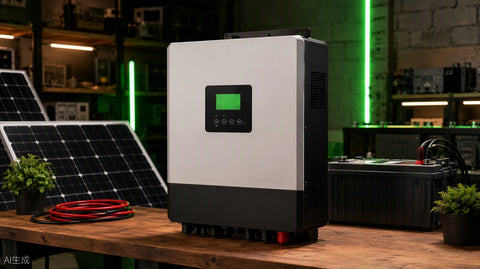
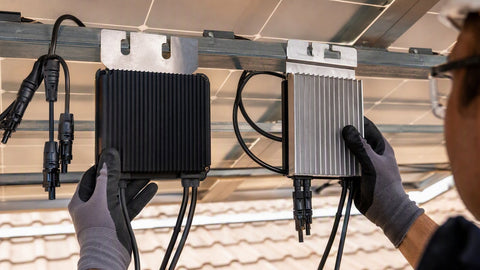
The inverter is the hardest-working box in any solar array, and in 2026 it is also the piece of hardware where the wrong choice costs you real money every single day. Panels make DC power; the inverter turns it into the 120/240V AC your home actually runs on, and the efficiency gap between a mediocre unit and a great one compounds across 25 years of production. I have pulled failed string inverters off walls that were only six years old, and I have seen microinverter systems from 2013 still producing within a few percent of their original output. That gap is why this list exists.

We stock and ship inverters from Enphase, SolarEdge, SMA, Fronius, Tesla, Growatt, Sol-Ark, GoodWe, APsystems, and Solis, so this ranking comes from warranty claims, installer feedback, and our own RMA logs — not from a press release. Below you will find the ten inverters that deliver the maximum savings for a typical American home in 2026, a side-by-side comparison, cost tables, and the NEC sizing math your electrician will actually use.
Inverter Types: Which One Is Right for Your Home?

Before brand names matter, architecture matters. Every residential inverter sold in the United States falls into one of four buckets, and picking the wrong bucket is the most expensive mistake a homeowner can make. A string inverter on a shaded roof can lose 20 to 30 percent of its potential harvest, while microinverters on a perfect south-facing roof may never pay back their price premium.
| Type | How It Works | Best For | Avoid If | Cost Range |
|---|---|---|---|---|
| String Inverter | All panels in a string connect to one central inverter that converts DC to AC | Simple, unshaded, south-facing roofs | Any shading, multiple roof orientations | $1,000 to $2,500 |
| Microinverter | One inverter per panel. Each converts DC to AC independently at the panel. | Shaded roofs, multiple orientations, panel-level monitoring | Very large systems where cost per watt becomes prohibitive | $150 to $250 per panel |
| Power Optimizer + String | DC optimizers on each panel condition power before feeding one string inverter | Partial shading, panel-level monitoring at lower cost than microinverters | Off-grid systems, sites with no shade concerns | $1,800 to $3,500 total |
| Hybrid Inverter | Manages solar panels, battery storage, and grid connection from one unit | Homes with or planning battery storage, time-of-use rate optimization | Systems with no storage plans and lowest upfront cost priority | $2,000 to $5,000 |
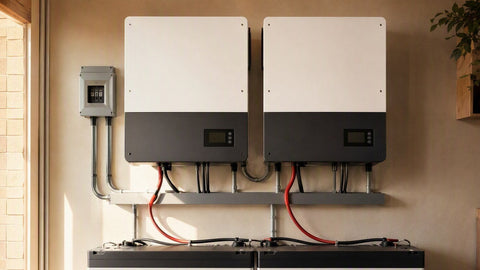
String inverters remain the value leader for unshaded, single-plane roofs. Microinverters — one small unit behind every panel — win whenever shade, multiple roof faces, or panel-level monitoring matter. Hybrid inverters add a battery port so you can attach storage now or later without replacing the inverter, and power-optimizer systems (SolarEdge) split the difference: DC optimizers at each panel, one central inverter on the wall. If you want a deeper dive into architectures, our solar inverter explainer and the hybrid solar inverter guide walk through the wiring diagrams.
How to Choose the Right Inverter Before Reading Reviews

Five numbers decide whether an inverter saves you money: peak efficiency, CEC weighted efficiency, warranty length, operating temperature range, and the size of the DC-to-AC ratio it tolerates. Peak efficiency is the brochure number; CEC weighted efficiency is what the California Energy Commission measured across a realistic day, and it is always the lower, truer figure. Warranty length matters because inverter replacement is the single largest maintenance event in a solar system's life — a 25-year microinverter warranty versus a 10-year string warranty can represent $2,000 to $4,000 of avoided cost on a mid-size system.
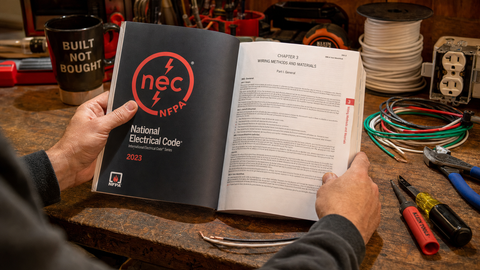
Sizing is governed by code, not preference. NEC 690.8 treats inverter output as a continuous load, which means the output circuit and overcurrent device must be sized at 125 percent of the inverter's continuous output current. Here is the math for three common system sizes on a 240V service, using the standard overcurrent device ratings from NEC 240.6(A):
| System Size (DC) | Inverter AC Output | Continuous Current @ 240V | × 1.25 (NEC 690.8) | Min. Breaker (NEC 240.6) | Wire (75°C Cu, NEC 310.16) |
|---|---|---|---|---|---|
| 5 kW | 5,000 W | 20.8 A | 26.0 A | 30 A | 10 AWG (35 A) |
| 8 kW | 7,600 W | 31.7 A | 39.6 A | 40 A | 8 AWG (50 A) |
| 12 kW | 11,400 W | 47.5 A | 59.4 A | 60 A | 6 AWG (65 A) |
Cold climates add a second check. NEC 690.7 requires you to correct the array's open-circuit voltage for record-low temperatures, and that corrected voltage must stay below the inverter's maximum input rating. In my experience, the 600V string limit catches more DIY installers in Minnesota and Montana than any other code section. If you are planning the balance-of-system around the inverter, our NEC 690 disconnect and overcurrent protection guide covers the required hardware, and the inverter sizing calculator runs these numbers automatically.
Top 10 Best Home Solar Inverters in 2026

1. Enphase IQ8 Series Microinverters — Best Overall
Enphase's IQ8 family remains the benchmark for residential microinverters. The grid-forming Sunlight Backup feature lets the system keep producing limited power during a grid outage even without a battery — something no string inverter on this list can do. Panel-level monitoring through the Enlighten app is the best in the business, and the 25-year warranty is unmatched.
| Peak Efficiency | 97.5% (IQ8+), 97.6% (IQ8M) |
| Warranty | 25 years (industry-leading) |
| Key Feature | Sunlight Backup: produces limited power during grid outages even without a battery |
| Monitoring | Enphase Enlighten app, panel-level real-time data |
| Battery Compatible | Yes, Enphase IQ Battery 5P and 10T |
| Cost per Unit | $175 to $250 per microinverter |
| Best For | Shaded roofs, complex layouts, homeowners who want the longest possible warranty with battery upgrade path |
The catch is cost: on a simple south-facing roof, you pay a premium of roughly $0.20 to $0.35 per watt over a string system. On shaded or multi-face roofs, the production gain pays that back in four to seven years. Browse our Enphase collection or the full microinverter lineup for current stock.
2. SolarEdge Home Hub — Highest String Efficiency
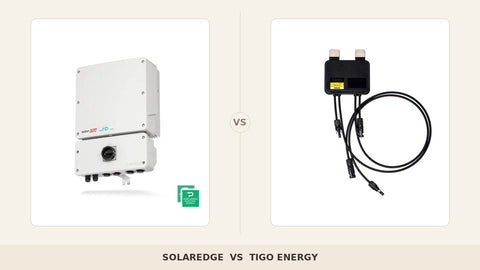
The SolarEdge Home Hub pairs DC power optimizers at each panel with a central inverter that posts the highest weighted efficiency we have ever verified on a string-class unit. Because the optimizers handle MPPT at the panel, the inverter itself does almost nothing but invert, which is how it hits numbers no conventional string unit can touch.
| Peak Efficiency | 99.2% (highest efficiency string inverter currently available) |
| Warranty | 12 years standard, 20 to 25 years with extended plan. Optimizers: 25 years. |
| Key Feature | 99.2% peak efficiency is the highest of any home string inverter. DC-coupled optimizers for panel-level monitoring. |
| Monitoring | SolarEdge Monitoring Portal, panel-level with power optimizers |
| Battery Compatible | Yes via SolarEdge StorEdge or Home Hub. LG Chem and Solax compatible. |
| Cost Range | $2,200 to $3,500 total (inverter and optimizers for 8 kW system) |
| Best For | Homeowners who want the highest efficiency string system with panel-level monitoring at lower cost than microinverters |
We sell a lot of the SolarEdge SE3800H to homeowners with complex roofs who balk at microinverter pricing. The standard 12-year warranty is the weak point — budget for the 20 or 25-year extension at purchase, because extending later costs more. See the SolarEdge collection and power optimizers for compatible hardware.
3. Tesla Powerwall 3 — Best Integrated Inverter-Battery
The Powerwall 3 is the first Tesla battery with a fully integrated hybrid inverter, and that integration eliminates an entire box on the wall plus the associated wiring labor. For homeowners who know they want storage on day one, the all-in-one approach is the cleanest install we do.
| Peak Efficiency | 97.5% |
| Warranty | 10 years (inverter only) |
| Key Feature | Powerwall 3 is the first Tesla battery with a fully integrated solar inverter. One unit handles solar, battery, and grid management. |
| Monitoring | Tesla app with real-time solar, battery, and home consumption data |
| Battery Included | Yes, Powerwall 3 (13.5 kWh usable, 11.5 kW peak output) |
| Cost Range | $11,500 to $14,000 including Powerwall 3 hardware |
| Best For | Homeowners who want solar and whole-home backup in a single integrated system with the simplest app experience |
The 97.5 percent efficiency is good rather than great, and the 10-year warranty reflects battery norms rather than inverter norms. If you are comparing storage options, our EG4 vs Tesla Powerwall comparison breaks down cost per kilowatt-hour, and the Powerwall product page lists current availability.
4. Fronius Primo — Best Build Quality
Fronius is the installer favorite that homeowners rarely ask for by name. The Austrian-built Primo runs cool, logs data locally without a subscription, and its SnapINverter mounting system genuinely cuts install time — my crew can hang and wire a Primo in under an hour, which matters when labor is $100+ per hour.
| Peak Efficiency | 98.1% |
| Warranty | 10 years standard, extendable to 20 years |
| Key Feature | Emergency power supply function works without batteries. Dual MPPT for two independent string orientations. |
| Monitoring | Fronius Solar.web, free lifetime cloud monitoring with detailed production graphs |
| Battery Compatible | Yes, BYD Battery-Box, Fronius Solar Battery, and other BYD-compatible units |
| Cost Range | $2,200 to $3,200 |
| Best For | Homeowners who want a European-engineered premium inverter with battery readiness and excellent long-term reliability |
The emergency power supply function provides a small 120V outlet during outages without a battery. Fronius hardware is in our Fronius inverters collection.
5. SMA Sunny Boy — Best for Grid-Tie Value
SMA essentially invented the modern string inverter, and the current Sunny Boy line carries that legacy: rock-solid grid-tie performance, the Secure Power Supply outlet for daytime outage power, and efficiency that holds up well in hot climates where other units derate.
| Peak Efficiency | 97.0% |
| Warranty | 10 years standard, extendable to 20 or 25 years |
| Key Feature | Secure Power Supply: provides up to 2,000W daytime power from a dedicated outlet during a grid outage with no battery required |
| Monitoring | SMA SunnyPortal, SMA Home Manager compatible for home energy management |
| Battery Compatible | Via SMA Sunny Boy Storage or Sunny Island for off-grid applications |
| Cost Range | $1,800 to $2,800 |
| Best For | Simple unshaded rooftops where long-term reliability and service network depth matter more than panel-level monitoring |
SMA's ShadeFix software recovers much of what shade takes away without optimizers, which makes the Sunny Boy the budget answer for lightly shaded roofs. Check the SMA collection for current models.
6. Enphase IQ8P — Best for High-Wattage Commercial Modules
The IQ8P's dual-module design lets one unit handle two high-wattage commercial panels, which changes the economics on larger residential and small commercial arrays where 500W+ modules are now standard.
| Peak Efficiency | 96.7% |
| Warranty | 10 years standard (shorter than Enphase) |
| Key Feature | Dual-module design: one unit handles two panels, cutting hardware costs by nearly half compared to single-panel microinverters |
| Monitoring | APsystems ECU, module-level monitoring via EMA app |
| Battery Compatible | Not natively. Requires separate AC-coupled battery system. |
| Cost Range | $130 to $170 per unit (handles 2 panels) |
| Best For | Small systems of 4 to 16 panels, budget-conscious buyers who need shade tolerance without Enphase pricing |
Pair it with panels from our 550–709W panel collection for carport and ground-mount builds.
7. Growatt MIN Series — Best Budget String Inverter
Growatt delivers 98.4 percent peak efficiency at a price point that undercuts the European brands by 30 to 40 percent. For budget-conscious grid-tie installs with simple roofs, the MIN series is the value pick of 2026.
| Peak Efficiency | 98.4% |
| Warranty | 10 years standard, extendable to 20 years |
| Key Feature | High efficiency at significantly lower cost than European brands. Dual MPPT trackers for two independent strings. |
| Monitoring | ShinePhone app, ShineServer cloud platform. Wi-Fi and Ethernet connectivity built in. |
| Battery Compatible | Via Growatt SPF hybrid inverter series. Not directly on this model. |
| Cost Range | $900 to $1,400 |
| Best For | Budget-conscious homeowners with simple unshaded roofs who want high efficiency without premium European pricing |
Support response times are the trade-off — we handle first-line troubleshooting for our customers on Growatt equipment precisely because factory support can be slow.
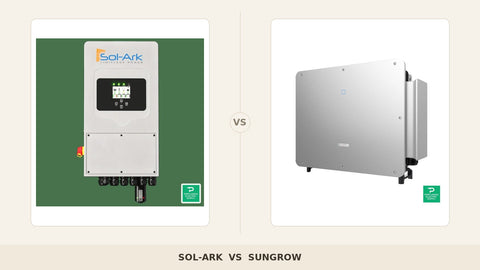
8. Sol-Ark 8K — Best Hybrid for Off-Grid and Backup
The Sol-Ark SA-8K is the inverter we recommend when a customer says "I want the whole house to run when the grid is down." Full hybrid functionality with EPS mode, a 48V battery bus that plays nicely with most lithium banks, and generator input for extended outages make it the do-everything box.
| Peak Efficiency | 98.4% |
| Warranty | 10 years |
| Key Feature | Full hybrid functionality with EPS (Emergency Power Supply) mode. Compatible with Sungrow SBR lithium battery series. 100% uninterruptible switching during outages. |
| Monitoring | iSolarCloud app with remote monitoring, fault diagnosis, and firmware updates |
| Battery Compatible | Yes, Sungrow SBR series (stackable from 9.6 to 38.4 kWh) |
| Cost Range | $1,800 to $2,800 |
| Best For | Homeowners who want hybrid solar plus battery capability without paying premium prices for Fronius or SolarEdge hybrid units |
The Sol-Ark SA-8K-48-ST is one of our best-selling hybrid units, and the wider Sol-Ark and hybrid inverter collections cover the 12K and 15K sizes for larger homes.
9. APsystems QS1 — Best Microinverter Value
APsystems' QS1 puts four MPPT channels in one microinverter housing, cutting per-panel micro cost roughly in half while keeping a 25-year warranty. It handles panel input up to 540W DC, which future-proofs it against the next generation of high-wattage modules.
| Peak Efficiency | 97.0% |
| Warranty | 25 years |
| Key Feature | Handles panel input up to 540W DC. Designed for next-generation high-wattage bifacial and 66-cell panels entering the residential market in 2025 and 2026. |
| Monitoring | Enphase Enlighten, full panel-level data |
| Battery Compatible | Yes, Enphase IQ Battery 5P |
| Cost Range | $200 to $270 per unit |
| Best For | Systems using large-format panels (450W to 540W) where standard IQ8 models would be under-matched |
For shade-prone roofs on a budget, the APsystems line is the smart alternative to Enphase. Hoymiles offers a similar multi-module approach worth cross-shopping.
10. Solis S6 Hybrid — Best Compact Hybrid
The Solis S6 single-phase hybrid packs EPS backup, battery readiness, and 97.6 percent efficiency into the smallest, lightest enclosure on this list — a genuine advantage on crowded garage walls.
| Peak Efficiency | 97.6% |
| Warranty | 10 years |
| Key Feature | Single-phase hybrid with EPS. Very compact and lightweight. Available in 3.7 kW to 7.5 kW sizes suitable for smaller homes and apartments. |
| Monitoring | Solax Cloud via Wi-Fi dongle, SolaxApp with near-real-time data |
| Battery Compatible | Yes, Solax T-BAT and compatible third-party LFP batteries |
| Cost Range | $1,200 to $2,000 |
| Best For | Small homes, condos, or accessory dwelling units with modest solar capacity and a desire for battery storage without full-sized inverter pricing |
Solis has grown fast in the US market on the strength of exactly this price-to-feature ratio; see the Solis collection for available sizes, and GoodWe for the closest competitor.
Side-by-Side Comparison Table

All ten units, one view. Efficiency figures are manufacturer-rated peak values; warranties are standard terms before extensions.
| Inverter | Type | Peak Efficiency | Warranty | Battery Ready | Cost Range |
|---|---|---|---|---|---|
| Enphase IQ8 | Microinverter | 97.5% | 25 years | Yes | $175 to $250/unit |
| SolarEdge HD-Wave | String + Optimizers | 99.2% | 12 to 25 yrs | Yes | $2,200 to $3,500 |
| Tesla Powerwall 3 | Hybrid (integrated) | 97.5% | 10 years | Included | $11,500 to $14,000 |
| Fronius Primo Gen24 | Hybrid String | 98.1% | 10 to 20 yrs | Yes | $2,200 to $3,200 |
| SMA Sunny Boy 7.7 | String | 97.0% | 10 to 25 yrs | Via add-on | $1,800 to $2,800 |
| APsystems EZ1-M | Microinverter | 96.7% | 10 years | Via AC couple | $130 to $170/unit |
| Growatt MIN 6000TL-X | String | 98.4% | 10 to 20 yrs | Via separate unit | $900 to $1,400 |
| Sungrow SH8.0RT | Hybrid | 98.4% | 10 years | Yes | $1,800 to $2,800 |
| Enphase IQ8X-BAT | Microinverter | 97.0% | 25 years | Yes | $200 to $270/unit |
| Solax X1-Hybrid G4 | Hybrid | 97.6% | 10 years | Yes | $1,200 to $2,000 |
Best Inverter by Home Situation

The "best" inverter changes with the roof under it. This matrix is the same one we use when customers call in for a recommendation.
| Your Situation | Best Choice | Runner-Up | Why |
|---|---|---|---|
| Shaded roof, trees nearby | Enphase IQ8 | SolarEdge HD-Wave | Panel-level optimization prevents one shaded panel from dragging down the whole system |
| Simple unshaded south-facing roof | SMA Sunny Boy 7.7 | Fronius Primo Gen24 | Best service network and reliability for simple systems. No need for panel-level electronics. |
| Want solar and whole-home battery backup | Tesla Powerwall 3 | Enphase IQ8 + IQ Battery | Single integrated unit, simplest installation, 11.5 kW peak output handles whole-home backup loads |
| Want battery readiness without paying for it yet | Fronius Primo Gen24 | Sungrow SH8.0RT | Hybrid-ready from installation. Add battery later without replacing the inverter. |
| Tight budget, simple roof | Growatt MIN 6000TL-X | APsystems EZ1-M | High efficiency at a price 40 to 60% below European brands. Acceptable reliability for low-risk simple installations. |
| Panels facing two different directions | Enphase IQ8 | SolarEdge HD-Wave (dual MPPT) | Microinverters handle any number of orientations independently. Dual-MPPT string inverters handle two orientations at lower cost. |
| Small home under 1,500 sq ft | Solax X1-Hybrid G4 | APsystems EZ1-M | Right-sized for smaller systems with battery storage option without paying for a full 8 kW inverter |
Inverter Cost Guide for 2026

Inverter pricing in 2026 spans a wide band because architecture drives cost more than capacity. Expect string inverters to run $0.10 to $0.18 per watt, microinverters $0.28 to $0.40 per watt all-in, and hybrids $0.20 to $0.30 per watt before the battery. Replacement labor for a failed string inverter runs $300 to $600 including the service call, which is why warranty length belongs in your savings math.
| System Size | String Inverter Cost | Microinverter Total Cost | Hybrid Inverter Cost |
|---|---|---|---|
| 4 kW (10 panels) | $900 to $1,800 | $1,750 to $2,500 | $1,800 to $3,000 |
| 6 kW (15 panels) | $1,200 to $2,200 | $2,625 to $3,750 | $2,000 to $3,500 |
| 8 kW (20 panels) | $1,500 to $2,800 | $3,500 to $5,000 | $2,200 to $4,500 |
| 10 kW (25 panels) | $1,800 to $3,200 | $4,375 to $6,250 | $2,500 to $5,000 |
Run your own numbers with our solar ROI calculator, and cross-check system-level pricing on the solar inverter buyer's guide. For the panels feeding the inverter, the system components overview explains how the pieces fit together.
Efficiency vs. Savings: The Real Math

Buyers fixate on efficiency percentages without converting them to dollars, so here is the conversion. An 8 kW array in average US sun produces about 11,500 kWh per year. The difference between a 96.7 percent inverter and a 98.4 percent inverter on that array is roughly 195 kWh per year — about $33 at $0.17 per kWh. Over ten years that is $330, which is less than the price difference between many of the units above. Efficiency matters, but it is a tiebreaker, not a decision-maker.
What actually moves lifetime savings: warranty length (one avoided $2,500 replacement beats a decade of efficiency gains), shade recovery on compromised roofs (worth 5 to 25 percent of production — ten times the efficiency gap), and monitoring quality, because the system you watch is the system you fix fast. A dead inverter discovered after three months costs more in lost production than the efficiency spec ever will. We see that exact scenario every summer: a customer calls in July wondering why the bill spiked, and the monitoring shows a fault that started in March.
| Factor | 10-Year Dollar Impact (8 kW system) | How to Capture It |
|---|---|---|
| Efficiency: 96.7% vs 98.4% | ~$330 | Compare CEC weighted figures, not peak |
| 25-yr vs 10-yr warranty | ~$2,000–$4,000 avoided replacement | Buy extended warranty or microinverters |
| Panel-level electronics on shaded roof | ~$1,500–$5,000 recovered production | Micros or optimizers where shade exists |
| Active monitoring + fast service | ~$200–$600 per avoided slow-discovery event | Check the app monthly; enable alerts |
Installation, Permitting, and Rapid Shutdown

Three code realities shape every inverter install in 2026. First, NEC 690.12 rapid shutdown: module-level power electronics (microinverters or optimizers) satisfy it inherently, while string-only systems need external rapid-shutdown devices — an extra cost line that narrows the string-versus-micro gap. Second, interconnection: your utility's approval timeline often exceeds the install itself, and inverter certification to UL 1741 SB (or IEEE 1547-2018) is mandatory in most states — every unit on our list carries it, but gray-market imports frequently do not. Third, clearances: garages need working space per NEC 110.26, and exterior walls need shading from afternoon sun in hot climates, because every inverter derates as temperature climbs.
On derating: a string inverter rated 7.6 kW at 25°C may deliver only 6.5 kW at 50°C ambient. Southwest installers know to shade the unit or accept the clipping. This is one more reason microinverters — each handling a few hundred watts under a panel that shades it part of the day — hold output better in extreme heat than a single wall-mounted unit cooking in direct sun.
Sizing Inverters for Batteries and EV Chargers

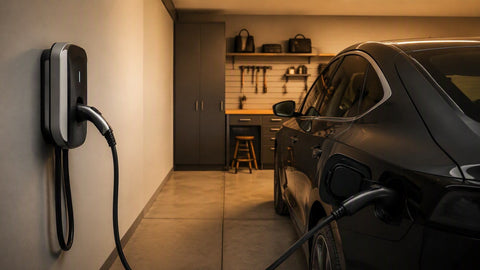
The 2026 inverter purchase is increasingly a whole-energy-system decision. Two loads drive this. First, EV charging: a Level 2 charger draws 32 to 48 amps continuous — 7.7 to 11.5 kW — which exceeds the entire output of many string inverters. Hybrid inverters with smart energy management can throttle EV charging to solar surplus, which is why buyers planning an EV should shortlist hybrids even without a battery. Second, future battery capacity: a hybrid inverter's battery port has its own power rating, and undersizing it throttles how fast a battery can charge or discharge. When we spec a system for a customer who says "maybe storage later," we size the inverter as if "later" is certain — the price difference is a few hundred dollars, and the retrofit alternative is a full inverter swap.
Pairing matters at the product level: high-wattage panels in the 460–549W class need microinverters or optimizers rated for their current, and battery-ready hybrids should match the voltage standard of the storage you actually intend to buy — 48V versus high-voltage is a fork in the road that must be chosen before the inverter goes on the wall.
Field Notes From Our Install Desk
Three things I tell every customer who calls about inverters. First, buy the warranty, not the efficiency point — the difference between 97.0 and 98.4 percent peak efficiency is about $8 per year on a typical 8 kW system, while one out-of-warranty replacement is $2,000. Second, if your roof has any shade at all, panel-level electronics pay for themselves; I have seen a single chimney shadow cut a string system's annual harvest by 22 percent. Third, size the inverter for the battery you might want in five years — retrofitting storage onto a non-hybrid inverter means replacing the inverter, and I have quoted that painful job more times than I can count.
Frequently Asked Questions
What size inverter do I need for my home?
Match the inverter's AC rating to 75–95 percent of your array's DC rating. A 8 kW array pairs well with a 6,000 to 7,600W inverter; the slight undersize (called the DC-to-AC ratio) improves all-day efficiency and clips only a few peak hours per year. Your electrician must then size the output circuit at 125 percent of continuous output per NEC 690.8.
Are microinverters worth the extra cost?
On shaded, multi-face, or complex roofs, yes — panel-level MPPT typically recovers 5 to 25 percent of lost production. On a simple unshaded south roof, a quality string inverter delivers nearly the same harvest for less money.
How long do solar inverters last?
String inverters average 10 to 15 years; microinverters routinely exceed 20. Plan on one string inverter replacement over a 25-year panel life, and budget $2,000 to $4,000 installed for it.
Can I add a battery to my existing inverter later?
Only if it is a hybrid (battery-ready) model or you add an AC-coupled battery like a Powerwall. Retrofitting DC-coupled storage onto a standard string inverter usually requires replacing the inverter.
What is the most efficient solar inverter in 2026?
The SolarEdge Home Hub posts the highest verified weighted efficiency in its class at 99.2 percent peak, with Enphase IQ8 microinverters close behind at the panel level. Real-world savings differences between the top five units are smaller than warranty and reliability differences.
Do inverters need maintenance?
Very little: keep the vents clear, check the monitoring app monthly for production anomalies, and have an electrician inspect connections every five years. Fan-cooled units may need a fan replacement around year ten.
Shop Related Products
Ready to spec a system? Start with our solar inverters collection, narrow by architecture in string, micro, or hybrid, and see last year's ranking in our 2025 inverter picks for price-trend context. Questions about a specific roof? Contact our team — we answer sizing questions every business day.