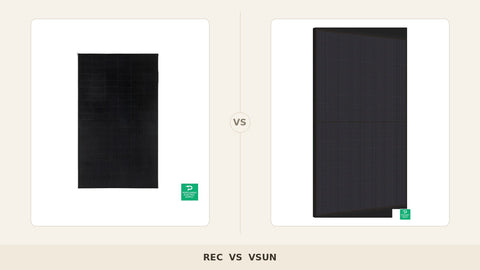
Trina vs JinkoSolar 2026: Vertex S+ vs Tiger Neo
The two largest module brands on the shelf, both shipping excellent n-type product in 2026. Here's how we pick between them when a customer puts both quotes on the counter.
Let's start with the uncomfortable truth that makes this article shorter than the forums want it to be: in 2026, Trina's Vertex S+ and Jinko's Tiger Neo are both excellent n-type TOPCon modules, and on most residential quotes the right answer is whichever one is on the pallet with the better delivered price and warranty paperwork. We stock both — Trina and Jinko — we've shipped both by the container, and our warranty-claim file on each is thin enough to read over coffee. What follows is the comparison we actually run: datasheet numbers, warranty terms, the supply-chain story, and the few project profiles where one genuinely beats the other.
Both companies are vertically integrated Chinese giants with multi-gigawatt annual capacity, US-friendly supply chains (both have navigated tariff and traceability requirements with documented supply chains), and bankability ratings that satisfy commercial lenders. If you're choosing between these two, you've already screened out the bottom of the market. Now let's split the hairs that are worth splitting.
| Attribute | Trina Vertex S+ (residential) | Jinko Tiger Neo (residential) |
|---|---|---|
| Cell technology | n-type TOPCon, dual-glass | n-type TOPCon (dual-glass variants standard in current US line) |
| Residential wattage class | ~430–450 W | ~430–475 W |
| Module efficiency | up to ~22.5% | up to ~23.2% |
| Temperature coefficient (Pmax) | ~ -0.30%/°C | ~ -0.29%/°C |
| First-year / annual degradation | 1% / 0.40%/yr | 1% / 0.40%/yr |
| Product warranty | 25 years (Vertex S+ dual-glass) | 25 years (current US residential SKUs) |
| Performance warranty | 30 years, ~87.4% at year 30 | 30 years, ~87.4% at year 30 |
| Format | Residential 108–120 half-cell formats | Residential + commercial formats across the line |
| US availability (our dock) | Steady | Steady, deepest SKU count of any brand we carry |
Datasheet figures reflect current US-market SKUs at writing — both brands revise wattage classes quarterly, so spec against the exact model number on your quote. The takeaway row is efficiency: Tiger Neo's top bin edges Vertex S+ by roughly half a point, which matters on constrained roofs and nowhere else. Everything else in that table is a statistical tie.
Run both on the same job: 10 kW target, standard Portland roof, 25-module class. With 440 W Vertex S+ modules you need 23 modules (10.12 kW); with 475 W Tiger Neo top bins you need 22 (10.45 kW). The Jinko build uses one fewer module, one fewer optimizer if you're running MLPE, and one fewer row of racking — call it $150–$250 of BOS savings — while producing ~3% more nameplate on the same setback boundaries. On an unconstrained roof that 3% is worth buying at equal $/W; on a constrained roof it can be the difference between fitting 10 kW and settling for 9.6.
| Design metric | 23 × Vertex S+ 440 W | 22 × Tiger Neo 475 W |
|---|---|---|
| Array nameplate | 10.12 kW | 10.45 kW |
| Roof area (approx.) | ~46 m² | ~44 m² |
| Year-1 energy (Portland, ~1,100 kWh/kWp) | ~11,100 kWh | ~11,500 kWh |
| Module count → MLPE / clamps / labor | 23 units | 22 units |
| String fit (600 V, cold Voc math) | 2 strings of 11 + spare MPPT | 2 strings of 11 |
| Year-30 warranted output | ~8.85 kW equivalent | ~9.13 kW equivalent |
Notice what's not in the table: reliability differences. There aren't any worth modeling. Both products carry the same 1%/0.40% degradation curve, both are dual-glass in current US residential stock, both pass the same IEC hail and load sequences. The decision variables are wattage class, price per watt on the day, and which pallet actually exists.
Both brands now offer 25-year product warranties on their residential dual-glass lines — a genuine industry improvement from the 12-year era — with 30-year performance warranties converging on ~87.4% warranted output at year 30. The differences live in the process, not the numbers. Our claims experience: both honor valid claims, both require the original purchase documentation, both move faster when the installer of record files. Keep your invoice, your pallet serials, and your commissioning photos. The warranty you can execute beats the warranty with the prettier PDF — which is a quiet argument for buying through a supplier (hi) who keeps your paperwork on file and has an account manager at both manufacturers.
One nuance worth knowing: dual-glass modules from both brands carry better fire-class and mechanical-load behavior than glass-backsheet equivalents, and both brands' residential flagships are now dual-glass by default. If a quote shows a glass-backsheet variant at a suspicious discount, it's older inventory — not necessarily bad, but ask why it's cheap.
Every US module purchase in 2026 carries a supply-chain question, and both of these brands answer it better than most: documented polysilicon traceability, Southeast Asian cell and module capacity, and established US import track records that survived the tariff rounds of the last several years. Jinko operates US module assembly in Jacksonville, Florida; Trina has pursued US capacity partnerships and maintains deep Southeast Asian manufacturing. Neither fact changes the physics on your roof; both facts change tariff exposure and replacement-module availability in year 12. We track this quarterly because our customers' warranties ride on it — the 2026 panel roundup notes current supply status per brand, and our USA-made collection exists for buyers who want domestic content for IRA bonus-credit reasons on commercial projects.
- Tiger Neo wins on top-bin efficiency (~23.2% class), SKU breadth (Jinko's residential-to-utility range is the deepest we stock — see the utility formats), and constrained-roof designs where one fewer module pays for itself.
- Vertex S+ wins on dual-glass build quality reputation at residential scale, clean all-black aesthetics options, and — in some quarters — delivered price per watt. Trina's residential line is a fixture on our best-value lists.
- Both win against the field on bankability: commercial lenders and lease providers accept either without a fight, which keeps financing friction at zero.
- Neither is the answer if your project needs HJT's temperature coefficient (see TOPCon vs HJT) or premium US-made product — different articles, different shelves.
The electrical layer is brand-blind but format-specific. Current residential n-type modules from both lines run Voc ≈ 49–52 V and Isc ≈ 13–14 A. Worked Portland example at -10°C design low with a Voc coefficient of -0.25%/°C: cold Voc = 50 × [1 + 0.0025 × 35] ≈ 54.4 V, so a 600 V string caps at 11 modules. Home-run conductor: Isc 13.6 A × 1.56 = 21.2 A → 10 AWG PV wire, 15 A series-fuse-compliant for paralleled-string designs only if the module's max series fuse rating allows it — check the datasheet line, not the forum. Our panel wiring guide, PV wire selection, and the NEC ampacity chart carry the full method, and grounding and bonding applies identically to either brand's frame.
Same five numbers as always: module efficiency (Jinko edges), temperature coefficient (tie), warranty pair (tie), brand durability (tie), and delivered $/W (varies by quarter — this is where the deal is). Then the two tiebreakers that actually decide our counter recommendations: format fit — which wattage class lands your array on the setback boundaries with the fewest modules — and pallet availability, because a module that's twelve weeks out is a financing problem, not a bargain. For most 2026 residential quotes we'd take either brand at equal pricing, take Tiger Neo's top bin when the roof is tight, and take whichever is on our dock when the schedule is tight. Browse live inventory in the panel catalog — the 400–459 W and 460–549 W shelves are where these two lines fight it out — and size the array first with the system size calculator so you know how many watts you're actually shopping for.
And the field note we end every brand-comparison article with: the installer matters more than the logo. A Trina array torqued to spec, flashed correctly, and wired to NEC will out-produce a Jinko array installed carelessly every single year of its 30-year life, and vice versa. Spend your anxiety budget on the crew, the flashing detail, and the wire management. The modules from both of these companies will do their job if you let them.
Both lines' current dual-glass residential modules carry 5,400 Pa front / 2,400 Pa rear load ratings and pass IEC 61215 hail sequences (25 mm at 23 m/s, with select SKUs tested beyond). Translation from standardese: either module survives any snow load a residential code official will allow on your rafters, and hail resistance is effectively identical. Where build differences show up is frame design and corner drainage — dual-glass modules shed debris differently than backsheet frames, and on low-slope installs we spec slightly steeper tilt or accept the soiling line that forms at the bottom edge of any frameless-adjacent design. Fire class: both carry Class A assemblies with standard racking, which keeps your AHJ and your insurer in the same meeting.
| Mechanical / durability item | Vertex S+ | Tiger Neo | Field note |
|---|---|---|---|
| Front load rating | 5,400 Pa | 5,400 Pa | Exceeds residential snow requirements |
| Rear load rating | 2,400 Pa | 2,400 Pa | Wind uplift — check racking clamps zones |
| Hail rating | 25 mm @ 23 m/s (IEC) | 25 mm @ 23 m/s (IEC) | Insurance riders cover beyond-rating events |
| Construction | Dual-glass | Dual-glass (current US residential) | Better fire class, no backsheet aging |
| Weight per module | ~24 kg class | ~24–26 kg class | Two-person sets, same either way |
For installers and commercial buyers reading this: the residential flagships are the shop window, but the volume business is 580–720 W utility formats where both brands fight hardest. Jinko's utility Tiger Neo formats and Trina's Vertex N utility line both post ~22.5–23%+ efficiencies in 72-cell-class formats, both ship in the same 31–36 piece pallets, and both price within a penny or two per watt of each other in container quantities. Our commercial desk's advice is always the same: run the layout with both formats — module dimensions differ by enough centimeters to change row counts on a carport or a ballasted flat roof, and the cheaper $/W module is sometimes the more expensive installed system when the racking math settles. The commercial panels shelf and pallet bundles show current format availability, and the commercial cost breakdown puts module pricing in installed-system context.
One logistics habit that has saved our customers real money with both brands: inspect and photograph pallets at delivery, before the driver leaves, and note corner damage on the BOL. Both manufacturers honor freight damage — with documentation. Without it, it's your word against a bill of lading, and the bill of lading always wins.
Both brands warrant the same curve — 1% year one, 0.40% per year after — so the dollarized difference between them is zero, and the dollarized value of the curve itself is worth understanding. On our 10.12 kW example at 1,100 kWh/kWp in Portland:
| Milestone | Warranted output | Annual kWh (Portland) | Value @ $0.16/kWh |
|---|---|---|---|
| Year 1 | 99% | ~11,000 | ~$1,760 |
| Year 10 | ~95.4% | ~10,600 | ~$1,700 |
| Year 20 | ~91.4% | ~10,150 | ~$1,625 |
| Year 30 | 87.4% | ~9,720 | ~$1,555 (at frozen rates — reality pays more as rates climb) |
The lesson in that table isn't Trina versus Jinko — it's that a modern n-type module still produces 87% of its day-one output when your mortgage is gone. That's the number that makes the 30-year math work, and both of these brands put it in writing. When a no-name import undercuts these two by 20%, what you're actually buying is a warranty entity that may not exist in year 9. We learned this the hard way in the 2010s with a container of panels whose manufacturer evaporated; the modules worked, the warranty was fiction, and the customer held the bag. Never again — it's why the shelf is tier-1 or nothing.
Both brands publish clamping-zone diagrams in the install manual, and both void the mechanical warranty if you clamp outside them — read the drawing for your exact SKU because the zones differ between residential and utility formats even within one brand. Mid-clamp torque is typically 12–16 N·m; use a torque driver, not an impact gun — we replace a handful of cracked corner cells every year that were clearly impact-gun casualties, and neither brand covers installer-inflicted damage. Wire management: dual-glass modules have no backsheet to hide sins, and exposed string wire under the array is a squirrel buffet and a hotspot risk. Clip every conductor, keep it off the roof surface, and your inspection goes smoother — our crews photograph the wire management before the modules go on the last row, and that photo has ended more than one argument with an inspector. Racking selection lives in the racking guide and the racking collection; for ballasted flat roofs the ballast guide covers the weight math.
Grounding note that applies to both brands equally: dual-glass frames still bond through the racking with listed WEEB-style or lay-in-lug methods per NEC 690.43 — glass-on-both-sides doesn't exempt the frame from the equipment-grounding path. Details in the grounding guide.
- Tight urban roof, maximizing kW inside setbacks: Tiger Neo top bin. The ~0.7-point efficiency edge is one fewer module on a 10 kW build, and one module is one row of racking, one optimizer, and one setback argument with the plans examiner.
- Value-driven residential, unconstrained roof: whichever of the two quotes lower delivered $/W this quarter — historically that alternates, and we check weekly. Trina's Vertex S+ has spent long stretches as our best-value premium module.
- Commercial / carport / ballasted flat roof: quote both utility formats against the racking layout; module dimensions move row counts, and the winner changes with the geometry, not the brand.
- Domestic-content or IRA-driven project: verify SKU-level qualification on either, and cross-shop the USA-made shelf where the bonus credit math often wins outright.
- All-black aesthetic priority: compare both brands' black-backsheet/black-frame SKUs side by side on the wall — the difference is visible in person and invisible on datasheets. The all-black collection gathers the options.
That's the whole decision tree we run at the counter, and it's deliberately boring. Two great brands, one honest tiebreaker: the number on the pallet tag. Everything else — layout, wire, torque, documentation — is craftsmanship, and craftsmanship is brand-blind.
Final word from the dock: we unload both of these brands every month, and the warehouse crew — who see every corner chip and every crushed carton before anyone else — have stopped betting on which pallet arrives cleaner. That's as close to a tie as the physical world gets. Pick your format, pick your price, document your delivery, and go build the array. If the quote comparison comes down to the last fifty dollars, call us and we'll tell you which pallet we'd load into our own truck that morning.
One last resource before you order: run your annual usage through the solar system calculator and your roof layout through a proper design tool, then let the module format fall out of the geometry. Buyers who shop wattage-class-first and roof-second end up redesigning at the permit counter; buyers who do it the other way order once. Both of these brands will still be excellent when your layout tells you which one to buy.
And if you're sourcing for a crew: both brands' current packaging survives LTL freight well, but liftgate deliveries and residential drop-offs are where damage happens. Order the extra module — one spare per pallet is cheap insurance against the single cracked corner that would otherwise idle your install day waiting on a freight claim.
Is Jinko or Trina more reliable?
Statistically, neither — both ship n-type TOPCon dual-glass residential modules with 1% first-year and 0.40%/year degradation warranties, 25-year product coverage, and low field-claim rates. Both are bankable tier-1 manufacturers accepted by commercial lenders. Reliability differences between them are smaller than the variance introduced by shipping handling and installation quality.
Which has the better warranty, Vertex S+ or Tiger Neo?
Effectively identical in 2026: both offer 25-year product warranties on residential dual-glass lines and 30-year performance warranties landing around 87.4% at year 30. The practical difference is claims execution — keep purchase documentation, register the product, and buy through a supplier with account relationships at both manufacturers.
Are Trina and Jinko panels made in the USA?
Jinko operates module assembly in Jacksonville, Florida; Trina manufactures primarily in Southeast Asia with US capacity partnerships. Both maintain documented supply chains that satisfy US traceability requirements. For projects needing domestic content for IRA bonus credits, verify the specific SKU's content qualification — assembly location and domestic-content percentage are different things.
Which panel is better for a small roof?
Jinko's Tiger Neo top bins reach roughly 23.2% module efficiency versus about 22.5% for Vertex S+, so Jinko fits more watts per square foot — on a 10 kW design, typically one fewer module. On unconstrained roofs and ground mounts, the difference is academic; buy on price per watt and availability.
Do these panels work with microinverters and optimizers?
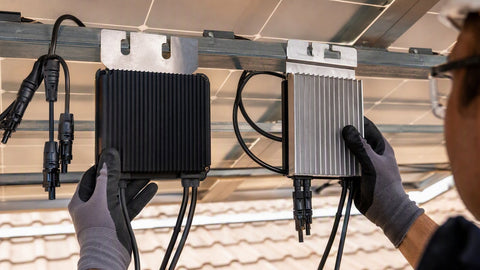
Yes — both lines use standard MC4-family connectors and voltage classes compatible with mainstream MLPE. Match the module's wattage and Imp to the device's rated ceiling (high-power 475 W+ SKUs need the high-current device variants). Our SolarEdge vs Tigo comparison covers the MLPE selection in depth.
What should I pay per watt for either brand in 2026?
Residential-format n-type from either brand typically trades between roughly $0.30 and $0.45 per watt delivered depending on volume, format, and quarter — pallet pricing moves with the market. If a quote is far below that band, ask whether it's current production, old inventory, or gray-market; if far above, ask what you're actually paying for.