AC Condenser Electrical Requirements — 2026 Contractor Guide
NEC 440-compliant breaker sizing, wire gauge tables, disconnect requirements, and inspection checklists for AC condenser installations. Field-tested by contractors.
Getting the electrical right on an AC condenser install is not optional — it is what keeps the permit signed off and the compressor running for fifteen years. I've been on job sites where the HVAC crew called us in because their 3-ton unit kept tripping the breaker. Turned out the electrician sized the wire to the breaker, not to the MCA on the nameplate. The conductors were cooking. We pulled new 10 AWG, swapped the HACR breaker, and the unit purred. That callback cost the contractor $400 and a reputation ding.
This guide covers breaker sizing, wire selection, disconnect placement, and the NEC 2023/2026 code references you actually need on the job site. Everything below assumes a standard 240V split-system condenser. If you are working on a heat pump or packaged unit, start with our general AC electrical guide first. For furnace circuits, see our furnace contractor guide.
Article 440 of the National Electrical Code governs all air-conditioning and refrigerating equipment. Unlike general motor circuits under Article 430, Article 440 recognizes that compressor motors start under high locked-rotor current and run at variable load. The two numbers that matter most are on the unit nameplate:
- MCA (Minimum Circuit Ampacity) — the minimum ampacity the branch-circuit conductors must carry. Size your wire to this number times 1.25 for continuous load, then match to NEC Table 310.16. In practice, the nameplate MCA already includes the 125% multiplier, so size wire directly to MCA.
- MOP (Maximum Overcurrent Protection) — the largest breaker or fuse permitted. Your breaker must be ≤ MOP. No exceptions. Not even if the supply house is out of the right size.
Key code citations to keep in your back pocket:
- NEC 440.22 — Overcurrent protection must not exceed nameplate MOP.
- NEC 440.32 — Branch-circuit short-circuit and ground-fault protection sizing.
- NEC 440.14 — Disconnecting means must be within sight of the condenser (≤50 ft and visible).
- NEC 110.3(B) — Install per manufacturer's instructions; the nameplate governs when it conflicts with a rule-of-thumb table.
- NEC 310.16 — Ampacity tables for conductor sizing.
- NEC 250.122 — Equipment grounding conductor sizing.
- NEC 440.6 — Branch-circuit conductors sized at 125% of RLA or branch-circuit selection current.
Rule of Thumb vs. Nameplate
The tonnage tables below are typical values based on common residential equipment. If the nameplate on the unit shows a different MCA or MOP, the nameplate wins — every time. NEC 110.3(B) is explicit about this. I've had inspectors red-tag jobs where the electrician used a "standard" 30A breaker on a unit with 25A MOP. The nameplate said 25A. The breaker had to come out.
Use this table as a field reference. Always confirm against the unit nameplate before pulling wire or ordering breaker.
| Tonnage | BTU | Typical MCA | Typical MOP | Min Wire (Copper) | Typical Breaker | Notes |
|---|---|---|---|---|---|---|
| 1.5 Ton | 18,000 | 12–15A | 20–25A | 12 AWG | 20A | Often 120V or 240V |
| 2 Ton | 24,000 | 14–18A | 25–30A | 12 AWG | 25A | 240V standard |
| 2.5 Ton | 30,000 | 17–21A | 30–35A | 10 AWG | 30A | 240V |
| 3 Ton | 36,000 | 19–24A | 30–40A | 10 AWG | 30A | Most common residential |
| 3.5 Ton | 42,000 | 22–28A | 35–45A | 10 AWG | 35A | 240V |
| 4 Ton | 48,000 | 25–32A | 40–50A | 8 AWG | 40A | 240V |
| 5 Ton | 60,000 | 32–40A | 50–60A | 8 AWG | 50A | May need #6 for long runs |
For wire, we stock THHN/THWN-2 stranded copper in the gauges you need for condenser runs. For 8 AWG, our Cerro Wire 8 AWG THHN/THWN-2 Stranded Copper Black 500' at $347.00 (SKU: PES-PA-ELC-0891) and the red companion reel at $442.74 (SKU: PES-PA-ELC-0892) are what most of our contractor customers pull for 4–5 ton jobs.
When you have the nameplate RLA (Rated Load Amps), you can calculate breaker size directly using NEC 440.22. The standard method multiplies RLA by 1.75. The alternate method (rarely used residentially) multiplies by 2.25 with time-delay fuses.
| Compressor RLA | Standard Method (×1.75) | Breaker Size | Wire (Cu, 75°C) | Ground (Cu) |
|---|---|---|---|---|
| 12A | 21A | 25A HACR | 12 AWG | 12 AWG |
| 14A | 24.5A | 25A HACR | 12 AWG | 12 AWG |
| 16A | 28A | 30A HACR | 10 AWG | 10 AWG |
| 18A | 31.5A | 35A HACR | 10 AWG | 10 AWG |
| 20A | 35A | 35A HACR | 10 AWG | 10 AWG |
| 22A | 38.5A | 40A HACR | 8 AWG | 10 AWG |
| 25A | 43.75A | 45A HACR | 8 AWG | 10 AWG |
| 28A | 49A | 50A HACR | 8 AWG | 10 AWG |
| 32A | 56A | 60A HACR | 6 AWG | 10 AWG |
The HACR rating matters. A standard thermal-magnetic breaker may nuisance-trip on compressor startup. HACR breakers (Heating, Air Conditioning, Refrigeration) have magnetic trip curves calibrated for motor inrush. Square D HOM, Siemens QP, and Eaton BR all make HACR-rated breakers. We stock HACR breakers in common sizes for contractor jobs.
The equipment grounding conductor (EGC) protects against fault current. Size it from NEC Table 250.122 based on the breaker rating, not the wire size. Here is the quick reference for condenser circuits:
| Circuit Breaker | Min EGC (Cu) | Min EGC (Al) | Typical Conduit |
|---|---|---|---|
| 15A | 14 AWG | 12 AWG | 1/2 in EMT |
| 20A | 12 AWG | 10 AWG | 1/2 in EMT |
| 30A | 10 AWG | 8 AWG | 3/4 in EMT |
| 40A | 10 AWG | 8 AWG | 3/4 in EMT |
| 50A | 10 AWG | 8 AWG | 1 in EMT |
| 60A | 10 AWG | 8 AWG | 1 in EMT |
Note that 10 AWG copper is the minimum EGC for all circuits up to 60A. You can upsize for voltage drop or physical durability, but Table 250.122 does not require it. I run 10 AWG green THHN for all condenser circuits up to 60A. It pulls easily, terminates cleanly, and passes inspection every time.
Here is the sequence we recommend for a clean, code-compliant condenser install. This assumes a 240V split-system residential replacement or new construction.
Step 1: Read the Nameplate
Before you touch a wire, read the nameplate. The MCA tells you wire size. The MOP tells you breaker size. The RLA tells you what the compressor draws at full load. The LRA tells you what it pulls on startup. Write all four numbers on your permit sketch. If the nameplate is sun-faded, take a photo with your phone and enhance the contrast. I've seen installers guess because they couldn't read the plate. That guess cost a re-pull.
Step 2: Size the Breaker
Select a HACR-rated breaker ≤ MOP. If MOP is 35A and your panel only takes standard breakers, order the HACR version. Do not install a 40A standard breaker because the supply house is out of 35A HACR. The inspector will fail it. The compressor manufacturer will void the warranty. And if the unit burns, your E&O insurance may not cover it.
Step 3: Pull the Wire
For outdoor runs, THHN/THWN-2 in EMT is the gold standard. For typical 2–3 ton units, 10 AWG is standard. For 4–5 ton, step up to 8 AWG. For runs over 75 ft, upsize one gauge to control voltage drop. In hot attics, derate per NEC 310.15(B)(2). Three current-carrying conductors in a 45°C attic drops 10 AWG THHN from 35A to 28A. If MCA is 24A, you are legal but tight. I upsize to 8 AWG and sleep better.
Step 4: Install the Disconnect
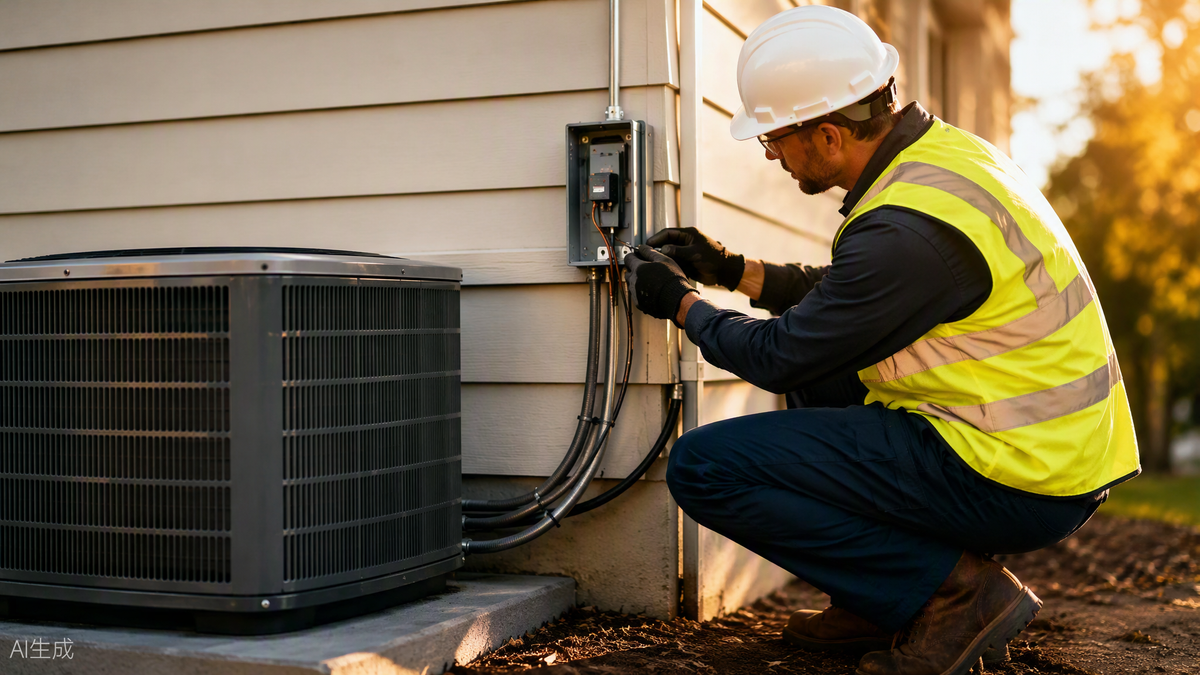
NEC 440.14 requires a disconnect within sight of the condenser — max 50 ft and visible. Non-fused disconnects are standard when the breaker is already ≤ MOP. We stock several options in our safety and protection collection:
- Siemens 30A 2-Pole Disconnect 240V Non-Fused — $92.97 (SKU: PES-PA-ELC-1337)
- 30A NON-FUSED AC Disconnect — $99.99 (SKU: PES-7560902803590-1)
- Eaton 100A AC Non-Fused Safety Switch DH363URK — $884.40 (SKU: PES-PA-ELC-2022)
Step 5: Ground and Bond
Size the equipment grounding conductor per NEC Table 250.122 based on breaker size. For 30A–60A breakers, 10 AWG copper is required. Bond the condenser frame, disconnect enclosure, and conduit system back to the panel ground. Use green grounding screws in metallic boxes. Do not rely on conduit threads for grounding — use a grounding bushing and jumper.
Step 6: Label and Test
Mark the disconnect and panel directory. Megger the conductors if it is a new run — 500V for 60 seconds, minimum 100 MΩ. Start the unit and check amp draw against the nameplate RLA after a ten-minute runtime. If you are pulling 18A on a unit rated 14A RLA, something is wrong. Check refrigerant charge, airflow, or voltage drop before you blame the electrical.
GFCI Note
NEC 2020 added GFCI requirements for outdoor condenser outlets and, in many jurisdictions, for the condenser circuit itself. Check local adoption — some AHJs enforce this strictly, others grandfather existing installs. Do not assume. If GFCI is required, use a GFCI breaker or a GFCI receptacle if the circuit also serves an outlet. Note that GFCI breakers on motor loads can nuisance-trip. HACR-rated GFCI breakers exist but cost more and may have longer lead times.
Contractors are installing more mini-splits every year. Here is how the electrical side breaks down next to a traditional central condenser.
| Factor | Central AC Condenser | Mini-Split Outdoor Unit |
|---|---|---|
| Voltage | 240V standard | 208/230V standard |
| Breaker | 20A–60A double-pole | 15A–40A double-pole |
| Disconnect required | Yes — NEC 440.14 | Yes — NEC 440.14 |
| Wire run | Line-voltage from panel to condenser | Line-voltage to outdoor unit; low-voltage to indoor heads |
| Conduit | EMT or PVC whip standard | Interconnect cable (manufacturer-specific) |
| Voltage drop sensitivity | High — long runs common in rural installs | Moderate — outdoor unit usually closer to house |
| Multi-zone ampacity | N/A | Outdoor unit MCA covers all indoor heads combined |
| Rapid shutdown | Not applicable (no DC) | Not applicable (no DC) |
| Permit complexity | Electrical + HVAC | Electrical + HVAC (often simpler) |
The bottom line: both need a code-compliant disconnect, both need wire sized to MCA, and both need grounding per 250.122. The mini-split just adds a low-voltage control cable you do not have on a central system. Do not mix the low-voltage cable with line-voltage conductors in the same raceway unless the manufacturer explicitly permits it — most do not.
NEC recommends keeping branch-circuit voltage drop under 3%. On a 240V circuit, that is 7.2V. In practice, once you are past 75 ft from panel to condenser, you should upsize at least one gauge to stay within tolerance and reduce conductor heating.
| Run Length | 2–3 Ton (Standard Wire) | 2–3 Ton (Upsized) | 4–5 Ton (Standard Wire) | 4–5 Ton (Upsized) |
|---|---|---|---|---|
| 0–50 ft | 10 AWG | 10 AWG | 8 AWG | 8 AWG |
| 51–75 ft | 10 AWG | 8 AWG | 8 AWG | 6 AWG |
| 76–100 ft | 8 AWG | 8 AWG | 6 AWG | 6 AWG |
| 101–150 ft | 8 AWG | 6 AWG | 6 AWG | 4 AWG |
If you are doing rural work or a panel relocation, measure the actual run and calculate drop with the conductor resistance from NEC Chapter 9, Table 8. When in doubt, pull the next size up — the material cost difference is cheaper than a callback. Our 8 AWG Cerro Wire and Omni Cable 8 AWG RHW-2 are the go-to choices when you need to upsize for distance.
Failed inspections cost money and delay HVAC startup. Here is what inspectors check on condenser electrical:
| Item | Code Reference | Pass Criteria | Common Fail |
|---|---|---|---|
| Breaker ≤ MOP | NEC 440.22 | Nameplate MOP not exceeded | 30A breaker on 25A MOP unit |
| Wire sized to MCA | NEC 440.6, 310.16 | Conductor ampacity ≥ MCA | 12 AWG on 21A MCA unit |
| Disconnect within sight | NEC 440.14 | ≤50 ft and visible from unit | Disconnect behind fence |
| Grounding conductor | NEC 250.122 | Sized to breaker, bonded | Missing EGC or undersized |
| HACR breaker | NEC 440.22 | Breaker marked HACR | Standard breaker installed |
| Conduit support | NEC 358.30 | EMT supported every 10 ft | Sagging whip to condenser |
| GFCI (if required) | NEC 210.8 | GFCI breaker or receptacle | Not installed in 2020 NEC jurisdictions |
| Labeling | NEC 110.22 | Disconnect marked "AC Condenser" | Generic or missing labels |
Print this checklist and walk the job before calling for inspection. I have caught more failures during a 10-minute walk-through than I care to count. The most expensive one was a 5-ton unit where the electrician ran 10 AWG for a 32A MCA load. The inspector made us pull 8 AWG through 80 feet of finished basement. The drywall repair alone was $800.
What Is Changing (and What Is Not)
New AC units are transitioning from R-410A to R-32 to meet lower-GWP refrigerant mandates. R-32 is classified A2L — mildly flammable — which affects handling and storage codes. However, the electrical requirements are not significantly different. R-32 units still run 240V, still use MCA/MOP nameplate values, and still wire the same way. The compressor efficiency may shift MCA slightly on some models, so read the nameplate on every new unit — do not assume last year's numbers carry over.
If you are working in a jurisdiction that has adopted A2L-compatible component requirements, verify that your disconnect and conduit seals are rated appropriately. The wire, breaker, and grounding do not change. What does change: the HVAC technician needs A2L certification, and the work area may need ventilation per ANSI/ASHRAE Standard 15. Stay in your lane — handle the electrical, let the mechanical contractor handle the refrigerant side.
What size breaker do I need for a 3-ton AC condenser?
Typically 30A double-pole HACR-rated, but the nameplate MOP governs. I've seen 3-ton units with MOP as low as 25A and as high as 40A. Read the plate. Size to the plate.
Can I use 10/2 wire for my AC condenser?
For 2–3 ton units with MCA under 24A, yes. For 4–5 ton or long runs, upsize to 8 AWG. And use conduit for the outdoor portion — NM-B is not rated for wet locations or physical damage exposure.
Does an AC condenser require a disconnect switch?
Yes. NEC 440.14 is unambiguous. Within sight, within 50 feet. Non-fused is standard for residential. Fused is rare but required in some commercial applications.
What is MCA vs MOP?
MCA = wire size. MOP = breaker size. Simple as that. MCA is the minimum ampacity your conductors must have. MOP is the maximum overcurrent protection allowed. Never exceed MOP.
How far can an AC condenser be from the panel?
No code limit, but voltage drop is real. At 75 feet, 10 AWG on a 24A load drops 2.9V — acceptable. At 120 feet, the same load drops 4.6V. The compressor works harder. Upsize one gauge for runs over 75 feet.
Is GFCI required?
NEC 2020 says yes for outdoor equipment in many jurisdictions. Some AHJs delayed adoption. Some enforce strictly. Call your inspector before you quote. If GFCI is required, use a HACR-rated GFCI breaker — they exist but lead times can be 2–3 weeks.
Fused or non-fused disconnect?
Non-fused when the breaker is ≤ MOP. That's 95% of residential jobs. Fused disconnects are for odd cases where the breaker must exceed MOP — usually commercial with long feeder runs.
What wire type for outdoor runs?
THHN/THWN-2 in EMT or PVC. Period. The "W" rating is for wet locations. THHN without the W is not sufficient for outdoor condenser whips exposed to weather.
What does HACR mean?
Heating, Air Conditioning, Refrigeration. It's a breaker marking that certifies the trip curve handles motor inrush. Standard breakers trip on compressor startup. HACR breakers don't.
Can I use a standard breaker?
No. NEC 440.22 requires HACR-rated protection. Your inspector will look for the marking. Your warranty requires it. Your customer expects the unit to start without tripping the breaker.
- AC Unit Electrical Requirements — Contractor Guide (2026)
- Furnace Electrical Requirements — 2026 Contractor Guide
- How to Size a Circuit Breaker
- PES Wire & Cable Collection
- PES Safety & Protection Collection
- PES Electrical Accessories Collection
- PES Residential Project Collection
- NEC Code Compliance Guide
- Grounding & Bonding Guide
- Pro Account — Wholesale Pricing
- PowerLink Network — Contractor Program
Bulk Electrical Supply for Your Next Job
Wire, conduit, disconnects, and fittings — shipped direct to your job site. Portlandia Electric Supply stocks contractor-grade electrical components with same-day shipping on orders placed before 2 PM ET.
Get a Quote