Enphase versus Tigo isn't really microinverters versus microinverters — it's two different philosophies of module-level power electronics. Enphase says: convert everything, everywhere, at every panel, all the time. Tigo says: deploy MLPE surgically — rapid shutdown where code demands it, optimization only where shade or orientation actually steals watts, monitoring where the customer will use it — and let a good string inverter do the bulk conversion. Both philosophies produce excellent systems. They produce very different invoices, failure modes, and service lives, and since we supply both ecosystems along with the string inverters Tigo pairs with, this is the comparison we walk contractors through when a bid could go either way.
The short version: Enphase is the premium, uniform, all-MLPE architecture with the industry's best monitoring and the cleanest storage retrofit path. Tigo is the flexible, value-oriented MLPE layer that bolts onto the string inverter of your choice — SMA, Fronius, Solis, Growatt, pick your favorite — and lets you spend module-level dollars only on the panels that need them. On a shaded, complex roof with a storage-minded customer, Enphase usually wins. On a big, clean, budget-sensitive roof with a code-driven shutdown requirement, Tigo selective deployment wins by a mile. The rest of this article is the long version with the math.
Head-to-Head Comparison Table
| Dimension | Enphase IQ8 Microinverters | Tigo TS4 MLPE Platform |
|---|---|---|
| Fundamental architecture | Full DC-to-AC conversion at every module | DC-DC conditioning / shutdown / monitoring per module; central string inverter converts |
| Deployment model | Uniform — one micro per module, always | Selective — deploy TS4 units only on modules that need them (TS4-A-O optimization, TS4-A-S shutdown, TS4-A-M monitoring variants) |
| Inverter relationship | Replaces the string inverter entirely | Works with most major string inverters — brand-agnostic |
| Efficiency class | ~97% per micro, uniform | ~99.5% class optimizer efficiency + high string-inverter weighted efficiency |
| Shade mitigation | Per-module MPPT, complete independence | Per-module MPPT on deployed units; optimized modules stop dragging down their string |
| Rapid shutdown | Integrated, NEC 690.12 compliant | TS4-A-S/-F class units provide module-level shutdown — a core use case |
| Monitoring | Enlighten — per-module, benchmark depth | Tigo Energy Intelligence — per-module on monitored units |
| Storage path | AC-coupled IQ Batteries; grid-forming, sunlight-backup capable | Inherits whatever the chosen string/hybrid inverter supports |
| Warranty class | 25-year micros | 25-year class on TS4 units (verify registration) |
| System cost profile | Premium, scales linearly with panel count | Lowest on clean roofs (shutdown-only deployment); moderate with full optimization |
Selective Deployment: The Whole Ballgame
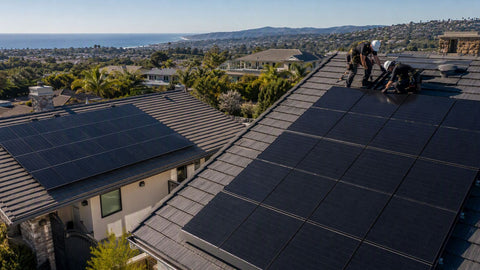
Tigo's killer feature isn't any single product — it's the word "selective." A 30-module roof with one chimney shading four panels doesn't need thirty optimizers. It needs shutdown compliance everywhere — which a TS4 on each module or a compliant transmitter solution provides — and real optimization on maybe four to eight modules. Enphase's model can't be deployed selectively; it's all or nothing, one micro per panel, twenty-four device line items on a twenty-four-panel roof. The BOM difference on that chimney roof is not subtle: full-optimization-everywhere pricing versus optimize-where-it-matters pricing commonly separates the quotes by four figures, with the shaded-string harvest recovered almost as well as full MLPE in most real geometries. We've modeled this on enough roofs to trust the pattern: shade losses are nonlinear, and fixing the worst modules recovers most of the string's lost energy.
Where selective deployment loses its edge is the truly pathological roof — five orientations, dormers everywhere, trees on two sides, panels scattered across every face that fits. At that point "selective" means "nearly everywhere," the device-count savings evaporate, and Enphase's uniform architecture, simpler design rules, and superior per-module independence win on both elegance and increasingly on price-parity. There's a crossover roof in every market; estimators who learn to spot it quote both architectures confidently and let the geometry decide.
The Inverter Question Tigo Leaves Open
With Enphase, the inverter question is answered: there isn't one, or rather there are twenty-four tiny ones. With Tigo, you still choose the string inverter — and that's either Tigo's greatest strength or its hidden complexity, depending on your crew. Strength, because you can pair TS4 units with the inverter you already trust: a Fronius Primo for the customer who wants European engineering, a Solis or Growatt for the value bid, an SMA for the bankable commercial job. Complexity, because every pairing has its own commissioning dance, its own monitoring split between Tigo's EI platform and the inverter manufacturer's portal, and its own warranty finger-pointing risk when something underperforms. We mitigate that risk the boring way: sell proven pairings we've commissioned before, document both vendors' settings in the job file, and register everything the day of startup. Contractors who run that discipline report Tigo systems as trouble-free as anything else on their trucks.
Storage follows the inverter here, which cuts both ways. Choose a hybrid string inverter with battery support and the Tigo-equipped roof inherits a native storage path. Choose a plain grid-tie string unit and storage later means AC coupling — fine, standard, we sell it weekly via our solar batteries and energy storage categories — but it's a second architecture decision. Enphase's grid-forming IQ8 plus IQ Battery path remains the single most elegant storage retrofit in the industry, and if "batteries within five years" is in the customer's plan, that elegance is worth pricing into the comparison honestly.
Cost Modeling: Three Roofs, Three Winners
| Scenario (28 modules) | Enphase BOM Profile | Tigo + String Inverter BOM Profile | Typical Winner |
|---|---|---|---|
| Clean south roof, code requires shutdown only | 28 micros — full MLPE cost for a roof that needs none | 28 shutdown-class TS4s + string inverter | Tigo, decisively |
| One chimney shading 4–6 modules | 28 micros | 28 shutdown units, 4–6 with optimization + string inverter | Tigo, comfortably |
| Five orientations, trees, dormers | 28 micros, native independence | Nearly full optimization — device count converges + inverter still required | Enphase, on simplicity and often price |
| Storage planned within 5 years | Grid-forming retrofit path, lowest future cost | Depends on inverter choice; hybrid now or AC-couple later | Enphase unless hybrid inverter chosen day one |
| 20 kW+ residential / light commercial | Per-module cost scales linearly | String economics + selective MLPE scale better | Tigo + three-phase string, usually |
Installation and Labor Reality
Roof labor between the two platforms is closer than marketing suggests: a TS4 unit clips to the module frame about as fast as an IQ8 mounts, and trunk-cable work for Enphase roughly matches string-homerun work for Tigo systems. The labor differences live elsewhere. Tigo systems keep DC string math on the table — series Voc checks per NEC 690.7 at record-low temperature, string-length balancing across MPPTs — where Enphase reduces design math to per-module compatibility. Enphase commissioning is scan-and-map; Tigo commissioning adds inverter configuration and, on monitored deployments, CCA/TAP gateway placement with its own wireless discipline. Neither is hard. Both punish the crew that skips the checklist. Conductor and raceway work is identical code territory for both: NEC 310.16 ampacity from our ampacity chart and NEC wire sizing guide, raceways per the conduit fill chart, disconnects and labels per the NEC 690 disconnect guide, grounding per the grounding guide, and a service SPD we put on every job without exception.
Reliability and Service: Different Shapes of Risk
| Factor | Enphase | Tigo + String Inverter |
|---|---|---|
| Rooftop device failure rate (our logs) | Low; mature IQ generation | Low; TS4 line notably robust |
| Blast radius per rooftop failure | One module | One module's optimization; string keeps producing |
| Central failure exposure | None — no central inverter | String inverter fault idles the array until swap |
| Central device warranty | N/A | Typically 10-yr class standard on string inverters, extendable |
| Service location | Roof, per event | Ground for inverter; roof for TS4 |
| Vendor stack complexity | One vendor owns everything | Two vendors (Tigo + inverter brand) — document both |
Notice the row that surprises people: a failed Tigo optimizer on a string doesn't zero anything — the module reverts to behaving like an unoptimized module, the string carries on, and the service visit is scheduled at leisure rather than urgency. A failed Enphase micro is similarly graceful at system level. The real systemic risk in a Tigo architecture is the same one SolarEdge carries: the central inverter. Budget an extended warranty or one replacement across a 25-year horizon and the lifetime arithmetic stays honest. In our fleet logs, total lifetime service hours between the two architectures run close; the distribution — many tiny roof visits versus rare ground-level swaps — is what the customer should actually choose between.
Monitoring: Depth Versus Flexibility
Enlighten remains the residential monitoring benchmark: per-module production history, per-device health, consumption CTs, battery integration, and fleet tools that let our service desk diagnose before dispatching. Tigo's Energy Intelligence platform delivers genuine per-module visibility on monitored deployments and has matured impressively — the catch is architectural: full per-module data requires monitoring-equipped TS4s across the array, which erodes the selective-deployment cost advantage, while selective monitoring gives you deep data on some modules and string-level inference on the rest. For the data-hungry homeowner, Enphase wins outright. For the contractor who mainly needs fault alarms and production verification, Tigo's platform covers the job, and pairing it with a string inverter's own portal gives two angles on system health that occasionally catch problems faster than either alone.
Where Each Platform Dominates: The Counter View
From behind our counter, the patterns are consistent. New-code-cycle markets where module-level rapid shutdown became mandatory but optimization wasn't needed — that's Tigo territory, and TS4 shutdown deployments have saved our contractors enormous money against full-MLPE bids. Retrofit markets full of older string systems needing shutdown compliance or shade fixes — Tigo again, often as the only economical answer. Premium residential with storage roadmaps, referral-driven sales, and data-engaged customers — Enphase, and it isn't close. Big clean commercial roofs — usually neither at full deployment; selective Tigo on problem rows or plain three-phase string from our commercial inverter and string inverter categories, priced honestly. The contractors who win consistently are the ones fluent in both architectures who let the roof and the roadmap pick the platform.
Design Workflow: How We Actually Spec It
The estimators who get this comparison right run the same five-step workflow, and it's worth stealing wholesale. Step one: shade study — a real one, with a SunEye-class tool or a drone survey, not a squint from the driveway. Step two: mark the modules that lose meaningful production — anything shaded past mid-morning in the high-yield months. Step three: price Enphase uniform across the array and Tigo selective across the marked modules plus shutdown-only units elsewhere, holding panels, racking, and BOS identical. Step four: add the storage path cost for each architecture given the customer's actual five-year plan — this line flips more quotes than any other. Step five: present both with the failure-mode table above and let the customer choose with open eyes. Contractors who run this workflow report fewer change orders, fewer post-sale renegotiations, and far fewer "my neighbor's system cost less" phone calls, because the customer watched the arithmetic happen instead of receiving a verdict.
Two traps to avoid inside that workflow. First, don't let a shading tool's annual-yield percentage make the decision alone — a 4% annual loss concentrated in winter afternoons may be worth half what the percentage suggests against the customer's rate plan. Second, don't forget the gateway and communication hardware in the Tigo BOM; selective deployment quotes that omit the CCA/TAP and cloud accessories come back as awkward change orders. Both platforms' full accessory stacks are in our system — build the quote from live SKUs and the surprises disappear.
Communications and Commissioning: PLC vs Wireless
Enphase rides the power lines: every micro talks power-line carrier to the IQ Gateway, no radios, no pairing, works through almost any electrical environment except genuinely noisy industrial services. Tigo's TS4 units talk wireless to the TAP/CCA gateway with a mesh-style resilience that handles big roofs well, provided the gateway placement respects the published range and the roof isn't a Faraday cage of standing-seam metal. Commissioning time runs similar — scan serials, build the array map, verify reporting — but Tigo adds inverter-side configuration on whatever string unit you paired, and that second vendor's app on the installer's phone is where the extra half hour hides. Neither process is difficult; both reward the crew that photographs every screen and files the array map in the job packet. The service department inherits whatever commissioning discipline the installers practiced, and a mismapped array is the single most common cause of phantom "dead panel" tickets on both platforms.
The Warranty Paperwork Nobody Reads Until It Matters
One-vendor versus two-vendor warranty stacks sound abstract until year six. On an Enphase system, underperformance has exactly one throat to choke — micro, gateway, battery, and app all carry the same logo, and the RMA portal handles the lot. On a Tigo-plus-string system, a harvest shortfall can ping-pong: optimizer vendor says check the inverter, inverter vendor says check the strings, and the contractor stands in the middle absorbing labor. The mitigation is unglamorous and completely effective: commission with both vendors' diagnostics captured, file baseline production data, and register both product lines on day one. Our mediations in two-vendor disputes have all been won on documentation, never on rhetoric. Also note the asymmetric warranties: Tigo's 25-year-class TS4 coverage pairs with string inverters typically warranted at ten years standard — the extension to twenty or twenty-five is a line item that belongs in every honest quote, because the comparison against Enphase's uniform 25-year coverage isn't complete without it.
Rapid Shutdown: The Code Driver Nobody Can Ignore
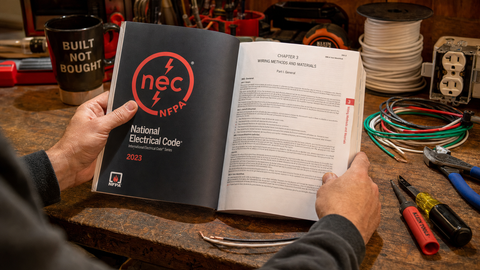
NEC 690.12 module-level rapid shutdown is the quiet force behind this entire comparison, because it's the reason MLPE shows up on roofs that don't need optimization at all. The 2017-and-later code cycles require conductors inside the array boundary to drop to 30V within 30 seconds of shutdown initiation — a requirement a plain string system can't meet without help. Both platforms answer it, but at very different price points, and inspectors in our service areas have learned to check.
| Compliance Approach | Hardware | Cost Profile | Best Fit |
|---|---|---|---|
| Full microinverter conversion | Enphase IQ8 per module — shutdown inherent | Premium uniform MLPE cost | Complex roofs, storage-minded customers |
| Selective optimization + shutdown | TS4 optimization on shaded modules, shutdown-class units elsewhere | Moderate — pay for MLPE only where it earns | Localized shade, value bids |
| Shutdown-only deployment | TS4-A-S class per module + plain string inverter | Lowest code-compliant module-level cost | Clean roofs, maximum kWh per dollar |
| Full optimizer deployment | TS4-A-O class across the array | Approaches uniform-MLPE pricing | Complex roofs where string architecture is preferred |
The shutdown-only row is the one that changed the market. When the code cycle rolled into our region, contractors who knew the Tigo playbook kept their bids alive on clean roofs while competitors quoting uniform MLPE priced themselves out of jobs. That's not a knock on Enphase — it's a reminder that code compliance is a floor, not a feature, and the cheapest compliant architecture that serves the customer's actual needs is usually the right one to quote first. Then upsell from there if the shade study, the storage roadmap, or the customer's appetite for per-panel data justifies it. Contractors who lead with the compliant baseline and present MLPE as an upgrade path report better close rates than those who lead with the premium architecture and negotiate down.
Choose Enphase If
- Storage is in the five-year plan — grid-forming IQ8 retrofit economics are unmatched.
- The roof is genuinely complex: many orientations, scattered shade, panels everywhere.
- The customer wants per-module monitoring depth and a single-vendor warranty stack.
- Your service model profits from Enlighten's fleet diagnostics and advance-replacement RMA.
Choose Tigo If
- The roof is clean and code requires shutdown compliance, not optimization — selective deployment saves four figures.
- Shade is localized: a chimney, one tree, one bad string — optimize the problem modules only.
- You want inverter freedom: pair with the string or hybrid inverter the job actually calls for.
- The project is large or price-sensitive, where per-module uniform MLPE can't pencil.
Build both BOMs from live stock — Enphase, Tigo Energy, microinverters, power optimizers, plus panels and racking — and walk the customer through the scenario table above. The inverter buyer's guide, inverter sizing calculator, and our top inverters roundup carry the same logic for customers who want the self-serve version.
Frequently Asked Questions
Is Tigo as good as Enphase for shaded roofs?
For localized shade — a chimney, a tree, one problem string — Tigo optimization deployed on just the affected modules recovers most of the lost harvest at a fraction of full-MLPE cost. For severe, scattered, multi-orientation shade, Enphase's uniform per-module independence edges ahead, and device-count savings stop justifying selective deployment anyway. Match the deployment to the shade geometry.
Can Tigo optimizers work with any inverter?
Tigo TS4 units are designed to be inverter-agnostic and pair with most major string inverter brands. That flexibility is the point: keep the inverter you trust, add module-level shutdown, monitoring, or optimization where needed. Verify specific pairings against Tigo's compatibility documentation at design time.
Which is cheaper, Enphase or Tigo?
On clean or lightly shaded roofs, Tigo selective deployment is commonly four figures cheaper than uniform Enphase microinverters. On complex roofs requiring near-universal optimization, costs converge and Enphase often wins on simplicity. At large system sizes, Tigo plus a string inverter usually undercuts per-module microinverter pricing significantly.
What happens if a Tigo optimizer fails?
The affected module reverts to standard string behavior — the array keeps producing, and the swap is scheduled at leisure. A failed string inverter, however, takes the whole system offline until replaced, which is why we recommend extended inverter warranties. Enphase failures are limited to one panel each with no central failure exposure.
Do both satisfy rapid shutdown code?
Yes. Enphase microinverters provide module-level shutdown inherently. Tigo's TS4 shutdown-class units provide NEC 690.12 module-level compliance on otherwise standard string systems — one of the platform's core use cases and a major cost saver in current code cycles.
Which platform is better for adding batteries later?
Enphase, clearly — grid-forming IQ8 micros plus AC-coupled IQ Batteries retrofit without touching the roof architecture. Tigo systems inherit their inverter's storage path: choose a hybrid string inverter day one for native storage, or plan on AC-coupled batteries later. Decide the battery roadmap before the MLPE brand.
Sources & Standards
- Enphase IQ8-series datasheets and Enlighten platform documentation
- Tigo TS4 MLPE datasheets, Energy Intelligence platform, and inverter compatibility documentation
- NEC 2023 Articles 690 (incl. 690.7, 690.12), 705, and 310.16
- UL 1741 SB / IEEE 1547 listings
- Portlandia Electric Supply quote desk data, install records, and service logs, 2022–2026