Solar Panel Tier 1: What It Is & Why It Matters for Your Project
Bankability math, financing spreads, and independent test data for using — and looking past — the BloombergNEF Tier 1 classification.
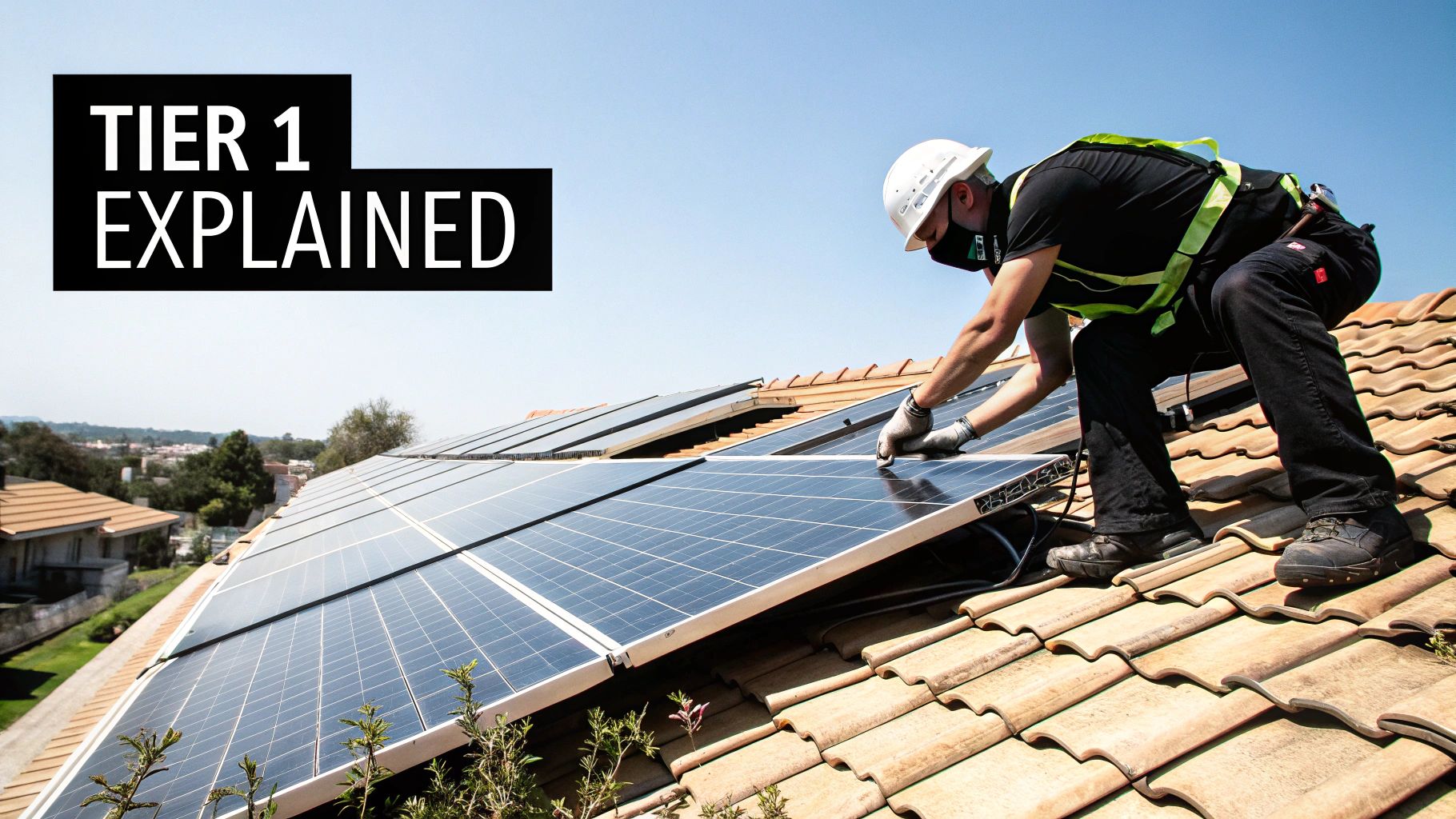
We move panels from more than forty manufacturers. We buy on both sides of the Tier 1 line every week. And I can tell you this: the number of projects that failed because a module was not on a quarterly list is approximately zero. The number that struggled because a manufacturer could not honor a warranty or deliver a replacement module in under six weeks is not zero. Tier 1 is a useful filter and a terrible verdict. This guide shows you how to use it correctly.
The Tier 1 classification comes from BloombergNEF (BNEF). It measures bankability, not product quality. A manufacturer earns Tier 1 status when its own-brand, own-manufactured modules have been used in at least six different projects, each financed non-recourse by six different commercial banks, each larger than 1.5 MW, within the previous two years. No lab testing. No teardown. No field failure data. It is a measure of whether banks have been willing to lend against projects using that manufacturer's panels.
For some projects, how the array looks matters as much as how it performs. Historic districts, high-end residential developments, and corporate campuses with strict design guidelines often reject standard silver-frame, blue-cell modules on aesthetic grounds. The module industry has responded with building-integrated photovoltaics (BIPV) and all-black modules that blend into rooftops more seamlessly.
All-black modules use black backsheets, black frames, and anti-reflective coatings that reduce the blue tint visible from the ground. The efficiency penalty is minimal — typically 1–3% lower than equivalent silver-frame modules due to slightly higher operating temperatures. The price premium is $0.01–$0.03/W, which is often justified by the aesthetic value and smoother permitting in design-sensitive jurisdictions.
BIPV takes integration further, replacing building materials rather than mounting on top of them. Solar roof tiles (Tesla Solar Roof, CertainTeed Apollo) replace asphalt shingles. Solar glass facades replace curtain wall panels. These products are visually striking but come with trade-offs: higher cost, lower efficiency, and more complex installation. A Tesla Solar Roof can cost 2–3x a standard rooftop array per watt, though it also replaces the roof itself. For most commercial applications, standard all-black modules on a low-profile racking system provide the best balance of performance, cost, and aesthetics.
We stock all-black modules from Qcells, JinkoSolar, and Silfab for projects where appearance matters. Our design team can provide renderings showing how different module options will look on your specific roof or facade.
Theory is useful, but field experience is definitive. Here are three real procurement decisions from our wholesale floor that illustrate the limits and value of the Tier 1 classification.
Case 1: 5 MW utility project in Texas. The developer needed non-recourse project financing from a regional bank. The bank's approved vendor list included Jinko, Trina, LONGi, and Qcells — all Tier 1. A competitive bid from a Tier 2 manufacturer was 6% cheaper on hardware, but the bank would not approve the loan without Tier 1 modules. The developer paid the premium, got the financing, and the project closed. Tier 1 status was literally the difference between a built project and a dead one.
Case 2: 50 kW church roof in Ohio. The church had no tax appetite and used direct pay for the ITC. There was no lender to please. We quoted Tier 1 LONGi modules at $0.28/W and Tier 2 Astronergy modules at $0.24/W. Both had solid PVEL scores and 25-year warranties. The church chose Astronergy, saved $2,000 on hardware, and has produced within 1% of the production model for two years. Tier 1 status added no value here.
Case 3: 2 MW community solar in New York. The project used a Tier 1 brand that had been on the BNEF list for 18 consecutive quarters. Six months after energization, the manufacturer filed for bankruptcy reorganization. The warranty was not insured. The project owner is now relying on the distributor's goodwill for any future RMAs. Tier 1 status predicted bankability but not financial health. This is why we always recommend warranty insurance for projects where the manufacturer is not a household name.
Most project developers think of distributors as logistics providers — warehouses that break bulk and ship pallets. That is true, but incomplete. A good solar distributor is a risk mitigation partner. They hold inventory (reducing your exposure to manufacturer lead times), handle quality control (inspecting incoming shipments), manage RMAs (warranty claims, returns, replacements), and provide technical support (string sizing, compatibility verification, code compliance advice).
The distributor's balance sheet matters. If a manufacturer goes bankrupt, the distributor may still honor warranties or source equivalent replacements from their inventory. If the distributor goes under, you lose that safety net. We have seen small distributors close shop with customer deposits in hand and no inventory to ship. The lesson: vet your distributor with the same diligence you apply to the manufacturer. Ask about: years in business, warehouse locations, inventory levels for your SKU, credit terms, RMA processing time, and whether they carry the manufacturer on a non-cancelable purchase order.
Portlandia Electric Supply operates warehouses on both coasts and stocks modules from Tier 1 and high-value Tier 2 manufacturers. We break bulk down to single-pallet quantities, kit orders with racking and inverters, and provide NABCEP-certified design support. For project developers, this means shorter lead times, lower freight costs, and a single point of contact for technical questions. Request a quote through our Pro Account portal for wholesale pricing.
Modules are among the most fragile freight items in construction. A standard 40-foot container holds 20–22 pallets of 72-cell modules (roughly 500–600 kW). Each pallet weighs 600–800 kg. The glass is tempered but not indestructible, and the frames can bend if improperly secured. Damage in transit is the leading cause of module replacement in the first 30 days after delivery.
Receiving inspection is critical. Before the truck leaves, inspect every pallet for: corner damage (the most common failure point), broken glass visible through wrapping, water intrusion (wet cardboard or staining), and proper strapping (cut or loose straps indicate shifting in transit). Photograph any damage before signing the bill of lading. If you sign a clean BOL and later discover damage, the freight claim is much harder to prove.
Storage matters too. Modules should be stored flat, on a hard surface, with proper weight distribution. Stacking pallets more than two high risks frame deformation. Outdoor storage is acceptable if the pallets are covered and elevated off the ground to prevent moisture absorption. We have seen modules stored on grass for three months develop frame corrosion at the contact points — not a warranty issue, but an avoidable problem. For best practices on site logistics, see our supply chain management guide.
Future-Proofing: Bifacial, Agrivoltaics, and Floating Solar
The module market is evolving beyond standard rooftop and ground-mount applications. Three emerging segments deserve attention from forward-thinking buyers: bifacial modules, agrivoltaics, and floating solar.
Bifacial modules capture light on both the front and rear surfaces, with rear-side gains of 5–25% depending on albedo and mounting height. They are now cost-competitive with monofacial modules for utility-scale projects, and the Section 201 tariff exemption for bifacial imports makes them particularly attractive in the US market. For commercial carports and elevated ground mounts, bifacial modules can deliver 10–15% more energy per watt installed. We stock bifacial options from JinkoSolar and LONGi.
Agrivoltaics — co-locating solar arrays with agriculture — is gaining traction in states with high land values. Elevated arrays (8–12 feet) allow farming or grazing beneath the panels. The panels provide partial shade that can reduce crop water demand by 20–30% in hot climates. Research from the University of Arizona and NREL has demonstrated successful co-location with tomatoes, peppers, and sheep grazing. For agricultural landowners, agrivoltaics can generate revenue from both crops and energy production.
Floating solar (floatovoltaics) installs arrays on reservoirs, ponds, and quarry lakes. The water cooling effect improves module efficiency by 5–10%, and the arrays reduce evaporation — a significant benefit in water-stressed regions. The US floating solar market is small today but growing, with several utility-scale projects in California and New Jersey. The racking is specialized (HDPE float platforms), and the electrical design must account for moisture and corrosion, but the energy yield premium is real.
The pandemic taught the solar industry a brutal lesson about concentration risk. When polysilicon prices spiked 400% in 2021–2022, manufacturers with captive polysilicon supply (Wacker, OCI, Tongwei) could keep shipping while pure assemblers faced months of delays. Tier 1 manufacturers, by virtue of their scale, generally have stronger upstream relationships — but not always.
Qcells, for example, backward-integrated into polysilicon through a partnership with REC Silicon, giving it a US-based supply chain for its Georgia factory. First Solar never had a polysilicon dependency because its CdTe technology uses a completely different semiconductor. JinkoSolar and LONGi, both massive Tier 1 producers, source polysilicon from multiple suppliers across China, Malaysia, and Europe to avoid single-source exposure.
For project developers, the supply chain question is not just who is Tier 1, but who can deliver on your timeline. A Tier 1 brand with 30 GW of annual capacity does you no good if their Q3 allocation is sold out and your project needs modules in August. We maintain rolling allocation forecasts with our key suppliers and advise customers to lock purchase orders 12–16 weeks ahead for utility-scale projects, 6–8 weeks for commercial, and 2–4 weeks for residential. Our supply chain guide covers contingency planning in detail.
No discussion of module procurement in 2026 is complete without trade policy. The United States maintains anti-dumping and countervailing duty (ADD/CVD) orders on crystalline silicon cells and modules from China, and Section 201 tariffs apply to imports from most countries. The Southeast Asia circumvention inquiry — targeting Chinese-owned factories in Malaysia, Thailand, Vietnam, and Cambodia — has added further uncertainty.
| Trade Measure | Covered Products | Effective Rate (2026) | Impact on Procurement |
|---|---|---|---|
| Section 201 tariffs | C-Si cells and modules | 14% (bifacial exempt) | Favors bifacial modules; adds cost to monofacial |
| ADD/CVD (China) | C-Si cells and modules from China | Variable; 50–250%+ | Effectively blocks direct China imports |
| Southeast Asia circumvention | C-Si from Malaysia, Thailand, Vietnam, Cambodia | Under review; provisional duties possible | Forces diversification to India, Korea, US |
| Section 301 (China) | Inverters, tracking equipment | 25% | Increases cost of Chinese inverters and trackers |
| Domestic content (45X + ITC adder) | US-made modules, cells, wafers | Credit offset; competitive cost | Makes US assembly competitive vs. imports |
The practical implication: a developer buying on price alone in 2026 may face surprise duty bills, detained shipments, or project delays. We verify country of origin, bill of materials, and tariff exposure for every module we quote. Customers buying US-made panels avoid ADD/CVD and Section 201 entirely, though the domestic premium has narrowed significantly since 2023.
A 25-year warranty implies a 25-year asset life, but the reality is more complex. Many systems will operate for 30+ years, and some will be repowered with higher-wattage modules before the original panels reach end-of-life. What happens to the old modules matters for ESG reporting, landfill restrictions, and project finance covenants.
The solar industry is building a recycling infrastructure, but it is not yet mature. Crystalline silicon modules are roughly 75% glass, 10% polymer, 8% aluminum, 5% silicon, and 2% silver and other metals. Recycling processes involve thermal delamination, acid leaching, and electrorefining to recover silver, copper, and high-purity silicon. Current recycling costs are $15–$30 per module, which exceeds the recovered material value for most panels. The economics improve for thin-film modules (First Solar operates a profitable recycling program for CdTe) and for large-scale decommissioning where volume drives unit costs down.
Washington State passed the nation's first solar product stewardship law in 2017, requiring manufacturers to finance take-back programs. California and New York are considering similar legislation. For project developers, the emerging best practice is to include a decommissioning bond or reserve in the project pro forma — typically $0.05–$0.10/W — to cover future removal and recycling costs. This is increasingly required by lenders and tax equity investors.
The module technology landscape is shifting faster than many buyers realize. P-type PERC, which dominated the market from 2018 to 2023, is being rapidly displaced by n-type TOPCon and heterojunction (HJT). By 2026, TOPCon accounts for the majority of new capacity additions. But the real disruption is coming: perovskite-silicon tandem cells.
Tandem cells stack a perovskite top layer on a silicon bottom layer, theoretically breaking the Shockley-Queisser single-junction efficiency limit. Laboratory demonstrations have reached 33%+ efficiency, and several manufacturers (Oxford PV, LONGi, Swift Solar) are targeting commercial production by 2027–2028. If tandems reach commercial scale at viable cost, they could push module wattages from today's 550–600 W to 700–800 W for standard 72-cell format — a 25%+ jump that would reduce BOS costs and land use significantly.
For buyers today, the question is whether to wait. Our view: do not wait. A 2026 module at 22% efficiency and $0.25/W is already a better economic proposition than a 2019 module at 19% and $0.40/W. Even if tandems arrive in 2028 at $0.35/W, the energy and savings you generate between now and then outweigh the marginal efficiency gain. Buy the best technology available today, and plan to repower in 15–20 years when the next generation is proven and cost-competitive. Our Best Solar Panels 2026 page tracks the current generation of commercially available modules.
Due Diligence Checklist for Module Procurement
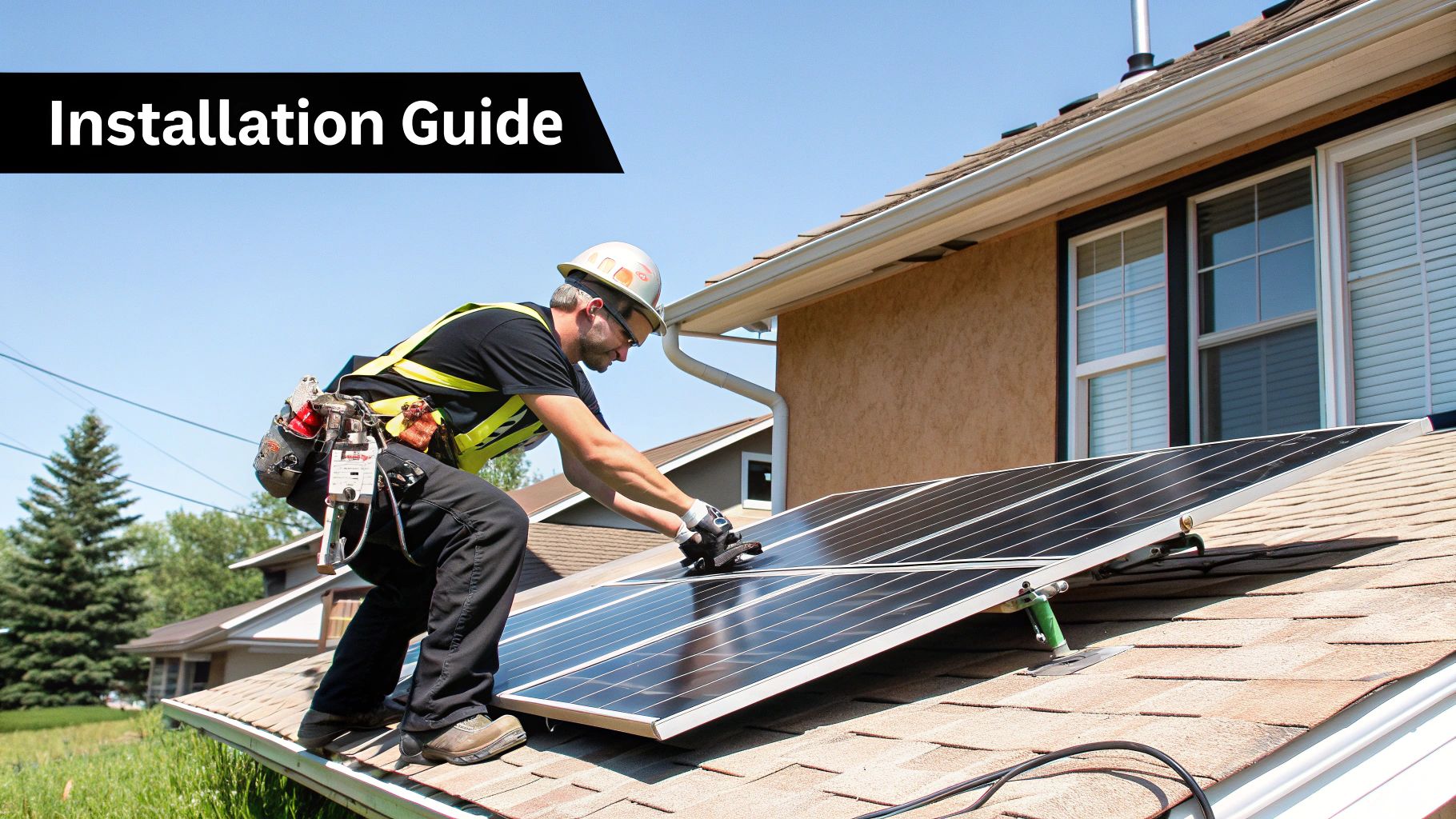
After fifteen years of buying and selling modules, here is the checklist we use for every procurement decision, whether the project is 10 kW or 100 MW:
- Verify the datasheet against the purchase order. Model numbers, wattage class, frame dimensions, and junction box location must match the design. We have received shipments where the junction box was on the long side instead of the short side, requiring a complete racking redesign.
- Request factory audit or third-party inspection. For orders over 500 kW, hire a third-party inspector (Bureau Veritas, SGS, TÜV Rheinland) to visit the factory and witness production line tests. The cost is $2,000–$5,000 and is trivial compared to shipping a bad batch across the Pacific.
- Confirm warranty insurance. Ask if the warranty is backed by an insurance policy (AM Best rated) or is a corporate obligation only. If the manufacturer disappears, an insured warranty is still collectible. A corporate warranty is only as good as the company's balance sheet.
- Check flash test data for the specific batch. Every module is flash-tested at the factory. Request the Pmax, Voc, Isc, and FF distributions for your container or lot. A batch with a wide distribution (Pmax variation >±3%) indicates process control issues.
- Plan for logistics and receiving. Modules are fragile freight. Inspect every pallet for corner damage, broken glass, or water intrusion before signing the BOL. Document damage with photos and refuse damaged pallets. Once you sign, the freight claim becomes much harder.
- Match the module to the racking and inverter. Verify clamp compatibility, frame thickness, and string voltage at your site's temperature extremes. A module that works in Arizona may over-voltage the same inverter in Wisconsin.
This checklist has saved our customers hundreds of thousands of dollars in avoidable mistakes. We apply it to every solar panel shipment that leaves our warehouse.
| Criterion | Requirement | What It Proves | What It Does Not Prove |
|---|---|---|---|
| Project count | ≥6 qualifying projects in 2 years | Sustained shipment volume into financed projects | Module efficiency, degradation rate, or failure rate |
| Project size | Each >1.5 MW | Commercial/utility scale focus | Residential product quality |
| Financing type | Non-recourse from ≥6 different banks | Independent lender due diligence passed | Lab test results or field performance |
| Module source | Own-brand, own-manufactured | Manufacturer controls production | Specific BOM or cell supplier |
| Update cadence | Quarterly | Status is a snapshot | Permanent quality grade |
Notice what is absent: efficiency thresholds, degradation limits, warranty length, PID resistance, and mechanical load ratings. Those quality dimensions are measured by entirely different instruments — PVEL's Module Scorecard, RETC testing, and IEC 61215/61730 certification. We will cover how to layer them onto the Tier 1 screen below.
For financed commercial and utility projects, Tier 1 status delivers three concrete benefits, all about risk rather than raw performance:
| Benefit | Mechanism | Typical Dollar Impact (1 MW project) |
|---|---|---|
| Financing access and cost | Banks maintain approved vendor lists | 25 bps rate saving = ~$17,500/year |
| Warranty survivability | Balance sheet strength backs 25-yr warranty | Avoided replacement risk = ~$50,000–$100,000 |
| Procurement liquidity | Volume production = replacement availability | Faster RMA = less downtime |
Let us quantify the financing effect. A 1 MW commercial rooftop, all-in cost $1.40/W ($1.4 million), 70% debt-financed ($980,000) over 20 years:
| Scenario | Interest Rate | Annual Debt Service | Year-1 Net Cash Flow | 20-Year Interest Delta |
|---|---|---|---|---|
| Tier 1 module (approved vendor) | 6.00% | ~$85,400 | ~$74,100 | — |
| Non-listed module (risk premium) | 6.50% | ~$89,000 | ~$70,500 | ~$36,000 more |
| Non-listed (cash only; no leverage) | n/a | $0 | ~$159,500 gross | Lost leverage benefit |
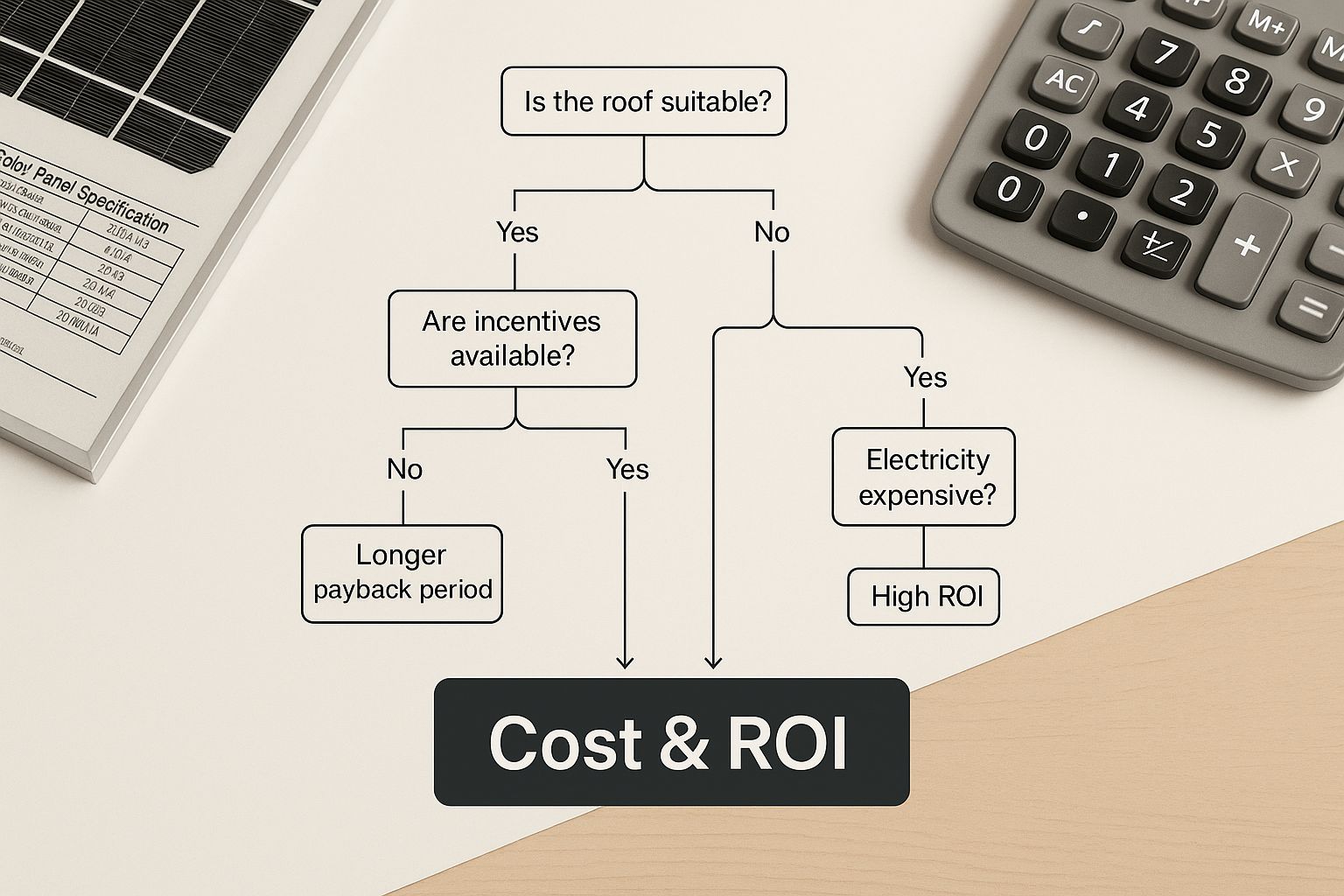
The ~$3,600 annual difference in debt service compounds to roughly $36,000 over the loan life. That is typically more than the 5–10% hardware premium a Tier 1 module commands on a project this size. For financed commercial and utility projects, Tier 1 usually pays for itself. For a cash residential purchase, the calculus flips: there is no lender to please, so the premium only makes sense if the specific module earns it on warranty, degradation, and performance.
The industry informally extends BNEF's language to Tier 2 and Tier 3, though BNEF publishes only a Tier 1 list.
| Dimension | Tier 1 | Tier 2 | Tier 3 |
|---|---|---|---|
| Definition | BNEF bankability list (current quarter) | Established maker, limited bank track record | Small assembler, often rebranding |
| Typical capacity | 5–50+ GW/year | 1–5 GW/year | <1 GW/year |
| Vertical integration | Ingot to module | Cell + module common | Assembly only |
| R&D spend | Hundreds of $M annually | Moderate | Minimal |
| Wholesale price delta | Baseline | 5–10% below | 10–20% below |
| Warranty risk | Low | Moderate | Elevated |
| Best use case | Financed C&I and utility | Cash residential, budget C&I | Off-grid, DIY, price-driven |
Here is the nuance from our wholesale floor: some of the best-value panels we sell come from manufacturers that hover at the Tier 1 boundary. Silfab (North American manufacturing, excellent build quality) may or may not appear on a given quarter's list, yet their modules routinely outperform bigger names in independent testing. Conversely, being Tier 1 does not make a brand's budget line better than a Tier 2 brand's premium line. Buy the module, not the tier.
Professionals treat Tier 1 as a first-pass screen, then evaluate the specific module. The checklist that actually predicts field performance:
- Independent test results. PVEL's Module Scorecard and RETC reports put modules through damp heat, thermal cycling, PID, mechanical load, and LID/LeTID stress. A Tier 1 brand with weak PVEL results is a warning; a non-listed brand with top marks deserves a look.
- Datasheet fundamentals. Efficiency, temperature coefficient (look for −0.30%/°C or better on premium N-type), first-year and annual degradation, and the warranted output floor at year 25.
- Warranty terms in writing. Product warranty of 25 years is now common on premium lines; 12–15 years signals a budget product. Check labor coverage, shipping, and whether the warranty is insured.
- Local support and RMA reality. Ask the distributor: how many RMAs has this brand processed in North America this year, and how fast? A warranty on paper is different from a warranty with a service team behind it.
Run the temperature-coefficient math on a real site and the spec-sheet deltas stop looking academic. Two 10 kW arrays in Phoenix, one on −0.30%/°C modules and one on −0.34%/°C modules, will diverge by roughly 1.5–2% of annual energy — around 250–350 kWh per year, or $40–$60 annually at desert Southwest retail rates, every year for three decades. Small numbers compound into real money across a fleet.
The domestic manufacturing picture has transformed since the Inflation Reduction Act's 45X production credits took effect. Qcells operates the largest module plant in the Western Hemisphere in Georgia. First Solar runs thin-film CdTe plants in Ohio, Alabama, and Louisiana. Canadian Solar, Jinko, Trina, JA Solar, and others have commissioned US module assembly. Brands like Silfab, Mission Solar, and Solar4America anchor the domestic-content residential market.
Domestic content can unlock a 10-percentage-point ITC adder on qualifying projects. On a $2 million commercial project, that is worth roughly $60,000–$70,000 after basis adjustments. The domestic module premium is now often under $0.05/W — a rounding error compared to the adder value. We track domestic-content eligibility for every panel in our warehouse.
Is Tier 1 a quality rating?
No. Tier 1 is BloombergNEF's bankability classification — it tracks whether banks have financed projects using a manufacturer's own-brand modules, not how the modules perform in a lab or in the field. Use it as a financial-risk screen, then judge quality with PVEL/RETC results, datasheet specs, and warranty terms.
How often does the Tier 1 list change?
Quarterly. BNEF re-evaluates the deal record every quarter, so membership is a snapshot. A manufacturer needs six qualifying bank-financed projects over 1.5 MW within a rolling two-year window, which means shipment slowdowns can drop a brand off the list even when nothing about its products changed.
Are Tier 1 panels worth the premium for a home system?
For a cash purchase, sometimes — you are paying for balance-sheet strength behind a 25-year warranty, plus easier replacements later. But several non-listed and borderline brands offer equal or better module-level specs at lower prices. Compare the specific modules, and buy from a distributor who will support an RMA a decade from now.
Which certifications matter more than tier?
IEC 61215 (design qualification/performance) and IEC 61730 (safety) are mandatory baselines. Beyond those, look for PVEL Module Scorecard or RETC test results, UL 61730 listing for the US market, and — for coastal or agricultural sites — ammonia and salt-mist corrosion certifications (IEC 62716 and IEC 61701).
Do Tier 1 panels degrade more slowly?
Not automatically. Degradation depends on cell technology and bill of materials, not bankability. That said, Tier 1 leaders currently dominate N-type TOPCon and HJT production, which carry 0.25–0.4% annual degradation versus 0.5–0.55% on mainstream PERC — so the correlation exists today, but the causation runs through technology choice, not the tier label.
Where can I buy Tier 1 solar panels wholesale?
Portlandia Electric Supply stocks Tier 1 brands including JinkoSolar, Trina, LONGi, JA Solar, Qcells, and Canadian Solar, plus high-quality alternatives. Request a quote through our contact page for project pricing.
Ready to spec your module shortlist?
Portlandia Electric Supply quotes across Tier 1 and high-value alternatives with domestic-content tracking and project-level support.
Related Resources: