Solar Panel Maintenance Guide for Peak Performance & Project ROI
Field schedules, torque specs, thermal thresholds, and real dollar math for keeping residential and commercial arrays at rated output for 25 years.
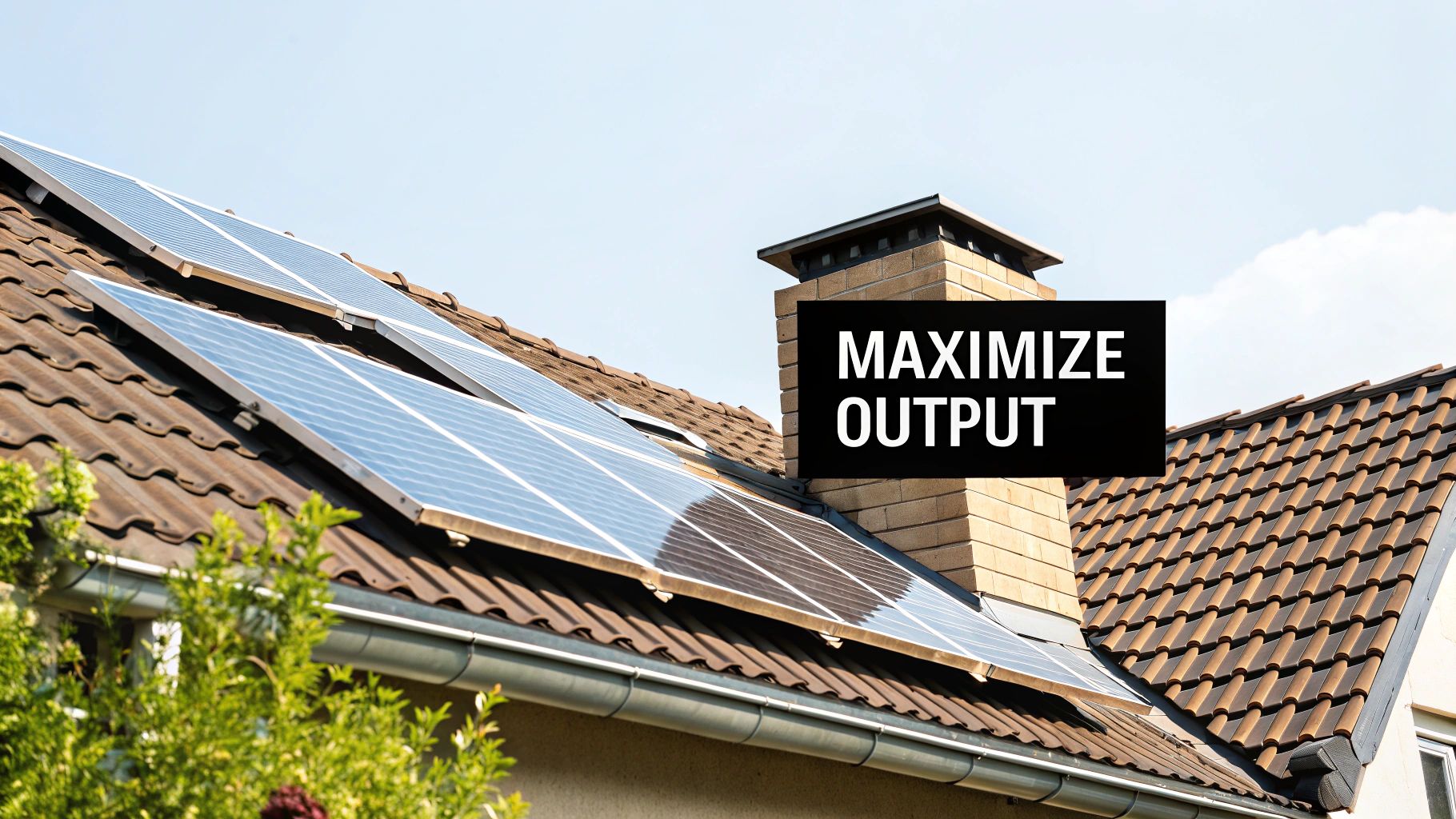
We talk to installers every week about what actually fails in the field. The patterns are remarkably consistent — and almost all of them are preventable with a modest maintenance routine. A loose MC4 connector costs nothing to tighten but can destroy a string's production for months. A $200 thermal camera rental spots a hot cell before it becomes a $400 panel replacement. The maintenance burden is real but modest; the trick is doing the right things at the right intervals.
This guide gives you a field-tested maintenance plan: what to check, how often, what it costs to ignore, and when to call a professional. We have pulled thousands of feet of 4/0 through EMT, and we have seen the same three failure modes — soiling, connection degradation, and inverter fatigue — account for 80% of avoidable production losses. The tables below use data from NREL field studies, manufacturer warranty documents, and our own RMA records.
I tell every system owner the same thing: your monitoring app is the cheapest maintenance tool you own, and most people never open it after the first month. I sized a 22 kW array last Tuesday and the first thing I checked was not the panels — it was the inverter error log. Three months of ground fault alerts, ignored. The homeowner had lost 8% production and did not even know it.
Working on a solar array requires respect for the electrical hazards involved. A residential string can operate at 400 VDC; commercial systems reach 1,000 VDC or 1,500 VDC. These voltages are lethal, and the DC arc hazard is particularly dangerous because DC current does not self-extinguish like AC.
Every maintenance technician must understand the rapid shutdown requirements of NEC 690.12. For systems installed under the 2020 or 2023 NEC, rapid shutdown devices must reduce voltage to 80 V or less within 30 seconds of activation, either at the array boundary or at the module level. Module-level shutdown (MLPEs — microinverters or DC optimizers) is the safest option because it eliminates high voltage in the DC conductors entirely when the inverter is off.
Before performing any maintenance, follow this lockout/tagout sequence: turn off the AC disconnect, turn off the DC disconnect, verify zero energy with a multimeter on both AC and DC sides, and tag the disconnects to prevent accidental re-energization. Never assume the system is dead because the inverter display is dark — capacitors inside the inverter can hold charge for several minutes after shutdown. Only qualified electricians should perform electrical maintenance.
Fire safety is equally important. Solar arrays cannot be simply "turned off" during daylight — the modules produce voltage whenever light hits them. Firefighters need to know where the rapid shutdown initiator is located, and the system must be clearly labeled per NEC 690.13. We recommend placards at the main service entrance, the inverter location, and the array itself. Our NEC compliance guide covers labeling requirements in detail.
Most modern solar installations include some form of monitoring, but the quality varies enormously. A basic inverter display tells you total production. A string-level monitoring system tells you which string is underperforming. Module-level monitoring (microinverters or DC optimizers) tells you exactly which panel is the problem. The right level of monitoring depends on system size, accessibility, and the cost of downtime.
For residential systems, we recommend at least string-level monitoring. The cost delta from basic to string-level is roughly $200–$400 in hardware and is worth it on the first fault. For commercial systems over 100 kW, module-level monitoring is increasingly standard. The additional cost is $0.03–$0.05/W, but the diagnostic precision saves labor on every service call. When a technician knows which panel to replace before climbing the roof, the service call is 30 minutes instead of 3 hours.
Alert tuning matters. A monitoring system that sends an email for every 2% cloud-induced dip will train the owner to ignore alerts. A system that only alerts on sustained deviations (more than 5% below expected for 48+ hours) catches real problems without noise. We configure alert thresholds based on the system's production model, with seasonal adjustments for expected variation. Inverters with built-in grid monitoring (SMA, SolarEdge, Fronius) make this easier by providing baseline comparison directly in their portals.
For system owners who want professional monitoring, we offer a managed monitoring service that reviews alerts, dispatches technicians, and handles warranty claims. The service costs $8–$12 per kW-year and includes quarterly performance reports. For a 250 kW commercial system, that is $2,000–$3,000 per year — typically less than the value of production losses from undetected faults. See our maintenance guide for more on monitoring best practices.
Seasonal Maintenance Checklists: What Changes by Quarter
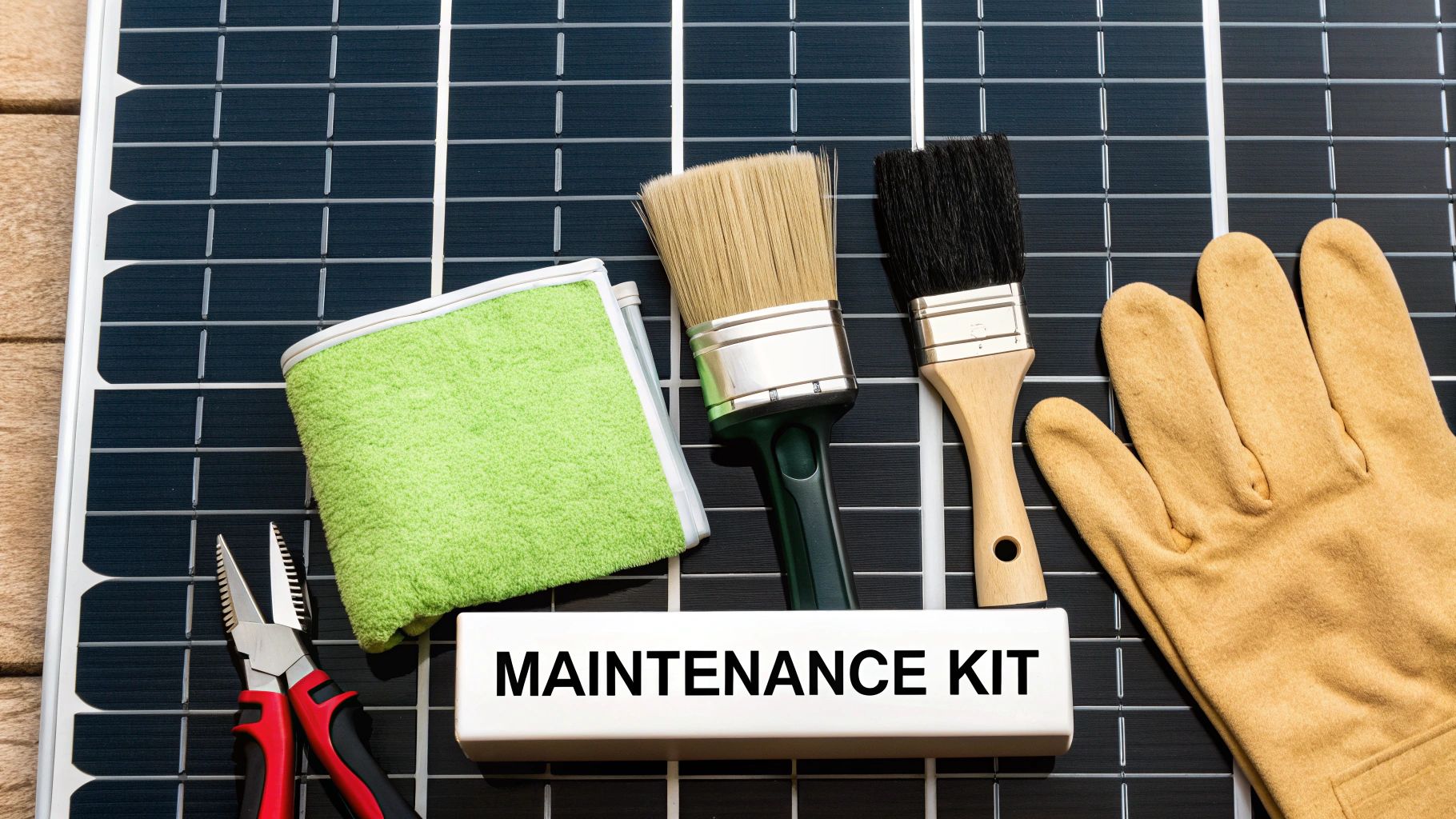
Maintenance is not the same in January as it is in July. I have seen crews waste time cleaning panels the day before a forecast rainstorm, and I have seen homeowners ignore pre-winter checks that would have caught a loose junction box before ice intrusion destroyed it. Seasonal intelligence matters.
| Season | Primary Risks | Professional Tasks | Homeowner Tasks |
|---|---|---|---|
| Spring | Pollen buildup; bird nesting; wind damage from winter storms | Full electrical inspection; thermal scan; torque check after freeze-thaw cycling | Clear gutters; trim overhanging branches; check for winter debris under array |
| Summer | Overheating; wasp nests under panels; peak production stress on inverters | Inverter filter cleaning; ventilation check; verify rapid shutdown functionality | Monitor production daily during peak months; rinse panels if drought conditions |
| Fall | Leaf accumulation; early frost; shorter days masking inverter issues | Pre-winter torque verification; insulation resistance test; gutter and wire management | Remove leaves weekly; check for new shading as sun angle drops |
| Winter | Snow load; ice dams; reduced access for repairs | Emergency response plan review; verify snow removal contract (commercial) | Do NOT rake snow off panels; let them melt naturally or call a pro with proper tools |
The winter point deserves emphasis. Homeowners often call us panicking about snow-covered panels. Our advice: leave it. Most panels are mounted at an angle that sheds snow within a day or two of sun exposure. The dark surface absorbs heat and accelerates melting. Attempting to remove snow with rakes, shovels, or salt risks scratching the anti-reflective coating, cracking glass, or voiding the warranty. If your roof is flat or low-slope and snow persists for weeks, hire a professional with foam-blade snow rakes and fall protection.
Cold climates add a unique maintenance dimension. Ice dams — ridges of ice that form at the eave and prevent meltwater from draining — are a roofing problem first and a solar problem second. But panels can exacerbate ice dams by warming the roof surface above them while leaving the eave cold. The solution is proper attic insulation and ventilation, not solar-specific hardware. If you are adding solar to a house with a history of ice dams, fix the roof first.
Snow loading calculations matter for ground mounts in snow country. A ground-mount array at a 30° tilt in upstate New York can accumulate 2–3 feet of snow in a single storm, creating loads well above the module's 5,400 Pa mechanical rating. Arrays with lower tilt angles (15–20°) are particularly vulnerable because snow does not slide off as readily. We recommend steeper tilts for northern ground mounts, or specify modules with 7,200 Pa load ratings if low tilt is required for site constraints.
Cold temperatures actually improve panel efficiency — for every degree below 25°C, a crystalline silicon module gains roughly 0.4% in voltage. A panel at -10°C produces about 14% more voltage than at 25°C. This is why string inverter voltage windows must be checked at the design minimum temperature; an array that is safe in summer can over-voltage the inverter in a Minnesota January. Our inverter sizing guide covers temperature-corrected string sizing in detail.
Trees grow. It sounds obvious, but we receive at least one call per month from a system owner whose production dropped 15% because a maple tree they planted as a sapling in 2015 is now shading their array at 2 PM. Vegetation management is a long-term maintenance discipline, not a one-time trim.
The rule of thumb: a tree will cast meaningful shade on a south-facing array when its height exceeds 1.5 times the distance to the array. A 30-foot oak 20 feet from the roof will shade the array for 2–3 hours on summer afternoons. Fast-growing species like poplar, willow, and silver maple can add 2–3 feet of height per year. We advise clients to choose slow-growing ornamentals within the solar setback zone, or to budget for professional tree trimming every 3–5 years.
For ground mounts, grass and weed control is a fire safety issue, not just aesthetics. NEC 690.4(B) and many local fire codes require vegetation clearance beneath arrays. We specify crushed stone or ground-cover plantings (low-growing sedum) for commercial ground mounts. Mowing under arrays is hazardous due to DC conductors at ground level; if you must mow, use a string trimmer with a plastic guard and never let metal blades contact cables.
Warranty Claims: Documentation That Gets Paid

When a panel fails in year eight, the manufacturer does not hand you a replacement. They want documentation: serial numbers, installation date, monitoring data showing the failure, photos of the defect, and proof that the panel was installed per their instructions. The installers who get paid are the ones who kept records.
Our recommended warranty documentation kit:
- As-built documentation: Final array layout with serial number mapping to physical position
- Commissioning report: Initial IV curves, insulation resistance, and open-circuit voltage readings
- Annual maintenance logs: Dates, tasks performed, technician name, and production snapshots
- Monitoring data exports: Monthly production by string or panel, with baseline model comparison
- Photo evidence: Time-stamped photos of any physical defect, nameplate, and installation environment
Most performance warranties require the owner to demonstrate a sustained output below the warranted curve, not a single bad day. This means you need 3–6 months of below-threshold data before filing. Start tracking early, and use a monitoring platform that exports data in a format manufacturers accept. We recommend systems with API access and automated baseline comparison alerts. Check our warranty guide for specific clause language from major manufacturers.
Every kilowatt-hour lost to dirt, shade, or a failed component is money left on the table. Consider a typical 10 kW residential array in Pennsylvania producing 11,500 kWh annually at $0.15/kWh. That is $1,725 in energy value per year. A 5% production loss costs $86 annually. Over 25 years, even without escalation, that is $2,150 — more than the cost of a decade of professional cleanings.
| Loss Source | Typical Annual Impact | kWh Lost (10 kW baseline) | Dollar Loss @ $0.15/kWh | Prevention Cost |
|---|---|---|---|---|
| Dust and pollen soiling | 2–5% | 230–575 kWh | $35–$86 | $150–$300 cleaning |
| Bird droppings (localized) | 3–8% on affected strings | 345–920 kWh | $52–$138 | Critter guard + spot clean |
| One failed optimizer/microinverter | ~1 panel (3%) | 345 kWh | $52 | Monitoring + fast RMA |
| New shading (tree growth) | 2–10% | 230–1,150 kWh | $35–$173 | Annual trim ($200–$500) |
| Loose/corroded connections | 1–5% plus fire risk | 115–575 kWh | $17–$86 | Annual torque check |
| Inverter degradation/failure | 0–100% (catastrophic) | 0–11,500 kWh | $0–$1,725 | Preventive maintenance |
The critical insight from our RMA data: systems with annual professional inspections average 1.2% higher annual production than uninspected systems after year five. That does not sound like much until you multiply it across a 500 kW commercial portfolio producing 600,000 kWh/year. At $0.12/kWh, 1.2% is $864 per year per 500 kW. A 5 MW portfolio loses $8,640 annually from skipped inspections. The $5,000 inspection contract pays for itself and then some.
All panels degrade. The question is how fast, and whether your monitoring can distinguish normal aging from a fault. N-type TOPCon and HJT modules currently lead the market with the lowest degradation rates, but the premium varies by manufacturer and batch.
| Cell Technology | First-Year Degradation | Annual Degradation | Year-25 Output | Performance Warranty Floor |
|---|---|---|---|---|
| Legacy polycrystalline | 2.5–3.0% | 0.70–0.80% | ~77–80% | 80% at year 25 |
| Mono PERC (P-type) | 2.0% | 0.50–0.55% | ~84–86% | 84% at year 25 |
| N-type TOPCon | 1.0% | 0.30–0.40% | ~88–91% | 87–90% at year 25 |
| HJT (heterojunction) | 1.0% | 0.25–0.30% | ~90–93% | 90% at year 25 |
| CdTe thin-film | 1.5–2.0% | 0.40–0.50% | ~86–89% | 87% at year 25 |
Track your specific yield monthly: kWh produced divided by kW installed, normalized for irradiance if you have a weather station. A sudden 5% drop in one string is a maintenance trigger, not aging. In year eight, a PERC panel at 86% of nameplate is normal. At 72%, it is a warranty claim. The difference matters because most performance warranties prorate, and the threshold for a claim is usually 10–20% below the warranted curve.
The Maintenance Schedule That Actually Works
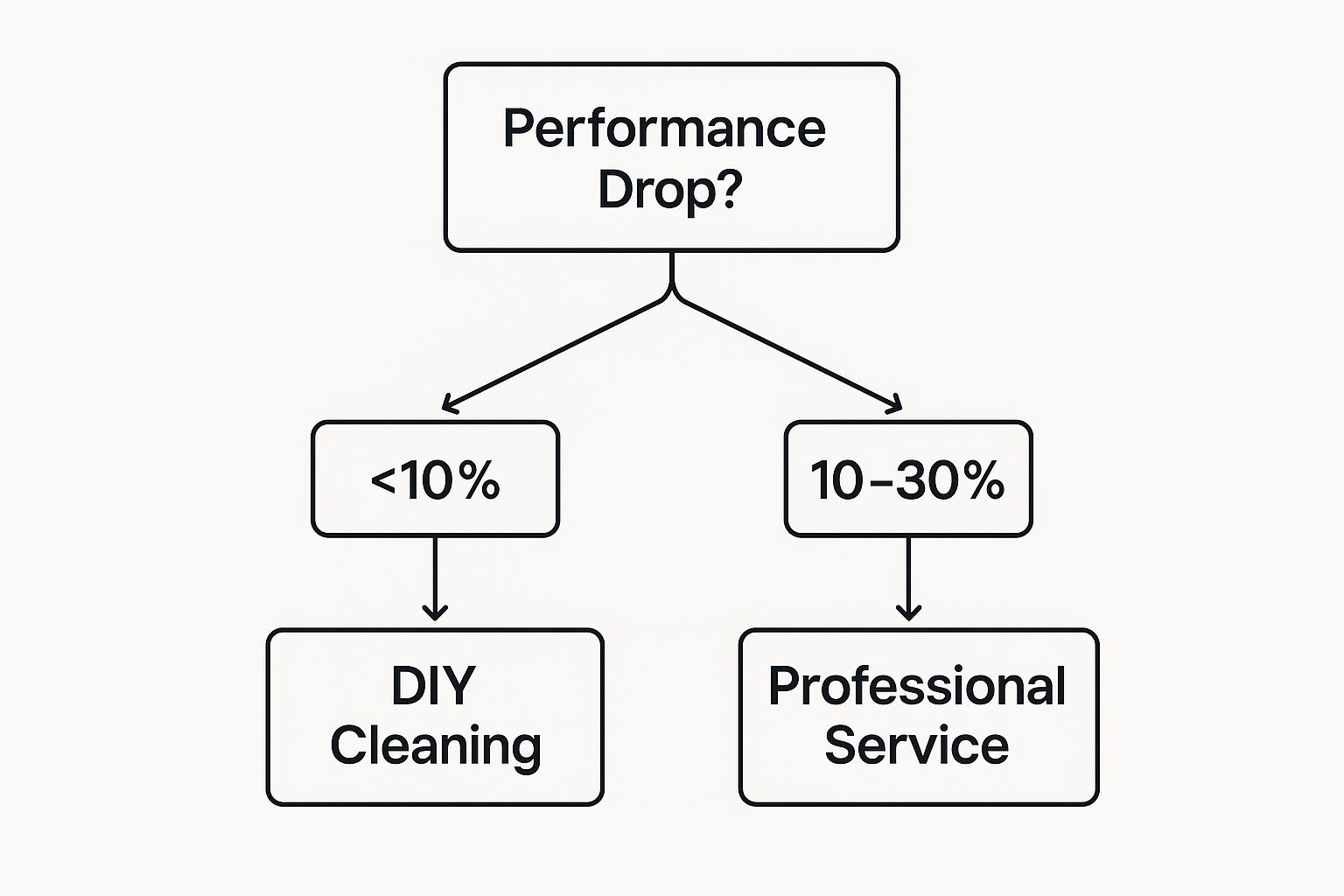
This schedule splits tasks between homeowner-safe ground-level work and licensed professional work. Never climb a roof without fall protection, never work on energized DC conductors without training, and never assume a shutdown inverter means a dead array — capacitors hold charge.
| Frequency | Professional Tasks | Homeowner Tasks | Key Objective |
|---|---|---|---|
| Monthly | Review monitoring alerts; respond to faults | Check inverter display for error codes | Catch failures within days, not seasons |
| Quarterly | Visual racking inspection from ladder; torque spot-check | Clear debris from array edges and gutters | Prevent shading and structural issues |
| Semi-annually | Professional cleaning in dusty/agricultural areas | Ground-level rinse with hose (if safe) | Maximize light absorption |
| Annually | Full electrical check: torque, thermal imaging, IV curves | Visual panel inspection with binoculars | Detect electrical faults per NEC |
| Bi-annually | Thermal imaging scan; insulation resistance test | Review annual production vs. model | Pinpoint cell-level faults before cascade |
After any severe weather event — hail over 1 inch, winds over 70 mph, or heavy ice loading — do an immediate visual check even if off-schedule. We have seen arrays that looked fine from the ground but had cracked back sheets and compromised seals that led to moisture ingress six months later. A $150 emergency inspection is cheap insurance against a warranty dispute.
Most soiling rinses off with plain water. The rules are simple: clean early morning or evening when panels are cool, use a soft brush and deionized water if available, never use pressure washers over 1,500 PSI, and never use abrasives or solvents. Scratched glass is permanent and voids most warranties.
Bird droppings deserve special attention. Because cells in a string are wired in series, one fully shaded cell can drag down the entire string and create a hot spot. A single pigeon colony can knock 8% off a 20-panel system. Spot-clean droppings promptly, and install critter guards if birds are nesting under the array. I have seen a $180 mesh barrier pay for itself in one quarter.
Whether professional cleaning pays depends on your soiling rate. In rainy climates like the Pacific Northwest, nature does the work. In the arid Southwest, agricultural regions, or near highways, scheduled cleaning is one of the best investments you can make. We advise clients to track production before and after cleaning. If a $250 cleaning recovers more than $250 in annual production value, schedule it semi-annually. If not, annually or on-demand is sufficient.
Panels last 25–30 years. Inverters do not. A quality string inverter is typically warranted for 10–12 years and will likely need replacement once during the array's life. Microinverters and power optimizers commonly carry 25-year warranties matched to the panels. Budget for replacement:
| Component | Typical Warranty | Expected Life | Replacement Cost | Failure Symptoms |
|---|---|---|---|---|
| String inverter (10–50 kW) | 10–12 yrs | 10–15 yrs | $1,500–$4,500 | Fault codes, no AC output, fan noise |
| Microinverter (per unit) | 25 yrs | 20–25+ yrs | $180–$350 + labor | One panel at zero in monitoring |
| Power optimizer (per unit) | 25 yrs | 20–25 yrs | $90–$220 + labor | Panel-level underperformance alert |
| Monitoring gateway | 5 yrs | 5–10 yrs | $150–$500 | System produces but reports nothing |
| AC disconnect / combiner | 5–10 yrs | 10–15 yrs | $200–$800 | Intermittent trips, corrosion |
Preventive maintenance for string inverters includes cleaning air intake filters, checking DC terminal torque, updating firmware, and verifying arc-fault and rapid-shutdown functionality. Most manufacturers publish preventive maintenance schedules — follow them. A $200 annual PM contract on a 50 kW commercial inverter is cheaper than a $3,500 emergency replacement plus lost production.
A qualified technician's annual visit should include, at minimum:
- Thermal imaging (IR scan) of every module under load. A hot cell running 20°C above neighbors is a failure in progress — bypass diode failure, cell crack, or severe soiling.
- Torque verification on all racking connections and electrical terminations per manufacturer specifications. Thermal cycling loosens hardware over time.
- IV curve tracing or string-level testing to compare actual string performance against expected values. A string reading more than 5% below its siblings needs investigation.
- Insulation resistance testing to detect ground faults before they trip the inverter or start a fire. NEC 690.5 requires ground-fault protection; verify it is functioning.
- Wire management inspection — conductors secured, UV-rated, not abraded. Our solar wire and cable guide covers compliant conductor types.
Connector inspection is critical. Mismatched or cross-mated MC4-style connectors from different manufacturers are a leading cause of DC-side failures and are explicitly flagged in NEC 110.3(B). We have replaced dozens of melted connectors where an installer mixed brands. The $0.50 connector is not where you save money.
How often should I clean my solar panels?
Most residential systems need cleaning one to two times per year. Dusty, agricultural, or high-pollen areas may need two to four. Let monitoring data decide: when production dips and panels look grimy, it is time. In rainy climates, nature often handles it.
Can I clean solar panels myself?
Yes, if you can do it safely from the ground with a hose and soft brush on an extension pole. Never climb on the roof without fall protection, never use a pressure washer, and never clean hot panels in full sun. When in doubt, hire a professional.
What are the warning signs I need a professional?
Call a pro if monitoring shows a sudden production drop, the inverter displays fault codes or a red light, you see cracked glass or burn marks, wiring looks loose or chewed, or the system trips breakers. Any of these can indicate an electrical fault that is both a production problem and a safety issue.
Will skipping maintenance void my warranty?
It can. Most warranties require reasonable care, and performance claims may be denied if output loss stems from soiling or neglect. Keep records of cleanings and inspections. Read your specific warranty documents — our warranty guide explains the common clauses.
How much production do dirty panels actually lose?
Studies and field data consistently show 2–5% losses from typical soiling, with extremes above 20% in heavy dust or after wildfire ash. Bird droppings cause outsized localized losses because of series wiring. An annual cleaning habit keeps you at the low end.
Do solar panels need maintenance if I have monitoring?
Monitoring tells you that something changed; it does not tell you why, and it cannot spot developing physical problems like corrosion, loose hardware, or sealant failure. Think of monitoring as the smoke detector and the physical inspection as the fire drill — you need both.
Need maintenance supplies or replacement parts?
Portlandia Electric Supply stocks replacement panels, inverters, critter guards, and cleaning kits with fast shipping.
Related Resources: