Victron MultiPlus vs Sol-Ark 2026: Component vs All-in-One Hybrid Design
The last honest fork in off-grid design: a modular European component system you assemble and program yourself, or one American all-in-one box that does everything out of the crate. We build both. Here's how to choose.
This is the comparison our off-grid customers agonize over longest, and they should — it's not really a product comparison, it's a design-philosophy commitment that will shape every service call for fifteen years. Victron is the component ecosystem: a MultiPlus (or Quattro) inverter/charger at the heart, separate MPPT charge controllers, a Cerbo GX brain, a Lynx DC distribution system, and monitoring stitched together by you or your installer into exactly the system you meant to build. Sol-Ark is the integrated hybrid: PV inputs, battery, grid, generator, and 200 A pass-through in one wall-mount box, commissioned in an afternoon. We stock both — the Victron Energy catalog and the Sol-Ark line — and we have strong opinions formed by truck rolls, not brochures.
The one-sentence version: Sol-Ark gets a house backup running this weekend; Victron builds the system you'll still be happily modifying in 2038. Everything below unpacks that sentence with wire sizes, dollars, and scars.
At a Glance


| Dimension | Victron MultiPlus-II / Quattro (component build) | Sol-Ark 12K / 15K (all-in-one) |
|---|---|---|
| Architecture | Modular: inverter/charger + separate MPPTs + GX controller | Integrated: PV MPPTs, inverter, charger, transfer in one box |
| Typical single-unit output (48 V) | MultiPlus 48/5000: 4 kW; Quattro 48/15000: 12 kW | 9.6–12 kW continuous |
| Scaling path | Parallel and three-phase stacking, up to 6+ units per phase | Parallel up to 12 units |
| PV connection | Separate Victron MPPTs (DC-coupled) or any AC-coupled array | Native MPPTs on the inverter, ~13–19.5 kW |
| Battery compatibility | Anything 48 V; deepest closed-loop list in the industry | Broad approved list + open-loop anything |
| Whole-home pass-through | Via external transfer gear / Quattro dual inputs | Native 200 A |
| Monitoring | VRM + Cerbo GX — best-in-class openness, local APIs | Sol-Ark portal — installer-grade, cloud-based |
| Programming burden | Real: VEConfigure, assistants, firmware discipline | Low: menus, app, done |
| Hardware cost, ~12 kW class system | Higher — multiple boxes, DC distribution, labor | Lower — one box |
| Repair granularity | Replace the failed box only | Replace/service the one big box |
A 10 kW-class Victron off-grid build on our design sheet: two MultiPlus-II 48/5000 units stacked in parallel (8 kW continuous, honest surge behavior, field-proven sine output), two or three SmartSolar MPPT 250/100 or RS 450/100 charge controllers feeding a 48 V busbar in a Lynx Distributor, a Cerbo GX running the show, and whatever battery bank the budget allows — the closed-loop list covers essentially every serious lithium brand plus open-loop anything. Every box does one job. Every box can be replaced, upgraded, or expanded independently. When a customer's MPPT fails in year 6, they lose one charging channel for the week it takes to swap a $600 controller — not the whole system. I've made exactly that swap at 7 a.m. in a customer's pump house with a flashlight in my teeth; the inverter never went down because it never knew. That's the component creed: no single failure owns the whole system.
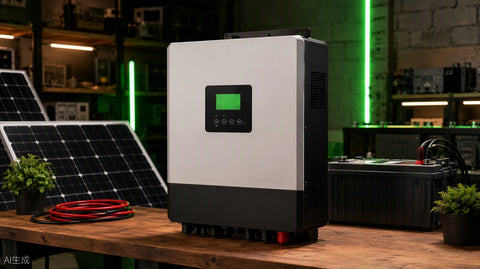
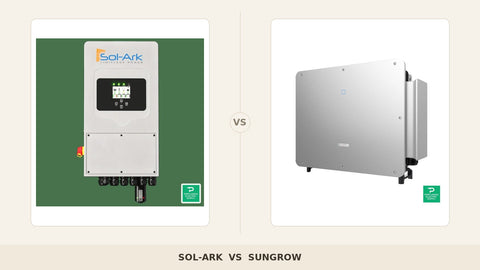
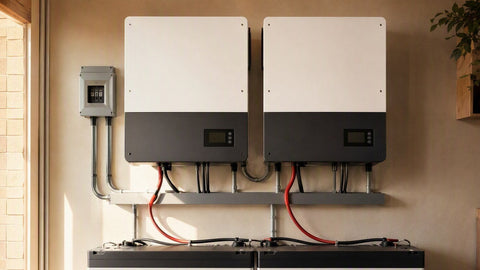
The same job in Sol-Ark form: one 15K on the wall, PV landed on its native MPPTs, batteries on the DC bus, generator on the gen input, done. If that box fails in year 6, the house goes to bypass or generator until the board or the unit is swapped. In practice Sol-Ark failure rates are low and their support ships parts fast — but the architecture concentrates risk by design, and anyone selling you otherwise hasn't read the wiring diagram.
| Line item | Victron build (~8–10 kW) | Sol-Ark 15K build (12 kW) |
|---|---|---|
| Inversion | 2 × MultiPlus-II 48/5000, ~$3,000 | 15K inverter, ~$7,500 (includes PV + charger + transfer) |
| PV charging (12 kW array) | 3 × SmartSolar 250/100, ~$2,400 | included |
| System controller | Cerbo GX + touch display, ~$600 | included |
| DC distribution / fusing | Lynx Distributor + busbars + class-T, ~$900 | External class-T + busbar, ~$300 |
| Transfer / AC distribution | External ATS or Quattro inputs + panels, ~$800 | Native 200 A pass-through, included |
| Hardware subtotal | ~$7,700 | ~$7,800 |
| Install + programming labor | Higher — figure 1.5–2× the Sol-Ark hours | Baseline |
The punchline surprises people: hardware lands within a few hundred dollars either way at this scale — the Victron premium is labor and complexity, not parts. What the component build buys for that labor is granularity (swap boxes, not systems), monitoring depth, and an upgrade path that never requires replacing the whole heart of the system. What Sol-Ark buys is speed, simplicity, 200 A native whole-home backup, and a single warranty throat. Price both against your actual labor market: where installer hours are expensive, Sol-Ark's integration is worth thousands; where the owner turns their own wrenches, Victron's labor premium evaporates. Our deep Victron catalog and the MultiPlus listings show current component pricing.
Here's the part nobody puts in the brochure: a Victron system is only as good as its configuration, and the configuration surface is enormous — charge profiles, grid codes, assistants, relay logic, DVCC, ESS modes. VEConfigure is a professional tool, and a mis-set Victron system will do exactly what you told it to do, including the wrong thing. Sol-Ark's menu tree is an order of magnitude shallower: set battery type, set grid mode, set gen parameters, walk away. Our honest routing rule: if the person who will own the system's settings has never programmed a charge profile, buy the Sol-Ark. If that person reads firmware release notes for pleasure — and we love you people — Victron will reward you forever. The DIY community around Victron, plus VRM's remote access, means a skilled owner genuinely never needs a service call for configuration; we've tuned customers' systems from our desk while they made coffee.
On the battery bus both are 48 V and both obey the same physics: 10 kW at 48 V is ~210 A — 4/0 copper, 300 A class-T fusing within 7 inches of the bank, lugs torqued to spec. On the AC side they diverge: Sol-Ark's 200 A pass-through makes it the service front door (one 4/0-class decision, one OCPD); Victron builds route through external transfer and distribution, sized to the inverter output — a 2× MultiPlus 48/5000 stack at 8 kW / 240 V is 33 A, so 8 AWG on a 40 A breaker per 310.16/240.6 math (33 × 1.25 = 41.7 A → 40 A is under; step to 50 A breaker with 8 AWG is fine at 50 A ampacity... actually 8 AWG Cu 75°C = 50 A, and 41.7 A needs ≥41.7 A conductor and a 45–50 A OCPD — clean). Whole-home Victron builds use Quattro dual AC inputs or an external 200 A ATS, which is where the design hours go. The full conductor method lives in our wire sizing guide and ampacity chart.
| Segment | Victron 2×48/5000 stack | Sol-Ark 15K |
|---|---|---|
| AC output continuous | 8 kW → 33.3 A @ 240 V | 12 kW → 50 A @ 240 V |
| × 1.25 continuous factor | 41.7 A | 62.5 A |
| Conductor (Cu, 75°C) | 8 AWG (50 A) | 4 AWG (85 A) |
| OCPD (NEC 240.6) | 50 A / 2-pole | 70 A / 2-pole |
| Battery DC @ full output | ~180 A → 2/0–4/0, 250 A class-T | ~270 A → 4/0, 300 A class-T |
| Whole-home transfer | External ATS / Quattro inputs | Native 200 A pass-through |
Victron's solar is DC-coupled through its MPPTs (silent, efficient, endlessly expandable — add a controller when you add a panel string) or AC-coupled through any grid-tie inverter with frequency-shift curtailment — the most forgiving AC-coupling ecosystem ever shipped. Sol-Ark lands PV on its native MPPTs (up to ~19.5 kW on the 15K) and also AC-couples legacy arrays. Both handle generators well; Victron's generator support via Quattro dual inputs and GX auto-start logic is the more programmable, Sol-Ark's is the more turnkey. For charge controllers in a Victron build, our controller sizing guide and the controller collection cover the MPPT math; the Victron vs Morningstar article compares controller brands head-to-head.
| Usage profile | Daily energy | Bank @ 1-day autonomy | Bank @ 2-day |
|---|---|---|---|
| Efficient cabin, 400 W avg | 9.6 kWh | ~10 kWh (2 rack batteries) | ~20 kWh (4) |
| Full-time home, gas heat, 1.2 kW avg | 28.8 kWh | ~30 kWh (6) | ~60 kWh (12) |
| Homestead + shop, 2 kW avg | 48 kWh | ~50 kWh (10) | 100 kWh — add generator instead |
Both platforms talk to the same batteries — EG4 racks, Pytes, Rolls, Trojan lead-acid — so the bank decision is architecture-independent. Run the bank sizing guide and battery calculator with your real loads, and read Sol-Ark vs EG4 if the all-in-one side of this fork is where you're leaning.
- Buy Sol-Ark for whole-home backup on a deadline, generator-integrated rural homes, grid-interactive features, and owners who want settings they'll never touch again.
- Buy Victron for true off-grid homesteads, marine/RV-class builds, three-phase or unusual power requirements, owners who will learn the platform, and anyone who wants to expand forever without a forklift upgrade.
- The tie-breaker we actually use: who answers the phone at year 8? If the answer is "my installer, and I want it simple" — Sol-Ark. If it's "me, with a laptop and a cup of coffee" — Victron.
Either way: torque the battery lugs with a calibrated wrench, label every conductor, and photograph the settings screens. The architecture decides the ceiling; the craftsmanship decides whether you ever reach it.
Sol-Ark commissioning is genuinely an afternoon: mount, land conductors, set battery comms, set grid mode, update firmware, run the transfer test, hand over the app. Victron commissioning is a project: flash and sync firmware across every GX device and MPPT, build the VEConfigure file (charge profile, grid code, assistant logic), pair the battery BMS on CAN, verify DVCC behavior, program relay logic for the generator, and test each path independently before testing them together. Budget a full day for a clean two-unit stack, and document the config file — that file is the system, and a backup of it is worth more than any spare part. The first time a firmware update resets a parameter at midnight, the paper trail pays for itself. None of this is a reason not to buy Victron; it's the admission price to the most capable platform in the industry. Just don't schedule the homeowner walkthrough for hour three.
| Scenario | Gen load during charge | Fuel (propane, est.) | Notes |
|---|---|---|---|
| Recharge 12 kWh into bank (one day's use) | ~7 kW charge load | ~3–4 gal | Both platforms; generator runs in efficient band |
| Same, unmanaged (gen carries house + charges) | Variable, often light | ~6–8 gal | The failure mode auto-start logic exists to prevent |
| Multi-day storm, 3 days autonomy gap | Cycled 2–3 h/day | ~10–12 gal total | vs ~30+ gal running continuously — the hybrid dividend |
Both platforms execute this strategy well; Victron's GX logic is more scriptable (start on SOC, on load, on schedule, on solar forecast if you wire it), Sol-Ark's is more discoverable in menus. Pairing candidates live on our generator shelf, and the inverter generator section covers the smaller units for cabin-scale builds.
Here's a design pattern we've deployed on several large homesteads: Sol-Ark as the whole-home front end (200 A pass-through, generator integration, house-simple operation for the family) with Victron MPPTs and a Cerbo GX handling DC-coupled solar and monitoring depth on the same battery bus. The platforms coexist on a 48 V bank more gracefully than forum warriors expect — charge sources coordinate through voltage and the battery BMS, and the GX gives you the data depth Sol-Ark's portal lacks. It's not the cheapest way to build, and it demands a designer who knows both ecosystems, but for customers who want Sol-Ark's simplicity and Victron's observability, the hybrid build is real. Ask us about it at the counter if your project fits; the off-grid inverter shelf shows both families side by side, and MidNite hardware often rounds out the DC distribution on these builds.
Whichever architecture you choose, finish the job with the boring layers done right: surge protection per the SPD guide, disconnects per the NEC 690 guide, and conduit fill per the fill chart. The platforms differ; the code doesn't.
If your project moves — a boat, an RV, a service trailer, an expedition rig — this comparison ends here. Victron's component line was born in the marine market and it shows: compact MultiPlus units down to 800 VA, 12/24/48 V options, DC-DC chargers, battery monitors, and a GX ecosystem that shrinks to a van without complaint. Sol-Ark's smallest hybrid is a residential wall unit that assumes a 240 V split-phase service exists. For mobile and small-scale builds, Victron isn't the better choice, it's the only one of the two on the shelf — our portable inverter and homestead/off-grid collections serve that crowd. Save the Sol-Ark conversation for when the project has a foundation.
| Ownership event (10-year horizon) | Victron component build | Sol-Ark all-in-one |
|---|---|---|
| Year-3 fan / relay board failure | ~$100–$400 part, swap the affected box | ~$150–$500 part, board-level service on the one box |
| Year-5 add 4 kW more solar | One MPPT + wire, ~$700 | Within MPPT ceiling: $0 hardware; beyond: second inverter or AC-couple |
| Year-6 monitoring/network refresh | Cerbo firmware, $0; community-supported forever | Portal-dependent; hardware refresh rare |
| Year-8 full inverter replacement | One stacked unit, ~$1,500, system runs degraded meanwhile | One box, ~$7,500 class, house on bypass meanwhile |
| Cumulative risk profile | Many small cheap failures, system never fully down | Few big failures, bypass covers the gap |
Neither column is scary — that's the point of buying either of these brands — but they are different risk shapes, and matching the shape to the owner is the whole job of this article.
Last counter note, and it applies to every brand argument in this industry: the best system is the one whose failure modes match your tolerance. Victron fails small and often-enough-to-stay-sharp; Sol-Ark fails rare and large. Owners who want to understand their infrastructure pick the first; owners who want infrastructure to be invisible pick the second. We've built both for the same customer on different properties — the shop gets Victron because the owner lives in there, the house gets Sol-Ark because the family doesn't. That's not indecision; that's matching the machine to the human. Bring us your loads and your temperament, and we'll do the same for you — the system calculator is a fine place to start the loads part.
One more practical detail for the spreadsheet crowd: resale and insurance. Documented, permitted systems from either brand appraise cleanly and satisfy insurers; undocumented owner-built systems of any brand create closing-table friction when the house sells. If the Victron path tempts you precisely because you can build it yourself, budget the permit and inspection anyway — the paper trail is part of the asset. Our installation guide covers the permitting layer, and the counter can point you at inspectors who know what a Cerbo GX is.
And the warranty-registration reminder we staple to every invoice: register the gear the week it lands, both brands. Unregistered hardware is the most common self-inflicted warranty wound we process, and it's a five-minute fix on day one that becomes a five-week email chain in year seven.
File that registration confirmation with the commissioning photos, the config-file backup, and the torque log. Fifteen years is a long time; the systems that get great service in year twelve are the ones with organized paperwork in year zero.
Frequently Asked Questions
Is Victron better than Sol-Ark for off-grid?
For true off-grid with a technically engaged owner, Victron's component architecture is the stronger platform: independent replaceable boxes, the deepest monitoring and programming surface in the industry, and expansion without system replacement. For off-grid owners who want turnkey simplicity and generator integration out of the box, Sol-Ark is the better fit. The deciding factor is who will own the system's configuration.
Can Victron do whole-home backup like Sol-Ark's 200A pass-through?
Yes, but with external hardware: Quattro units offer dual AC inputs for grid-plus-generator changeover, and external 200A transfer switches complete the whole-home path. It adds design hours and panel hardware that Sol-Ark includes natively. For dedicated whole-home backup as the primary goal, Sol-Ark's integration is genuinely simpler and cheaper installed.
Which system is easier to expand later?
Victron, by design. Add another MultiPlus for more AC output, another MPPT for more solar, another battery on the bus — each independently. Sol-Ark expands by paralleling whole inverters (up to 12) or adding batteries; PV expansion beyond the onboard MPPT ceiling means another inverter or AC-coupled array. Both expand; Victron expands in finer, cheaper increments.
What happens when something fails in each system?
In a Victron build, you replace the failed box — a $600 MPPT, a $1,500 inverter unit — while the rest of the system carries on. In a Sol-Ark build, the one big box is serviced or swapped, with the 200A bypass keeping the house powered from grid or generator meanwhile. Victron's granularity wins on repair cost; Sol-Ark's bypass wins on keeping lights on during repair.
Do both work with EG4 or Pytes batteries?
Yes — both platforms closed-loop communicate with the major 48V lithium brands including EG4 and Pytes, and both run open-loop with anything else, including lead-acid banks. The battery decision is independent of this architecture fork.
Which monitoring is better, VRM or Sol-Ark's portal?
Victron VRM with a Cerbo GX is the most open and scriptable monitoring in the industry — local APIs, Modbus, MQTT, and a decade of community integrations. Sol-Ark's portal is polished and installer-oriented with deep remote parameter access. For data nerds and automation builders, VRM wins; for set-and-forget owners, both are more than sufficient.