After fifteen years of sizing, installing, and 2 a.m. troubleshooting standby generators, I can tell you the "best whole house generator" question has exactly three right answers depending on your fuel, your panel, and your patience for maintenance — and about forty wrong ones. This guide ranks the best whole house generators of 2025–2026 the way we rank them at the counter: by watts that actually reach your panel, fuel math you can verify, transfer equipment that passes inspection, and a service network that answers when the ice storm hits. If you haven't sized anything yet, start with our whole-home generator sizing guide and come back — a perfectly chosen 22 kW on a house that needs 30 is still the wrong generator.

How the pros actually choose
Forget the box-store checklist. Five numbers decide a standby generator purchase:
- Running and starting kW at altitude and temperature. Nameplate assumes sea level and 77°F. Lose roughly 1% per 100 feet above 500 feet of elevation on naturally aspirated engines, and 10% per 25°F above 77°F intake air. A 22 kW unit in Denver is a 20 kW unit.
- Fuel on site. Natural gas is unlimited runtime but derates the engine (NG produces fewer BTUs per cubic foot than propane vapor). Propane means full rating but a tank that empties — a 22 kW at full load drinks LP fast enough to surprise you.
- Transfer switch amperage and smarts. A 200A service-rated automatic transfer switch (ATS) with load management beats a bigger generator on a dumb switch. Load shedding lets a 22 kW carry a house that calculators say needs 26.
- THD and motor-starting capacity. Total harmonic distortion under 5% keeps modern HVAC boards and variable-speed drives happy. Locked-rotor kVA is what starts your 4-ton compressor.
- Service network. The best generator with no local dealer is a lawn ornament by year six. Check who within 50 miles stocks parts for the brand before you sign.
Quick comparison: the best whole house generators of 2025–2026
| Model | Output (LP / NG) | Engine | THD | Warranty | Best for |
|---|---|---|---|---|---|
| Generac Guardian 26 kW (7290/7291) | 26 kW / 25 kW | 999cc G-Force 1000 series | <5% | 5 yr limited | Best overall air-cooled value |
| Generac Guardian 22 kW (7043) | 22 kW / 19.5 kW | 999cc G-Force | <5% | 5 yr limited | The volume king; huge dealer network |
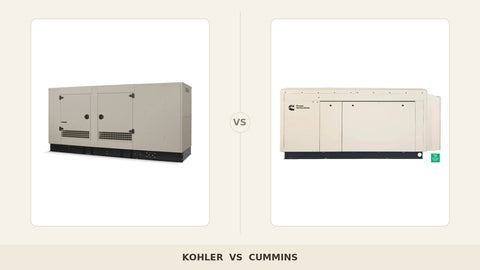
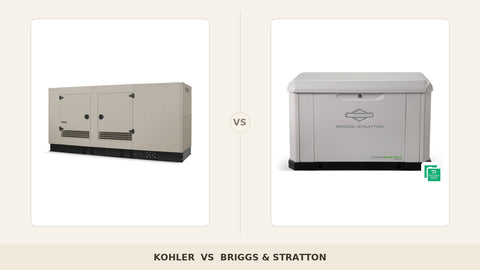
| Kohler 20RESC / 26RCA | 20 kW / 18 kW · 26 kW / 24 kW | Kohler Command Pro / KG6208 | <5% | 5 yr / 2,000 hr | Premium build, corrosion-proof enclosure |
| Cummins QuietConnect RS20A / RS25 | 20 kW / 18 kW · 25 kW / 22.5 kW | Cummins QSJ series | <5% | 5 yr / 2,000 hr | Quietest in class; cold-climate kits |
| Briggs & Stratton PowerProtect 22 kW | 22 kW / 19.8 kW | 993cc Commercial Vanguard | <5% | 6 yr limited (best in class) | Warranty-driven buyers |
| Champion 14 kW aXis | 14 kW / 12.5 kW | 754cc Milwaukee Twins | <5% | 10 yr limited | Budget installs, smaller homes |
| Generac Protector QS 27 kW (liquid-cooled) | 27 kW / 27 kW | 1.5L 4-cyl liquid-cooled | <5% | 5 yr | Big homes, low-NG-pressure areas |
Output figures are manufacturer-published standby ratings — LP vapor / natural gas. Always confirm the current spec sheet for the exact SKU, because model-year refreshes move these numbers.
The brands, from the field
Generac Guardian series — the default, and mostly for good reasons
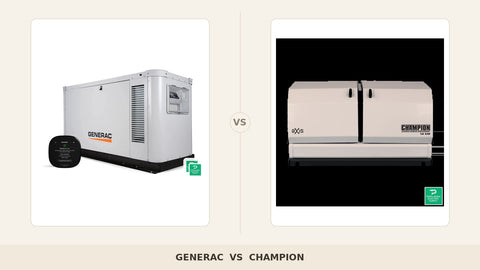
Generac owns something like 75% of the residential standby market, and it isn't marketing magic — it's parts availability and the fact that every HVAC tech in America has wrenched on one. The 26 kW Guardian is the most watts-per-dollar in air-cooled standby power right now, the G-Force engine is purpose-built for standby duty (pressure lubrication, full-flo oiling), and the Wi-Fi monitoring actually works. My knock on Generac is controller longevity on early-2010s units, but the current Evolution 2.0 platform has been solid. For deeper model math, our 22 kW breakdown and 26 kW guide walk specific installs, and the Generac brand guide covers the full contractor line.
Kohler — the premium pick
Kohler's 20RESC and 26RCA cost more and feel like it: corrosion-proof composite enclosures, commercial-grade governors, and the cleanest frequency regulation we've logged on a Fluke. The RDC2 controller's load-shed logic is the smartest in the air-cooled class. If you're within earshot of salt air, Kohler's enclosure alone justifies the premium — I've repainted enough rusted steel generator cabinets on coastal jobs to have opinions. See the Kohler brand guide for the full lineup.
Cummins QuietConnect — the quiet professional
Cummins builds the RS20A/RS25 like they build their diesel truck engines: over-cranked, over-cooled, and quiet (65 dB at 23 feet in exercise mode on the RS20A, which is conversation-level). Their cold-weather kits are the best engineered in the business — battery warmers and oil heaters that actually hold at −20°F. Dealer network is thinner than Generac's in rural areas, so check coverage first. The Cummins brand guide goes deep on the commercial side too.
Briggs & Stratton PowerProtect — the warranty play
Briggs offers a 6-year limited warranty where everyone else stops at 5, and their Symphony II load-management system is genuinely clever — it can sequence a 5-ton AC, a well pump, and an electric water heater onto a 22 kW unit without nuisance trips. Build quality is a half-step below Kohler, support network a half-step below Generac, but at the price the math often wins. Full rundown in the Briggs & Stratton brand guide.
Champion aXis — the honest budget option
Champion's 14 kW aXis with a 200A aXis transfer switch is the least expensive legitimate whole-house install we quote, and their 10-year warranty is unheard of at this price. You're giving up output headroom and some enclosure refinement, not safety or code compliance. For a 1,600 sq ft ranch with gas heat, it's often all the generator the house needs. Details in the Champion brand guide.
Sizing: the load math that picks the kW
NEC 220 Article IV gives the legal method; here's the working version we run at the kitchen table. Add your large motor and HVAC loads at full nameplate, general lighting/receptacle load at 3 VA per square foot, and two small-appliance circuits at 1,500 VA each, then apply demand factors:
| House profile | Typical calculated demand (NEC 220) | Recommended standby size | Notes |
|---|---|---|---|
| 1,200–1,600 sq ft, gas heat + gas water heater, 3-ton AC | 9–12 kW | 14–18 kW | Champion 14 kW or Generac 18 kW covers it |
| 1,800–2,500 sq ft, gas heat, 4-ton AC, some electric cooking | 13–17 kW | 20–22 kW | The sweet spot; most installs land here |
| 2,500–3,500 sq ft, electric water heater, 4–5-ton AC, well pump | 18–24 kW | 24–26 kW + load management | Generac 26 kW or Kohler 26RCA |
| 3,500+ sq ft, all-electric, dual HVAC, EV charger, pool | 26–38 kW | 27–38 kW liquid-cooled | Step up to Protector QS or commercial unit |
Our 12 vs 16 vs 20 vs 24 kW comparison runs four real houses through this math, and the 13 kW guide covers the small-home case.
Fuel consumption: the numbers your gas bill will see
Published manufacturer figures for the volume models, natural gas and propane vapor at half and full load:
| Model class | NG half-load | NG full-load | LP half-load | LP full-load |
|---|---|---|---|---|
| 14 kW air-cooled | ~135 ft³/hr | ~200 ft³/hr | ~1.4 gal/hr | ~2.3 gal/hr |
| 20–22 kW air-cooled | ~180–205 ft³/hr | ~280–310 ft³/hr | ~2.0–2.2 gal/hr | ~3.3–3.7 gal/hr |
| 26 kW air-cooled | ~210 ft³/hr | ~350 ft³/hr | ~2.4 gal/hr | ~4.0 gal/hr |
| 27–38 kW liquid-cooled | ~250–330 ft³/hr | ~430–600 ft³/hr | ~2.8–3.6 gal/hr | ~4.8–6.5 gal/hr |
Run the propane math before you buy the tank: a 22 kW at full load for a 3-day outage burns roughly 240 gallons of LP. That's a 500-gallon tank at 80% fill, gone. A 22 kW at realistic average load (most houses idle along at 30–50%) burns about 2.2 gal/hr — call it 160 gallons for the same outage. I tell every LP customer: 500-gallon tank minimum, 1,000 if you're on a well pump and electric heat strips. On natural gas, check your meter's BTU capacity with the utility — a 22 kW at full load wants roughly 300+ ft³/hr on top of your furnace and water heater, and undersized meters are the number-one NG install failure I get called to fix.
Wire, breaker, and transfer switch sizing
The generator's output feeder lands on NEC 310.16 ampacities, protected per NEC 240.6(A) standard ratings, and NEC 445/702 govern the install. The laminated shop table (copper THHN, 75°C):
| Generator output | Full-load amps @ 240V | Feeder conductor (Cu, 75°C) | 310.16 ampacity | OCPD (240.6(A)) | ATS rating |
|---|---|---|---|---|---|
| 14 kW | 58 A | 4 AWG | 85 A | 70 A | 100 A |
| 18 kW | 75 A | 3 AWG | 100 A | 80–90 A | 100–200 A |
| 22 kW | 92 A | 2 AWG | 115 A | 100 A | 200 A service-rated |
| 26 kW | 108 A | 1 AWG | 130 A | 125 A | 200 A service-rated |
| 27–38 kW | 113–158 A | 2/0–3/0 AWG | 175–200 A | 150–175 A | 200–400 A |
A service-rated 200A ATS installs between meter and main panel and carries the whole house — that's the "whole house" in whole house generator. Pair it with load-shed modules for the big 240V loads and a 22 kW behaves like a 26. For the breaker-side fundamentals, how to size circuit breakers covers the 125% continuous-load rule, and our NEC wire sizing guide has the full ampacity charts. If you're on an older 100A service, read the service upgrade walkthrough before sizing anything. Converting nameplate watts to amps for your own math: amps-to-watts conversion and what a 10 kW generator actually delivers in amps.
Generator vs battery — when each wins
A standby generator wins on multi-day outages, heavy motor loads, and any house with medical equipment that can't gamble. A battery system wins on silence, instant transfer, daily solar shifting, and outages under 24 hours. The honest 2026 answer for a lot of my customers is both: battery for the 95% of outages that last four hours, generator behind it for the ice storm. We ran the full comparison in battery backup vs generator, and the PWRcell cost guide prices the battery side.
Maintenance: the part that decides if it starts in year 9
Every manufacturer says the same thing and every service log I've read proves it: oil and filter annually or every 100–200 run hours, spark plugs every 2–3 years, valve lash check around 400 hours on air-cooled twins, battery every 3–4 years whether it tests bad or not. Run the weekly exercise cycle — 12 minutes, no load, keeps the rings seated and the battery topped. The generators that fail in storms almost always have a dead $80 battery behind a healthy $6,000 engine. Our generator maintenance guide has the full service schedule.
Air-cooled vs liquid-cooled: where the line sits
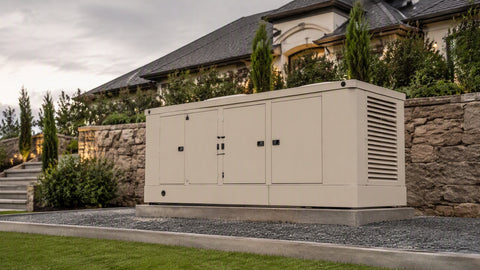
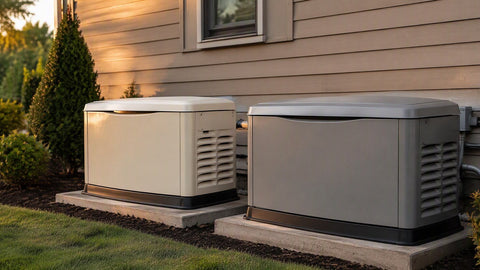
Air-cooled standby units (everything under ~27 kW) use a fan-forced engine like a big lawnmower — cheaper to buy, simpler to service, and limited by heat rejection. Liquid-cooled units run a real radiator and automotive-style engine, hold rated output in 100°F heat, and deliver 3,000+ hour service lives. The crossover: if your calculated load exceeds ~22 kW, if your NG pressure is marginal (liquid-cooled units keep full rating on lower gas pressure), or if you're in a hot climate where summer derating eats 10% of nameplate, step up to liquid-cooled. The Generac Protector QS 27 kW is the usual first rung; past 38 kW you're in commercial territory with different service intervals and different dealers.
Natural gas vs propane: the derating nobody mentions at the showroom
Every air-cooled unit makes less power on natural gas than on propane vapor — typically 8–12% — because NG carries fewer BTUs per cubic foot and the carburetion leans out. A "22 kW" generator is a 19.5 kW generator on NG. Size to the NG column if that's your fuel, not the brochure headline. Propane restores full rating and stores forever, but you're now managing a tank: 500 gallons minimum for a 22 kW class, filled to 80% (propane needs vapor space), and your supplier's storm-week delivery reliability becomes part of your resilience plan. Diesel standby exists at residential scale too — longer engine life, on-site fuel for weeks — but the units start around 30 kW and the price climbs into liquid-cooled commercial range.
Noise: the number your neighbors care about
| Unit | Exercise mode (dB @ 23 ft) | Full load (dB @ 23 ft) | Reference |
|---|---|---|---|
| Cummins RS20A | ~65 dB | ~70 dB | Normal conversation / vacuum cleaner |
| Generac Guardian 22–26 kW | ~67 dB | ~71–74 dB | Conversation / dishwasher |
| Kohler 20RESC | ~66–69 dB | ~72 dB | Dishwasher |
| Typical 7,500W open-frame portable | — | 74–78 dB | City traffic, and it runs all night |
Check local noise ordinances before siting — several municipalities cap residential mechanical equipment at 65–70 dB at the property line, and the weekly exercise cycle at 8 a.m. Sunday has started more neighbor feuds than fence lines.
What installation really costs, and where the money goes
The generator is 55–65% of a standby project. The rest: pad and placement ($400–$900), gas line or propane rough-in ($800–$2,500 depending on run length and sizing), electrical with service-rated ATS ($1,500–$3,000), permits and utility coordination ($200–$600). Quotes that come in far below range are usually skipping the gas sizing or planning a sub-panel ATS dressed up as "whole house." Get the transfer switch model number on the quote — a 100A 16-circuit sub-panel and a 200A service-rated switch are both called "ATS" by salesmen.
Mistakes I fix on other people's installs
Undersized gas lines are the champion: a 22 kW needs roughly 300 ft³/hr and the installer reused the furnace's 3/4-inch run. Second place: generators set on gravel or bare dirt that sink a corner by year two and cock the crankshaft bearings — pour the pad or buy the composite one. Third: no load-bank test at commissioning, so the first real full-load run happens during the ice storm with your family inside. Fourth: skipping the cold-weather kit north of the freeze line — a $150 battery warmer is the difference between a 10-second start and a service call at −10°F. Fifth: weekly exercise disabled because "it was loud." An unexercised generator is a parts collection.
Monitoring, apps, and the service plan question
Every major brand now ships Wi-Fi monitoring — Generac's Mobile Link, Kohler's OnCue Plus, Cummins' Cloud Connect — and they all do the three things that matter: exercise-cycle confirmation, fault alerts to your phone, and dealer-facing diagnostics. Turn the dealer alerts on. The service plan question I get weekly: yes, buy the dealer's annual maintenance plan if you're not the type to change oil on schedule, because the plan's real value isn't the oil — it's a tech who catches the weeping fuel fitting and the mouse nest before the storm does. Typical plans run $250–$450/year and pay for themselves the first time they prevent a no-start.
The bottom line from the counter
For most homes in 2026: Generac Guardian 22 or 26 kW on natural gas with a 200A service-rated ATS and two load-shed modules is the answer I quote first, because the dealer network and parts pipeline are unbeatable. Step up to Kohler if you're coastal or want the premium enclosure, to Cummins if noise and cold-start reliability top your list, to Briggs for the warranty, and to Champion when the budget is the constraint. Size from the NEC 220 calc, derate for altitude and temperature, size the gas line for full load, and replace the battery every 3–4 years whether it needs it or not. Do those things and the brand debate mostly takes care of itself.
One more sizing note that bites rural buyers: electric vehicle charging. A Level 2 EV charger pulls 7.7–11.5 kW continuous — a load class all its own. If whole-house backup must include the EV, you're in 26 kW-plus territory with aggressive load management, or you accept that the car charges on grid power only. Most of my customers choose the latter and keep a full charge ahead of forecasted storms. Write the decision down at design time; it changes the generator class, the gas line, and the quote.
Permitting note for the folder: standby installs need electrical and usually mechanical/gas permits, plus utility coordination for the service disconnect. The inspection catches reversed neutrals and undersized gas lines while they are still cheap to fix, and the signed permit card belongs in the same folder as the load calc, the commissioning sheet, and the warranty. That folder has won my customers insurance claims and home-sale negotiations alike.
Frequently asked questions
What size whole house generator do I need?
Most 1,800–2,500 sq ft homes with gas heat land at 20–22 kW; homes under 1,600 sq ft can run 14–18 kW; large all-electric homes need 26–38 kW, often liquid-cooled. Size from an NEC 220 load calculation, not square footage alone, and use ATS load management to cover HVAC starting surges without oversizing.
Is Generac, Kohler, or Cummins better for whole house backup?
Generac wins on value and dealer coverage (about 75% market share), Kohler on build quality and corrosion resistance, and Cummins on quiet operation and cold-weather engineering. All three produce under 5% THD with 5-year warranties. The best choice is usually the brand with the strongest dealer within 50 miles of your house.
How much propane does a 22 kW generator use?
Published figures put a 22 kW air-cooled unit at roughly 2.0–2.2 gal/hr of propane at half load and 3.3–3.7 gal/hr at full load. A three-day outage at realistic average load consumes around 150–170 gallons, so a 500-gallon LP tank (400 usable) is the practical minimum, and 1,000 gallons is right for homes with well pumps or electric heat.
What is a service-rated transfer switch and do I need one?
A service-rated ATS installs between the utility meter and your main panel, contains its own service disconnect, and carries your entire electrical service — typically 200A. It is what makes a generator "whole house." The alternative, a sub-panel ATS, only powers selected circuits and is the right call only when budget or generator size forces it.
How long does a whole house generator last?
Air-cooled standby units typically deliver 1,500–3,000 run hours, which at typical outage duty (20–60 hours a year) plus weekly exercise cycles means 15–25 years of service life with annual maintenance. Liquid-cooled units run 3,000+ hours. The components that actually die early are batteries (3–4 years), controllers on neglected units, and enclosures in coastal air.
Can I install a whole house generator myself?
The concrete pad and placement, sometimes. The electrical and gas work, no — a service-rated ATS involves utility coordination, NEC 702 compliance, permit inspection, and a gas line sized for the full BTU load. DIY electrical mistakes on standby systems backfeed utility lines and kill linemen. Budget $2,500–$5,000 for professional installation on top of equipment.