Choosing The Right 13kW Generator for Your Needs
A field-tested guide to sizing, wiring, and selecting a 13kW standby generator for residential and light commercial backup power.

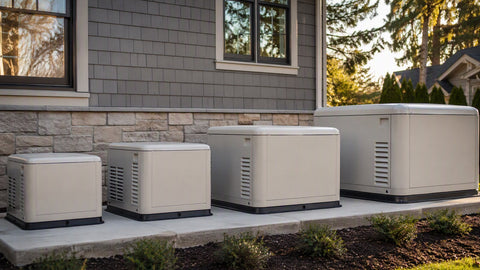
Thirteen kilowatts sits at the sweet spot for American homes. Not so small that you sacrifice the heat pump. Not so large that you burn propane like a bonfire. I've walked dozens of these installs — from suburban ranch homes outside Portland to lake cabins in Maine — and the 13kW class is what most homeowners actually need once they run the numbers honestly.
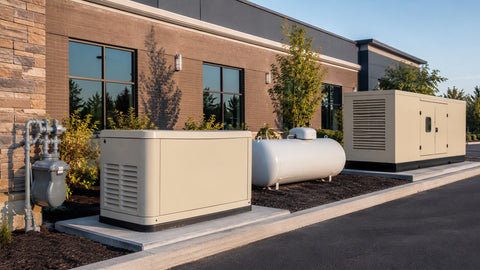
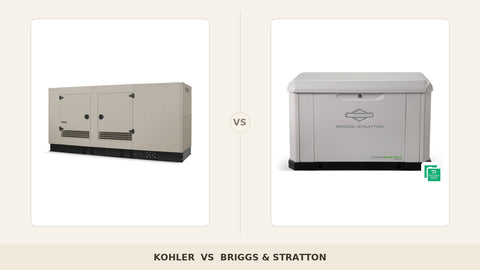
This guide covers load calculation, fuel consumption math, transfer switch sizing, and the NEC requirements that matter. We also break down two models we stock and ship daily: the Briggs & Stratton 040746 PowerProtect 13kW and the Cummins RS13A Quiet Connect. Both are listed to UL 2200. Both run on natural gas or propane. The difference is in the enclosure, the controller, and the warranty terms.
If you are still debating generator size, run your load calc first. Everything else follows from that number.
Load Calculation: What a 13kW Generator Actually Runs


The math is straightforward. A 13kW generator produces 13,000 watts of continuous power at its rated fuel. At 240V single-phase, that is 54.2 amps (13,000 ÷ 240 = 54.2A). Starting watts — what the generator can deliver for a few seconds to spin up motor loads — typically run 20–35% higher. The Briggs & Stratton 040746 is rated for 22.5 kVA surge, which covers most residential motor-starting events.
But here is what separates a professional install from a guess: you must calculate running watts and starting watts separately. A 3-ton heat pump might draw 3,500W running but pull 7,200W on compressor start. If your generator cannot cover that inrush, the breaker trips or the compressor stalls. I've seen both. Neither is cheap to fix.
| Appliance | Running Watts | Starting Watts | Notes |
|---|---|---|---|
| Central AC (3 ton) | 3,200–3,800 | 6,500–7,500 | LRA × 240V = start surge |
| Heat pump (3 ton) | 3,000–3,500 | 6,000–7,200 | Defrost cycle adds ~500W |
| Electric water heater | 3,000–4,500 | 3,000–4,500 | No surge; resistive load |
| Well pump (1/2 HP) | 900–1,200 | 2,000–3,000 | Submersible types vary |
| Sump pump (1/3 HP) | 600–800 | 1,300–1,800 | Critical for flood-prone areas |
| Refrigerator (20 cu. ft.) | 150–250 | 600–1,200 | Compressor start surge |
| Freezer (chest) | 100–200 | 400–800 | Lower if garage-kept |
| Gas furnace (blower) | 600–1,000 | 1,200–1,800 | ECM motors = lower surge |
| Electric range (one element) | 1,200–2,500 | 1,200–2,500 | Resistive; no surge |
| Microwave (1.2 kW) | 1,200 | 1,200 | Pure resistive load |
| LED lighting (whole house) | 200–500 | 200–500 | Negligible surge |
| TV + entertainment | 200–400 | 200–400 | Modern sets are efficient |
| Security system | 50–150 | 50–150 | UPS-backed usually |
Here is a realistic 13kW load scenario for a 2,200 sq. ft. home with gas heat:
- Gas furnace blower: 800W running, 1,500W start
- Refrigerator: 200W running, 1,000W start
- Freezer: 150W running, 700W start
- Well pump: 1,000W running, 2,500W start
- LED lighting: 300W
- TV + router + devices: 400W
- Microwave (intermittent): 1,200W
Running total: 4,050W. Starting total (worst-case simultaneous): 7,900W. A 13kW generator handles this with headroom to spare. That headroom matters. You do not want to run a generator at 90% load for days on end. The engine works harder, fuel consumption spikes, and service intervals compress.
We sell generators from 7kW to 150kW. The 13kW class is popular because it covers most single-family homes without oversizing. Oversizing wastes fuel. Undersizing triggers overload alarms and shortens engine life.
| Generator Size | Typical Coverage | Fuel/hr (NG, 50% load) | Best For |
|---|---|---|---|
| 7–10 kW | Essential circuits only | 0.8–1.2 therms | Small homes, cabins, seniors |
| 13 kW | Whole-house (gas heat) | 1.4–1.7 therms | 2,000–3,000 sq. ft. homes |
| 18–20 kW | Whole-house + AC | 1.9–2.4 therms | Large homes, all-electric |
| 22–26 kW | Whole-house + two ACs | 2.5–3.2 therms | 3,500+ sq. ft., pool pumps |
| 38–48 kW | Estate / small commercial | 4.0–5.5 therms | Multi-unit, farm, workshop |
The 13kW size is the tipping point. Below it, you are managing loads manually or with a priority controller. Above it, you are writing bigger checks for fuel and installation. I've had customers call back six months after a 20kW install complaining about the propane bill. They should have sized to 13kW and added a load-shed module for the second AC.
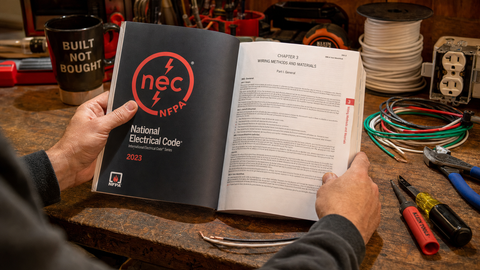
NEC 702.4: Optional Standby Systems
Generators installed as optional standby systems must have adequate capacity for all loads to be operated simultaneously. If you use an automatic load management system, NEC 702.4(B) permits sizing the generator for managed load instead of total connected load. This is how a 13kW unit can legally back up a home with two ACs — the second AC is shed until the first cycles off.
Fuel math determines your tank size or gas meter capacity. Natural gas is measured in cubic feet per hour (ft³/hr) or therms. Propane is measured in gallons per hour (gal/hr) or pounds per hour. A therm is roughly 100 cubic feet of natural gas.
The Briggs & Stratton 040746 consumes 1.7 gallons of propane per hour at half load. At full load, that climbs to 2.9 gal/hr. On natural gas, it pulls about 190 ft³/hr at half load and 289 ft³/hr at full load. Those numbers come straight from the spec sheet, and they track with what I've measured in the field using a diaphragm gas meter.
| Load Level | Propane (gal/hr) | Propane (lb/hr) | Natural Gas (ft³/hr) | Run Time (250-gal tank) |
|---|---|---|---|---|
| 25% (3.25 kW) | 1.1 | 4.6 | 130 | 227 hrs |
| 50% (6.5 kW) | 1.7 | 7.1 | 190 | 147 hrs |
| 75% (9.75 kW) | 2.3 | 9.6 | 245 | 109 hrs |
| 100% (13 kW) | 2.9 | 12.1 | 289 | 86 hrs |
A 250-gallon propane tank at 50% load gives you roughly six days of continuous runtime. In practice, generators do not run 24/7 during outages. They cycle. A typical winter ice storm in the Northeast sees 8–12 hours of actual runtime per day, stretching that tank to two weeks. I've seen homeowners go 18 days on a 250-gallon fill during a March nor'easter.
Natural gas is simpler — no tank, no refill truck, no level monitoring. But you need adequate gas pressure. Most 13kW units require 5–7 inches water column (WC) at the generator inlet. If your home already feeds a high-BTU furnace and tankless water heater, have the gas company verify meter and regulator capacity. A common mistake is assuming the 1-inch service line can handle another 289 ft³/hr. Sometimes it cannot.
Transfer Switch Sizing and Wiring

The transfer switch is what separates a standby generator from a portable hookup. For a 13kW generator, you need a 100-amp automatic transfer switch (ATS) minimum. The switch must match the generator's voltage (240V single-phase) and be listed to UL 1008. We stock ATS units from Eaton, Generac, and Cummins in our electrical components collection.
Wire sizing from generator to ATS follows NEC Article 310. For a 13kW unit at 240V, the full-load current is 54.2A. NEC 310.16 gives 6 AWG THHN a 75°C ampacity of 65A. That covers the load with headroom. But if the run from generator pad to ATS exceeds 75 feet, upsize to 4 AWG to keep voltage drop under 3%. I have seen installs where the electrician pulled 6 AWG across a 120-foot backyard and wondered why the compressor struggled to start.
| Run Length | Min Wire (Copper) | Upsized Wire | Conduit Size (EMT) |
|---|---|---|---|
| 0–50 ft | 6 AWG THHN | 6 AWG THHN | 3/4 in |
| 51–75 ft | 6 AWG THHN | 4 AWG THHN | 1 in |
| 76–100 ft | 4 AWG THHN | 4 AWG THHN | 1 in |
| 101–150 ft | 4 AWG THHN | 2 AWG THHN | 1-1/4 in |
Grounding is non-negotiable. NEC 250.35 requires a grounding electrode conductor (GEC) sized per Table 250.66. For a 100A service, that is 8 AWG copper minimum. Bond the generator frame, the ATS enclosure, and the grounding electrode system together. Do not ground the neutral at the generator if the ATS switches the neutral — that creates a parallel path and trips GFCI devices.
This is the sequence we use on our contractor jobs. Always pull a permit. Always get inspected. The homeowner's insurance depends on it.
Step 1: Site Selection and Pad Prep
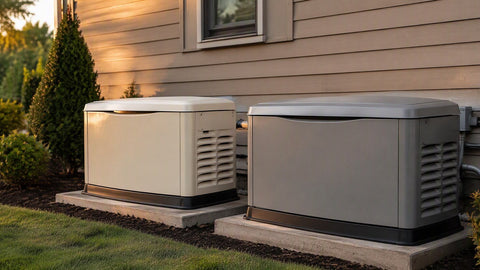
Place the generator at least 18 inches from any structure (5 feet from openings per some local amendments) on a pre-cast concrete pad or poured slab. We use 4-inch reinforced concrete with rebar mesh. Slope the pad away from the generator for drainage. In flood zones, raise the pad 6 inches above grade.
Step 2: Fuel Connection
For propane, run CSST or black iron from the tank regulator to the generator fuel inlet. Install a shutoff valve within 3 feet of the generator. For natural gas, verify meter capacity with the utility. Size the gas line per the generator manufacturer's chart using the longest run method. The Briggs & Stratton manual includes a table: at 50 feet, 1-inch pipe delivers 295 ft³/hr, which covers full-load demand.
Step 3: Electrical Rough-In
Pull THHN/THWN-2 in EMT or PVC from the ATS to the generator. Install the ATS between the meter and the main panel (service entrance rated) or as a subfeed (load center rated). We prefer service-entrance rated switches for clean installs. Label every conductor at both ends.
Step 4: Load Management Setup
If the home has electric heat or a second AC, install a load management module. The Generac PWRmanager or Briggs & Stratton Symphony II system sheds non-critical loads when the generator approaches capacity. Program priority: sump pump (1), furnace (2), refrigerator (3), water heater (4), AC (5), optional circuits (6+).
Step 5: Start-Up and Test
Run the generator under load for 30 minutes. Check voltage at the ATS output (should be 240V ±5%). Check frequency (should be 60 Hz ±0.5%). Record amp draw on each phase. Test the automatic transfer by killing utility power at the meter. Time the transfer — should be under 10 seconds. Test load shedding by applying all managed loads simultaneously.
Both units are air-cooled, single-cylinder overhead valve engines with electronic governors. Both run on LP or NG. The differences are in the details that matter after year three.
| Specification | Briggs & Stratton 040746 | Cummins RS13A (A071Z390) |
|---|---|---|
| Rated Power (NG) | 13 kW | 13 kW |
| Rated Power (LP) | 13 kW | 13 kW |
| Surge Capacity | 22.5 kVA | 21.5 kVA |
| Engine | Vanguard 627cc OHV | Cummins 2.4L inline-4 |
| Sound Level | 69 dB at 23 ft | 65 dB at 23 ft |
| Enclosure | Galvanized steel, Dura-Zen coat | Aluminum, powder coat |
| Clearance to Structure | 18 in (side), 36 in (front) | 18 in (side), 36 in (front) |
| Controller | InfoHub Wi-Fi / cellular | Cummins QuietConnect digital |
| Warranty | 6-year parts & labor | 5-year limited |
| Weight (dry) | 315 lb | 338 lb |
| Price | $4,245 | $4,890 |
The Cummins is quieter and uses a four-cylinder engine that runs smoother at partial load. The Briggs & Stratton costs less and carries a longer warranty. I've installed both in neighborhoods where noise ordinances exist — the Cummins at 65 dB passes muster in communities with 70 dB limits. The Briggs at 69 dB is still quiet enough for most lots, but if the generator pad sits under a bedroom window, every decibel matters.
Both controllers offer remote monitoring. The InfoHub sends oil-pressure, battery-voltage, and exercise-schedule alerts to a smartphone app. The Cummins controller does the same through their CloudConnect service. In practice, both work well until year five, when the cellular modem may need replacement.
A standby generator is only as reliable as its maintenance. The engine sits idle for weeks, then runs for days under full load. Oil degrades. Batteries sulfate. Spark plugs foul. Here is the schedule we follow on PowerLink Network service contracts:
- Every 6 months: Exercise run (auto-start, 20-minute cycle), check oil level, inspect battery terminals for corrosion, clear debris from enclosure vents.
- Every 12 months: Change oil and filter (SAE 5W-30 synthetic), replace spark plugs, inspect air filter, test battery under load, check coolant level (liquid-cooled units only).
- Every 24 months: Replace battery (proactive), inspect fuel lines for cracks, clean slip rings (if equipped), torque all electrical connections to spec, verify ATS contact wear.
- Every 5 years: Major service — valve adjustment, compression test, fuel regulator inspection, enclosure repaint if corrosion is present.
Propane generators run cleaner than natural gas. Less carbon buildup. Longer oil life. But propane regulators can freeze in extreme cold if the tank level drops below 20%. I keep customer tanks at 30% minimum during winter storm season. That one habit has prevented more no-starts than any other maintenance item.
Frequently Asked Questions
Will a 13kW generator run my whole house?
It depends on your heat source and AC count. Gas heat plus one central AC? Usually yes. All-electric with two heat pumps? You'll need load management or a larger unit. Run the load calc before you buy.
How much propane does a 13kW generator use per hour?
At 50% load, about 1.7 gallons per hour. At full load, 2.9 gallons per hour. A 250-gallon tank (80% fill = 200 usable gallons) runs roughly 117 hours at 50% average load — about five days of continuous use. Most outages are shorter.
What size transfer switch do I need for a 13kW generator?
100-amp ATS minimum. If your home has a 200-amp main panel, a 200-amp ATS with integrated load management gives you the most flexibility. We stock both configurations in our electrical components collection.
How far can a 13kW generator be from the house?
As close as 18 inches per manufacturer specs. Local fire codes often require 5 feet from openings. The limiting factor is usually the electrical run — upsize wire for distances over 75 feet.
What wire size do I need for a 13kW generator?
6 AWG THHN for runs under 75 feet. 4 AWG for 76–150 feet. Always pull in conduit — NM-B is not rated for outdoor generator runs.
How loud is a 13kW standby generator?
65–69 dB at 23 feet. That's quieter than a lawnmower, louder than a refrigerator. If noise is a concern, specify the Cummins RS13A at 65 dB or add a acoustical barrier.
Do I need a permit to install a standby generator?
Yes. Electrical permit is universal. Building permit for the pad is common. Fuel permit may be required for propane tank placement. Always check with your local AHJ before breaking ground.
Can I install a 13kW generator myself?
You can pour the pad and trench the conduit. The electrical and fuel connections require licensed professionals in most jurisdictions. More importantly, professional installation is required to maintain the manufacturer's warranty.
- A Complete Guide to 18kW Generators
- AC Unit Electrical Requirements — 2026 Contractor Guide
- Furnace Electrical Requirements — 2026 Contractor Guide
- Solar System Calculator
- Battery Sizing Calculator
- Inverter Sizing Calculator
- NEC Code Compliance Guide
- Grounding & Bonding Guide
- Solar Incentives by State
- Pro Account — Wholesale Pricing
- PowerLink Network — Contractor Program
- Generac Brand Guide for Contractors
- Cummins Brand Guide for Standby Generators
- Generac PWRcell Cost Guide
- Shop All Generators
Need a 13kW Generator for Your Next Project?
Briggs & Stratton and Cummins 13kW standby generators in stock with contractor pricing available. We ship nationwide and offer bulk quotes for multi-unit jobs.
Get a Quote