Most service upgrades we quote start the same way: a homeowner adds a Level 2 EV charger or a heat pump, the lights dim when the compressor kicks, and suddenly the 100-amp panel that "worked fine for thirty years" is the bottleneck for the whole property. An electrical service upgrade replaces the meter base, service entrance conductors, main disconnect, and panel — the entire delivery path from the utility drop to your branch circuits. This guide walks through the warning signs, the NEC math that decides between 150A, 200A, and 400A, what the job actually costs in 2026, and how the process runs from permit to final inspection.
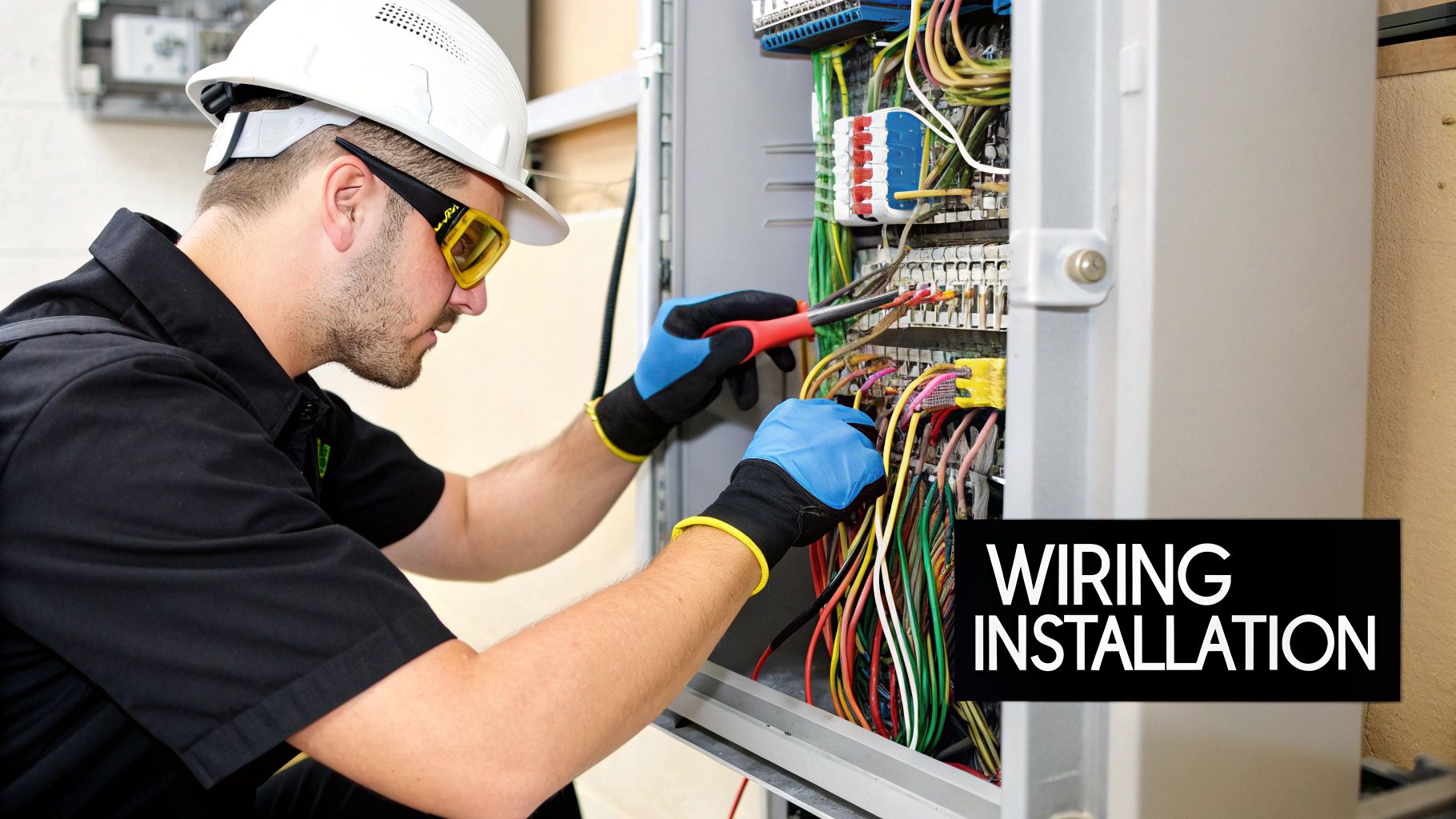
We've pulled thousands of feet of 4/0 through EMT on these jobs, and the pattern is consistent: the panel swap is the easy day. The hard part is load calculation, utility coordination, and scheduling the disconnect window. Plan for those and the rest is workmanship.
The Warning Signs You Can't Ignore
A service that is undersized or worn out announces itself long before it fails. Watch for these:
- Breakers that trip under normal combined loads — range plus dryer plus AC on a summer evening. That is not a bad breaker; it is a service running at its ceiling.
- Lights that dip when large motors start. A momentary sag when a 4-ton compressor starts is normal. A deep sag that lasts a second or more points at undersized service conductors or a failing neutral.
- A fuse panel, or a breaker panel with no main disconnect. Split-bus panels and fuse boxes are uninsurable in some markets and cannot accept modern backfeed breakers for solar.
- Warm panel cover or a hot smell at the meter base. Heat means resistance, and resistance at 100+ amps is a fire in slow motion. We megger and torque-check every lug on service calls for exactly this reason.
- Double-lugged neutrals and shared grounds in a panel that has been "added onto" for decades. Every add-on circuit was a vote that the service is too small.
- Aluminum branch wiring or a Zinsco/FPE panel. These are replacement conversations, not repair conversations.
Common Triggers for an Electrical Service Upgrade
The table below is the same one we use in the shop when a customer calls with a project in mind. Match your project to the typical new service size, then confirm with a real load calculation before anyone orders a panel.
| Project or Symptom | Why It Requires an Upgrade (NEC Compliance) | Typical New Service Needed |
|---|---|---|
| Installing a Level 2 EV Charger | Adds a continuous high-amperage load that older 100A panels can't support per NEC load calculations (NEC 220.57 treats EVSE as continuous; NEC 625 covers the circuit itself). | 200A minimum |
| Adding a Hot Tub or Pool | Heaters and pumps require dedicated high-power circuits and specific GFCI protection under NEC 680. | 200A or higher |
| Major Kitchen Remodel | New electric ovens, cooktops, and microwaves demand more power and dedicated circuits than the original wiring can provide (NEC 220.55 demand factors apply). | 200A |
| Going All-Electric (Heat Pump, etc.) | Eliminating natural gas means your electrical system must handle the entire home's energy load, requiring a new NEC 220.83 load calculation. | 200A to 400A |
| Frequently Tripping Breakers | The existing service is already at its maximum capacity and cannot handle daily loads safely. | 150A or 200A |
| Installing Solar + Battery | The panel must manage bi-directional energy flow and accommodate the inverter backfeed breaker per NEC 705.12 — the 120% rule often forces a bus upgrade or a line-side tap. | Varies, often 200A |
| Adding an ADU or Guesthouse | A second dwelling load can be served from the house panel only if the service calculation supports it; most ADUs push a 100A service past its limit. | 200A to 400A |
If you are already pricing the solar side, our guide to NEC 625 EV charging and solar integration covers how the two loads stack on one service, and the transfer switch explainer covers the standby-power side of the same panel decision.
100A vs 150A vs 200A vs 400A: Choosing the New Service Size
| Service Amperage | Best For | Can Support | Considerations for Installers & Developers |
|---|---|---|---|
| 100-Amp | Small, older homes (under 1,500 sq. ft.) with mostly gas appliances. | A standard mix of appliances, but not all at once. Pushes its limits with an electric dryer, range, and AC. | Compliance watchout: insufficient for new builds in many jurisdictions. Fails load calcs for EV/solar additions. |
| 150-Amp | Mid-sized homes (1,500–2,500 sq. ft.) with a mix of gas and electric. | Central AC, electric dryer, and range comfortably. Might handle a Level 2 EV charger with careful load management. | Hidden cost: a marginal upgrade that often forces another costly upgrade in 5–7 years. Poor ROI. |
| 200-Amp | Most modern homes over 2,000 sq. ft. and anyone planning for electrification. | All-electric homes: heat pump, electric water heater, EV charger, and standard appliances simultaneously. | The expected minimum for new construction. Essential for marketing "EV-ready" or "solar-ready" homes. |
| 400-Amp | Very large homes (over 4,000 sq. ft.) with high-demand features. | Multiple HVAC units, pool and hot tub, two EV chargers, guesthouse, or a workshop with heavy equipment. | Requires detailed load calculation and early utility coordination; usually delivered as two 200A panels with a 400A meter base. |
Our honest advice after years of these jobs: skip 150A. The material difference between a 150A and a 200A panel is often under $150, the labor is identical, and the 200A panel is the last one you will ever buy for that house. Every electrician I know has the same scar — a customer who paid for 150A in 2019 and paid again for 200A in 2024 when the heat pump and the EV arrived.
The NEC Load Calculation: How the Size Is Actually Decided
Nobody gets to pick a service size by vibes. NEC Article 220 governs, and for an existing dwelling the optional method in 220.83 is the fast path. Here is a worked example for a real 2,400 sq. ft. all-electric home we upgraded last spring:
| Load Item (NEC 220.83 Optional Method) | Calculation | VA |
|---|---|---|
| General lighting & receptacles: 2,400 sq. ft. × 3 VA | 2,400 × 3 | 7,200 |
| Small-appliance circuits (2 × 1,500 VA) | 2 × 1,500 | 3,000 |
| Laundry circuit | 1 × 1,500 | 1,500 |
| Subtotal — first 10 kVA at 100% | 10,000 × 100% | 10,000 |
| Remainder at 40% | (11,700 − 10,000) × 0.40 | 680 |
| Heat pump (4-ton, 240V, 3.5 kW heat strip staged) | nameplate | 5,800 |
| Electric water heater | nameplate | 4,500 |
| Range (12 kW, NEC 220.55 demand) | Table 220.55 | 8,000 |
| Dryer | nameplate, min 5,000 | 5,000 |
| EV charger (40A continuous × 240V) | 40 × 240 | 9,600 |
| Total demand load | 44,580 VA ÷ 240V | ≈ 186A |
That house needs 200A. A 150A service fails at 186A of calculated demand; a 200A service passes with a small margin. This is why we run the calculation before we quote — the number, not the panel price, decides.
Conductor and Breaker Sizing for the New Service
Once the amperage is set, NEC 310.16 (75°C column for terminations) and 240.6 standard breaker sizes take over. The most common residential combinations:
| Service Size | Service Entrance Conductor (Cu, 75°C) | Ampacity per NEC 310.16 | Alternative (Al, 75°C) | Typical Conduit |
|---|---|---|---|---|
| 100A | 4 AWG copper | 95A (round up per 240.4(B) for dwelling services per 310.12) | 2 AWG aluminum | 1¼" EMT/PVC |
| 150A | 1 AWG copper | 130A (dwelling adjustment via 310.12) | 2/0 AWG aluminum | 1½"–2" EMT/PVC |
| 200A | 3/0 AWG copper | 200A per 310.12 dwelling table | 4/0 AWG aluminum | 2"–2½" EMT/PVC |
| 400A | 400 kcmil copper (or parallel 3/0) | 335A base; 400A via 310.12 for dwellings | 600 kcmil aluminum | 3" conduit, often two runs to twin 200A panels |
Note that NEC 310.12 lets dwelling-unit services use conductors sized at 83% of the service rating — that is why 4/0 aluminum legally serves a 200A residential panel even though its straight 310.16 ampacity is 180A. Inspectors know this table; handymen often do not. If you are pulling the feeders yourself, check the conduit fill chart before you buy pipe — three 4/0 XHHW conductors plus a ground will not legally fit in 1½" EMT, and we see that mistake on failed inspections every month. Our PVC vs EMT vs RMC comparison covers which raceway survives your jurisdiction's burial and exposure rules, and the conduit installation guide covers bending and pulling technique.
Breaker selection follows NEC 240.6(A) standard ratings — 15, 20, 25, 30, 35, 40, 45, 50, 60, 70, 80, 90, 100, 110, 125, 150, 175, 200, 225A and up. Pair conductor ampacity to the next standard size up only where 240.4(B) allows, and never on motor or continuous loads without applying the 125% continuous multiplier from 210.19/210.20 first. Our breaker sizing walkthrough and the bus bar explainer go deeper on the panel internals.
Grounding, Bonding, and the Parts Inspectors Actually Flag
A service upgrade is also a grounding electrode system rebuild. NEC 250.50 requires all available electrodes — metal water pipe, ground rods, concrete-encased electrode — to be bonded into one system. In practice that means two 8-foot ground rods spaced at least 6 feet apart (250.53), a #4 copper GEC for a 200A service (Table 250.66), an intersystem bonding termination for the low-voltage trades (250.94), and a bonded neutral at the first disconnect — and only at the first disconnect. Neutrals and grounds stay separated in every subpanel downstream (250.24, 408.40). We also torque every lug to the manufacturer spec printed on the panel label — typically 250 in-lbs on 4/0 lugs — and write the values on the permit card. Inspectors notice that, and it takes ninety seconds.
What a Service Upgrade Costs in 2026
| Scope | Typical Price Range (Installed) | What Drives the Cost |
|---|---|---|
| 100A → 200A, overhead service, same location | $2,500 – $4,500 | Panel, meter base, mast, SE cable, grounding; utility disconnect/reconnect usually no-charge but scheduled |
| 100A → 200A, underground service | $3,500 – $6,500 | Adds trenching, conduit, utility pull, sometimes a new transformer pad fee |
| 200A → 400A | $5,500 – $9,500 | 400A meter base, twin 200A panels, heavier conductors, utility engineering review |
| Panel relocation or long reroute | +$800 – $2,500 | Junction boxes for extended branch circuits, drywall, stucco patch |
| Whole-home surge protection (add-on) | +$250 – $450 | Type 1/2 SPD at the new panel — cheap insurance while the panel is open |
| Solar-ready / backfeed provisions (add-on) | +$150 – $600 | 225A bus with 200A main, or line-side tap provisions per NEC 705.12 |
Prices swing with region, utility fees, and stucco versus siding. Anyone quoting a 200A upgrade under $2,000 in 2026 is either skipping the permit or planning to leave your old grounding in place — ask which before you sign.
The Upgrade Process from Start to Finish
Planning and Permitting
Every legitimate upgrade starts with the load calculation above, a site visit, and a permit from the AHJ. Your contractor also files a work order with the utility for the disconnect — lead time runs from three days to six weeks depending on the utility. This is the schedule risk on every job, and it is out of the electrician's hands. Order the panel and meter base the week the permit issues; 200A meter-main combos still run 2–4 weeks out at some distributors.
The Disconnect and Physical Installation
On job day the utility drops the service, and the crew has a 6–10 hour window. Old panel out, new meter base and panel in, service entrance conductors pulled and terminated, grounding electrode system installed, branch circuits landed and labeled. I still label every circuit with a printed strip, not a Sharpie — the next electrician in that panel might be me, and I like me.
Reconnection and Final Inspection
The inspector checks conductor sizes, torque marks, grounding, working clearances (NEC 110.26 — 30" wide, 36" deep, 6'6" headroom), and labeling. After the green tag, the utility reconnects, usually the same or next business day. Total homeowner downtime is typically one day without power, two if inspection scheduling slips.
Planning for What Comes Next
A new 200A panel is a 30-year asset, so spend ten minutes planning the next three projects before the crew leaves:
- EV charging: have the electrician stub out a 60A circuit path to the garage now. The wire is cheap while walls are open. See our generator amperage guide if you are weighing standby power instead.
- Solar backfeed: ask for a 225A-bus panel with a 200A main. NEC 705.12 then allows up to ~70A of solar backfeed without derating the main — that covers a 12–14 kW residential array. Our transfer switch wiring guide covers the generator interlock side.
- Battery storage: systems like Generac PWRcell or SolarEdge storage land a critical-loads subpanel next to the main — leave 24" of wall space beside the new panel.
- Future circuits: a 40-space panel costs about $60 more than a 30-space. Buy the 40. Every full panel we see started as "we'll never use all these spaces."
Simple power math helps when planning additions: our amps-to-watts conversion guide turns nameplate amps into real load numbers you can stack against the calculation above.
Panel Swap vs Heavy-Up vs Full Service Upgrade: Know What You're Buying
Three jobs get confused on quotes, and the price difference between them is thousands of dollars:
| Scope of Work | What Gets Replaced | Typical Cost | When It's the Right Call |
|---|---|---|---|
| Panel swap (same amperage) | Breaker panel only | $1,500 – $3,000 | Panel is failed/recalled (Zinsco, FPE) but service size is adequate |
| Heavy-up (service upgrade, same location) | Panel, meter base, service entrance conductors, grounding | $2,500 – $6,500 | The standard 100A → 200A job |
| Full service relocation | All of the above plus new panel location and branch-circuit extensions | $4,000 – $9,000 | Panel in a bathroom/closet (NEC 240.24(D) violation) or blocking a remodel |
| 400A service | 400A meter base, twin 200A panels, utility engineering | $5,500 – $9,500 | Large all-electric homes, dual EVs, ADU plus main house |
A red flag on any quote: "panel upgrade" with no mention of the meter base or service entrance conductors. If the wire from the weatherhead to the panel stays 100A-rated, you bought a panel swap at heavy-up prices. I've been called behind exactly that job more than once — new panel, old 2 AWG feeders, and a homeowner who paid for 200A and got 100A with nicer breakers.
Working Clearances and Placement Rules (NEC 110.26)
Inspectors measure clearances with a tape, and panels fail over inches. The residential rules that matter:
| Requirement | NEC Reference | Dimension / Rule |
|---|---|---|
| Working space depth | 110.26(A)(1) | 36" clear in front of the panel (0–150V to ground, Condition 2) |
| Working space width | 110.26(A)(2) | 30" wide or the width of the equipment, whichever is greater |
| Headroom | 110.26(A)(3) | 6'6" minimum, except existing dwellings with ≤200A panels |
| Prohibited locations | 240.24(D) | No overcurrent devices in clothes closets or bathrooms |
| Over stairs | 240.24(F) | Not over stairway steps |
| Height to highest breaker | 240.24(A) | 6'7" maximum to the center of the grip |
That last table is why "just put it in the closet" ends up as a relocation line item. Plan the wall before the crew arrives, not during.
Grounding Electrode Conductor Sizing (NEC 250.66)
| Service Entrance Conductor (Cu) | Service Entrance Conductor (Al) | GEC to Water Pipe / Ufer (Cu) | GEC to Ground Rod (Cu) |
|---|---|---|---|
| 2 AWG – 2/0 | 1/0 – 4/0 | 4 AWG | 6 AWG max required by 250.66(A) |
| 3/0 – 350 kcmil | 250 – 600 kcmil | 2 AWG | 6 AWG max required by 250.66(A) |
| 400 – 600 kcmil | 600 – 1000 kcmil | 1/0 | 6 AWG max required by 250.66(A) |
Two ground rods spaced 6 feet apart, a #4 copper bonding jumper to the water service within 5 feet of entry (250.68), and the intersystem bonding termination for cable and phone (250.94) close out the grounding scope. In dry Rocky Mountain and Southwest soils we drive a third rod when the single-rod 25-ohm test (250.53) is borderline — it costs $15 in material and kills the argument.
Surge Protection: Cheap Now, Expensive Later
NEC 2020's 230.67 made surge protection mandatory on new and replaced dwelling services — a Type 1 or Type 2 SPD at the service equipment. Even where your AHJ is still on an older code cycle, add one. The panel is open, the two-pole breaker space is right there, and a $250 SPD protects every board in the house: the furnace control, the refrigerator inverter, the EVSE. I've replaced enough lightning-fried control boards to treat this as non-negotiable, and most inspectors in 2026 expect to see it anyway.
The Five Most Common Inspection Failures We See
| Failure | Why It Gets Flagged | Fix Before the Inspector Arrives |
|---|---|---|
| Neutral/ground bonded in a subpanel | Violates 250.24(A)(5) / 408.40 separation rules | Pull the bonding screw; add a ground bar kit |
| Undersized or missing GEC | Table 250.66 mismatch, or no second rod | Verify conductor against the table above; drive rod #2 |
| Working clearance blocked | 110.26 — water heater or shelving inside the 30"×36" box | Relocate the obstruction, not the panel |
| Double-tapped neutrals | 408.41 — one neutral per terminal | Pigtail with listed connectors |
| Missing or wrong labeling | 110.22 / 408.4 — circuit directory required | Printed directory, not marker on painter's tape |
What a 200A Upgrade Parts List Actually Looks Like
For contractors pricing the job and homeowners checking a quote, the material core of a standard overhead 200A heavy-up:
| Component | Typical Spec | Material Cost Range |
|---|---|---|
| Meter-main combo or meter base + main panel | 200A, 40-space, 22kAIC, outdoor rated | $450 – $900 |
| Service entrance conductors | 4/0-4/0-4/0-2/0 Al SER or 4/0 Cu THHN in conduit | $150 – $400 |
| Service mast / riser hardware | 2"–2½" RMC or EMT, weatherhead, guy attachments | $80 – $200 |
| Grounding kit | 2 × 8' rods, clamps, #4 Cu GEC, intersystem bonding bridge | $60 – $120 |
| Whole-home SPD | Type 1/2, 50kA per mode class | $80 – $250 |
| Branch breaker fill | Mix of 15–50A plus AFCI/GFCI where 210.8/210.12 require | $150 – $450 |
| Misc: connectors, sealant, labels, lugs | Listed connectors, duct seal, printed directory | $50 – $100 |
Material lands at roughly $1,000–$2,400 depending on panel choice and breaker mix; the rest of the quote is labor, permit, and utility coordination. A quote under $2,000 all-in for a true service upgrade means something on this table is missing.
Timeline Deep Dive: Where the Weeks Actually Go
| Phase | Duration | Who Controls It |
|---|---|---|
| Site visit + load calculation | 1–3 days | Contractor |
| Permit issuance | 2 days – 3 weeks | AHJ |
| Utility disconnect/reconnect work order | 3 days – 6 weeks | Utility — the long pole on most jobs |
| Equipment lead time (meter-main, panel) | 0 – 4 weeks | Supply chain; order at permit issuance |
| Installation day | 6 – 10 hours | Crew |
| Inspection + utility reconnect | 1 – 3 business days | Inspector, then utility |
We tell every customer the same thing: your job is one day of noise, but the calendar belongs to the utility and the inspector. A contractor who promises a firm date without a utility work order number in hand is guessing.
Special Cases: ADUs, Workshops, and Solar-Ready Services
ADUs: a detached accessory dwelling can be fed from the house panel as a feeder (four-wire, grounds and neutrals separated, grounding electrode at the ADU per 250.32) or as its own service. On a 100A house service, an ADU almost always forces the 200A or 400A conversation. On a fresh 200A upgrade, have the crew stub a 60–100A feeder path while the trench or conduit run is open — the incremental cost is trivial compared to retrofitting.
Workshops and welders: a 50–60A workshop subpanel rides fine on a 200A service with the load calc to prove it. On 100A, a 50A welder circuit is usually the load that breaks the calculation.
Solar-ready provisioning: specify a 225A-bus panel with a 200A main breaker. Under NEC 705.12(B) the 120% rule then permits up to 70A of PV backfeed — enough for a 14 kW array — without a supply-side tap. This single spec choice, about $100 in hardware, is the difference between a solar-ready service and a solar-blocked one. Pair it with battery planning: a Sol-Ark or EG4-based storage system wants wall space beside the panel and a critical-loads subpanel feed.
Financing, Incentives, and Insurance Angles
A panel upgrade itself is not a federal credit item — but when it is required to enable a solar or battery installation, the incremental panel cost can be rolled into the project basis in many tax situations; have your tax professional make that call, not your electrician. What we can say from the field: some insurers now surcharge or decline homes with known-problem panels (FPE, Zinsco), and several carriers offer small premium credits for documented modern services with whole-home surge protection. Ask your agent — the paperwork takes an hour and the discount repeats every year.
How to Vet the Contractor
- License and insurance verified with the state board — not a photocopy, a live lookup. Electrical work is licensed for reasons that show up in fire statistics.
- The load calc in the proposal. If the quote says "200A upgrade" with no NEC 220.83 worksheet attached, the size was picked by habit.
- Utility coordination named. Who files the disconnect order, and what is the current utility lead time? A real contractor answers this in one sentence.
- Permit in the contractor's name. A homeowner-pulled permit on a contractor job shifts liability to you.
- References from the last year, called, with one question: "Did they pass inspection the first time?"
Copper vs Aluminum Service Conductors
Both are code-legal for service entrances; the trade is cost versus bulk and termination discipline:
| Factor | Copper (3/0 for 200A) | Aluminum (4/0 for 200A) |
|---|---|---|
| Material cost (typical 20-ft run) | Higher — often 2–3× the aluminum option | The default choice on most residential upgrades |
| Conduit size | Slightly smaller for equal ampacity | One size up is common |
| Termination discipline | Forgiving; torque to spec | Requires oxide inhibitor and exact torque; re-check is good practice |
| Long-term record | Excellent | Excellent when installed with inhibitor and torqued — the horror stories are termination failures, not the metal |
We've seen aluminum feeders run clean for forty years and copper lugs overtorqued into cracked insulation in six months. The metal is rarely the problem; the workmanship is. Whichever you choose, the torque value on the panel label is the law of the job.
Meter-Main Combos vs Separate Meter Base and Panel
A meter-main combination unit puts the meter socket and main breaker panel in one outdoor enclosure — faster install, one enclosure, and the disconnect is outside where firefighters and the NEC's 230.85 emergency-disconnect rule for dwellings want it. A separate meter base plus indoor main panel keeps the breaker count indoors, which homeowners prefer for resetting at midnight in January. In 2026, most utilities and inspectors push the combo or an outdoor disconnect; NEC 230.85 requires an outdoor emergency disconnect on new dwelling services regardless. Ask which configuration your utility's service standards require before ordering equipment — utility specs override preference.
Day-Before Checklist for Homeowners
- Clear 4 feet around the existing panel, meter, and the path between them.
- Empty the refrigerator strategically — power will be off 6–10 hours.
- Charge phones and laptops; set aside flashlights.
- Board pets; the doors will be open and the crew will be carrying long material.
- Confirm the utility disconnect appointment time with your contractor in writing.
- Know where every circuit you care about lands — label questions are fastest before the old panel comes out.
EV Charger Circuit Sizing (NEC 625)
The EV charger is the trigger on most modern upgrades, so here is the branch-circuit table we quote from — EVSE is a continuous load, so the circuit runs at 125% of the charger rating:
| EVSE Output | Circuit Breaker (NEC 240.6) | Wire (Cu, 75°C) | Charge Speed (approx.) |
|---|---|---|---|
| 16A | 20A | 12 AWG | ~12–14 miles of range per hour |
| 24A | 30A | 10 AWG | ~18–21 mi/hr |
| 32A | 40A | 8 AWG | ~24–28 mi/hr |
| 40A | 50A | 6 AWG | ~30–35 mi/hr |
| 48A | 60A | 4 AWG | ~36–44 mi/hr |
| 80A | 100A | 2 AWG | ~60+ mi/hr — commercial territory on most homes |
For most households a 40A charger on a 50A circuit is the sweet spot — it fills any EV overnight from empty and lands comfortably inside a 200A service calculation. The 48A tier makes sense for dual-EV households and long commutes. Anything above that belongs on a commercial-grade discussion, not a residential panel.
What Happens to the Old Panel
Removal and disposal are part of the job, and worth a sentence in the quote. Old panels with value (clean Square D QO, for instance) sometimes get kept as spares by the homeowner; recalled gear (FPE, Zinsco) should leave the property, period — I've seen "spare" FPE breakers reappear in garages years later, and they are not safer the second time. Ask for the disposal or recycling note on the invoice; it closes the loop with your insurance company.
Subpanels and Future Expansion After the Upgrade
A fresh 200A main panel is the hub; the spokes come later. We advise roughing in capacity for the three additions homeowners actually make: a garage or workshop subpanel (60–100A feeder), a critical-loads subpanel if storage is on the horizon, and conduit paths to the roof for solar homeruns while walls are open. A 2" empty conduit from panel to attic costs under $50 in material during the upgrade and several hundred as a retrofit. Every panel we install leaves with at least one spare conduit and a printed directory with the planned expansions written in — the next project starts faster when the panel remembers it was coming.
The Bottom Line on Timing
If your panel is full, your insurance is asking questions, or a project is waiting on capacity, the upgrade math rarely improves with waiting. Material costs drift up, utility queues lengthen in storm seasons, and the loads you are planning are not getting smaller. Run the load calculation, size for the house you will own in ten years — almost always 200A — and schedule around the utility, not around hope.
One last field note: keep every document from this job — permit, inspection card, load calc, panel schedule, and photos of the finished service. The next electrician, the insurance adjuster, and the buyer's inspector at resale will each want that folder someday, and the homeowner who can hand it over skips an hour of questions every time.
Ready when you are: measure twice, permit once, and build the service for the decade ahead.
And if the project starts with a simple question — "is my panel big enough for what I'm planning?" — that question deserves the twenty-minute load calculation, not a guess over the phone. We run those calculations with homeowners and contractors every week at no charge, because the right answer sized once beats the wrong answer installed twice.
Frequently Asked Questions
What is the difference between a panel upgrade and a service upgrade?
A panel upgrade (swap) replaces only the breaker panel. A service upgrade replaces the entire delivery path: meter base, service entrance conductors, main disconnect, and panel. If the conductors from the utility to your panel stay 100A-rated, you did not get a 200A service — you got a new panel on an old service.
Can I stay in the house during the upgrade?
Yes. You will be without power for 6 to 10 hours on installation day. Keep the refrigerator closed, charge devices beforehand, and plan around well pumps or medical equipment — tell the crew upfront about anything that cannot lose power so they can stage temporary power if needed.
How long does a 200A service upgrade take?
The physical work is one long day — 6 to 10 hours without power. The full timeline runs 2 to 6 weeks, dominated by utility disconnect scheduling and inspection slots, not labor.
Do I need a permit for a service upgrade?
Yes, everywhere in the U.S. A service change involves the meter base and utility conductors, and utilities will not reconnect an unpermitted service. An unpermitted upgrade can also void homeowner's insurance after a fire claim.
Can I upgrade to 200A without upgrading the service drop?
Sometimes, for overhead services where the utility drop is already adequately sized — the utility decides that, not the electrician. Underground services almost always need utility involvement because their lateral and transformer must support the new load.
Is 200 amps enough for an all-electric home with an EV?
For most homes under about 3,000 sq. ft., yes — the worked NEC 220.83 calculation above lands at 186A with a heat pump, range, dryer, water heater, and 40A EVSE. Very large homes or dual-EV households with electric heat should price 400A.
Will upgrading my panel increase home value?
Appraisers and inspectors treat a modern 200A panel as baseline for a renovated home, and "EV-ready/solar-ready" listings increasingly call it out. The bigger value is avoided friction: no failed inspection and no rushed $4,000 panel job in the middle of a sale.
Can I add solar to my old 100A panel instead of upgrading?
Only up to about 20A of backfeed under the NEC 705.12 120% rule on a typical 100A/100A-bus panel — roughly a 4 kW array. Anything larger forces a main breaker derate, a line-side tap, or the service upgrade. Most 100A homes adding solar end up upgrading; combining the projects saves a second mobilization.
Ready to spec the job? Portlandia Electric Supply stocks 200A meter-mains, panels, breakers, and grounding hardware, and our team reviews load calculations with contractors every week — request a quote or browse the brands we carry.