⚡ Interactive Amps to Watts Calculator
→ Full calculator with conversion tables
Explore the Electrical Hub → breaker, conduit, and wiring guides plus free calculators in one place.
Last Updated: March 2026 • Verified for NEC 2026 Compliance
Ask a journeyman what math he runs most and it’s this one. Amps to watts, every day — at the panel schedule, on the roof, in the quote. We’ve sized everything from 15A garage circuits to 480V three-phase services, and this conversion is where every one of those jobs started. Below: the three formulas, the charts we actually use in the field, and the mistakes that’ll cost you an inspection.
Quick Answer
The core formula is Watts = Volts × Amps for DC circuits and resistive AC loads. For AC circuits with inductive loads (motors, HVAC), use Watts = Volts × Amps × Power Factor. For three-phase industrial systems, add the 1.732 multiplier: Watts = Volts × Amps × PF × 1.732. Those three lines cover every circuit you’ll ever spec.
Key Takeaways
- DC, single-phase AC, and three-phase AC each get their own formula — grab the wrong one and every number downstream is wrong.
- Ignore PF on motors, HVAC, or pumps and your wattage comes out low — undersized wire and a code violation baked right in.
- Run a single-phase formula on a three-phase system and your answer lands 42% under true power. That’s an undersized service, full stop.
- 1 amp has no fixed wattage — it’s 120W at 120V, but only 12W at 12V DC. Voltage sets the value.
- Motor inrush (6–10× full-load amps) doesn’t go in the watts calc, but it drives breaker and starter sizing — miss it and you’ll chase nuisance trips forever.
- Every wire gauge, breaker, inverter, and generator spec starts with this calc. Bad watts math cascades into failed inspections and unpaid rework.
In This Guide
🔋 DC Circuit: Watts = Volts × Amps
🏠 Single-Phase AC: Watts = Volts × Amps × Power Factor
🏭 Three-Phase AC: Watts = Volts × Amps × Power Factor × 1.732
* Power Factor (PF) = 1.0 for resistive loads (heaters, incandescent lights). Check nameplate for motors, HVAC, and VFDs.
This conversion shows up on every job we touch. Sizing a branch circuit, speccing a backup generator, ordering wire by the reel — they all start with watts. Get it right and the job passes inspection and stays on budget. Get it wrong and you’re buying material twice.
The relationship itself is simple: Watts (W) = Amps (A) × Volts (V). Amps are the volume of current moving through the conductor. Volts are the pressure pushing it. Multiply them and you get watts — the rate energy is actually being consumed or produced. Three places it matters right away:
- You can’t match a solar inverter (Sungrow, Fronius) to an array without the true total wattage. Same story for generator sizing, battery banks, and load centers.
- An undersized circuit is a fire hazard and a straight NEC violation. Compliance starts with the load calc — every conductor size and breaker rating hangs off it.
- Mis-spec’d components are how jobs lose money: reorders, rework, inspector callbacks.
Pro Tip for Installers & Developers: A ten-second math check at design time beats a failed inspection later. Verify power factor and phase configuration before you spec or order anything. We’ve watched a $40 calculator check save a $9,000 switchgear reorder.
Here’s the field reference for how amps, volts, and watts relate across the usual US circuit setups. Watch how fast the wattage moves when voltage or current changes — that’s why “close enough” isn’t.
| Amps (A) | Volts (V) | Calculated Watts (W) | Typical Circuit |
|---|---|---|---|
| 5 A | 12 V | 60 W | DC automotive / marine / solar panel sub-circuit |
| 10 A | 12 V | 120 W | DC battery bank load (lighting, fans) |
| 15 A | 120 V | 1,800 W | Standard residential branch circuit |
| 20 A | 120 V | 2,400 W | Kitchen / bathroom / garage dedicated circuit |
| 30 A | 240 V | 7,200 W | Water heater, clothes dryer, EV charger |
| 50 A | 240 V | 12,000 W | Level 2 EV charger, large electric range |


This is the master chart — it answers “how many watts is one amp?” at every voltage from a 12V battery bank to a 240V dryer circuit. Find your amperage in the left column and read straight across. All values assume a power factor of 1.0 (purely resistive loads). For AC motors and compressors, multiply by the nameplate PF — usually 0.8–0.95 — to get real watts.
| Amps | 12V DC | 24V DC | 48V DC | 120V AC | 240V AC |
|---|---|---|---|---|---|
| 1 A | 12 W | 24 W | 48 W | 120 W | 240 W |
| 2 A | 24 W | 48 W | 96 W | 240 W | 480 W |
| 3 A | 36 W | 72 W | 144 W | 360 W | 720 W |
| 5 A | 60 W | 120 W | 240 W | 600 W | 1,200 W |
| 10 A | 120 W | 240 W | 480 W | 1,200 W | 2,400 W |
| 15 A | 180 W | 360 W | 720 W | 1,800 W | 3,600 W |
| 20 A | 240 W | 480 W | 960 W | 2,400 W | 4,800 W |
| 25 A | 300 W | 600 W | 1,200 W | 3,000 W | 6,000 W |
| 30 A | 360 W | 720 W | 1,440 W | 3,600 W | 7,200 W |
| 40 A | 480 W | 960 W | 1,920 W | 4,800 W | 9,600 W |
| 50 A | 600 W | 1,200 W | 2,400 W | 6,000 W | 12,000 W |
| 60 A | 720 W | 1,440 W | 2,880 W | 7,200 W | 14,400 W |
| 75 A | 900 W | 1,800 W | 3,600 W | 9,000 W | 18,000 W |
| 100 A | 1,200 W | 2,400 W | 4,800 W | 12,000 W | 24,000 W |
Notice the doubling pattern: the same 20 amps that delivers just 240 watts from a 12V battery delivers 2,400 watts from a 120V wall circuit and 4,800 watts from a 240V circuit. That’s exactly why off-grid solar moved to 24V and 48V battery banks — same power at a fraction of the current, which means smaller wire, cooler lugs, and less voltage drop.

Worked Example: What Can a 100Ah 12V Battery Actually Power?
Take the most common battery in our battery storage lineup: a 12V 100Ah LiFePO4. Total energy is 12.8V × 100Ah ≈ 1,280 watt-hours. Now run the formula backwards. A steady 10-amp draw is 10A × 12V = 120 watts — a laptop, LED lights, and a fan for roughly 10 hours. Push it to 50A (600W — a small microwave through the inverter) and the same battery is dead in about 2 hours. Run a 1,200W space heater at 100A continuous and you’re empty in under an hour. The formula never changes: watts = amps × volts, at every voltage, every time.
⚡ Field Rule of Thumb
Memorize one number per voltage and you can do most conversions in your head: at 12V, 1 amp ≈ 12 watts; at 24V ≈ 24W; at 48V ≈ 48W; at 120V ≈ 120W; at 240V ≈ 240W. For motor loads, knock 15–20% off the chart number to cover power factor — and always size wire and breakers off the amps column, never off watts.
DC is the clean one. Solar arrays, battery systems like FranklinWH, off-grid builds, most automotive and marine work — no power factor muddying the math, so field calcs stay fast and reliable.
Power (W) = Volts (V) × Amps (I)
Real-World DC Power Examples
Example 1: Solar Panel Output
A panel spec sheet lists output as 5 amps at a nominal voltage of 40 volts.
40V × 5A = 200 Watts
That’s the number the array design and inverter match hang on. Undersize the inverter against total array wattage and you clip production — and hand the manufacturer a warranty-out.
Example 2: Sizing a DC Load
A 12V DC circulation pump on an off-grid solar thermal setup draws 8 amps while running.
12V × 8A = 96 Watts
That’s the daily draw the battery bank has to carry — the starting input for sizing storage to hit your runtime requirement.
Critical Note for System Designers: This formula is step one for battery banks and charge controllers. Total up every DC load in watts before you size a single component — skip it and the system underperforms the day it goes in.
AC — everything in a house or commercial building — needs one more variable: the Power Factor (PF). Any inductive load (motors, pumps, HVAC compressors, VFDs) pulls current that doesn’t all do useful work. Leave PF out and your wattage comes out low, your equipment comes out undersized, and the inspector comes out with a red tag.
Watts = Volts × Amps × Power Factor
For single-phase AC circuits with inductive loads (motors, HVAC, pumps, VFDs)
What Exactly Is Power Factor?
Power Factor is an efficiency score for AC power, expressed between 0 and 1.0. A PF of 1.0 means every amp does useful work — resistive loads like heaters and incandescent lamps. Inductive loads (motors, transformers, compressors) knock the current and voltage waveforms out of phase, dropping PF below 1. Utilities penalize big commercial customers for low power factor because it loads the grid without delivering work. The PF is always on the nameplate or datasheet — use that number, not a guess.
Applying Power Factor: Rooftop HVAC Unit
Commercial HVAC Sizing Example
A rooftop HVAC unit nameplate shows: 240V, 15A, PF = 0.85
❌ Without Power Factor (incorrect): 240V × 15A = 3,600W (apparent power only)
✅ With Power Factor (correct): 240V × 15A × 0.85 = 3,060W (true power)
That 540-watt gap is real. Spec wire or a breaker off the uncorrected number and you’ve got a compliance problem and a safety problem in the same box.
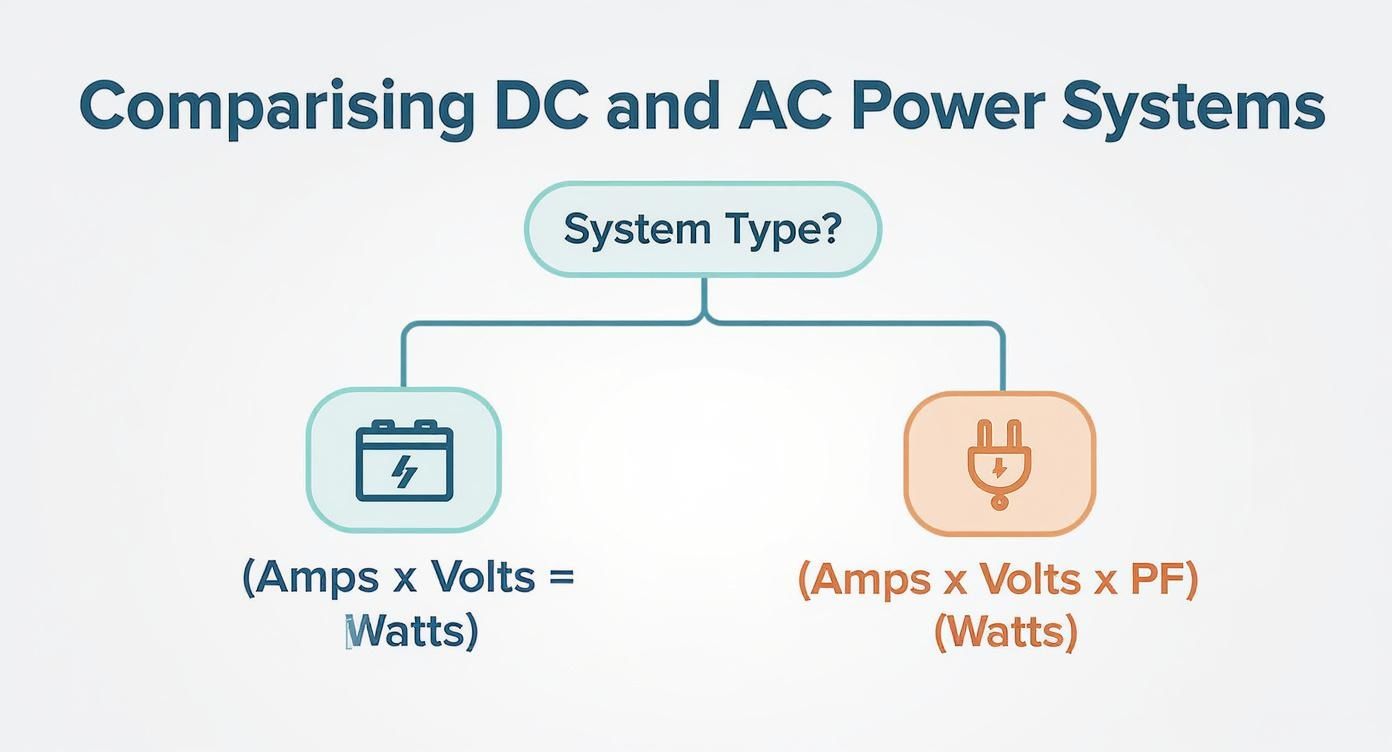

Industrial work — heavy machinery, large motors, manufacturing lines, complex distribution — runs on three-phase, and single-phase math there isn’t just wrong, it’s 42% wrong. On a 480V service that’s the difference between a job that works and a service that cooks. The formula picks up one more term to account for the three power legs.
Watts = Volts × Amps × Power Factor × 1.732
1.732 = √3 (square root of 3) — the constant for three-phase power distribution. It is not optional.
High-Stakes Industrial Example: CNC Machine
Industrial CNC Machine — 480V Three-Phase
Machine nameplate: 480V, 50A full load current, PF = 0.90
❌ Single-phase formula (incorrect): 480V × 50A × 0.90 = 21,600W
✅ Three-phase formula (correct): 480V × 50A × 0.90 × 1.732 = 37,411W (37.4 kW)
That’s a 15,811-watt miss. Spec the service off the single-phase number and you’ve undersized it by nearly half — failed inspection, cooked equipment, dead production line.
Critical Compliance Warning: This one isn’t academic. Single-phase math on a three-phase system undersizes everything downstream — components, conductors, protection. The 1.732 multiplier is mandatory. Verify the phase configuration before you calculate anything.
All three formulas side by side. Confirm which circuit type you’re standing in front of before you finalize a design or cut a material order.
| Circuit Type | Formula | Common Applications | Example Result |
|---|---|---|---|
| DC | W = V × A | Solar arrays, battery banks, automotive, marine | 40V × 5A = 200W |
| Single-Phase AC (Resistive) |
W = V × A × 1.0 | Heaters, incandescent lights, coffee makers | 120V × 15A = 1,800W |
| Single-Phase AC (Inductive) |
W = V × A × PF | Motors, HVAC units, pumps, VFDs, compressors | 240V × 15A × 0.85 = 3,060W |
| Three-Phase AC | W = V × A × PF × 1.732 | Industrial motors, CNC machines, large HVAC, manufacturing | 480V × 50A × 0.90 × 1.732 = 37,411W |

Theory’s cheap — here’s where the math earns. Wire gauge for a new branch circuit, generator capacity for a critical facility, protecting five-figure VFDs and commercial inverters: all of it starts with this conversion. Undersized wiring is an NEC violation and a fire hazard at the same time.
Real-world numbers for common appliances — note where power factor moves the answer and where it doesn’t. Keep this one handy for load calcs on circuits, panels, and generator sizing.
| Appliance | Voltage (V) | Amps (A) | Power Factor | True Watts (W) | Load Type |
|---|---|---|---|---|---|
| Residential Microwave | 120V | 12.5A | 0.98 | 1,470 W | Resistive/mixed |
| Window AC Unit (10k BTU) | 120V | 8.5A | 0.85 | 867 W | Inductive ⚠️ |
| Commercial Coffee Maker | 120V | 15A | 1.00 | 1,800 W | Resistive (heating element) |
| Small Workshop Air Compressor | 240V | 15A | 0.78 | 2,808 W | Inductive ⚠️ |
| Three-Phase Industrial Fan | 480V | 4A | 0.88 | 2,923 W | 3-Phase Inductive ⚠️ |
⚠️ Critical Compliance Watchouts: The Most Costly Field Mistakes
- >
- This is the #1 error in AC design. Treat an inductive load (motor, compressor) like a resistive one (heater) and your wattage always comes out low — undersized wire and an NEC violation, every time. >
- A single-phase formula on a three-phase system drops the 1.732 multiplier and lands 42% under true power. The circuit gets built too small. Period. >
- Big motors pull 6–10× their full-load amps for a split second at startup. That number doesn’t belong in the continuous watts calc, but it drives breaker and motor starter selection — ignore it and you’ll be resetting breakers every time the motor kicks. >
- Panel voltage is nominal. A “240V” circuit might measure 235–245V under load. For tight calcs, meter the actual operating voltage instead of trusting the nameplate.
For Installers & EPCs: A math error in a bid eats the job’s profit. Double-check PF and phase config before you order material or send the proposal. PES Supply’s technical team offers design review — we’ll sanity-check your load calcs against NEC before you commit to a bill of materials.
How many watts are in one amp?
There isn’t one answer — watts are amps times volts, so voltage decides. On a standard 120V residential circuit, 1 amp = 120 watts. In a 12V DC vehicle system, that same amp delivers only 12 watts. Never quote a watts-per-amp figure without the voltage attached.
Why do I need to convert amps to watts at all?
Three reasons. One: summing total load so the circuit doesn’t overload. Two: sizing wires, breakers, inverters, and generators correctly. Three: finding the hogs when you’re trying to cut consumption. Amps alone tell you nothing about actual power until you know the operating voltage.
Is the car battery formula different?
No. A car battery is a DC system — plain Watts = Volts × Amps. A fully charged battery sits at about 12.6V, so a device pulling 5A consumes 12.6V × 5A = 63 watts. Same principle for every DC source, whatever the application.
What is a typical power factor for common loads?
It varies by load type: resistive loads (heaters, incandescent lighting) = PF 1.0. Fluorescent/LED lighting = 0.85–0.95. HVAC compressors = 0.80–0.90. Air compressors and industrial motors = 0.75–0.85. VFDs = 0.90–0.98. Use the nameplate or datasheet value for anything that matters.
How do I size a wire gauge from a wattage calculation?
Convert watts back to amps (Amps = Watts ÷ Volts), then apply the NEC 125% rule for continuous loads (3+ hours). Match that amperage to a conductor in NEC Table 310.16 at the 75°C column (most terminal ratings). Example: 3,060W ÷ 240V = 12.75A continuous → × 1.25 = 15.9A → 14 AWG minimum, 12 AWG if you want margin.
Can I use the same formula for solar inverter sizing?
Yes — and it’s where accuracy matters most. Total array wattage (V × A per panel × panel count) has to match the inverter’s rated capacity. Undersize the inverter and it clips production every sunny afternoon. Sungrow and Fronius both publish sizing guides that start from accurate DC array wattage.
What causes a circuit to trip even when wattage seems within limits?
Motor inrush, nine times out of ten. At startup, motors draw 6–10× their rated full-load amperage for a fraction of a second — the breaker sees the spike and trips even though running wattage is in spec. The fix is a motor-rated (HACR) breaker sized per NEC Article 430, Table 430.52, which allows breaker sizing above motor FLA to ride through the inrush.
Need Help Sizing Components for Your Project?
Commercial solar array or a single residential circuit — our in-house techs have sized both, and everything in between. Send us your load calculations and we’ll validate them before you order. It’s free, and it’s cheaper than a reorder.
Get a Technical QuoteCircuit Breaker Sizing GuideRelated Guides
- Apply wattage calculations to select the correct breaker and wire gauge >
- Convert energy consumption over time for generator and battery sizing >
- Use DC wattage calculations to size battery banks correctly >
- Select panels with the right voltage and current specs for your array design >
- Get component specifications reviewed by our technical team
About PES Supply
PES Supply is a nationwide distributor of solar panels, battery storage, inverters, EV charging equipment, HVAC systems, generators, circuit breakers, and electrical components. Our in-house design team provides technical support for installers, EPCs, and facility managers — from initial load calculations to final component specification and bulk procurement.
Location: 1507 Portland Ave, Louisville, KY, United States | Phone: 1 888-876-0007 | Website: www.portlandiaelectric.supply
Article: Amps to Watts Conversion: DC, AC Power Factor, and Three-Phase Formulas for Electrical Professionals
Category: Electrical Calculations | NEC Compliance | Circuit Design | Installer Resources
Last Updated: March 2026 • Verified for NEC 2026 Compliance
Disclaimer: All formulas and examples are for educational reference. Always verify calculations with a licensed electrician or engineer and confirm compliance with the current NEC edition and local AHJ requirements before finalizing any electrical design or installation.
Related Resources:
- Best Solar Panels 2026 — Buyer's Guide
- EG4 vs Tesla Powerwall
- Qcells vs Trina vs JA
- Solar Inverter Buyer's Guide
- Solar Battery Buyer's Guide
- 5kW Solar Kit
- 10kW Solar + Battery Kit
- Off-Grid Cabin Kit
- EG4 Batteries
- Qcells Solar Panels
- Trina Solar
- JA Solar
- REC Solar
- Mission Solar
- Sol-Ark Inverters
- SolarEdge Inverters
- Generac PWRcell
Calculate how much storage you need with our battery sizing calculator.
Check solar incentives available in your state.
Use our free solar system calculator to size your array.
Check out our Solar Panel Comparison Tool. Check out our Inverter Sizing Calculator.
Calculate your solar payback and 25-year savings with our Solar ROI Calculator. Follow our complete DIY solar installation guide for step-by-step instructions. Keep your system running at peak performance with our Solar Maintenance Guide.
- NEC 240.6(A) — Standard Ampere Ratings for Fuses and Circuit Breakers (nfpa.org)
- UL 489 — Molded-Case Circuit Breakers (ul.com)
- UL 943 — Ground-Fault Circuit-Interrupters (ul.com)
Related Resources
- Quote My System — free project pricing from PES
- Solar System Calculator
- Battery Sizing Calculator
- Solar Panel Comparison Tool
- Inverter Sizing Calculator
- Solar ROI Calculator
- Solar Installation Guide
- Solar Maintenance Guide
- Solar Permitting Guide
- Battery Installation Guide
- NEC Code Compliance Guide
- Solar Panel Mounting Guide
- Grounding & Bonding Guide
- Solar Incentives by State
- Pro Account — Wholesale Pricing
- PowerLink Network — Contractor Program


Related:
- Standby Generators — convert your amperage load into the right generator kW rating
- Whole-Home Generator Sizing Guide — worked amp-to-watt load calculations for whole-home backup
- Complete Solar Kits — size a solar system from your wattage requirements
Shop the products mentioned in this guide and get everything you need for your project.

SolarEdge Energy Hub HD-Wave 3.8kW 1-Ph Inverter - SE3800H-USMNBBX14
SolarEdge
$1,979.00
View Product
Victron SmartSolar MPPT 250/100-Tr VECan Charge Controller - SCC125110411
Victron
$1,006.77
View Product


Explore our full selection: FranklinWH ACCY-CT200V1-US Current Trans · SolarEdge Energy Hub HD-Wave 3.8kW 1-Ph · Victron SmartSolar MPPT 250/100-Tr VECan · Ecobee Smart Thermostat Premium · Square D HOMT2020250 Circuit Breaker
🔧 Need Help Choosing?
Our team can help you find the right product for your project. Get a free quote today!
Get a QuoteRelated Products:
FranklinWH ACCY-CT200V1-US Current Transforme... SolarEdge Energy Hub HD-Wave 3.8kW 1-Ph Inver... Victron SmartSolar MPPT 250/100-Tr VECan Char... Ecobee Smart Thermostat Premium