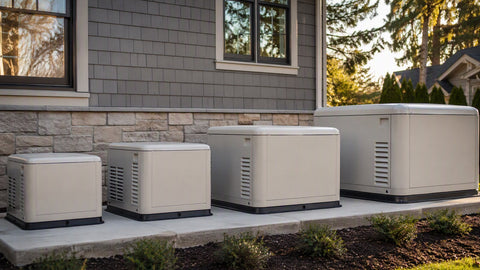
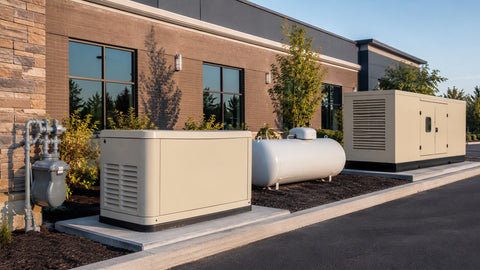
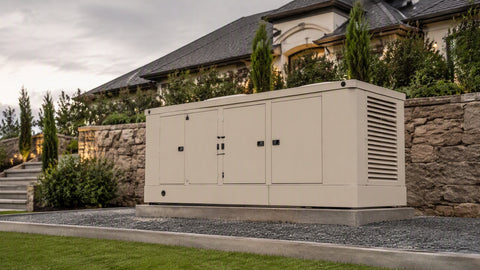
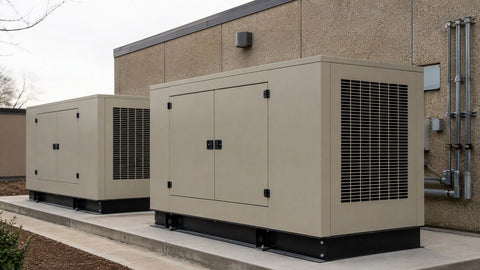
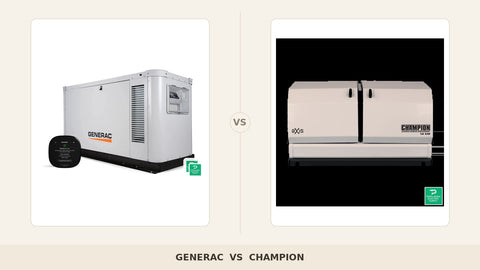
A 60kW generator is where backup power stops being a household purchase and becomes a piece of plant infrastructure. The buyers at this size are small manufacturers, grocery and cold-storage operators, medical and dental clinics, churches, multi-tenant commercial buildings, and large estates — operations where an outage has a meter running in dollars per minute. We spec, supply, and coordinate service on this class regularly, and the pattern is consistent: buyers who treat a 60kW like a big residential unit get burned on fuel logistics, permitting, and lead times; buyers who plan it like equipment get twenty-five years of quiet insurance. This guide covers the machines, the fuel math, the electrical code reality, and the ownership economics of the 60kW class in 2026.

For context at smaller capacities first, our 60kW generator overview and 26kW complete guide bracket this class from below, and the commercial generator guide covers the tier above.
What 60kW Actually Powers


Sixty kilowatts is a specific, useful plateau: the largest size that typically runs on commercial natural gas service without a dedicated high-pressure meter upgrade, and the entry point of the liquid-cooled commercial tier. In the field, 60kW covers:
Commercial Kitchen
| Facility Type | Typical 60kW Coverage | Notes from Installs |
|---|---|---|
| Small grocery / convenience store | Full store including refrigeration, lighting, POS | Refrigeration compressors define the surge budget; load management on HVAC |
| Medical / dental clinic | Full clinic incl. imaging-adjacent loads (not MRI/CT) | Life-safety circuits may require separate code-compliant transfer |
| Small manufacturing / machine shop | Critical panels, air compressor (managed), office | Motor-heavy loads; size for across-the-line starts or add soft starters |
| Church / school building | Sanctuary HVAC, kitchen, lighting | Intermittent occupancy favors propane for fuel freshness |
| Large estate (8,000–15,000 sq ft) | Whole property incl. multiple HVAC, pool, guest house | Often two 60kW in parallel is smarter than one 120kW — redundancy |
| Multi-tenant small commercial | House panel: corridors, elevators (check code), common HVAC | Elevator loads trigger specific NEC 700/701 emergency-system review |
Key Factors in Selecting a 60kW Generator for Your Business
60 kVA vs 60 kW: The 0.8 Power Factor Rule
Fuel Choice at the 48-60kW Class
The load study is non-negotiable at this size. We insist on 30 days of utility interval data or a power-logger deployment before quoting, because nameplate arithmetic at 60kW misleads: diversity factors in real buildings mean a 60kW unit often carries a facility whose connected load suggests 100kW. Oversizing here isn't caution — it's a fuel-efficiency and wet-stacking problem. Liquid-cooled engines need to work; running a 60kW at 20% load for eight hours a week carbon-fouls injectors and washes cylinders. Target 40–70% average loading on the design outage profile. And if the load study says 48kW, buy the 48–50kW class unit and pocket the difference — the best-specced generator is the one sized to the measured building, not the roundest number on the quote.
The Machines: 60kW Class, Brand by Brand

Four platforms dominate the 60kW gaseous class, and diesel options for buyers who want them. Street prices below are 2026 unit-only numbers, gathered from live quotes on recent projects; installed figures come later.
Liquid-Cooled Standby Options in the 48-60kW Class
| Platform | Engine / Cooling | Fuel Options | Noise (typ.) | Unit Price (2026) | Field Notes |
|---|---|---|---|---|---|
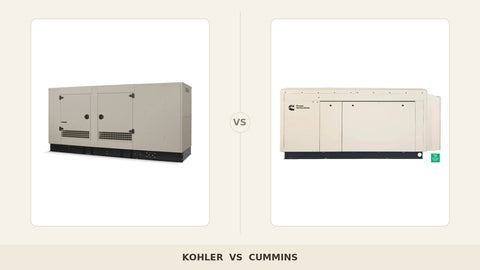
| Cummins C60N6 / QuietConnect series | Liquid-cooled, 6-cyl gaseous | NG / LP | ~66–69 dBA | $24,000–$30,000 | Commercial Cummins DNA; best national service depth at this size; see our Cummins guide |
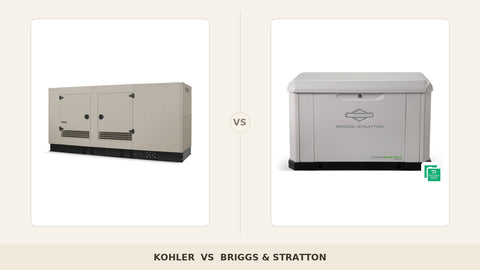
| Kohler 60RCL / KG60 | Liquid-cooled, turbocharged gaseous | NG / LP | ~65–68 dBA | $26,000–$32,000 | Tightest voltage regulation in class; premium enclosure; Kohler/Rehlko guide |
| Generac Protector RG060 / gaseous | Liquid-cooled, purpose-built gaseous | NG / LP | ~68–71 dBA | $20,000–$26,000 | Best parts ubiquity and dealer count; ecosystem lock-in on controls; Generac guide |
| Briggs & Stratton 60kW liquid-cooled | Liquid-cooled gaseous | NG / LP | ~69–72 dBA | $18,000–$24,000 | Value entry into liquid-cooled; verify regional dealer depth; Briggs guide |
| Diesel alternatives (Cummins/Kohler/Generac industrial) | Liquid-cooled diesel | Diesel | ~70–75 dBA | $30,000–$45,000 | Best transient response and kW-per-gallon; fuel polishing and emissions permits add cost |
Diesel alternatives earn their premium in two scenarios: no utility gas within economic trenching distance, and duty profiles with long, hard runtimes where diesel's fuel density and engine longevity pay. For everyone else, gaseous is the default answer in this class for a reason.
Our default spec at this size is gaseous Cummins or Kohler when the site has utility gas, diesel when it doesn't and runtime autonomy matters. Generac Protector wins when the budget leads and the local Generac dealer is strong. Briggs is the price disruptor — a real machine at a meaningfully lower number, provided a competent local dealer stands behind it. The brand-level reasoning is the same logic we lay out in the generator brand rankings: at 60kW, the service relationship outranks the spec sheet by a wider margin than ever.
Fuel: The Math That Runs the Decision

Fuel consumption at this size is where facilities managers earn their keep. Typical published-consumption ranges for a 60kW gaseous unit, with diesel for comparison:
| Fuel | Consumption @ 50% Load | Consumption @ 100% Load | Fuel Cost per kWh (2026 avg) | 24-Hour Full-Load Fuel Bill | Storage / Supply Reality |
|---|---|---|---|---|---|
| Natural gas | ~420–480 ft³/hr | ~640–780 ft³/hr | $0.20–$0.35 | $230–$420 | Unlimited runtime; requires meter capacity — this is the gating item |
| Liquid propane | ~3.5–4.5 gal/hr | ~6.5–8.0 gal/hr | $0.40–$0.60 | $390–$620 | 500–1,000 gal tank = 2.5–6 days full load; vaporization rate limits tank size |
| Diesel | ~2.5–3.2 gal/hr | ~4.5–5.5 gal/hr | $0.45–$0.70 | $430–$660 | On-site tank = total independence; polish fuel annually, treat for cold |
Three hard-won notes on that table. First, natural gas meter capacity: a 60kW gaseous unit wants 650–800 ft³/hr at full load. Most commercial services can deliver it, but plenty of buildings share a meter with existing boilers and kitchen equipment — get the utility's capacity letter before the PO, not after the pad is poured. Second, propane vaporization: in cold weather, a propane tank can only boil off vapor at a rate proportional to its wetted surface. A 60kW at full load in January can outrun a 500-gallon tank's vaporization rate even with fuel in it. This is a real design constraint — ask us or your supplier for the vaporization tables, and expect to land on a 1,000-gallon tank in cold climates. Third, diesel's hidden line items: annual fuel polishing, biocide, and in freeze country a tank heater — budget $400–$800 a year. The 60kW Cummins generator page and 60kW Cummins standby coverage include current configuration specifics for the volume seller in this class.
Electrical Design: Voltage, Conductors, and the Code Sections That Apply

What kind of electric system would be required
At 60kW the electrical design decisions multiply, because voltage configuration changes everything downstream. NEC 445.13 requires generator feeder conductors sized to at least 115% of the nameplate current rating; breakers come from NEC 240.6; the whole system lives under NEC 700 (legally required emergency), 701 (standby), or 702 (optional standby) depending on what loads you carry — and that classification drives transfer-switch listing, wiring methods, and inspection depth. The conductor math at 75°C copper per NEC 310.16:
| Voltage Configuration | Full-Load Amps (60kW) | × 1.15 (NEC 445.13) | Min. Cu Conductor (75°C) | Standard Breaker (240.6) | Typical Use |
|---|---|---|---|---|---|
| 120/240V single-phase | 250 A | 287.5 A | 350 kcmil (310 A) | 300 A | Large estates, light commercial |
| 120/208V three-phase | 166.6 A | 191.6 A | 3/0 AWG (200 A) | 200 A | Most small commercial buildings |
| 277/480V three-phase | 72.2 A | 83 A | 4 AWG (85 A) | 90 A | Industrial services, long feeder runs |
Most 60kW gaseous units are field-configurable across voltages, but the decision must happen at order time because alternator reconnects and breaker ratings ship configured. Voltage choice follows the building service — match the service, don't fight it — with 480V earning its keep whenever the generator sits more than a couple hundred feet from the transfer switch, because conductor cost at 250A single-phase over distance is real money. Grounding and bonding at this size also stops being cookbook: whether the generator neutral is switched by the ATS determines whether the genset is a separately derived system with its own neutral-ground bond and ground electrode, and getting it wrong creates ground-fault sensing problems that trip the main at the worst possible moment. This is stamped-engineer territory on commercial jobs, and it's money well spent. Our NEC ampacity chart guide has the full tables, and torque discipline matters double at this size: we've meggered more than one "bad alternator" that was a lug torqued by feel instead of by the manufacturer's chart.
The transfer switch at 60kW is typically a 200–400A service-rated ATS, and here's where projects blow schedules: service-rated ATS gear in this class carries 8–16 week lead times in peak season. Order the ATS when you order the generator. And classify the system honestly with your AHJ up front — a clinic carrying life-safety loads under NEC 700 faces a different (and more expensive) wiring-methods requirement than a grocery store under NEC 702, and discovering that at rough-in inspection instead of design review is a five-figure change order.
Installation Economics and Total Cost of Ownership

Before the numbers, one process note: the cheapest 60kW project is the one designed once. The expensive version is the one where the generator arrives before the load study, the ATS gets value-engineered to a non-service-rated unit that forces a main-panel rebuild, or the gas utility's capacity letter comes back negative after the pad is poured. Sequence the project — load study, utility coordination, permits, equipment order, then construction — and the budget below holds. Scramble the sequence and it won't.
All-in 2026 budgets for a turnkey 60kW gaseous install, Pacific Northwest pricing:
| Line Item | Typical Cost | Notes |
|---|---|---|
| Generator (gaseous, 60kW) | $18,000–$32,000 | Brand spread per table above |
| Service-rated ATS (200–400A) | $4,000–$9,000 | Lead time 8–16 weeks — order early |
| Pad, enclosure siting, crane/rigging | $2,500–$6,000 | A 60kW liquid-cooled unit weighs 2,500–3,500 lbs |
| Electrical labor + feeders | $6,000–$15,000 | Distance and voltage configuration drive this |
| Gas plumbing / propane tank set | $2,000–$8,000 | Includes regulator sizing; LP adds tank cost |
| Permits, engineering, load study | $1,500–$5,000 | Structural pad calcs and utility coordination |
| Total installed | $35,000–$70,000 | Diesel +$8,000–$15,000 for unit and fuel system |
Ownership runs $1,200–$2,500 a year for a professional maintenance contract (semi-annual service, fluid analysis, battery, exercise logs) — cheap against the revenue a single avoided outage protects. A grocery store losing refrigeration and POS for eight hours eats $10,000–$40,000 in product and lost sales; a machine shop with a job on the mill can ruin a $15,000 workpiece with one voltage event. The ROI conversation at 60kW isn't "is it worth it" — it's "how fast does it pay back," and for most commercial buyers the answer is one bad week. For properties where the answer is borderline, the hybrid math in battery backup vs generator is worth an hour; we increasingly spec a 60kW genset with a modest battery ride-through for sensitive loads that can't tolerate the ten-second transfer gap. Smaller commercial buyers should also read the generators for business overview before locking the size — sometimes two smaller units beat one large one on both price and redundancy.
Lead Times, Procurement, and the Schedule Traps

Procurement at 60kW runs on industrial timelines, not retail ones. As of 2026, gaseous 60kW units run 6–14 weeks from PO to delivery depending on brand and season, service-rated transfer switches in the 200–400A class run 8–16 weeks, and utility gas-capacity letters can take a month on their own. A realistic project timeline — load study to commissioning — is four to six months. The failure mode we see twice a year: a buyer orders the generator in August expecting coverage for storm season, discovers the ATS lead time in September, and rents a towable diesel at $2,500 a week through November. Start the conversation a season before you need the machine. Freight is its own chapter: a 60kW liquid-cooled unit ships at 2,500–3,500 pounds via flatbed or liftgate LTL; the site needs a crane or a rated forklift and a pour-ready pad on delivery day, because the driver's schedule does not include waiting for your concrete to cure. Inspect the crate before signing — freight-damage claims filed after a clean signature are nearly unwinnable.
Paralleling, Redundancy, and the Case for Two Smaller Units

A question worth asking before signing for one 60kW: would two 30–36kW units serve the facility better? Paralleling two smaller generators costs 15–30% more in equipment but buys genuine redundancy — one unit down for service leaves the other carrying critical loads — and better part-load fuel efficiency, since a single 30kW at 60% load runs in its efficient band where a 60kW at 30% load wet-stacks and carbon-fouls. For estates and small commercial sites without a single load that demands the full 60kW at once, the parallel pair is frequently the smarter engineering. Where one big motor or process genuinely needs 60kW of surge, the single unit wins. This is exactly the kind of decision a real load study settles — the 100kW class coverage shows how the same logic scales upward for larger plants.
Siting, Sound, and the Zoning Conversation
A 60kW liquid-cooled unit at full load runs 68–75 dBA at 23 feet — quieter than the air-cooled residential class proportionally, but it runs for days at a time, which changes the neighbor math. Site the unit with the exhaust and radiator discharge away from occupied windows, respect the manufacturer's clearances (typically 3–5 feet minimum, more at the radiator end), and check local zoning before the pad is poured: many jurisdictions treat commercial gensets as mechanical equipment subject to noise ordinances at the property line, and some require screening or setbacks. In freeze country, specify the cold-weather package — battery warmer, block/oil heater, and for propane the tank-sizing discipline covered above. A 60kW that won't start at 15°F is a very expensive sculpture.
Security and access deserve a mention at this size because the asset is worth real money. Commercial units disappear off job sites and rural properties more often than you'd think — a 3,000-pound machine is a flatbed and a winch away from being someone else's generator. Anchor the enclosure, use the lock provisions, consider a camera covering the pad, and etch the serial into the frame in a second, non-obvious location. Service access cuts the other direction: leave the manufacturer's specified clearance on all four sides so a tech can actually open panels and pull components; we've seen units fenced in so tightly that a coolant service required removing fence panels, at the owner's expense, twice a year.
Maintenance: The Contract That Protects the Asset
Commercial generators live and die by their maintenance log. The professional standard at this size is semi-annual service plus weekly automatic exercise with reporting, and the schedule looks like this:
| Interval | Service Item | Why It Matters |
|---|---|---|
| Weekly (automatic) | Exercise run, 15–30 min under load or load-bank schedule | Keeps seals wet, battery charged, faults reported early |
| Monthly (owner) | Visual: fluid levels, block heater operation, exercise log review | Catches the $80 battery before the outage does |
| Semi-annual (pro) | Oil and filter, coolant check, belts/hoses, battery load test, transfer test | The core preventive cycle |
| Annual (pro) | Coolant service as specified, spark plugs (gaseous), valve lash, fuel system service, full-load bank test | Load-bank testing burns off wet-stacking and proves the unit can carry rated load |
| Every 2–3 years | Starter battery replacement, hoses/belts as inspection dictates | Batteries fail on calendar time, not run hours |
| Diesel only, annual | Fuel polishing, biocide, tank water check | Stored diesel grows algae; contaminated fuel is the #1 diesel no-start cause |
Budget $1,200–$2,500 a year for the contract version of that table. Then do one more thing: run an annual full-load test under the actual building load or a load bank, logged. The day the utility fails is not the day to discover the unit was exercising at 10% load for three years and can no longer carry its nameplate. Keep the logbook with the unit's paperwork, too — at resale or facility sale, a documented service history measurably raises what the asset is worth, and an undocumented one invites a discount bigger than the contract ever cost.
Emissions Permitting and the Compliance Layer
Commercial engines live under air-quality rules that residential units mostly escape, and the 60kW class sits right at the threshold where they start to matter. Stationary diesel engines fall under EPA's RICE NESHAP rules and, in many states and air districts, require a permit or registration — with runtime limits on non-emergency operation that affect how you can use the unit for demand response or peak shaving. Gaseous units face lighter requirements in most districts but aren't exempt everywhere; California and several metro air districts want registration regardless of fuel. The exercise schedule also touches compliance: weekly no-load exercise is generally exempt as readiness testing, but logged hours matter when an inspector asks. None of this is a reason not to buy — it's a reason to fold the air-permit question into the design phase alongside the electrical and gas permits, because retrofitting compliance paperwork after commissioning is everyone's least favorite change order. Your dealer's commercial team handles this weekly; lean on them, and get the permit responsibility assigned in writing in the install contract.
Frequently Asked Questions
How much does a 60kW generator cost installed?
What Is the Weight of A 60kW Generator?
A turnkey 60kW gaseous standby installation runs $35,000–$70,000 in 2026: $18,000–$32,000 for the generator, $4,000–$9,000 for the service-rated transfer switch, and the balance in pad, rigging, electrical, gas plumbing, and permits. Diesel configurations add $8,000–$15,000. Annual professional maintenance adds $1,200–$2,500.
What can a 60kW generator power?
A 60kW unit typically carries a small grocery or convenience store including refrigeration, a medical or dental clinic (excluding MRI/CT-class imaging), a church or small school, a machine shop's critical panels, or a large estate property whole. A proper load study with utility interval data should confirm coverage — real building diversity factors mean connected-load arithmetic usually overstates the requirement.
How much natural gas does a 60kW generator use?
A 60kW gaseous generator consumes roughly 420–480 cubic feet per hour at half load and 640–780 cubic feet per hour at full load. Before purchase, get the gas utility's written confirmation that your meter and service can deliver that volume alongside existing building loads — meter capacity is the most common gating item in gaseous 60kW projects.
How long will a 60kW generator run on propane?
A 500-gallon propane tank (400 gallons usable) runs a 60kW unit roughly 50–60 hours at full load or 90–115 hours at half load. In cold weather, vaporization rate — not fuel volume — can become the limit: a full 500-gallon tank in January may not boil off vapor fast enough for full load, which is why cold-climate 60kW propane designs typically specify 1,000-gallon tanks.
Is a 60kW generator single-phase or three-phase?
Most 60kW commercial units are orderable in 120/240V single-phase, 120/208V three-phase, or 277/480V three-phase, configured at the factory. Match the building's service voltage. Choose 480V when the generator sits far from the transfer switch — full-load current drops from 250A (single-phase) to 72A, dramatically cutting feeder conductor cost over distance.
Do I need a permit for a 60kW commercial generator?
Yes, several: electrical permit, mechanical/plumbing permit for gas work, often a structural review for the pad, and in many jurisdictions an air-quality permit for the engine (diesel especially). Systems carrying life-safety loads fall under NEC 700 with stricter wiring methods and testing requirements. Budget permits and engineering at $1,500–$5,000 and involve the AHJ at design stage, not at rough-in.