A 100 kW generator is where backup power stops being an appliance and becomes an electrical service. At this rating you're feeding a small commercial building, a large custom home with every circuit live, a pump station, or a farm operation — and the buying decision involves fuel infrastructure, transfer gear, permits, and a maintenance contract, not just a price tag. I've spec'd and commissioned units in this class for grocery stores, clinics, and estates, and the mistakes are always the same three: undersized gas service, an afterthought transfer switch, and no load bank in the maintenance plan. This guide walks the full decision for the Cummins 100 kW class — the RS100 QuietConnect on gas and the C100D6 diesel — with the amp, fuel, and code math worked out. For adjacent sizes, see our 100 kW Cummins power generator overview, the Cummins brand guide, and the Generac vs. Cummins commercial comparison.

What 100 kW Actually Delivers: The Amp Math
Kilowatts don't land on a busbar — amps do, and the voltage configuration you choose changes everything downstream: breaker size, conductor size, transfer switch rating, and fault current. Here's 100 kW converted at the common service voltages (power factor 0.8 for kVA context, as generators in this class are rated 125 kVA):
| Configuration | Formula | Full-Load Amps | Typical Main Breaker (NEC 240.6) | Min Copper Feeder per Phase (75°C, NEC 310.16) |
|---|---|---|---|---|
| 120/240V single-phase | 100,000 ÷ 240 | 416.7A | 450A frame | Parallel 4/0 or 500 kcmil class |
| 120/208V three-phase | 100,000 ÷ (208 × 1.732) | 277.6A | 300A frame | 350 kcmil (285A) |
| 277/480V three-phase | 100,000 ÷ (480 × 1.732) | 120.3A | 125–150A frame | 1 AWG–1/0 class (130–150A) |
Look at the conductor column and you'll see why commercial 100 kW installs favor 480V distribution with a step-down transformer: 120 amps is a manageable pull of 1/0 in EMT, while 417 amps of single-phase is parallel 4/0, big conduit, and a very long day. NEC 445.13 wants the generator feeder ampacity at no less than 115% of nameplate rating, and the breaker landings follow NEC 240.6 standard sizes — your engineer signs the final schedule, but this table is what the quote should be built around. For ampacity fundamentals, our NEC wire sizing guide and the kWh to amps conversion explainer are the reference pieces.
The Cummins 100 kW Lineup: Gas vs. Diesel
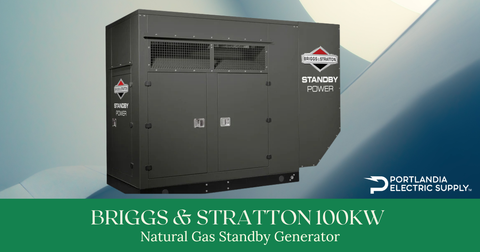
Cummins serves this rating from two directions. The RS100 QuietConnect is the gaseous unit — natural gas or propane, liquid-cooled, engineered for commercial standby with the QuietConnect enclosure treatment that keeps neighborhood-grade noise levels. The C100D6 is the diesel: a Cummins B-series engine under a 125 kVA alternator, built to run long and hard, and the default choice where runtime and fuel security matter more than first cost. Representative specs for the class:
Remote sites and industrial operations
| Attribute | RS100 QuietConnect (NG/LP) | C100D6 (Diesel) |
|---|---|---|
| Standby rating | 100 kW | 100 kW (125 kVA) |
| Engine | Cummins gaseous-fueled, liquid-cooled | Cummins B-series diesel |
| Fuel supply | Utility NG or on-site LP tank | On-site diesel tank (sub-base or remote) |
| Noise class | QuietConnect enclosure, neighborhood/commercial | Enclosure-dependent; generally louder |
| Runtime limiting factor | Utility gas pressure / LP tank size | Tank capacity and refueling logistics |
| Best fit | Commercial standby, estates, light industrial with gas service | Critical loads, remote sites, long-outage duty |
The fuel decision drives the project. Gas units never run out as long as the utility flows — but gas pressure drops in disasters when everyone fires their generators at once, and a 100 kW gaseous unit demands a serious service: expect roughly 1,100–1,400 cubic feet per hour at full load, which usually means a dedicated meter and pressure verification with the utility before you sign. Diesel stores on-site and answers to nobody, but it needs polishing, rotation, and a fuel vendor who shows up in a storm. Our natural gas vs. propane vs. diesel comparison walks the trade-offs in detail.
Fuel Consumption and Runtime Math
Budgeting fuel is where bids get honest. Representative published figures for the 100 kW class (verify against the specific engine data plate — altitudes and ambients move these numbers):
| Load Level | Diesel (C100D6 class) | Natural Gas (RS100 class) | Propane (RS100 class) |
|---|---|---|---|
| 100% load | ~7.5 gal/hr | ~1,100–1,400 ft³/hr | ~13–15 gal/hr |
| 75% load | ~5.7 gal/hr | ~850–1,100 ft³/hr | ~10–12 gal/hr |
| 50% load | ~4.1 gal/hr | ~600–800 ft³/hr | ~7–9 gal/hr |
| 25% load | ~2.4 gal/hr | ~350–500 ft³/hr | ~4–6 gal/hr |
Run the math for a real outage: a 500-gallon sub-base diesel tank at half load gives you roughly five days of continuous run — but half-loaded diesels that never work hard develop wet stacking (unburned fuel washing the cylinders), which is why the maintenance plan below includes load banking. A propane install needs a 1,000-gallon tank minimum to feed full load without pressure drop in cold weather, and two of them is better. I've watched a clinic's LP vaporization rate fall behind demand during a January cold snap — the generator was fine, the tank was the bottleneck. Size the tank for the coldest night, not the average one.
Transfer Switching: The Other Half of the System
The generator is only as useful as the gear that connects it. At 100 kW you're choosing between a service-rated automatic transfer switch ahead of the distribution or load-side ATS panels, and the choice has code teeth: NEC 700 (emergency), 701 (legally required), and 702 (optional standby) systems have different separation and listing requirements, and mixing emergency loads onto an optional standby system is the kind of violation that fails inspections and voids insurance. Match the ATS to the configuration table above — 300A at 208V three-phase, 400–450A class at 240V single-phase, 150A at 480V. Our transfer switch explainer and the transfer switch wiring guide cover the wiring sequence. One field rule: specify the ATS with the generator, same PO, same commissioning day. A generator that arrives before its switch is a very expensive yard ornament.
Site, Permits, and Code Checklist
AHJ expectations vary, but the 100 kW checklist is remarkably consistent across jurisdictions:
- Placement and clearances: NFPA 37 governs stationary combustion engines — standard practice keeps the unit at least 5 feet from openings (doors, windows, fresh-air intakes) in combustible walls, farther for some constructions, with the exhaust aimed away from anything that breathes. Flood zones want elevation above design flood level; hurricane zones want anchoring per the engineered drawings.
- Permits: Electrical for the ATS and feeders, mechanical/plumbing for gas piping, and often a zoning or noise review for commercial districts. Diesel tanks above threshold sizes trigger fire-marshal and sometimes environmental registration.
- Emissions: Stationary emergency engines fall under EPA RICE NESHAP and state air rules; emergency-rated units get runtime-limited exemptions (typically 100 hours/year of non-emergency operation including testing). Exceed the hours and you've built a non-emergency engine without a permit.
- Commissioning: NFPA 110 for Level 1/2 emergency systems where they apply, acceptance testing with a load bank, and documentation the inspector can hold. Budget the load bank rental in the original quote — retrofitting that line item after the inspector asks is embarrassing and expensive.
Maintenance: The Part Everyone Undersells
A standby generator is a machine that must work perfectly after months of doing nothing. The schedule that keeps a 100 kW unit honest:
| Interval | Task | Who |
|---|---|---|
| Weekly | Auto-exercise run (unloaded, 15–20 min); visual leak and alarm check | Automatic + owner walk-by |
| Monthly | Fluid levels, battery charge state, block heater operation, enclosure pests | Owner or service tech |
| Semi-annual | Oil and filter sample/analysis (diesel), coolant test, belt and hose inspection | Service tech |
| Annual | Oil/filter change, air filter, spark plugs (gas units), valve-lash check per hours, full electrical inspection and torque check | Service contract |
| Annual (diesel) | Load bank test to 75%+ for 2–4 hours; fuel polish/sample | Service contract |
| Every 2–3 years | Coolant change, battery replacement, thermographic scan of connections | Service contract |
Plan on a real service contract — $1,500–$3,500 a year in most markets for this class — and treat the weekly exercise as non-negotiable. The generators that start during hurricanes are the ones that ran every Tuesday at 9 a.m. for three boring years. Boring is the goal — excitement in generator ownership is always bad news, and the owners who treat the exercise schedule like a religion are the ones telling calm stories after the storm while their neighbors are renting equipment at panic prices. The battery backup vs. generator analysis is worth a read if your loads are modest and your outages short — at 100 kW you usually need the iron, but hybrid designs that let batteries carry the first minutes are increasingly common on the projects we quote.
Cost Picture: Honest Numbers for the Class
Enclosure and installation types
Total cost of ownership (TCO)
All-in project cost for a 100 kW standby installation typically lands between $45,000 and $90,000 depending on fuel, configuration, and site work. The generator itself is roughly $25,000–$45,000 of that; the ATS, feeders, gas service or tank, pad, permits, and commissioning are the rest. Quotes that come in far below that range are usually missing the fuel infrastructure or the transfer gear — ask for the itemized breakdown and compare scope, not totals. Also ask about lead time: 100 kW units have carried extended factory lead times in tight markets, and the difference between a 12-week and a 30-week delivery can decide whether you're protected this storm season or next one. Budget the soft costs nobody mentions in the first phone call: engineering letters where the AHJ requires them, the load-bank rental for commissioning, crane service if the pad isn't truck-accessible, and utility fees for the upgraded gas meter on gaseous units. On a clean, truck-accessible pad with gas at the property line, a disciplined installer lands near the low end of the range; every complication — long feeders, rock excavation, a panel that needs replacing, a noise-sensitive neighbor requiring the acoustic enclosure — walks the number upward in $2,000–$8,000 steps. For neighboring capacities, our guides to the 60 kW Cummins and 175 kW Cummins bracket this size, and the Kohler vs. Cummins comparison covers the other premium option.
Is 100 kW the Right Size? Load Planning Before the Quote
The most common sizing error in this class isn't undersizing — it's oversizing by round number. "We need a hundred" gets said before anyone reads a demand meter, and the building ends up with a generator that never breaks 40% load. Undersized is dangerous, but chronically underloaded is expensive in a quieter way: wet stacking on diesels, glazed cylinders on gas units, and a capital number $15,000 higher than the building needed. The disciplined sequence: pull 12 months of utility interval data if it exists, identify the peak 15-minute demand, add motor-starting inrush for the biggest concurrent starts (fire pump, elevator, big HVAC compressors), apply a 20–25% growth margin, and only then pick the rating. Typical buildings that honestly land at 100 kW:
| Building Type | Typical Peak Demand | 100 kW Fit | Notes |
|---|---|---|---|
| 8,000–15,000 sq ft custom home | 40–80 kW | Comfortable with margin | Pool, multiple HVAC stages, and shop loads push peaks |
| Small grocery / convenience store | 60–90 kW | Good fit | Refrigeration restart after outage is the sizing driver |
| Medical / dental clinic | 50–85 kW | Good fit | NEC 517 essential electrical system separation applies |
| Small farm with irrigation | 70–120 kW | Borderline — study the pumps | Pump inrush can demand 125 kVA or soft-starts |
| Office building 20,000+ sq ft | 120 kW+ | Usually undersized | Step to 125–150 kW class instead |
If your demand study lands at 75–85 kW, buy the 100 kW — the margin is cheap. If it lands at 95 kW, look hard at the 125 kW class, because a generator running at its ceiling during every event is aging in dog years. For smaller residential needs, our standby generator size comparison covers the air-cooled range; this 100 kW class is liquid-cooled commercial equipment wearing a residential-friendly enclosure.
Noise, Enclosures, and Neighbors
Enclosures, noise, and aesthetics
A 100 kW engine is a truck engine running at governed speed, and no enclosure makes that silent. QuietConnect-class enclosures bring the gaseous units into the low-to-mid 70s dB(A) at 23 feet — conversation-loud, not mower-loud — while diesel equivalents typically run several dB higher. Municipal noise ordinances usually measure at the property line, and at night the limits tighten; a unit that's legal at noon can be a violation at 2 a.m. The fixes, in order of cost: site the unit on the far side of the building from the nearest neighbor, use the building itself as a sound shadow, add an acoustic barrier wall (mass-loaded, not just a fence), and specify the highest-attenuation enclosure the factory offers at order time — retrofitting sound kits costs double and performs half as well. Also respect the thermal reality: acoustic enclosures restrict airflow, so the cooling package and ambient rating must be specified together. A sound-attenuated unit in a 110°F climate needs the right radiator option or it will derate exactly when you need it most — during the heat wave that knocked the grid down.
Controls, Monitoring, and Remote Annunciation
Key technical specifications to know for 100 kW units
Remote monitoring, smart load management, and automation
Remote monitoring platforms
Modern Cummins units in this class ship with PowerCommand-level controls: electronic governing, voltage regulation, event logging, and Modbus/Ethernet hooks into building management systems. Spend the modest money on the remote monitoring option — cellular or Ethernet-connected monitoring catches the three failures that actually strand buildings: a dead starting battery, a tripped block heater breaker, and a "not in auto" switch left after service. Every one of those is invisible until the outage, and every one is caught by a monitoring dashboard within hours. I make customers open the monitoring app during commissioning and acknowledge a test alarm; a monitoring system nobody watches is just a blinking light with a subscription fee. For buildings with code-required emergency systems, remote annunciation of generator status isn't a convenience — NFPA 110 wants the annunciator where a responsible person will see it.
New, Surplus, and the Lead-Time Trade
The 100 kW class has an active secondary market: low-hour take-outs from telecom and data-center refresh cycles, dealer demonstrators, and factory surplus. A used C100D6 with 200 verified hours can sell for 40–60% of new, and for a budget-constrained farm or shop it's often the right call — with three conditions. Get the hour meter and service records, not the seller's memory. Have a Cummins dealer pull the ECU history and compression-check the engine. And price the missing warranty honestly: a new unit's coverage is worth several thousand dollars of risk transfer in the first years. One warning from hard experience: avoid ex-rental units unless the fleet maintenance records are complete. Rental iron lives a hard life — overheated, under-cooled, and started cold twice a day — and the hour meter understates the wear.
The Realistic Project Timeline
Customers consistently underestimate calendar time. A realistic 100 kW schedule: site survey and load study (1–2 weeks), engineering and permit submission (2–6 weeks depending on jurisdiction), equipment lead time (8–30 weeks in current markets — ask before you sign), site work including pad and fuel (1–2 weeks), electrical rough-in and ATS (1 week), startup and commissioning with load bank (2–3 days), inspection and closeout (1–2 weeks). That's 4–10 months from handshake to protected building. The implication is blunt: if you're buying because storm season is coming, buy nine months before storm season. We keep select 100 kW configurations in stock or with short factory allocation precisely because the lead-time surprise is the worst surprise in this business.
Climate: Specifying for Cold Snaps and Heat Waves
Generators fail at temperature extremes because extremes are when they're needed. In cold country, the block heater is not optional — a diesel at 0°F without coolant heat may not crank fast enough to fire, and starting batteries lose a third of their punch below freezing. Battery warmers, oil pan heaters, and winter-grade coolant are cheap line items at order time and expensive service calls later. In hot climates, the radiator and ambient rating carry the load: specify the 50°C cooling package where summer ambient can climb, keep the enclosure intake clear of landscaping (every spring, without exception, someone plants shrubs against the intake louvers), and confirm the alternator's temperature-rise class matches sustained full-load duty. Coastal sites add salt air to the list — specify the coastal enclosure treatment or expect the cabinet to show rust in year three. None of these options costs much. All of them cost everything when omitted.
Exercise Strategy: Run It Like You Mean It
The weekly exercise deserves more thought than the default settings give it. Unloaded 15-minute runs keep the engine moving but don't seat rings, don't fully warm the oil, and on diesels they contribute to the wet-stacking problem. Better practice: exercise under whatever building load the ATS can carry (many modern controls support loaded exercise), or schedule the annual load-bank test to do the deep work. Set the exercise clock for business hours — a generator that fails its Tuesday 9 a.m. exercise gets a service call Tuesday; one set for 3 a.m. Sunday gets discovered during the next outage. Log every exercise and every alarm. The logbook is boring right up until it settles a warranty claim or an insurance dispute, and then it's the most valuable document in the building file. Modern controls make this easy — exercise history, runtime hours, and fault logs export in minutes, and we've settled more than one warranty conversation by emailing a three-year exercise log that showed a machine maintained by the book.
Frequently Asked Questions
How many amps does a 100 kW generator produce?
It depends on voltage: about 417A at 240V single-phase, 278A at 208V three-phase, and 120A at 480V three-phase. The configuration determines your breaker, conductor, and transfer switch sizes, so decide voltage architecture before quoting anything downstream.
Is natural gas or diesel better for a 100 kW standby generator?
Maintenance, warranties, and service networks
Natural gas wins on runtime (no refueling), maintenance simplicity, and noise; diesel wins on fuel security, energy density, and independence from utility infrastructure. If your utility gas service can deliver the required volume at pressure — verify with the utility, in writing — gas is usually the lower-hassle choice. Critical loads and disaster-prone regions still favor diesel with generous tankage.
How long will a 100 kW generator run on a 500-gallon diesel tank?
At half load (roughly 4.1 gal/hr for the class), around five days of continuous operation. At full load, about two and a half days. Usable tank capacity is less than nameplate, and refueling logistics during widespread outages are the real constraint — contract a fuel vendor before storm season, not during it.
Do I need a permit for a 100 kW commercial generator?
Yes — electrical permits for the ATS and feeders, mechanical or plumbing permits for gas piping, often zoning review for placement and noise, and fire-marshal or environmental registration for larger diesel tanks. Emergency-rated engines also carry EPA runtime limits. A reputable installer handles the permit stack; if your quote doesn't mention permits, ask why.
What size transfer switch does a 100 kW generator need?
Match the full-load current at your voltage: roughly 300A at 208V three-phase, 400–450A at 240V single-phase, or 150A at 480V three-phase, using NEC 240.6 standard frame sizes with the feeder sized per NEC 445.13 at 115% minimum. Emergency loads under NEC 700 may require separate listed transfer equipment.
How often does a 100 kW generator need professional service?
Annual professional service minimum, with semi-annual fluid analysis on diesel units and an annual load-bank test. Budget $1,500–$3,500 per year for a service contract in this class. Weekly automatic exercise plus monthly visual checks by the owner fill the gaps between visits.
Related Resources
- 100 kW Cummins power generator overview
- Cummins brand guide for standby professionals
- Generac vs. Cummins for commercial standby
- Natural gas vs. propane vs. diesel standby generators
- Transfer switch wiring guide
- NEC wire sizing and ampacity charts
Ready to quote a 100 kW project? Send us the building's voltage configuration, peak demand from the utility bill, and fuel availability — we supply the generator, transfer gear, and the itemized scope your electrician and AHJ will both accept.