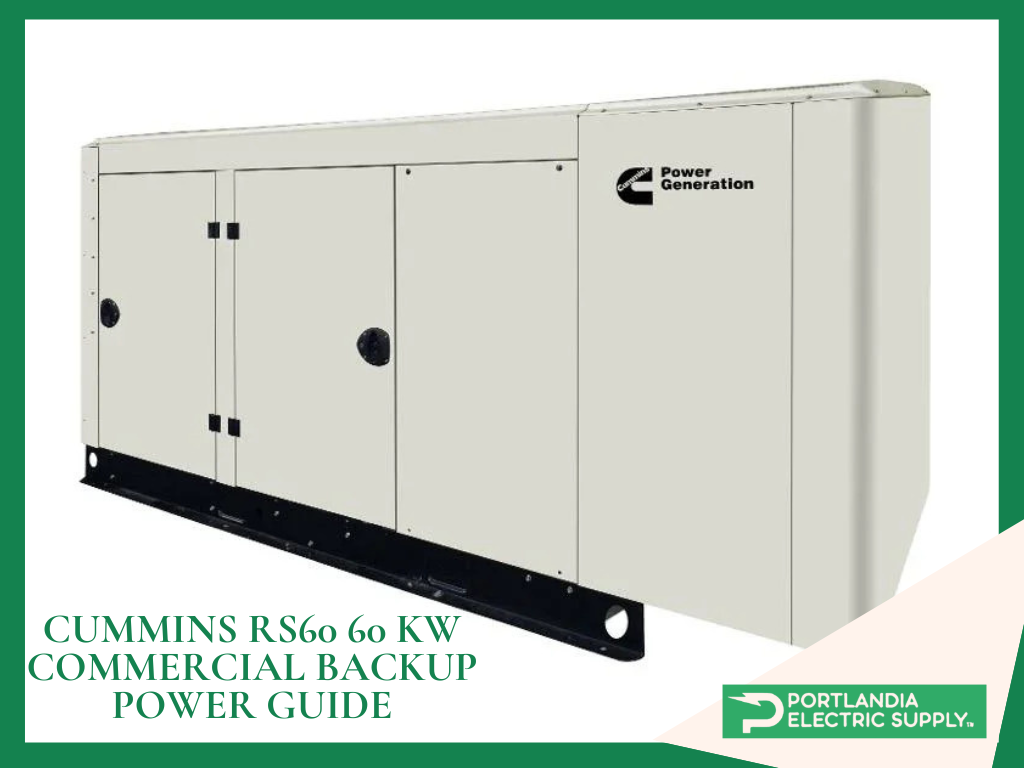
Shopping for a 60 kW generator in 2026 means choosing between diesel and natural gas, open frame and whisper enclosure, a $28,000 value brand and a $45,000 premium one — and getting the transfer switch and permits right regardless of which badge you pick. This guide is brand-agnostic on purpose. We sell Cummins, Generac, Briggs & Stratton, and Kohler-class equipment at Portlandia Electric Supply, and the honest truth is that the sizing math, fuel decision, and installation discipline matter more than the logo. If you've already settled on Cummins, our 60 kW Cummins guide goes deep on that brand. This one covers the whole field. Live inventory: 60 kW generators.

Why 60 kW — and Who It Actually Fits
Sixty kW delivers 72–90A at 480V three-phase or 250A at 240V single-phase. In practice that's a dental or medical clinic, a 15,000–30,000 sq ft retail or office building's critical loads, a restaurant group, a small data room, or an ag operation's critical pumps and cold storage. It is emphatically not a whole-plant solution for heavy manufacturing, and it's oversized for most homes — the sweet spot is critical-load commercial backup. If your load study says 25–35 kW, don't round up to 60 "for safety": chronic light loading below 30% of capacity wet-stacks diesel engines and wastes capital. Right-size with the sizing guide, then sanity-check against neighbors in the range: 48 kW and 80 kW generators.
Fuel Options: Diesel, Natural Gas, LPG, Dual-Fuel
| Fuel | 60 kW Full-Load Burn (approx.) | Autonomy Model | Strengths | Costs You |
|---|---|---|---|---|
| Diesel | ~4.5–5.5 gal/hr | On-site tank: 250 gal ≈ 30–40 hr at half load | Energy density, motor-starting kVA, engine life (20k–30k hr with maintenance) | Fuel polishing, cold-weather additives, Tier 4 questions on non-emergency duty |
| Natural gas | ~750–900 ft³/hr | Utility: effectively unlimited | No tanks, no fuel maintenance, cleaner stack | Utility dependency; verify service capacity in writing before ordering |
| LPG (propane) | ~7–9 gal/hr | Tank farm: 1,000 gal ≈ 4–5 days at half load | Indefinite storage, off-grid capable, clean | Tank cost, vaporization limits below ~0°F, slight output derate |
| Dual-fuel | Blended | Gas primary + diesel backup | Resilience against single-fuel failure | Price premium, control complexity, more maintenance points |
The decision framework is simple: if the disaster you're planning for can also hurt the gas utility (earthquake, major storm), diesel's on-site autonomy wins. If outages are short and utility-serving (equipment failures, localized faults), natural gas's zero-maintenance fuel supply wins. Everything else is refinement — read our three-way fuel comparison for the long version.
Efficiency, Emissions, and What Changed by 2026
Three trends matter. First, the EPA emergency-vs-non-emergency split now dominates the spec conversation: stationary standby sets running only outages and testing are generally permitted without Tier 4 Final aftertreatment, but any peak-shaving or prime-duty plan drags you into DPF/SCR/DEF territory with its cost and regeneration management. Second, remote monitoring went from option to default — any 60 kW set you buy in 2026 should phone home, and you should budget the gateway and subscription at purchase. Third, 1800 rpm liquid-cooled engines have fully taken the class over from 3600 rpm air-cooled designs; if a quote at this size is air-cooled, ask why.
Noise, Footprint, and Enclosure Choice
| Enclosure | Typical Sound @ 7 m | Weight Class (wet) | Use When |
|---|---|---|---|
| Open skid | 85–95 dBA | Lightest | Indoor mechanical rooms with engineered ventilation |
| Weather-protective | 72–78 dBA | 3,500–5,000 lb | Industrial yards, no nearby receptors |
| Sound-attenuated Level 2 | 65–72 dBA | 4,500–5,500 lb | Most commercial installs |
| Hospital-grade / super-quiet | 58–65 dBA | Heaviest, costliest | Healthcare, mixed-use, tight property lines |
Measure to the property line, account for reflections off adjacent walls, and remember dB is logarithmic — 78 to 68 dBA is not "10 points quieter," it's roughly a perceived halving. The enclosure decision is cheap at order time and expensive after the first complaint.
Transfer Switches, Paralleling, and Integration
The ATS is half the system. At 60 kW / 480V three-phase, full-load current is about 90A, so a 100–125A ATS frame covers it; at 208V three-phase (~208A) you need a 225A+ frame; at 240V single-phase (250A), a 300A frame. Pole count follows the grounding scheme: 3-pole keeps the generator non-separately-derived; 4-pole switched-neutral makes it separately derived per NEC 250.30 — choose deliberately, because the wrong choice causes ground-fault nuisance tripping that masquerades as equipment failure.
| Voltage | Full-Load Amps | Min. Conductor Ampacity (NEC 445.13, 115%) | Copper (75°C, NEC 310.16) | ATS Frame |
|---|---|---|---|---|
| 277/480V 3-ph | 90 A | 104 A | 2 AWG | 100–125 A — browse 100–125A ATS |
| 120/208V 3-ph | 208 A | 240 A | 250 kcmil | 225–250 A — 200–225A ATS |
| 120/240V 1-ph | 250 A | 288 A | 350 kcmil | 300 A |
Paralleling note: if there's any chance you'll need 120 kW later, decide now. Paralleling-capable controls and switchgear cost modestly more at purchase and brutally more as a retrofit. Otherwise, keep it simple — one set, one ATS, done. References: what is a transfer switch, manual vs automatic ATS, ATS sizing chart, transfer switch wiring. Inventory: transfer switches and automatic transfer switches.
Installation, Code, and Permitting
The sequence that avoids pain: load study → permit set → utility coordination (gas capacity or electrical service) → pad and fuel rough-in → set and wire → inspection → witnessed commissioning with a load test. Plan 8–16 weeks order-to-commissioning. Codes in play: NEC 445/700/701/702 for the wiring, NFPA 37 for siting and fuel, NFPA 110 where the loads are life-safety class. Skip the permit and you've built an insurance exclusion, not a backup system.
Maintenance and What Actually Fails
| Interval | Tasks | Cost Reality |
|---|---|---|
| Weekly | Automatic exercise; verify via monitoring app | Free — but confirm it happened |
| Monthly | Loaded exercise 30 min; battery, fluids, leaks, louvers | Owner or service plan |
| Semi-annual | Oil/filters, coolant test, belts and hoses | $400–$800 service call |
| Annual | Full service + loaded test (load bank if building load <75%) | $800–$1,500 incl. load bank rental |
| 2–3 years | Battery, coolant, thermostat/sensors, ATS contacts | $600–$1,200 |
What fails, in order of frequency across the fleets we support: starting batteries (replace on a 3-year schedule, not on failure), fuel quality on diesel (polish annually or after any suspect delivery), coolant neglect, and block heaters that quietly died in September. None of these cost more than a few hundred dollars to prevent; all of them produce the same 2 AM outcome. The maintenance guide, maintenance kits, and generator accessories cover the parts side.
Total Cost of Ownership and Brand Positioning
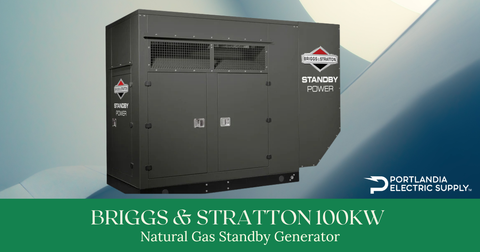
Turnkey 60 kW in 2026: $45,000–$75,000 installed for diesel standby, natural gas units similar once gas-line work is included. Annual carrying cost runs $1,500–$3,500 for service plus fuel for testing. Over a 15-year life, maintenance and fuel typically exceed the purchase price — which reframes brand choice: pay for the service network and parts pipeline, because that's what converts a failure into a same-week repair instead of a month-long outage. Cross-shop the class: Cummins RS60, Briggs & Stratton 60 kW Fortress (LP/NG), Generac 60 kW 1800 rpm, and the best 60 kW backup generators roundup. Brand-level: Cummins, Generac, Kohler/Rehlko, Generac vs Cummins, Kohler vs Cummins.
Prime vs Standby at 60 kW: The Table That Saves Your Warranty
| Rating | Hours/Year | Load Profile | Overload | Typical kW on a "60 kW" Set |
|---|---|---|---|---|
| Standby | Limited (typically ≤500, varies by manufacturer) | Variable, outage-only | None | 60 kW |
| Prime | Unlimited | Variable | 10% for 1 hr in 12 | ~54–55 kW |
| Continuous | Unlimited | Constant 100% | None | ~48–50 kW |
The trap: standby is the big number on the brochure, so it's the number that gets quoted. If your application is grid backup with a few dozen outage hours a year, standby is correct and cheapest. If you're running prime duty — remote site, daily peak shaving, unreliable grid — pay for the prime rating, because a warranty claim on a standby-rated engine with 3,000 hours in year two is a short, sad conversation.
Brand Comparison at 60 kW: What You're Actually Buying
| Brand Tier | Representative Options | What You Pay For | What You Risk |
|---|---|---|---|
| Premium commercial | Cummins RS60, Kohler 60R-class | Deepest service networks, PowerCommand-class controls, strong resale | Highest capital cost |
| Volume commercial | Generac 60 kW | Price, dealer density, fast parts on common SKUs | Check lead times in storm season |
| Value LP/NG | Briggs & Stratton Fortress 60 kW | Lowest entry price at the kW class | Thinner commercial service bench in some regions |
None of these is the wrong answer for the right site. The wrong answer is any of them without a local service bench, a witnessed commissioning, and a maintenance contract. Brand homework: Cummins, Generac, Kohler/Rehlko, Briggs & Stratton, and the Generac vs Cummins and Kohler vs Cummins head-to-heads.
The Downtime Math That Justifies the Purchase
CFOs don't buy generators; they buy avoided loss. Run it for a representative business: a specialty-food cold-storage site loses roughly $8,000 of margin per day of outage, plus spoilage risk past hour 12. At two significant outages a year averaging 9 hours, that's about $15,000/year of exposure before counting the spoilage tail. A $60,000 turnkey 60 kW system with $3,000/year of carrying cost pays back in under five years on avoided loss alone — faster if the insurer offers a premium credit for protected refrigeration, which several commercial carriers do. Put that one-page math in the proposal and the generator stops being an expense and becomes a hedge with a payback period.
Installation Walkthrough: Six Steps, In Order
The sequence below is the one our installer network runs. It looks obvious written down; projects still go sideways when steps get reordered.
| Step | Action | Gate Before Next Step |
|---|---|---|
| 1. Load study | Meter critical loads for a representative week; document motor starting kVA | Written kW/kVA number signed off by the owner |
| 2. Permits & utility | Electrical/mechanical permit set; gas capacity letter (NG) or fuel plan (diesel); air-district filing if required | Permits issued |
| 3. Site work | Engineered pad, anchor template, conduit stubs, fuel rough-in | Pad cured and inspected |
| 4. Set & wire | Crane set, feed to ATS, control wiring, battery, coolant, first-fill oil check | Megger and rotation verified |
| 5. Inspection | AHJ electrical inspection; fuel system inspection where applicable | Green tag |
| 6. Commissioning | Witnessed transfer test, loaded run (load bank if needed), monitoring registration, owner training | Signed commissioning report |
The two gates people rush are 1 and 6. Rushing the load study buys you the wrong-size machine; rushing commissioning buys you a machine nobody has ever seen carry the building. Neither mistake announces itself until the outage.
Monitoring Platforms and What to Actually Watch
Every major brand's 2026 platform does the same five things — run status, exercise logs, fault alerts, fuel level (with the right sender), and battery health — and the differences are in pricing and app polish rather than capability. Whatever platform you land on, configure four alerts without fail: failure to exercise (the weekly self-test that didn't happen), battery charger fault (the silent killer), low fuel (diesel), and any fault code during a utility event. Then assign them to two humans, not one, because alerts that land in one person's inbox have a way of arriving during that person's vacation. The monitoring subscription is the cheapest insurance line in the whole budget.
Diesel Fuel Maintenance: The Boring Discipline That Matters Most
Diesel in a standby tank degrades on a clock whether the generator runs or not: water condenses, microbial growth colonizes the fuel-water interface, and asphaltenes drop out of aging fuel to clog filters at the worst moment. The maintenance program is cheap and unglamorous: annual fuel sampling (a $40 lab test or a field kit), polishing through a filtration cart when the sample warrants, biocide treatment on a schedule in humid climates, and a tank top-off discipline that keeps the air gap small. Facilities that run this program essentially never have fuel-related no-starts. Facilities that don't eventually learn about it during an outage, from the service tech, at emergency rates.
Altitude, Ambient, and Duty Cycle: The Fine Print Trio
Three spec-sheet footnotes change what a 60 kW generator actually is at your site. Altitude: engines lose output with elevation — figure roughly 3–4% per 1,000 feet on naturally aspirated units, less on turbocharged — so a mountain-site project needs the site-adjusted rating, not the sea-level brochure number. Ambient: cooling packages are rated to a temperature (often 40–50°C); a set parked in reflected heat off a south-facing wall can exceed it and high-temp shutdown during the heat-dome outage you bought it for. Duty cycle: the standby/prime/continuous table above is a warranty instrument, not a suggestion. Any quote you collect should state all three adjustments explicitly; if it doesn't, ask for the site-adjusted rating in writing before comparing prices, because two quotes for "60 kW" can be for machines that deliver 60 and 52 kW respectively at your pad.
When NOT to Buy 60 kW
Honesty section, because the wrong size is the most expensive generator. Don't buy 60 kW if your measured critical load is under 25 kW — a right-sized 30–36 kW unit (see the 35 kW guide or 30 kW generators) will cost less, run healthier, and sip less fuel. Don't buy it if the real answer is 100+ kW and you're hoping to "manage loads" — chronic overload trips are worse than an honest larger unit (see 100 kW options and 100 kW generators). And don't buy any standby set if what you actually need is prime power for daily off-grid duty — that's a different rating, a different maintenance plan, and often a different machine entirely. The sizing guide exists so the generator fits the job; use it.
Load Management: The Feature That Downsizes Your Generator
Load-management modules deserve a closer look because they routinely save buyers a frame size. These devices — smart breakers or shed-modules tied to the ATS — watch generator output and temporarily drop non-critical circuits (water heater, dryer, second AC condenser, EV charger) when demand approaches capacity, then restore them as headroom returns. The practical effect: a facility that "needs" 75 kW on paper often runs comfortably on 60 kW with two managed loads, because the spikes that forced the larger size were brief and discretionary. The savings are real — smaller unit, smaller ATS, smaller conductors, less fuel per test hour. The caveat is discipline at design time: decide explicitly which loads are sheddable, label them, and tell the occupants, because nothing breeds generator resentment like a surprise cold shower mid-outage.
Questions to Ask Every Seller Before You Sign
Regardless of brand, these seven questions separate solid vendors from box-shippers at this size. One: what's the site-adjusted rating at my altitude and ambient temperature, in writing? Two: is the unit standby, prime, or continuous rated, and what are the exact annual-hour limits? Three: what's included at commissioning — is the load test and monitoring registration in the quote or a change order? Four: who services it locally, how many factory-trained techs do they have, and what's the emergency response commitment? Five: what's the lead time, and what happens to it if a storm event hits between order and delivery? Six: what's the warranty, in hours and years, for my duty profile — and what's excluded? Seven: what's the fuel plan — tank sizing, polishing schedule, and supplier relationship for diesel, or the utility capacity letter for gas? A seller who answers all seven crisply has done this before. One who hand-waves question three will hand you surprises later.
The Boring Path to a Good Outcome
Everything in this guide compresses to one pattern: the 60 kW projects we're proud of were boring. Measured loads, right-sized machine, correct fuel, engineered pad, permitted work, witnessed commissioning, scheduled maintenance, monitored alerts. The projects that generate midnight phone calls skipped one of those steps to save money, and the step always sends the invoice later with interest. Whether you land on a Cummins RS60, a Generac 60 kW, or a Briggs & Stratton Fortress, the boring path is available for all of them. Take it.
One final note from the counter: the buyers happiest with their 60 kW purchase a decade in are the ones who treated the generator as infrastructure with an owner, a calendar, and a binder — not as a box on a pad. The hardware from every major brand is good enough in 2026 that ownership discipline, not the badge, is what separates the reliable fleets from the cautionary tales.
Frequently Asked Questions
How much does a 60 kW generator cost installed?
Plan on $45,000–$75,000 turnkey for a diesel standby unit in 2026 — the generator, ATS, pad, fuel system, electrical, permits, and commissioning. The unit itself is only about half the project.
Diesel or natural gas for a 60 kW genset?
Diesel when outage scenarios can take down utilities too, or when heavy motor starting matters. Natural gas when outages are short and you want zero fuel logistics. Both work; the site risk profile picks the winner.
What size transfer switch does a 60 kW generator need?
480V three-phase: ~90A full load, so a 100–125A frame. 208V three-phase: ~208A, so 225A+. 240V single-phase: 250A, so a 300A frame. Match pole count to your grounding scheme.
How much fuel does a 60 kW generator use per hour?
Diesel: roughly 4.5–5.5 gal/hr at full load, ~2.9 gal/hr at half load. Natural gas: roughly 750–900 ft³/hr at full load. Propane: ~7–9 gal/hr. Verify against the specific engine's published fuel map.
Can I run a 60 kW generator continuously?
Only if it's prime or continuous rated. Standby-rated sets carry limited annual hours and no overload allowance — run one as your daily power source and you'll void the warranty and shorten the engine's life.
How long does a 60 kW commercial generator last?
A maintained 1800 rpm diesel delivers 20,000–30,000 operating hours — at typical standby duty of 50–100 hours a year including exercise, that's decades of calendar life. Maintenance history decides which side of the range you land on.
Related: what size generator do I need · whole-home sizing 2026 · standby generators for home · kW-to-amps calculator · fuel calculator · all generators · commercial standby generators · natural gas generators · propane generators