🇺🇸/🇲🇽 Versión en español →

⚡ Key Takeaways
- The 20-80% rule was written for NMC lithium cells — the chemistry in phones, laptops, and most EVs. It still works there.
- LiFePO4 (LFP) solar batteries play by different rules: they tolerate 80–100% depth of discharge daily and still deliver 3,000–6,000 cycles, and they actually need periodic 100% charges so the BMS can balance the cells.
- Heat kills batteries faster than any charging habit. A cool battery at 100% outlives a hot battery babied at 60%.
- The math below shows why: an LFP bank cycled at 60% DoD delivers roughly 40% more lifetime energy than the same bank hammered at 100% DoD — and modern LFP storage now costs about $0.04–$0.05 per kWh of throughput, versus ~$1.25/kWh for a legacy AGM bank.
- Lead-acid banks are the opposite case: keep them near full, never below 50%.
Where the 20-80% Rule Came From — and Why It Stuck
Shop this guide


The 20-80% rule is simple advice: keep your battery between roughly 20% and 80% state of charge, and avoid the two extremes. It spread because it works — for a specific battery chemistry. NMC (nickel manganese cobalt) lithium cells, which power most phones, laptops, and the majority of electric vehicles, age fastest at the edges of their charge range. Hold an NMC cell at 100% and the high terminal voltage accelerates electrolyte oxidation and lithium plating. Drain it to 0% and the anode copper current collector starts to dissolve. The middle 60% of the range is where the chemistry is under the least mechanical and electrochemical stress.
Battery researchers quantified this decades ago: NMC cells cycled between 25% and 75% can last two to four times longer than identical cells cycled 0–100%. EV makers baked that finding into their products — most electric cars display "100%" on the dash while the pack is actually sitting near 90% of its true capacity, with a hidden buffer at the top and bottom. Your phone does the same thing.
What changed by 2026 is the chemistry mix. LFP — lithium iron phosphate — has taken over stationary solar storage and a growing share of the EV market, and LFP doesn't share NMC's sensitivity to high states of charge. The olivine crystal structure of the iron phosphate cathode is far more stable at full charge, which is why the rule that governed a decade of gadget advice needs a 2026 update. If your battery bank is LFP — and if you bought a solar battery in the last few years, it almost certainly is — the 20-80% rule is mostly a leftover habit, not a requirement.
Why Batteries Degrade Over Time

Every rechargeable battery loses capacity through two broad mechanisms, and only one of them has anything to do with how you charge it.
| Effect | What Happens | User Experience |
|---|---|---|
| Capacity Fade | Battery can't hold as much energy as when new | Device doesn't last as long on a full charge |
| Impedance Growth | Internal resistance increases, limiting power delivery | Unexpected shutdowns during high-demand tasks |
Capacity fade is driven by the slow loss of cyclable lithium to side reactions — the growth of the solid electrolyte interphase (SEI) layer on the anode, electrolyte decomposition, and (at high states of charge) oxidation at the cathode. Impedance growth is the same chemistry viewed from the power side: as those reaction products build up, the cell's internal resistance climbs, voltage sags harder under load, and a system that once ran your well pump without blinking starts tripping offline when the pump and the well-house heater kick on together.
Both mechanisms share three accelerants: heat (reaction rates roughly double for every 10°C rise), time at high voltage (hours parked at 100% matter more for NMC than the act of charging there), and depth of discharge (deeper swings strain the electrode structure more per cycle). The 20-80% rule attacks only the third factor. That is why it helps — and why it was never the whole story.
Reference Table: LFP Cycle Life vs. Depth of Discharge

This is the table we point customers to when they ask how hard they can use a LiFePO4 bank. The cycle-life figures are typical published ranges for quality LFP cells at room temperature, discharged to roughly 80% of original capacity; the throughput column is plain multiplication — cycles × usable energy per cycle for a 10 kWh bank.
| Depth of Discharge (DoD) | Typical LFP Cycle Life (to ~80% capacity) | Usable Energy per Cycle (10 kWh bank) | Lifetime Energy Throughput |
|---|---|---|---|
| 100% DoD (full 0–100% swings) | ~3,000 cycles | 10.0 kWh | 3,000 × 10.0 = 30,000 kWh |
| 80% DoD (10–90% band) | ~4,500 cycles | 8.0 kWh | 4,500 × 8.0 = 36,000 kWh |
| 60% DoD (20–80% band) | ~7,000 cycles | 6.0 kWh | 7,000 × 6.0 = 42,000 kWh |
| 40% DoD (30–70% band) | ~10,000 cycles | 4.0 kWh | 10,000 × 4.0 = 40,000 kWh |
| 20% DoD (40–60% band) | ~15,000 cycles | 2.0 kWh | 15,000 × 2.0 = 30,000 kWh |
Read the last column, not the second. Going from 100% DoD to 60% DoD buys you ~40% more lifetime energy from the same bank (30,000 → 42,000 kWh), and going all the way down to 20% DoD gives the throughput back — shallow cycles help cycle count, but each cycle moves so little energy that lifetime throughput falls. For most off-grid and backup applications, the sweet spot is the 60–80% DoD band: deep enough to use the capacity you paid for, shallow enough to add years of service. Note the practical corollary: an LFP bank at 80% DoD still beats a lead-acid bank at its 50% ceiling by an order of magnitude on lifetime energy, which is why the old lead-acid "never go below half" rule doesn't transfer to lithium.
🔧 Installer note — sizing for the DoD you actually plan to use
When I size a customer's bank, I don't spec the battery against the nameplate kWh — I spec it against the kWh at the DoD they'll actually run. A cabin owner who wants 8 kWh every night, every night, gets a 10 kWh LFP bank (80% DoD, ~4,500 cycles, roughly 12 years of daily use), not an 8 kWh bank run flat. The upsell from 8 kWh to 10 kWh costs them about 25% more upfront and buys them nearly double the calendar life. I've yet to have a customer regret that line item.
Reference Table: Charge Rate (C-Rate) and What It Means for Charging Time

C-rate is charge or discharge current expressed as a fraction of the battery's amp-hour capacity: 1C on a 100 Ah battery is 100 A, 0.2C is 20 A. LFP cells are typically rated for 0.5C continuous charge (many BMS boards cap it there) and 1C discharge, though spec sheets vary — always check the datasheet for your exact model. The right-hand column answers the question we hear constantly: how long to refill the working 20–80% band, i.e., 60% of capacity.
| Charge Rate | Current — 100 Ah Battery | Current — 200 Ah Battery | Time to Move 20% → 80% (60% of capacity) |
|---|---|---|---|
| 0.1C (trickle / small solar array) | 10 A | 20 A | 60 Ah ÷ 10 A = 6.0 h (100 Ah) · 120 Ah ÷ 20 A = 6.0 h (200 Ah) |
| 0.2C (typical LFP recommended charge) | 20 A | 40 A | 60 Ah ÷ 20 A = 3.0 h · 120 Ah ÷ 40 A = 3.0 h |
| 0.5C (fast charge, most LFP BMS limit) | 50 A | 100 A | 60 Ah ÷ 50 A = 1.2 h (72 min) · 120 Ah ÷ 100 A = 1.2 h (72 min) |
| 1.0C (maximum for many LFP packs, check spec sheet) | 100 A | 200 A | 60 Ah ÷ 100 A = 0.6 h (36 min) · 120 Ah ÷ 200 A = 0.6 h (36 min) |
Notice that charge time scales with capacity, not C-rate: a 100 Ah battery and a 200 Ah battery both refill the 20–80% band in 3 hours at 0.2C, because the bigger battery accepts proportionally more current. Where this bites in real systems is solar charging. A 200 W panel in good sun delivers roughly 10–12 A into a 12 V bank — about 0.1C on a 100 Ah battery — so a 60% refill takes most of a summer day. We walk through that exact scenario in our 200 W panel / 12 V 100 Ah charging breakdown, and if you're speccing the controller side, the MPPT vs. PWM comparison and the 2026 charge controller sizing guide cover why an MPPT unit recovers 15–30% more of that panel's output into the battery.
Reference Table: Capacity Fade Over a Decade of Daily Use

Capacity fade combines calendar aging (the battery ages even sitting still) and cycle aging (it ages with use). The illustrative model below assumes 0.7 cycle per day (~250 cycles/year), indoor temperatures, a 1.0%/year calendar loss plus ~0.004% per cycle for LFP at 80% DoD, and a 2.5%/year calendar loss plus ~0.008% per cycle for NMC run at full depth — figures consistent with the fade rates in manufacturer warranty curves. Your results will vary with temperature and use, but the shape of the comparison is what matters.
| Service Year | Cumulative Cycles (250/yr) | LFP Capacity Remaining (80% DoD daily use) | NMC Capacity Remaining (100% DoD daily use) |
|---|---|---|---|
| Year 1 | 250 | ~98% (100 − 1.0 calendar − 1.0 cycling) | ~95% (100 − 2.5 calendar − 2.0 cycling) |
| Year 3 | 750 | ~94% | ~86% |
| Year 5 | 1,250 | ~90% | ~77% — below the 80% warranty threshold |
| Year 7 | 1,750 | ~86% | ~68% |
| Year 10 | 2,500 | ~80% — typical end-of-warranty threshold | ~55% — effectively end of useful life |
Two lessons here. First, LFP's decade-long glide path to 80% is exactly why "is the 20-80% rule still valid?" gets a different answer for solar than for phones: the bank is engineered to spend its life deep-cycling. Second, NMC at full depth crosses the 80% line around year 4–5 — the same chemistry, the same calendar, roughly double the fade rate. That gap is the entire reason the 20-80% rule exists. If you run NMC (an older EV, a laptop, some legacy storage products), shrinking the daily band is still the cheapest lifespan upgrade available. If you run LFP, temperature management and a sane charge rate buy you more than obsessing over the top and bottom 20%.
Temperature: the Degradation Factor Nobody Puts on a Sticker

If the fade table above has a practical takeaway, it is that every assumption in it collapses when the battery gets hot. Lithium reaction rates roughly double for every 10°C rise in cell temperature, so an LFP bank installed against a south-facing garage wall in Phoenix ages on a different calendar than the same bank in a conditioned basement in Portland. NMC is even less forgiving: an NMC pack stored at 100% charge and 40°C can lose a quarter of its capacity in a year without a single cycle. This is why we steer customers toward the boring details — ventilation clearances, insulation from unconditioned spaces, keeping charge controllers and inverters from dumping their waste heat into the battery enclosure — before we talk about charging habits at all. A 20-80% charging discipline in a 45°C shed loses to sloppy charging in a 20°C utility room every single time. For outdoor and garage installs, the enclosure and its placement are battery-life equipment just as much as the cells are.
Reference Table: Cost per Cycle — the Math That Actually Decides Purchases

Sticker price comparisons between battery chemistries are misleading because they ignore cycle life. The honest metric is storage cost per kWh of lifetime throughput: upfront cost ÷ (rated cycles × usable kWh per cycle). Here is that math for representative equipment tiers, using round numbers typical of the current market:
| Option | Upfront Cost | Cycle Life × Usable kWh per Cycle | Lifetime Throughput | Storage Cost per kWh Throughput |
|---|---|---|---|---|
| 5.12 kWh server-rack LFP (value tier) | $1,100 | 6,000 cycles × 4.61 kWh (90% DoD) | 27,648 kWh | $1,100 ÷ 27,648 = $0.040/kWh |
| 5.12 kWh server-rack LFP (premium tier, 8,000-cycle rating) | $1,900 | 8,000 cycles × 4.61 kWh (90% DoD) | 36,864 kWh | $1,900 ÷ 36,864 = $0.052/kWh |
| 10 kWh wall-mount LFP (whole-home backup) | $2,800 | 6,000 cycles × 9.0 kWh (90% DoD) | 54,000 kWh | $2,800 ÷ 54,000 = $0.052/kWh |
| 4.8 kWh AGM lead-acid bank (legacy off-grid) | $1,500 | 500 cycles × 2.4 kWh (50% DoD limit) | 1,200 kWh | $1,500 ÷ 1,200 = $1.25/kWh |
The AGM row is not a typo. A lead-acid bank limited to 50% DoD and ~500 cycles delivers about 1,200 kWh over its life; at $1,500 upfront that's $1.25 per kWh cycled — roughly thirty times the per-kWh storage cost of a value-tier LFP rack battery. This is why, dollar for dollar, the LFP banks in our LiFePO4 battery collection and lithium battery collection have displaced lead-acid in nearly every new off-grid build we quote, and why sizing guidance like our solar battery sizing guide and home battery bank sizing guide now start from lithium assumptions.
🔧 Installer note — the customer who "saved money" on AGM
Early in my career I installed a 4.8 kWh AGM bank for a workshop customer who balked at the lithium quote. He was back in year three for a full replacement — the bank was sulfated from chronic undercharging off a small array — and the second bank plus my labor cost more than the LFP system I'd originally proposed, which would still be under warranty today. When I show the $1.25/kWh vs. $0.04/kWh throughput math in the table above, the conversation usually ends there. Cheap batteries are the most expensive batteries you can buy twice.
How Modern Battery Management Changed the Equation

The "False" 100%
Almost no modern device lets you actually charge to the cell's true chemical limit. The battery management system (BMS) reserves buffer zones at both ends of the gauge, so the "100%" and "0%" you see are already conservative:
| Buffer Zone | What It Does | Benefit |
|---|---|---|
| Top Buffer | Stops charging slightly below true 100% | Prevents high-voltage stress and oxidation |
| Bottom Buffer | Shuts down before true 0% | Prevents deep discharge damage to electrodes |
This is why the catastrophic version of the 20-80% anxiety — "I charged to 100%, did I just kill my battery?" — is misplaced. The pack's own electronics are already enforcing a softened version of the rule for you.
Smart Charging Algorithms
The bigger 2026 shift is algorithmic. Phones learn your alarm time and hold at 80% until just before you wake. Hybrid inverters and LFP rack batteries let you set charge and discharge limits in software — a feature worth using, but differently per chemistry. For an NMC device, capping charge at 80% is the single best habit available. For an LFP solar bank, the standard practice is inverted: set absorption to the manufacturer's full-charge voltage and let the bank reach 100% at least weekly, because the BMS balances its cells near the top of the charge curve. An LFP bank that never reaches full charge slowly drifts out of balance, and the BMS state-of-charge estimate drifts with it — the opposite of what the 20-80% rule predicts. Our battery maintenance best-practices guide covers the balancing routine in detail.
🔧 Installer note — the out-of-balance service call
The most common LFP service call I run isn't dead cells — it's a bank whose owner set an 80% charge cap "to be safe" and never let it balance. Twelve months later the pack's state-of-charge reads 40% while one cell group is actually near empty, and the inverter faults on low voltage under load. The fix is boring: charge to 100%, hold absorption for an hour, let the BMS balance, and repeat monthly. Every LFP manual we ship says this, and it's the one page people skip. With LFP, being too gentle is its own failure mode.
How the 20-80% Rule Plays Out by Battery Chemistry

The same charging habit that doubles the life of an NMC laptop battery is irrelevant — or counterproductive — on an LFP solar bank, and actively harmful in reverse on lead-acid. Here is the full comparison:
| Chemistry | Daily Sweet Spot | Deep-Discharge Tolerance | Typical Cycle Life | Does 20-80% Apply? |
|---|---|---|---|---|
| NMC lithium (phones, laptops, most EVs) | 20–80% state of charge | Full charges and deep discharges accelerate wear | ~800–2,000 cycles | Yes — this is where the rule came from and where it still matters most |
| LiFePO4 / LFP (solar storage, EG4-style rack batteries) | Roughly 10–90%, but the full 0–100% is genuinely usable | Tolerates 80–100% depth of discharge daily with minimal penalty | ~3,000 cycles at 100% DoD; ~6,000 at 80% | Mostly outdated — charge to 100% regularly for BMS cell balancing |
| AGM / flooded lead-acid (legacy off-grid banks) | Top 50% only — cycle between 100% and 50% | Dies fast below 50% DoD; sulfation sets in when left discharged | ~300–500 cycles at 50% DoD | Inverted — keep it near full, never near empty |
What This Means for a Solar Battery Bank
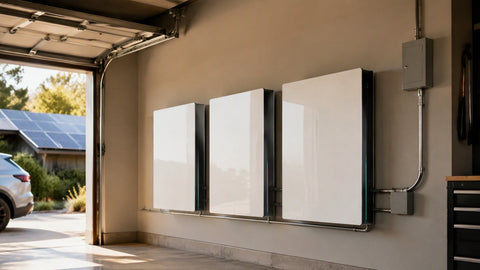
If you're running LFP — the chemistry behind essentially every current rack-mount and wall-mount solar battery we stock, from 100 Ah building blocks and 200 Ah workhorses up through 10 kWh and 15 kWh class banks — the practical 2026 rules are: cycle as deep as your loads require, charge to 100% regularly for balancing, keep the bank within its temperature window, and size the bank so daily use lands in the 60–80% DoD band when you can afford the headroom. If you're comparing whole-home options, the Generac PWRcell cost guide is a useful benchmark against the modular LFP banks in our battery storage collection, and the backup runtime calculator turns your critical loads into a concrete kWh target before you spend anything.
Daily Habits That Still Matter in 2026

For the NMC devices in your life — phones, laptops, tablets, most EVs — the classic advice holds, with heat management at the top of the list:
| Practice | Why It Matters | How To Do It |
|---|---|---|
| Keep Your Device Cool | Heat is the #1 enemy of batteries | Remove case while charging; avoid direct sunlight |
| Avoid Charging During Heavy Use | Gaming + charging = excessive heat | Charge when idle; take breaks during intensive tasks |
| Don't Leave in Hot Cars | Car interiors can exceed 60°C (140°F) | Take devices with you; use insulated bags if necessary |
| Be Mindful of Wireless Charging | Generates more heat than wired | Use wired charging when possible; watch for warmth |
| Enable Smart Charging | Automatically optimizes charge cycles | Turn on "Optimized Battery Charging" or equivalent |
| Avoid Complete Discharge | Deep discharge stresses the battery | Charge when hitting 15-20%; don't wait for 0% |
| Store at 50% (Long-term) | Most stable state for idle batteries | Charge to ~50%, power off, store in cool place |
Notice what's not on that list: "never charge to 100%." Occasional full charges are fine on any modern chemistry. The damage case is habitual — parking at 100% for days, in the heat, every week of the year. A full charge before a road trip or a long power-outage forecast costs a battery essentially nothing.
Myths You Should Ignore

| ❌ Myth | ✓ Fact |
|---|---|
| "You have to drain the battery to 0% to calibrate it." | This was true for nickel-cadmium batteries with memory effect. Modern Li-ion batteries don't require calibration, and deep discharge causes unnecessary stress. |
| "Charging overnight will damage the battery or cause explosions." | Modern devices stop charging at full capacity. With smart charging enabled, your device manages overnight charging safely and efficiently. |
| "Closing background apps saves battery." | Modern operating systems manage background apps efficiently. Force-closing apps actually uses more power when you reopen them. |
| "You should only use the charger that came with your device." | Any quality charger meeting safety standards (UL, CE) works fine. However, cheap knockoffs without certification can be dangerous. |
| "Fast charging destroys your battery." | Modern fast charging protocols adjust speed to minimize heat. The main concern is heat buildup—if the device stays cool, fast charging is fine. |
| "New batteries need to be 'conditioned' with full charge cycles." | Li-ion batteries are ready to use immediately. No break-in period required—just charge and use normally. |
Long-Term Storage: the 40-60% Rule

The one place a modified 20-80% rule still applies to every lithium chemistry is the shelf. For storage measured in months — a seasonal cabin bank, a spare e-bike pack, an RV battery over winter — charge to roughly 40–60%, disconnect all loads (including the always-on BMS parasitic draw where the design allows), and store cool: every 10°C below 25°C roughly halves the calendar aging rate. Check voltage every two or three months and top back up to the 50% area if the bank has drifted below it. Storing full is the second-worst option; storing empty is the worst, because self-discharge plus parasitic loads can drag a cell group below its safe minimum, at which point a protective BMS may refuse to let the pack charge again at all.
The Verdict on the 20-80% Rule in 2026

Is the 20-80% battery rule still valid in 2026?
So, is the 20-80% battery rule still worth it in 2026? It depends entirely on which battery you mean:
- Phones, laptops, most EVs (NMC): Yes. Staying in the middle band, avoiding heat, and using optimized charging still meaningfully extends lifespan — potentially doubling it.
- Solar and backup storage (LFP): Mostly no. Use your capacity, charge fully on a regular schedule for balancing, and spend your worry budget on temperature and bank sizing instead.
- Lead-acid anything: The rule runs in reverse — keep it full, recharge immediately after use, and never let it sit discharged.
The rule was never wrong; it was just written for a chemistry that no longer dominates every application. Match the habit to the chemistry in front of you and the math takes care of itself.
Frequently Asked Questions

What is the 20-80% battery rule?
The 20-80% rule says to keep lithium-ion batteries between 20% and 80% state of charge to slow degradation. It was developed for NMC lithium cells in phones, laptops, and EVs, where both full charges and deep discharges accelerate capacity loss.
Is the 20-80% battery rule still valid in 2026?
For NMC lithium devices like phones and most EVs, yes — staying between 20% and 80% meaningfully extends lifespan. For LiFePO4 batteries used in solar storage, the rule is mostly outdated: LFP tolerates 80–100% depth of discharge daily and still delivers 3,000–6,000 cycles.
Does charging to 100% damage my battery?
For NMC lithium, routinely holding at 100% accelerates wear, especially combined with heat. For LiFePO4, charging to 100% is not only safe but recommended periodically so the BMS can balance the cells.
What is the biggest factor in battery degradation?
Heat, followed by time spent at very high or very low states of charge. A battery kept cool at moderate charge levels will outlast an identical one stored hot at 100% regardless of cycling habits.
Should I let my battery drain to 0% to calibrate it?
No. The calibration habit came from nickel-cadmium batteries with memory effect. Modern lithium batteries do not need full discharges, and regularly hitting 0% causes unnecessary stress on the electrodes.
What is the best charge level for long-term battery storage?
Store lithium batteries at roughly 40–60% state of charge in a cool, dry place. For LiFePO4 solar batteries stored over winter, charge to about 50–60%, disconnect loads, and check voltage every few months.
Build a Battery Bank That Lasts


PES Supply stocks in-demand LiFePO4 batteries, hybrid inverters, and complete storage systems with same-day shipping from our US warehouse and installer-grade tech support on every order. Browse the battery storage collection, or run your loads through the backup runtime calculator and bring us the numbers — we'll help you size a bank that matches the DoD you actually plan to use.