Off-grid solar is the most unforgiving corner of this industry. A grid-tied design mistake costs efficiency; an off-grid design mistake costs lights, water, and heat — usually discovered in February, usually by the person who trusted the kit's marketing photo. We've designed and supplied off-grid systems from 400-watt van builds to 20 kW ranch compounds, and the pattern is always the same: the projects that work start with a ruthless load audit, and the projects that fail start with a shopping cart. This guide walks the full decision — system types, components, sizing math with the numbers shown, and real cost brackets — for installers, EPCs, and homeowners doing it right the first time.
How to Choose Your Off-Grid Solar System
Key Decision Framework
Four questions, in order, before any equipment talk. First: what's the daily energy budget in watt-hours, measured or honestly estimated? Second: how many days of autonomy — cloudy-day runtime from the battery alone — does the site's weather and your risk tolerance demand? Third: what's the largest surge load (pumps and compressors set the inverter size, not the total watts)? Fourth: what's the worst-month solar resource, because December sizes an off-grid array, not the annual average. Every number in the sizing section below hangs off those four answers.
Quick Guide to Off-Grid System Types by Application
| Application | Recommended System Type | Key Decision Factors | Best For |
|---|---|---|---|
| Remote Residential Cabin | Small to Medium Kit (3–5 kW) | Seasonal usage, moderate loads, 2–3 days of autonomy | Weekend getaways, hunting cabins, tiny homes |
| Agricultural Operation | Medium to Large Kit (5–15 kW) | High-draw equipment (pumps, irrigation), consistent daily use | Farms, ranches, water pumping stations |
| Commercial Communications | High-Reliability Custom System | 100% uptime, surge protection, 5+ days of autonomy | Cell towers, remote monitoring sites, critical infrastructure |
| Full-Time Residence | Large Custom System (8–20 kW+) | High daily consumption, appliance diversity, future expansion | Primary homes, properties far from grid access |
Deconstructing the Modern Off-Grid System
Solar Panels: The Power Generation Engine
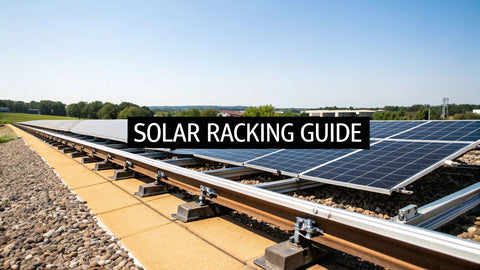
Off-grid arrays are sized to the worst month, so they run oversized relative to annual consumption — that's normal and correct. Monocrystalline is the only sensible choice now; polycrystalline is gone from serious supply chains. Bifacial panels earn a real premium on ground mounts over bright ground cover — snow in particular can push double-digit winter gains, exactly when off-grid systems are starving. Browse solar panels and the bifacial options in the same catalog; for ground-mount projects our 24-panel ground-mount racking kit is the backbone of a lot of the ranch systems we ship.
Charge Controllers: The System Guardian
MPPT, full stop. PWM controllers waste 20–30% of array potential by forcing the array to battery voltage — acceptable on a 200W van roof, malpractice on a 5 kW homestead. Size the controller for worst-case cold-array voltage and full array current with margin; our MPPT vs. PWM breakdown and the controller sizing guide run that math in detail. Proven units we stock: Victron SmartSolar 250/60 and 250/100 for mid-size arrays, MidNite MN3024DIY for budget builds.
Battery Storage: The Energy Reservoir
LFP has taken over serious off-grid storage for the same reasons it took residential: 4,000–6,000 cycle life at 90% DoD, no maintenance, no ventilation requirements, and no sulfation death from sitting partial-charged — the failure mode that killed generations of lead-acid banks. Rack-format 48V modules like the Fortress eFlex Max 5.4 kWh and wall-mount units in our battery catalog scale from cabin to compound. Lead-acid still wins one niche: extreme cold below LFP's charging limits, or budgets where upfront cost trumps everything — but run the 10-year replacement math before choosing it. Three lead-acid replacements cost more than one LFP bank.
Inverters: The Power Converter
The inverter-charger is the heart of an off-grid system and the component where cheap hurts most. Requirements: pure sine wave (anything less damages motors and electronics), surge rating 2–3× continuous for motor starting, and — for any serious installation — a generator input with automatic start control, because even the best-designed off-grid system wants a generator for the darkest weeks and maintenance days. The Sol-Ark 8K, EG4 FlexBOSS21, and MidNite MNEMS4448PAECL150 pre-wired system cover most builds we supply; classic off-grid territory is also served by the OutBack Power and Victron Phoenix lines for smaller pure-sine applications.
Comparing Off-Grid Solar Kits for Real-World Scenarios
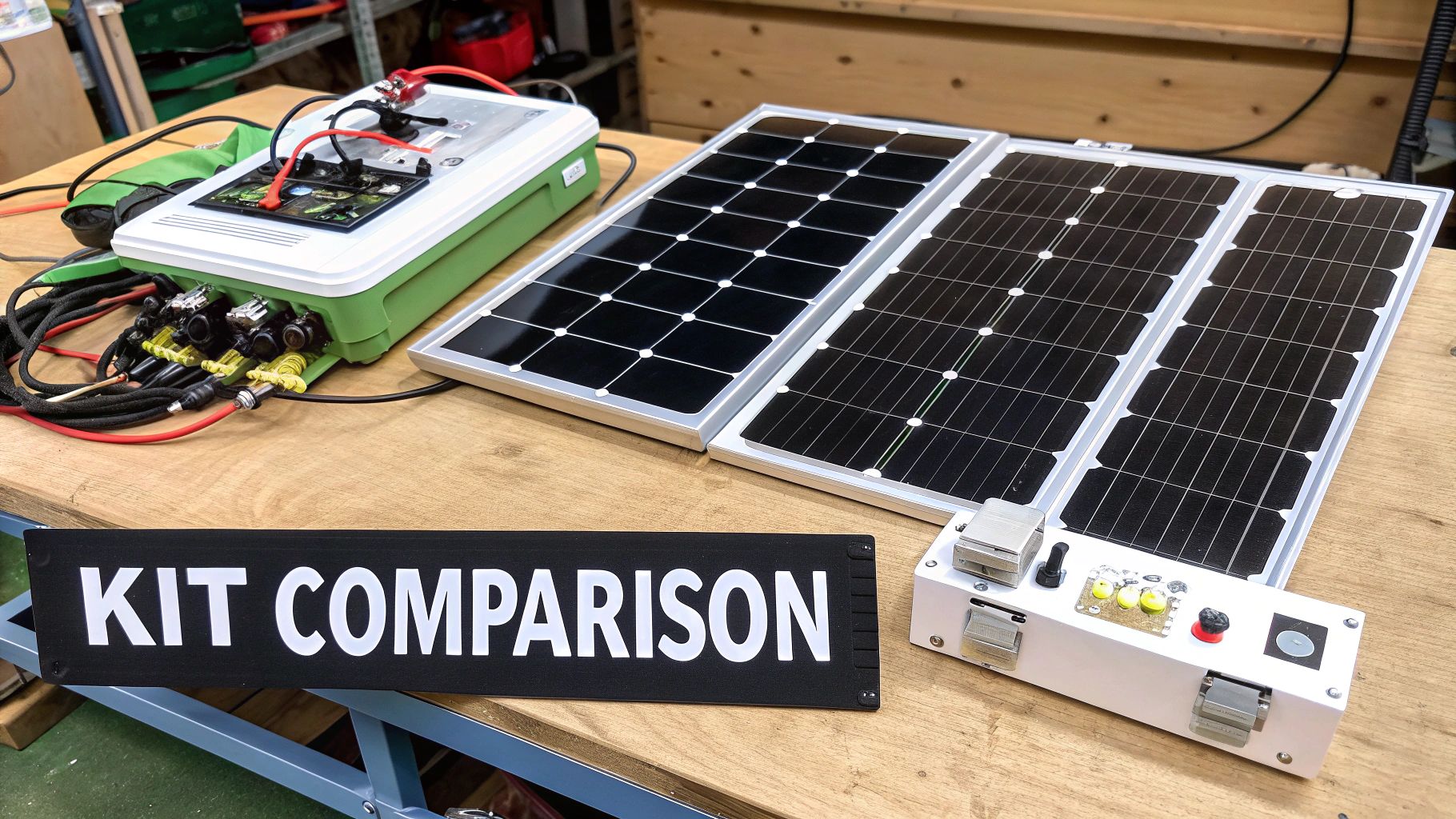
| System Scenario | Key Components (Brands) | PV Array Size (kW) | Battery Capacity (kWh) | Estimated Cost Bracket | Best Use Case |
|---|---|---|---|---|---|
| Remote Residential Cabin | Monocrystalline panels, hybrid inverter, LFP battery | 3–5 kW | 10–15 kWh | $15,000–$25,000 | Weekend homes, tiny houses, seasonal cabins |
| Mid-Sized Agricultural Op | Tier 1 panels, Sol-Ark/Sungrow-class inverter, LFP bank | 8–15 kW | 20–40 kWh | $30,000–$60,000 | Farms, irrigation pumps, remote workshops |
| Critical Commercial Tower | Bifacial panels, redundant inverters, high-capacity LFP | 15 kW+ | 50–100+ kWh | $70,000+ | Telecom sites, SCADA systems, essential infrastructure |
Those brackets include equipment and typical install scope — panels, racking, inverter, batteries, wire, protection — and they're honest 2026 numbers, not 2019 nostalgia. Where quotes vary wildly is civil work (trenching, ground-mount foundations) and the generator integration. If two quotes for the "same" system differ by 40%, the difference almost always lives in those two lines, so ask each bidder to break them out before you compare totals.
Sizing Your System for Maximum Reliability
Step 1: Conduct a Meticulous Load Analysis
List every load with its watts and honest daily hours. A worked cabin example:
| Appliance | Wattage | Daily Hours | Daily Watt-Hours |
|---|---|---|---|
| Refrigerator (Energy Star, cycling) | 150 W | 8 | 1,200 Wh |
| LED lighting (whole cabin) | 60 W | 5 | 300 Wh |
| Well pump (1/2 HP) | 750 W | 1 | 750 Wh |
| Laptop + internet/Starlink | 100 W | 6 | 600 Wh |
| TV / entertainment | 120 W | 3 | 360 Wh |
| Microwave | 1,000 W | 0.25 | 250 Wh |
| Ceiling fans (2) | 150 W | 6 | 900 Wh |
| Total daily consumption | — | — | 4,360 Wh (4.36 kWh) |
Verify with a plug-in energy monitor on the big loads for a week if the building exists; nameplate watts lie in both directions. The surge column matters as much as the energy column: that 750W well pump wants 2,200–3,000W for a second at startup, which sets the inverter's surge floor.
Step 2: Determine Required Days of Autonomy
Days of autonomy = how long the battery alone carries the load with zero solar input. Guidance from the field: 2 days for weekend cabins in decent climates, 3 days for full-time homes, 5+ for critical infrastructure. Each added day is linear battery cost, so this is where reliability meets budget — and where a small backup generator earns its keep, converting "5 days of battery" into "2 days of battery plus a $900 inverter generator for the tail."
Step 3: Size Your Battery Bank — Full Math
| Step | Calculation | Result |
|---|---|---|
| Daily consumption | From load audit | 4.36 kWh |
| Days of autonomy | Cabin, 2.5 days | 4.36 × 2.5 = 10.9 kWh usable |
| Depth of discharge (LFP at 90%) | 10.9 ÷ 0.90 | 12.1 kWh nameplate |
| Temperature/cold derate (unheated space, 10%) | 12.1 × 1.10 | 13.3 kWh |
| In battery-bank terms (48V) | 13,300 ÷ 48 | ≈ 277 Ah at 48V |
| Actual configuration | 3 × 5.4 kWh LFP modules | 16.2 kWh installed — margin for growth |
Step 4: Calculate Your Solar Array Size
| Step | Calculation | Result |
|---|---|---|
| Daily consumption | From Step 1 | 4.36 kWh |
| Worst-month peak sun hours (site-specific; example: northern tier, December) | PVWatts/local data | 2.5 PSH |
| System derate factor (temperature, wiring, soiling, charge efficiency) | 0.75 combined | — |
| Minimum array | 4.36 ÷ 2.5 ÷ 0.75 | 2.33 kW |
| With 20% growth margin | 2.33 × 1.2 | 2.8 kW |
| Actual configuration | 7 × 450W modules | 3.15 kW array |
The derate factor is where optimism sneaks in. Cold helps panel voltage, but soiling, wire losses, controller efficiency (~97–98%), and battery round-trip losses (~95%) stack to 0.70–0.80 honestly. Use 0.75 and sleep through December.
Wiring the Bank: Ampacity Check
DC side currents surprise people: 3.15 kW charging into a 48V bank is 3,150 ÷ 48 ≈ 66A of charge current — size controller and wire for 80A-class duty (1.25× NEC continuous multiplier: 66 × 1.25 = 82.5A → #4 AWG copper at 75°C per NEC 310.16 carries 85A). The inverter side is heavier: an 8 kW inverter at 48V pulls up to 8,000 ÷ 44 (low-battery cutoff) ≈ 182A continuous, which needs 2/0 copper (175A at 75°C, so verify against 90°C ratings and termination limits — many designers go 4/0 for margin) with a 250A-class DC breaker. Details in our ampacity chart and NEC wire sizing guide.
Scenario Deep Dives: What the Three Builds Actually Look Like
Scenario 1: The Remote Residential Cabin
The cabin build above — 4.36 kWh/day, 3.15 kW array, 16.2 kWh of LFP, an 8 kW hybrid inverter — is the modal off-grid project we ship, and its design philosophy is restraint. The discipline isn't in the equipment; it's in the load list. Propane does the heavy thermal work (cooktop, water heat, backup space heat), because electric resistance heat would double the array and triple the battery for a building occupied 120 days a year. The generator is a small inverter unit that auto-starts through the hybrid inverter when the bank hits a setpoint — it runs maybe 40 hours a year, mostly in November. Total discipline cost: one honest conversation about what the cabin actually needs. Total system: right around $18,000–$22,000 installed by a competent owner-builder.
Scenario 2: The Mid-Sized Agricultural Operation
The ranch build is a different animal because the loads have hooves: stock-water pumping can't wait for sunshine, and a frozen trough in January is an animal-welfare emergency, not an inconvenience. The typical design: 10 kW bifacial ground mount, 30–40 kWh LFP bank in a conditioned powerhouse, a 12–15 kW inverter-charger with serious surge capacity for the pumps, and a 14–20 kW diesel or propane generator wired for automatic start. The generator isn't a compromise here — it's the component that lets the battery bank stay at 40 kWh instead of 80. We also spec lightning protection and surge devices aggressively on these sites; a long fence-line run in open country is a lightning collector, and the grounding and bonding guide is required reading before the first post goes in.
Scenario 3: The Critical Communications Tower
Telecom and SCADA sites invert the residential logic: the loads are small (a few kWh/day) but the availability requirement is absolute — 99.9%+ uptime, 5+ days autonomy, N+1 on the power electronics. Dual inverters, dual charge controllers, monitored everything, and usually a propane generator with a big tank as the last line. These are engineered systems with stamped drawings, not kits; the $70,000+ bracket reflects redundancy and civil work, not panel count. If you're speccing one, the conversation starts with the availability target and works backward to the hardware.
Generator Integration: The Component Everyone Needs and Nobody Plans

Design the generator in from day one even if you don't buy it yet. That means an inverter-charger with a proper AC-input/generator mode, a transfer path that doesn't require rewiring later, and ventilation/exhaust planning in the powerhouse layout. Generator sizing for battery charging: the charger stage will pull its rated current for hours, so a "2,000W generator" that bogs down charging a 48V bank at 60A (≈ 3,000W) is a mismatch we see constantly. Rule of thumb: generator continuous rating ≥ 1.25× the charger's maximum draw. And buy the generator for the worst case — starting a well pump while charging — not the average case.
Designing for Expansion
Off-grid systems grow — the cabin becomes a guesthouse, the workshop adds a welder, the family becomes full-time. Design the growth path at the start and expansion is a weekend; ignore it and expansion is a rebuild. Three cheap decisions that preserve the path: oversize the inverter-charger one class (an 8 kW unit where 5 kW suffices) so the AC side never strands; choose rack-format batteries so adding capacity is bolting in another module instead of replacing a bank; and leave physical space on the ground mount for a second array section, with conduit stubbed for it. The kit route handles the first build well; the modular discipline is what makes the second build cheap.
Monitoring: You Can't Manage What You Can't See
Remote sites need remote eyes. Every off-grid system we ship includes monitoring — state of charge, array yield, generator run hours, and alarm push notifications at minimum — because the first symptom of a problem (a tripped controller, a failed generator start) is invisible until the battery dies if nobody's watching. A $200 monitoring gateway has saved more than one customer's battery bank from a weeks-long undetected fault. If the site has Starlink, you have no excuse; if it doesn't, cellular monitors or scheduled local check-ins close the gap.
Understanding the True Cost of Going Off-Grid
Hidden Costs & Soft Costs Checklist
The line items that blow up off-grid budgets: ground-mount foundations or pole mounts; trenching between array, powerhouse, and home; the DC disconnects, combiners, and surge protection (SPD sizing guide — non-optional on long rural runs that attract lightning); a backup generator plus fuel storage; battery enclosure/conditioning in cold climates; monitoring hardware with remote alerts; and permits, which apply off-grid too in most counties. On a $30,000 equipment build, expect $5,000–$12,000 of the above depending on site work.
Calculating Your Return on Investment
Off-grid ROI isn't a rate-arbitrage game — it's a avoided-infrastructure game. The comparison is against the utility's line-extension quote, which for rural parcels routinely runs $20–$50 per foot: a half-mile extension is a $50,000+ check to the utility for the privilege of a monthly bill. Against that benchmark, a $35,000 full-time-home system pays back instantly and keeps paying. If the grid is already at the property line, the honest advice is to connect — off-grid economics require distance from infrastructure or a reliability mandate.
Tapping into Financial Incentives
Off-grid systems qualify for the 30% federal Investment Tax Credit — storage included, even standalone. USDA REAP grants can cover a significant share for qualifying agricultural operations; that program alone has funded a meaningful slice of the ranch systems we've supplied. State programs vary wildly. File the paperwork before purchase where programs require pre-approval.
A note on claiming the ITC for off-grid: the credit applies to the solar and storage equipment and its installation, not to generators, site grading, or the propane line. Keep the invoice broken out by category from day one — the tax-preparer conversation in April goes much better when the equipment lines are clean, and we've watched customers leave real money unclaimed because one bundled invoice couldn't be substantiated.
Frequently Asked Questions About Off-Grid Solar
What Are the Most Common Mistakes When Designing an Off-Grid System?
Undersizing the battery (using nameplate kWh instead of usable kWh after DoD), sizing the array to annual-average sun instead of worst-month, ignoring surge loads when picking the inverter, and skipping the backup generator. All four come from designing to the brochure instead of the load audit.
How Do I Choose Between Lead-Acid and Lithium-Ion Batteries?
LFP lithium for almost everything now: 4,000–6,000 cycles at 90% DoD versus 500–1,200 cycles at 50% DoD for lead-acid, with no maintenance and no sulfation risk. Lead-acid survives only where upfront budget dominates or where unheated spaces sit below LFP's charging-temperature limits for weeks at a time.
Can I Install an Off-Grid Solar System Myself?
Competent DIYers build cabins and van systems routinely — pre-wired inverter systems and modern all-in-ones have lowered the bar considerably. For full-time residences, hire out at least the design review and the AC panel work: 48V battery banks hold lethal energy, and the permitting/insurance picture for owner-built primary residences varies by county.
How Much Maintenance Does an Off-Grid System Require?
Modern LFP-based systems: panel cleaning seasonally, a quarterly connection and torque check, firmware updates, and generator exercise if you have one. Figure a half-day per quarter. Lead-acid banks multiply that by five — watering, equalizing, terminal cleaning — which is part of why they've lost the market.
How many solar panels do I need to live off-grid?
Panels follow the load audit, not the house size. A frugal cabin at 4–5 kWh/day needs 2.5–3.5 kW (6–8 modern 450W panels) at typical northern winter sun; a full-time all-electric home at 20–30 kWh/day needs 10–20 kW. Work the four-step sizing math above with your worst-month sun hours — that's the only honest answer.
Do off-grid systems work in winter?
Yes, if designed for it: array sized to December production, battery bank conditioned or indoors, steep tilt or ground-mount for snow shedding, and a generator for extended dark stretches. The systems that fail in January were designed to September's sunshine.
Build It Once, Build It Right
Send us your load list and site location — we'll return a sized system with the worst-month math shown, two or three kit configurations at different price points, and the honest note about where a generator belongs. Start with DIY solar kits for cabin-scale builds, complete storage systems for larger sites, and the component catalogs above. Related reading: battery bank sizing, off-grid storage calculations, and battery counts for a 4 kW system.