🇺🇸/🇲🇽 Versión en español →
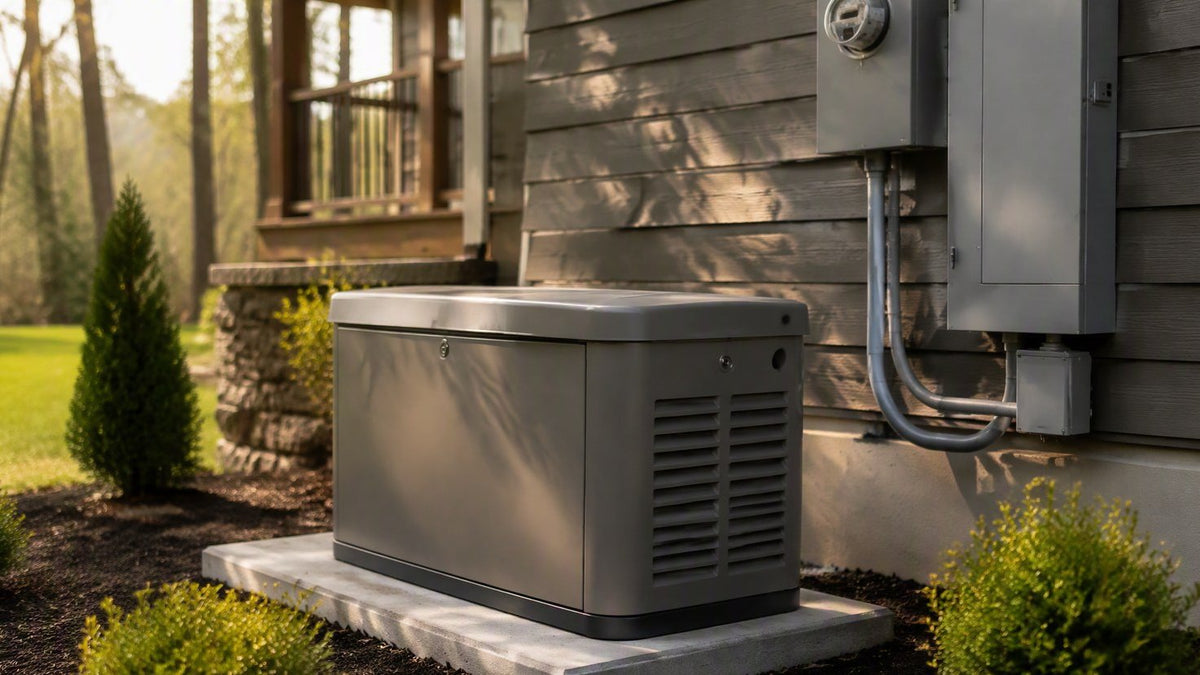
The most common question we hear from contractors and homeowners alike is deceptively simple: how many kW does a whole home generator actually need to be? The honest answer is that "whole home" is not a size — it is a load calculation. A 22 kW air-cooled unit that comfortably carries a 2,200 sq ft home in Michigan will stall trying to start a 5-ton compressor in Houston. This guide walks through the same sizing methodology we use when speccing standby generators for residential jobs: load calculation, motor starting, service-entrance constraints, fuel derating, and the point where you stop shopping air-cooled and step up to liquid-cooled.
Spec Sheet — Whole-Home Sizing at a Glance
- Sweet-spot units: 14 kW (small / essential loads) · 18 kW (1,500–2,000 sq ft) · 22 kW (most 200A homes) · 26 kW (top of air-cooled class)
- AC starting rule: ~5 kW of headroom per conventional compressor ton · ~2 kW per ton with a soft starter
- Load calc: NEC 220.82/220.83 optional method — 40% demand factor above the first 10 kW
- Derating: −3% per 1,000 ft elevation · −1–2% per 10°F above 77°F · −8–10% on natural gas vs LP
- Step-up trigger: calculated load > 24–26 kW, multi-week outage duty, or light-commercial use → liquid-cooled 30–60 kW
Step 1: Run a Load Calculation, Not a Guess


NEC Article 220 gives you two legitimate paths, and both are defensible with your AHJ:
- Standard method (NEC 220 Part III): 3 VA per square foot of living area, plus 1,500 VA per small-appliance branch circuit, 1,500 VA for laundry, nameplate ratings for fixed appliances, and HVAC at 100% of the larger of heating or cooling. Demand factors apply to ranges, dryers, and general lighting after the first 10 kVA.
- Optional method (NEC 220.82/220.83): The contractor favorite for dwellings. Take the total connected load and apply a 40% demand factor on everything above the first 10 kW. For most existing homes the optional method lands 30–50% below the standard method, and it is what makes a 14–18 kW generator viable on houses that "calculate out" much larger.
NEC 702.4 requires that an optional standby system have the capacity to supply all loads it is intended to serve — or that load-shedding equipment automatically prevents overload. That second clause is the engineering escape hatch: a properly configured load-management system lets you install a smaller generator legally, because the ATS sheds the water heater or second compressor before the genset ever sees it.
Air conditioning is the sizing driver in almost every American home. The rough math:
- Running draw: ~1.0–1.5 kW per ton for modern condensers (a 3-ton unit runs around 3.5–4.5 kW including the blower).
- Locked-rotor starting: 3–5× running current on a conventional single-stage compressor. That 3-ton unit can demand 12–18 kW for a fraction of a second.
- Soft-start / inverter-driven: A soft-start kit or variable-speed condenser cuts inrush by 60–70%, which is why a 14 kW generator with a soft starter often outperforms an 18 kW unit without one.
Rule of thumb the field actually uses: count ~5 kW of generator headroom per conventional AC ton you intend to start, or ~2 kW per ton with a soft starter. Two 3-ton compressors that might cycle simultaneously are the classic case that pushes a house from an 18 kW to a 22–26 kW unit.
The optional method is where most residential sizing jobs are actually won or lost, so here is the full walkthrough we run on a real house. Example: 2,400 sq ft all-gas home, 200A service, one 4-ton conventional AC.
- General load: 2,400 sq ft × 3 VA = 7,200 VA, plus two small-appliance circuits (3,000 VA) and laundry (1,500 VA) = 11,700 VA.
- Nameplate appliances: range 8,000 VA, dryer 5,000 VA, dishwasher 1,200 VA, disposal 900 VA, garage door 800 VA. Running subtotal: 27,600 VA.
- Apply the demand factor: first 10 kW at 100%, remainder at 40% → 10,000 + (17,600 × 0.40) = 17,040 VA ≈ 17 kW diversified.
- Add HVAC correctly: the AC's running load (≈4.8 kW with blower) is already covered inside the diversified figure for most calcs; what the calc does not capture is locked-rotor inrush. That is a generator-selection problem, not a demand problem — handle it with the per-ton headroom rule from Step 2.
- Result: 17 kW diversified + a 4-ton conventional start (~16 kW momentary) → a 22 kW unit with a soft starter, or 26 kW without one. That is the decision, in one line of arithmetic.
The demand factors that do the heavy lifting:
| Load Block | NEC 220.83 Treatment | Field Note |
|---|---|---|
| First 10 kW of connected load | 100% | Assumes the base household load is always on |
| Remainder of general + appliance load | 40% | The discount that makes 14–22 kW units viable |
| Heat pump / AC (no supplemental heat) | 100% of nameplate, larger of heat or cool | Starting inrush handled separately via headroom |
| Electric thermal storage / strip heat | 100%, no diversity | The load that breaks small-generator plans |
| EV charger circuit | 100% continuous | Shed it during outages or size for it fully |
Planning a standby install? Get a whole-home generator quote — units in stock at 12+ PES hubs, or browse our generator lineup.
Assumes gas heat (electric resistance heat changes everything — see below), standard appliance set, and optional-method load calc.
| Home Size | HVAC | Typical Generator | Notes |
|---|---|---|---|
| 1,000–1,500 sq ft | 1.5–2.5 ton, single system | 10–14 kW | 14 kW covers AC start on most single-compressor homes |
| 1,500–2,000 sq ft | 2.5–3.5 ton | 14–18 kW | 18 kW if well pump, sump, or electric dryer are on the backed-up panel |
| 2,000–3,000 sq ft | 3.5–5 ton, or two systems | 18–22 kW | 22 kW is the volume seller for a reason — covers most 200A homes with load management |
| 3,000–4,000 sq ft | 5 ton + second system, pool equipment | 22–26 kW | 26 kW air-cooled or step up to liquid-cooled |
| 4,000+ sq ft | Multiple systems, guest house, shop | 30–48 kW liquid-cooled | Air-cooled tops out here — see below |

Electric heat warning: 10 kW of resistance strip heat is a real, continuous 10 kW. Homes with electric strip backup heat almost always need load management or a generator one tier larger than the table suggests.
- 14 kW: Right for smaller homes, essential-loads-only installs, or paired with a soft starter and load-shed modules. Marginal for a 3.5-ton compressor without help.
- 18 kW: The sweet spot for 1,500–2,000 sq ft with one AC. Handles a 3-ton start plus kitchen and lighting loads.
- 22 kW: The default whole-home answer for 200A services in the 2,000–3,000 sq ft band. Starts a 4-ton conventional compressor while carrying the rest of the house, and pairs natively with a 200A service-entrance-rated ATS.
- 26 kW: The top of the air-cooled class. Buys you a second AC start, pool equipment, or a workshop circuit without load shedding.
After hundreds of these jobs, the callbacks almost never come from the kW math — they come from the site details nobody put on the quote:
- Gas meter and piping capacity. A 22 kW unit at full load pulls roughly 280–330 cu ft/hr. Half the "undersized generator" complaints we see are actually undersized gas services starving the unit at the worst moment. Verify meter BTU rating and pipe run sizing before finalizing the model.
- What is actually on the backed-up panel. Homeowners remember the fridge and forget the sump pump, the well pressure tank, the septic aerator, and the garage freezer full of venison. Walk every breaker, not the kitchen.
- Compressor type on the existing condenser. Two-stage and inverter-driven systems change the starting math completely. Read the condenser data plate; do not assume.
- Future loads in the next five years. A pool, a hot tub, an EV, a shop welder, a kitchen addition. Sizing to today's panel with zero headroom guarantees a undersized unit by 2029.
- Setback, clearance, and sound ordinances. Most jurisdictions want 5 ft from openings, 3 ft working clearance, and some HOA or municipal noise caps at the property line. A 3,600 RPM air-cooled unit in the wrong spot generates neighbor complaints that become your problem.
- Exercise schedule and firmware. Units that never exercise die early, and controllers with stale firmware mis-report faults. Put both on the commissioning checklist.
The generator does not exist alone — it ships as a system with an automatic transfer switch. Match the ATS to the service, not the generator:
- 100A service: A 100A service-entrance-rated ATS carries the whole panel. Generator sizes 14–18 kW are typical; the switch, not the genset, is usually the constraint on what stays live.
- 200A service: You need a 200A SE-rated ATS (the standard pairing for 22/26 kW packages) or a sub-panel strategy backing up selected circuits only. A service-rated switch is also your service disconnect, which simplifies the permit drawing.
- Load management: Modules that shed the water heater, dryer, or second compressor let a smaller generator serve a bigger panel. Budget them into the quote — they are cheaper than stepping up a generator tier.
Browse matched units and switches in our Generac and automatic transfer switch collections.
- Natural gas: Zero refueling, unlimited runtime, but expect roughly 8–10% output derate versus the LP rating on the same air-cooled unit, and you must verify gas meter and piping capacity (a 22 kW unit at full load pulls ~280–330 cu ft/hr — many residential meters need a utility upgrade).
- LP (propane): Full nameplate output, stable storage, but a 22 kW at full load burns ~3.5–4 gal/hr. A 500-gallon tank is the practical minimum for whole-home duty; 1,000 gallons for multi-day autonomy.
- Diesel: The liquid-cooled and commercial answer. Better fuel economy under heavy load, longest engine life, on-site storage with polishing requirements. Overkill under ~30 kW residential.
Nameplate kW is a sea-level, 77°F number. Plan on roughly 3% output loss per 1,000 ft of elevation on naturally aspirated gas engines, plus 1–2% per 10°F above 77°F ambient. A 22 kW unit installed at 5,000 ft in Denver is effectively a 19 kW unit before summer heat. At elevation or in extreme heat, size up a tier or step to liquid-cooled, which derates more gracefully.
Air-cooled standby units top out around 26 kW and are engineered for outage duty measured in hours to days. Step up to liquid-cooled — Kohler, the Generac Protector line, or Briggs & Stratton Fortress — when any of these apply:
- Calculated load exceeds ~24–26 kW (large homes, multiple HVAC systems, electric heat)
- Multi-week outage duty is realistic (rural grids, hurricane zones)
- Quieter operation is required — liquid-cooled units run 1,800 RPM vs 3,600 RPM air-cooled
- The application is light-commercial: offices, small retail, agricultural
Liquid-cooled costs meaningfully more upfront and on installation, but the engine life and load tolerance are a different class of machine.
Field takeaway: Run the NEC 220.82 optional-method calc, count 5 kW of headroom per conventional AC ton (2 kW with soft start), match the ATS to the service amperage, and derate for altitude and heat. If the number lands above 24 kW, stop comparing air-cooled models and quote liquid-cooled. The generator that is one tier too small is the one you get the callback on.
Frequently Asked Questions
Can a 14 kW generator run a whole house?
Yes — for smaller homes (roughly under 1,500 sq ft) with a single AC of 2.5 tons or less, gas heat, and a disciplined load set. On larger homes, a 14 kW unit works only as an essential-loads system or with aggressive load management and a soft starter on the compressor. Run the NEC optional-method calc before committing.
What size generator do I need for a 2,000 sq ft house?
For a typical 2,000 sq ft home with one 3–3.5 ton conventional AC and gas heat, 18 kW covers the load with starting headroom; step to 22 kW if you have a well pump, electric dryer, or want whole-home coverage without load shedding. Electric resistance heat pushes you up at least one tier.
Is it cheaper to oversize the generator or add load management?
Load management, almost every time. Shed modules for a water heater, dryer, or second compressor cost a few hundred dollars each installed, while stepping from 18 kW to 26 kW adds thousands to equipment and installation. The exception is when you genuinely need simultaneous heavy loads during every outage — then buy the capacity.
How long can a standby generator run continuously?
Air-cooled units are engineered for outage duty measured in hours to a few days; most manufacturers recommend a shutdown and oil check every 24–48 hours of continuous running. For multi-week duty — rural grids, hurricane zones — liquid-cooled units with larger oil capacity and 1,800 RPM engines are the correct tool.
Does a standby generator add value to a home?
In outage-prone markets, consistently yes — appraisers and buyers in Gulf Coast, Florida, and rural-grid regions treat a permitted, professionally installed standby system as a real asset. The resale premium tracks install quality: permitted, service-rated ATS, documented maintenance. A DIY unit without permits adds little and can complicate a sale.
Do I need a permit to install a whole home generator?
Effectively always. A standby install touches the electrical service (transfer switch), the fuel system (gas piping or LP tank), and usually requires setbacks and inspections. Beyond code compliance, the permit record is what protects the manufacturer's warranty and your homeowner's insurance position after a claim.
- NEC (NFPA 70) Article 220 — Branch-Circuit, Feeder, and Service Load Calculations (nfpa.org)
- NEC Article 702 — Optional Standby Systems (nfpa.org)
- NFPA 37 — Standard for the Installation and Use of Stationary Combustion Engines and Gas Turbines (nfpa.org)
- Generac protector/guardian series specification sheets (generac.com)
- Kohler residential standby generator specification sheets (kohlerpower.com)
- Cummins Power Generation residential spec sheets (cited by document name)
Ready to price your project? Quote My System — free from PES.
Related Resources:
- Best Solar Panels 2026 — Buyer's Guide
- EG4 vs Tesla Powerwall
- Qcells vs Trina vs JA
- Solar Inverter Buyer's Guide
- Solar Battery Buyer's Guide
- 5kW Solar Kit
- 10kW Solar + Battery Kit
- Off-Grid Cabin Kit
- EG4 Batteries
- Qcells Solar Panels
- Trina Solar
- JA Solar
- REC Solar
- Mission Solar
- Sol-Ark Inverters
- SolarEdge Inverters
- Generac PWRcell
| Generator kW | Full-Load Amps @ 240V | NEC 125% Wire Size (Copper) | Breaker Size |
|---|---|---|---|
| 10 kW | 41.7 A | #8 AWG THHN | 50 A |
| 14 kW | 58.3 A | #6 AWG THHN | 70 A |
| 16 kW | 66.7 A | #4 AWG THHN | 80 A |
| 20 kW | 83.3 A | #3 AWG THHN | 100 A |
| 22 kW | 91.7 A | #2 AWG THHN | 100 A |
| 26 kW | 108.3 A | #1 AWG THHN | 125 A |
| 30 kW | 125.0 A | 1/0 AWG THHN | 150 A |
| 38 kW | 158.3 A | 2/0 AWG THHN | 175 A |
| Generator Size | NG @ 50% Load | NG @ 100% Load | LP @ 50% Load | LP @ 100% Load | 250-gal LP Runtime @ 50% |
|---|---|---|---|---|---|
| 14 kW | 1.6 ft³/hr | 2.9 ft³/hr | 0.68 gal/hr | 1.25 gal/hr | 368 hrs |
| 20 kW | 2.3 ft³/hr | 4.2 ft³/hr | 0.98 gal/hr | 1.80 gal/hr | 255 hrs |
| 22 kW | 2.5 ft³/hr | 4.6 ft³/hr | 1.08 gal/hr | 1.98 gal/hr | 231 hrs |
| 26 kW | 3.0 ft³/hr | 5.5 ft³/hr | 1.28 gal/hr | 2.35 gal/hr | 195 hrs |
| 38 kW | 4.3 ft³/hr | 7.9 ft³/hr | 1.85 gal/hr | 3.40 gal/hr | 135 hrs |
Browse our standby generators, generator + transfer switch kits, 100–125A transfer switches, and generator accessories including soft-start modules, load-shed controllers, and maintenance kits.