We've unloaded containers of both technologies, and the honest answer in 2026 is simpler than the forum arguments suggest: polycrystalline is a legacy technology, monocrystalline is the market, and the only question left is which flavor of mono you buy. But "which is best" deserves a real answer with numbers, because there are still edge cases — tight budgets, surplus stock, off-grid cabins — where the old blue panels earn their keep.
This guide compares monocrystalline and polycrystalline solar panels on efficiency, temperature behavior, degradation, cost per watt, and real-world energy yield, using the same math we run when customers call our counter asking whether a pallet of discount poly modules is a bargain or a boat anchor. Every table below is computed from published datasheet values, NREL degradation research, or NEC-standard electrical math — no hand-waving.
The Real Difference in 2026
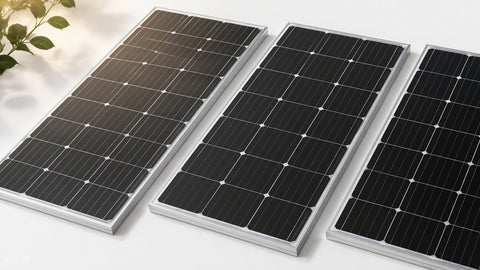
Both panel types are crystalline silicon. The difference is how the silicon ingot is grown. Monocrystalline cells are sliced from a single continuous crystal pulled by the Czochralski process — one uniform lattice, which lets electrons move with less resistance and fewer recombination losses. Polycrystalline cells are cast from melted silicon fragments that cool into many grains; every grain boundary is a tiny speed bump for current, and under a microscope a poly cell looks like a blue mosaic.
That single structural fact cascades into everything else: efficiency, heat tolerance, appearance, and ultimately price per watt. I still remember pulling a poly 250W panel off a 2013 install last summer — it was making about 215W after eleven Arizona summers, which is actually respectable. The problem was never that poly panels don't work. The problem is that a modern mono panel makes nearly twice the power in the same footprint, and footprint is what you're short on.
The manufacturing economics flipped too. Czochralski pullers got faster, diamond-wire saws cut kerf loss, and wafer sizes standardized at 182mm and 210mm. By 2021 the cost per watt of mono cells dropped below poly, and the industry didn't look back. Poly's last advantage — cheaper casting — evaporated the moment mono wafers became the volume standard.
| Attribute | Monocrystalline | Polycrystalline |
|---|---|---|
| Cell structure | Single continuous silicon crystal | Multiple silicon grains, cast ingot |
| Typical module efficiency (2026) | 20.5–23.0% (TOPCon/HJT up to 23%+) | 15–17% (legacy stock) |
| Typical residential wattage | 400–470W | 250–330W (discontinued lines) |
| Temperature coefficient (Pmax) | −0.29 to −0.35 %/°C | −0.38 to −0.41 %/°C |
| Appearance | Uniform black or dark blue-black | Blue, speckled/marbled |
| First-year degradation (LID) | ~1–2% | ~2–3% |
| Annual degradation after year 1 | 0.40–0.55%/yr | 0.55–0.70%/yr |
| Typical product warranty | 25 years (some 30) | 10–25 years (legacy) |
| Performance warranty | 25–30 years at 84.8–87.4% | 25 years at ~80% |
| Low-light behavior | Better spectral response at dawn/dusk | Noticeably weaker in diffuse light |
| Manufacturing status 2026 | ~99% of new Tier 1 production | Effectively discontinued by majors |
Efficiency Math: What the Percentages Buy You
Efficiency only matters when area is scarce — but area is almost always scarce. Here is the math on a real 8 kW residential target, using the standard residential module footprint of roughly 17.6 ft² per panel (about 1.7 m × 1.0 m):
| Scenario | Panel Wattage | Panels for 8 kW | Roof Area Needed | Extra Penetrations vs Best Case |
|---|---|---|---|---|
| Modern mono TOPCon, 22.5% eff. | 440W | 19 (8.36 kW) | ~335 ft² | 0 |
| Mainstream mono PERC, 21% eff. | 410W | 20 (8.2 kW) | ~352 ft² | ~2–3 flashings |
| Legacy poly, 16.5% eff. | 320W | 25 (8.0 kW) | ~440 ft² | ~12 flashings |
| Old poly stock, 15.5% eff. | 280W | 29 (8.12 kW) | ~510 ft² | ~20 flashings |
That last row is the killer. Twenty-nine panels means ten more rail attachment points, ten more roof penetrations to flash and seal, roughly 25% more balance-of-system hardware, and an extra day of labor for a two-person crew. On most residential jobs the labor and racking delta alone — we figure $45–$70 per additional panel installed, including rail, clamps, and flashing — eats whatever you saved buying cheap modules. If you're pricing racking, our IronRidge XR rail guide and the Unirac SolarMount breakdown show what that per-panel hardware actually costs. Every extra penetration is also one more potential leak point in year fifteen.
Temperature Behavior: The Spec Nobody Reads
Panel wattage is rated at STC — 25°C cell temperature, 1,000 W/m² irradiance. On a summer roof, cells run 55–70°C regardless of air temperature, because dark glass in direct sun heat-soaks. Multiply the degrees above 25 by the temperature coefficient and you get real power loss. This is where mono's structural advantage shows up on your utility bill:
| Cell Temp | Mono TOPCon @ −0.30%/°C | Mono PERC @ −0.35%/°C | Poly @ −0.40%/°C |
|---|---|---|---|
| 25°C (STC lab) | 100.0% | 100.0% | 100.0% |
| 45°C (mild sunny day) | 94.0% | 93.0% | 92.0% |
| 60°C (typical hot roof) | 89.5% | 87.8% | 86.0% |
| 70°C (heat wave, dark shingles) | 86.5% | 84.3% | 82.0% |
On a 70°C-cell day, a 440W mono TOPCon panel is still making about 380W. A 320W poly panel is making 262W — and it started 120W behind at STC. The summer-afternoon gap, exactly when air conditioning load peaks and time-of-use rates spike, is where this difference compounds into money. We cover the seasonal side of this in our summer vs winter production analysis, and the newer cell architectures in the TOPCon vs HJT vs tandem comparison.
Degradation Over 25 Years: The Real Payback Number
Warranties tell you the floor, not the expectation. Field data from NREL's long-run degradation studies put modern mono around 0.4–0.5%/yr after a ~1.5% first-year light-induced drop; poly fleets averaged closer to 0.6–0.7%/yr, partly because grain boundaries host more defect sites. Compound the two curves side by side:
| Year | Mono (1.5% yr-1, then 0.45%/yr) | Poly (2.5% yr-1, then 0.65%/yr) | Gap |
|---|---|---|---|
| 1 | 98.5% | 97.5% | 1.0 pt |
| 5 | 96.7% | 94.9% | 1.8 pt |
| 10 | 94.5% | 91.7% | 2.8 pt |
| 15 | 92.3% | 88.5% | 3.8 pt |
| 20 | 90.0% | 85.3% | 4.7 pt |
| 25 | 87.8% | 82.1% | 5.7 pt |
On an 8 kW system producing ~11,500 kWh in year one, that 5.7-point gap at year 25 is roughly 660 kWh of lost production per year — about $100 annually at a $0.15/kWh retail rate, every year, for the rest of the system's life. Over the back half of the array's life that compounds into four figures. Warranty terms matter too; see our solar panel warranty explainer for what the paper actually guarantees versus the marketing language on the brochure.
Electrical Specs: String Design Consequences
Module choice changes your string math. Poly panels of the 280–320W class carry lower Voc (around 38–40V) and lower Vmp than modern 440W mono modules (Voc often 49–53V for 108-half-cell formats). Cold-weather Voc headroom per NEC 690.7 — using the record-low temperature correction — decides how many modules you can series before exceeding the inverter's 600V residential ceiling:
| Module Class | Typical Voc (STC) | Voc @ −10°C (×1.14) | Max Series on 600V Inverter (×0.95 headroom) |
|---|---|---|---|
| Modern 440W mono TOPCon | ~49.5V | ~56.4V | 10 modules |
| 410W mono PERC | ~37.2V (108HC) | ~42.4V | 13 modules |
| 320W legacy poly (60-cell) | ~39.8V | ~45.4V | 12 modules |
| 280W old poly (60-cell) | ~38.5V | ~43.9V | 12 modules |
Higher per-panel voltage isn't automatically better — check your inverter's MPPT window — but fewer, denser strings mean less home-run wire, and wire is real money at current copper prices. Our NEC wire sizing and ampacity chart covers the conductor math, and the series-wiring guide walks through string layout step by step.
Cost Per Watt: 2026 Street Pricing
Poly's only remaining pitch is price, so run the actual numbers. These are typical wholesale tiers we see at the counter — your market will vary, but the relationships hold:
| Source | Typical $/W | Cost for 8 kW Modules | Hidden Cost |
|---|---|---|---|
| New mono TOPCon, Tier 1 pallet | $0.28–0.38 | $2,240–3,040 | None — full warranty |
| New mono PERC, value brand | $0.22–0.30 | $1,760–2,400 | Shorter warranty on some lines |
| New-old-stock poly | $0.18–0.25 | $1,440–2,000 | +25% BOS and labor for extra panels |
| Used/surplus poly pulls | $0.10–0.20 | $800–1,600 | Unknown degradation, no warranty, +30% array size |
Add $700–$1,200 of extra racking, clamps, flashings, and labor to those bottom two rows for the larger array, and the "cheap" poly install often lands within a few hundred dollars of a new mono system that carries a 25-year warranty and 40% more production per square foot. We've done this quote comparison at the counter dozens of times; the surplus route only wins when the modules are nearly free and the ground is flat and empty.
Why Mono Kept Winning: The Cell Architecture Race
Poly didn't lose because of one bad year. It lost three technology races in a row. First, PERC (passivated emitter rear cell) added a dielectric layer to the back of mono wafers in the mid-2010s and captured an extra point of efficiency for pennies per watt — poly could adopt PERC too, but its lower starting point meant the same investment bought a smaller absolute gain, so the money flowed to mono lines. Second, diamond-wire wafer slicing cut mono's kerf loss and made thin mono wafers cheaper per piece than cast poly bricks. Third, half-cell architecture and multi-busbar layouts scaled better on uniform mono material, where current collection is predictable across the whole cell.
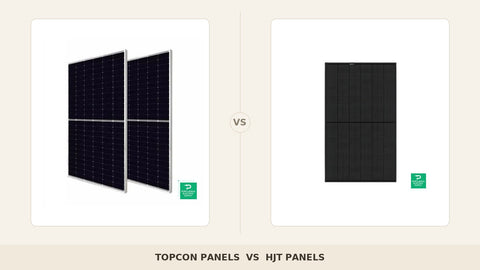
Now the frontier has moved again: TOPCon adds an ultra-thin tunnel oxide layer that pushes mass-production mono past 22.5% module efficiency, and HJT sandwiches amorphous silicon layers around the wafer for even better temperature coefficients (around −0.24%/°C on the best HJT datasheets). Every one of these architectures assumes a mono wafer as the starting material. Poly has no upgrade path left; the research labs stopped publishing poly results years ago. When you buy a panel in 2026, you are really buying into an architecture roadmap, and only one road still has pavement.
Worked Example: A Real Counter Quote
Last spring a customer brought in an auction listing: forty used 275W poly panels, $45 each — $1,800 for 11 kW of nameplate. Sounded great. We priced the complete job both ways. The poly route needed 40 panels tested and sorted (figure a day of labor right there), 40 sets of clamps, ten strings' worth of home-run cable, and a 40-rail ground-mount structure. The mono route was twenty-two 450W TOPCon panels at $0.32/W — $3,168 — with 18 fewer panels to mount, wire, and torque. Total installed cost came out within $900 of each other, and the mono system modeled 14% more annual kWh thanks to the better temperature coefficient and lower degradation, with a 25-year warranty the auction panels didn't have. He bought the mono. That $900 pays back in avoided kWh purchases in under three years at his co-op's rate, and he never has to wonder whether panel number seventeen is quietly dying.
How to Inspect Surplus or Used Poly Panels (If You Insist)
If the surplus route still makes sense for your project, treat it like buying a used truck — the inspection is the whole game:
| Step | What to Do | Pass Standard |
|---|---|---|
| 1. Visual | Check glass for chips, frame for twist, backsheet for burns or bubbles | No delamination, no snail trails across cells |
| 2. Voc test | Multimeter across leads in full sun, panel pointed at the sun | Within 5% of nameplate Voc |
| 3. Isc test | Multimeter in current mode, same conditions (brief test only) | Within 10% of nameplate Isc |
| 4. Diode check | Pop the junction box, inspect bypass diodes and potting | No corrosion, diodes test one-way |
| 5. Sort and label | Group tested panels into strings by matched Isc | String members within 3% of each other |
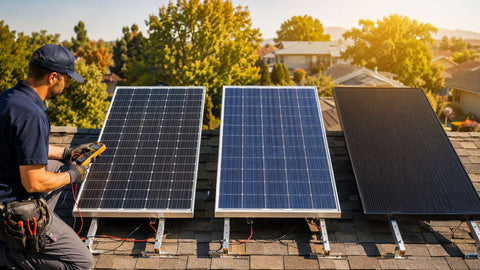
Reject anything with snail trails — those brown worm-like lines are microcracks bleeding moisture, and they only get worse. Budget to reject 10–15% of a used lot; build that into your per-watt math before you commit.
Durability, Hail, and End-of-Life
Durability differences between the two technologies are smaller than the efficiency gap, but they're real at the margins. Both use tempered glass and EVA or POE encapsulant; the glass doesn't care what color the cells are. What differs is how the cells handle mechanical stress. Poly's grain boundaries are natural crack-initiation sites, so poly cells microcrack more readily under hail impact and handling torque, and microcracks are the seed of hot spots five years later. Modern mono half-cells, being smaller rectangles of uniform crystal, distribute stress better — which is part of why Tier 1 mono modules now routinely carry 5,400 Pa front-load ratings and survive 25mm hail at test velocities while older poly fleets show higher claim rates in hail-belt states.
On end-of-life: silicon is silicon, and both types recycle the same way — aluminum frame, glass, copper, and a thin sandwich of silicon and silver. The salvage value per panel is nearly identical, which is another way of saying the mono panel's extra decade of useful output is pure bonus. If you're planning a system that will outlive its installer, buy the technology with the longest remaining roadmap. That is mono, by a margin that isn't close.
When Polycrystalline Still Makes Sense
Three situations, and only three:
- Ground space is unlimited and the price is right. A ranch, a warehouse lot, a ground-mount pasture — if surplus poly modules are under ~$0.20/W and you have room for 30% more panels, the math can work. Price the racking first, because ground-mount hardware doesn't care whether the panel is mono or poly.
- You're matching an existing poly array. Mixing mono and poly on one MPPT input is a mismatch headache. If you're expanding a 2015-era poly string, matching used poly panels keeps voltages aligned and avoids dragging the new modules down to legacy behavior.
- The price is genuinely scrap-level. I've bought used poly at $0.10/W for a pump shed where nobody cares about looks or density. At that price, physics wins arguments that aesthetics lose. Test every panel before you pay: Voc within 5% of nameplate, no snail trails, no delamination at the edges.
When Monocrystalline Is the Only Answer
- Any rooftop. Area-constrained by definition. Density wins, and fewer penetrations mean fewer leak risks.
- Hot climates. The better temperature coefficient pays every summer afternoon for thirty years.
- Net metering caps or interconnection limits. When the utility caps your AC export, you want maximum DC harvest per square foot in the shoulder hours.
- Battery-coupled systems. Every watt-hour matters when you're sizing storage; pair panel choice with our battery sizing calculator and the runtime calculator.
- Anything you want warranty service on in 2045. The mono manufacturers are the ones still standing. A poly warranty from a defunct brand is wallpaper.
For current mono options, the Jinko Tiger Neo, JA Solar DeepBlue, and Canadian Solar HiKu/HiHero lines are what we move by the container, and the 2026 efficiency roundup ranks the leaders. Budget buyers should read our affordable panels guide before chasing surplus poly deals on auction sites.
The 2026 Market Reality
LONGi, Jinko, JA Solar, Trina, Canadian Solar — every Tier 1 converted fully to mono between 2020 and 2023. Polycrystalline held roughly 55% global market share in 2017; today it is a rounding error in shipment data. PERC itself is now giving way to TOPCon and HJT within the mono family, which tells you how fast the frontier moves. What remains of "poly" is surplus inventory, secondary-market pulls, and a few off-brand lines aimed at buyers who shop by sticker price alone.
That shift has one practical consequence: poly pricing is no longer systematically cheaper per watt, because nobody manufactures it at scale anymore. Scarcity of supply killed the volume discount that was poly's whole identity. When we quote jobs, mono wins the $/W comparison most weeks even before you count density, heat, or degradation. Our Tier 1 manufacturer list and brand rankings track who's who this quarter.
Bottom Line
Buy monocrystalline — specifically a modern TOPCon mono if your budget allows — for any installation where roof space, heat, or long-term yield matter, which is nearly every installation we see. Poly survives only as a surplus-bin play for space-rich, budget-poor projects where you can test every module before money changes hands. The 4–6 point efficiency gap, the better heat behavior, the slower degradation curve, and the warranty backing of solvent manufacturers make mono the default answer in 2026. If you're planning the rest of the system, our inverter types guide, the panel output testing walkthrough, and the 400W vs 500W module comparison are the next reads.
Frequently Asked Questions
Are polycrystalline solar panels still being made?
Effectively no, at scale. All Tier 1 manufacturers completed their conversion to monocrystalline production lines by 2023. What you find for sale in 2026 is surplus, used, or off-brand stock with limited warranty support.
Can I mix monocrystalline and polycrystalline panels in one system?
Only on separate MPPT inputs or separate strings with matched electrical characteristics. Mixing them in a single series string forces the whole string toward the weakest panel's behavior and costs you harvest. Different cell technologies also carry different temperature coefficients, so the mismatch grows on hot days.
Do black mono panels get hotter than blue poly panels?
Slightly — darker modules absorb a bit more heat — but the mono panel's better temperature coefficient (−0.30 to −0.35%/°C versus −0.40%/°C) more than compensates. Net power on a hot roof still favors mono by a wide margin.
How long does each type last?
Both physically last 25–30+ years. The difference is output at the end: expect ~85–88% of nameplate from mono at year 25 versus ~80–83% from poly, per warranty terms and NREL field degradation data.
Is used polycrystalline worth buying for an off-grid cabin?
Sometimes. At $0.10–0.20/W with unlimited ground space, surplus poly is a legitimate budget play. Test Voc and Isc with a multimeter before paying, check for snail trails and delamination, and size your array 25% larger to compensate. See our off-grid kit guide for complete system planning.
Which is better for snow and cold climates?
Monocrystalline. Cold improves all crystalline panel voltage, but mono's efficiency advantage holds, and modern mono modules carry 5,400 Pa snow-load ratings. Poly's lower light response hurts more during short, overcast winter days when every diffuse photon counts.
What replaced polycrystalline?
Monocrystalline PERC first, and now TOPCon and HJT cell architectures built on mono wafers. Modern mono costs less to manufacture per watt than poly did at its peak, which is why the transition was so fast and so total.