The string inverter is the workhorse of the solar industry — the technology behind the majority of the world's installed PV capacity, from three-kilowatt rooftops to hundred-megawatt utility blocks. Even in an era of microinverters and optimizers, understanding string inverter architecture is foundational knowledge for any solar professional, because the design decisions it forces — string sizing, voltage windows, MPPT allocation — shape every PV system regardless of which electronics ultimately get specified. This guide covers how string inverters work, how to size strings to NEC requirements with the math shown, where string topology wins and loses against module-level electronics, and the installation practices that separate systems that run for decades from systems that generate service calls.

Portlandia Electric Supply stocks string inverters from SMA, Fronius, SolarEdge, Growatt, and others alongside microinverters and hybrid inverters — we sell every topology, so the comparisons below come from spec sheets and installer feedback, not brand loyalty. For a broader view of inverter selection across all architectures, see our solar inverter buyer's guide and 2025 inverter picks.
What Is a String Inverter?
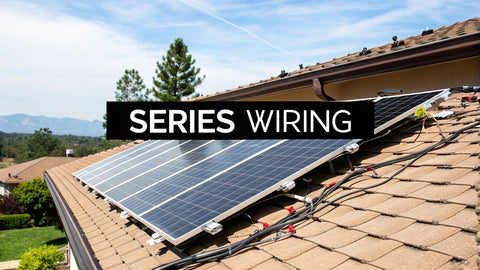
A string inverter is a centralized power-electronics unit that converts the combined DC output of a series-connected group of solar panels — a "string" — into grid-synchronous AC power. Where a microinverter architecture puts a small inverter behind every panel, a string architecture wires 6–20+ panels in series, runs that high-voltage DC (typically 300–600 V residential, up to 1,000–1,500 V commercial) to a single inverter, and converts it there. Modern residential string inverters carry two to four independent MPPT inputs, so a rooftop with three different orientations can still be served by one wall-mounted box.
The architecture's economics are simple and powerful: one conversion stage, one enclosure, one installation labor event, one service point. That is why, per watt, string inverters remain the lowest-cost quality conversion option — typically $0.10–$0.20/W for the inverter hardware versus $0.25–$0.40/W for a microinverter fleet on the same array.
How a String Inverter Works: DC In, Grid AC Out
Inside the enclosure, three functional stages do the work. The MPPT stage (maximum power point tracking) continuously adjusts the DC operating voltage of each input to keep its string at the voltage-current combination producing maximum power as irradiance and temperature change — a modern MPPT sweeps and settles within fractions of a second, harvesting 99%+ of available energy. The DC-AC inversion stage (a transformerless H-bridge or similar topology in most modern units) chops and filters the DC into clean 60 Hz sine-wave AC at grid voltage. The grid interface and safety stage synchronizes to utility frequency and voltage, provides anti-islanding protection (UL 1741 / IEEE 1547), ground-fault detection (NEC 690.5), arc-fault detection (NEC 690.11), and — on systems installed under recent code cycles — the rapid-shutdown initiation logic of NEC 690.12.
Efficiency on a quality string inverter runs 97–98.5% CEC-weighted; the gap between brands is now small enough that reliability history, service network, and monitoring software differentiate more than datasheet efficiency does.
String Sizing: The NEC Math That Governs Design
String design is a bounded optimization: maximize panels per string (reducing BOS and labor) while never exceeding the inverter's absolute maximum input voltage — including on the coldest morning in recorded site history, when panel open-circuit voltage peaks. This is where NEC 690.7 and 690.8 do their work.
Maximum Voltage (NEC 690.7)
Module Voc rises as temperature falls. NEC 690.7 requires correcting the module's rated Voc for the site's extreme minimum temperature using either the module's temperature coefficient of Voc or the NEC Table 690.7(A) correction factors. Worked example — a 450 W residential module with Voc = 41.2 V and a Voc temperature coefficient of −0.27%/°C, sited where the extreme minimum is −10°C (14°F):
- STC reference is 25°C; delta is 25 − (−10) = 35°C.
- Correction: 41.2 V × (1 + 0.0027 × 35) = 41.2 × 1.0945 ≈ 45.1 V worst-case Voc per module.
- Inverter absolute maximum input: 600 V (typical residential). Maximum series count: 600 / 45.1 ≈ 13.3 → 13 modules maximum.
- Check the operating window too: 13 modules × Vmp 34.5 V ≈ 449 V, within a typical 90–550 V MPPT range. Good.
Minimum String Size and Current (NEC 690.8)
On the hot side, verify the string's operating voltage at high cell temperature stays above the inverter's minimum MPPT voltage — a string that is too short drops out of tracking on August afternoons. For current, NEC 690.8 sizes conductors and overcurrent devices at 125% of the module's Isc (with an additional 125% continuous factor applied per 690.8(B), the familiar 156% rule for combined circuits): a string with Isc = 11.0 A requires conductors rated for 11.0 × 1.25 × 1.25 ≈ 17.2 A after derating — standard 12 AWG PV wire (30 A at 90°C) covers single strings comfortably, which is why it is the industry default. Our wire and cable guide and NEC ampacity guide cover conductor selection in full.
| Design Parameter | Rule / Source | Worked Example (450 W module, Voc 41.2 V, Isc 11.0 A) |
|---|---|---|
| Max modules per string | Inverter max V ÷ cold-corrected Voc (NEC 690.7) | 600 V ÷ 45.1 V = 13 modules |
| Min modules per string | Inverter min MPPT V ÷ hot Vmp | 90 V ÷ ~30 V (hot) = 3–4 modules practical minimum |
| String conductor ampacity | Isc × 1.25 × 1.25 (NEC 690.8) | 11.0 × 1.5625 = 17.2 A → 12 AWG PV wire OK |
| Overcurrent protection | Required when >2 parallel strings per fuse rating | 3+ strings in parallel → 15–20 A fuses per string |
| Rapid shutdown | NEC 690.12: conductors ≤30 V within 1 ft of array (inside boundary) | Module-level shutdown device or listed inverter-integrated solution |
The Role of MPPT: Why Input Count and Windows Matter
Each MPPT input is an independent tracker. Strings paralleled on one tracker must share orientation, tilt, module count, and shading exposure — mixing a sunny south string with a shaded west string on one MPPT forces both to a compromise operating point, and the tracker will often find a local rather than global power maximum. The design rules we enforce on every submittal: one orientation per MPPT input, matched string lengths on paralleled inputs, and shade-prone planes given their own tracker or moved to module-level electronics. Modern string inverters with three or four MPPTs and wide windows (some track from 90 V to 560 V) have closed much of the flexibility gap that used to push complex roofs toward microinverters automatically.
String vs. Microinverter vs. Optimizer: The Honest Comparison
| Dimension | String Inverter | String + DC Optimizers | Microinverters |
|---|---|---|---|
| Hardware cost per watt | $0.10–$0.20/W (lowest) | $0.25–$0.35/W | $0.25–$0.40/W |
| Shade tolerance | Weakest (bypass diodes only) | Strong (module-level MPPT) | Strong (module-level MPPT) |
| Panel-level monitoring | No (string-level) | Yes | Yes |
| Service access | Ground-level wall unit — easiest | Electronics on every roof module | Electronics on every roof module |
| Rapid shutdown (NEC 690.12) | Needs MLPE devices in most cases | Native | Native |
| Typical warranty | 10–12 yrs (extendable) | 25 yr optimizer / 12 yr inverter | 25 yrs |
| Best fit | Unshaded, uniform roofs; commercial; budget-sensitive | Complex roofs wanting string economics | Heavily shaded or many-orientation residential |
The pattern from thousands of installed systems: shading and roof complexity should pick the topology, not fashion. A clean south-facing barn roof on microinverters is money spent solving a problem that does not exist; a dormered, tree-lined Victorian on a single-MPPT string is a service contract waiting to happen. Our inverter buyer's guide and the solar inverter overview extend this comparison; for hybrid systems that add batteries, see the hybrid inverter guide and products like the Sol-Ark 8K.
Best Applications for String Inverters
- New construction with a designed-for-solar roof: one plane, one orientation, no shade — the string inverter's home turf.
- Ground mounts and carports: uniform arrays, easy conduit runs, and service access at ground level. Pair with a ground-mount kit like our 24-panel Sinclair rack package.
- Commercial and industrial rooftops: three-phase string inverters in the 25–125 kW class dominate C&I for cost and serviceability; browse commercial inverters for the current lineup.
- Budget-driven residential where the roof cooperates: the cost delta funds an extra panel or two of capacity.
Installation Best Practices From the Field
- Mount for heat: inverters derate above ~45°C ambient. Shade the unit (north wall, awning), maintain manufacturer clearances, and never bury it in a garage corner that bakes all afternoon. Heat is the number-one life-shortener for power electronics. I have replaced inverters that failed at year four because the installer tucked them behind a pool heater exhaust vent. The customer saved $200 on conduit and bought a $2,000 replacement.
- Respect conduit fill and derating on DC homeruns — see the conduit fill chart — and keep PV wire off the roof surface with proper clips.
- Land the DC disconnect and SPD correctly: surge protection on both DC and AC sides is cheap insurance in lightning country; our SPD guide covers selection, and the NEC 690 disconnect guide covers the switching requirements.
- Torque every termination to spec and document it. Loose DC connections cause the arc faults that 690.11 exists to catch — and they are an installation-quality issue, not an equipment defect. We include torque spec sheets with every inverter shipment and recommend calibrated torque screwdrivers on every truck.
- Commission with data: record string voltages and currents at startup. A baseline makes every future troubleshooting call shorter. I keep a folder of commissioning readings for every system we have touched; the number of warranty arguments it has settled in ten minutes justifies the habit many times over.
Pre-Installation Checklist for Pros and EPCs

- Confirm module Voc/Isc from the exact model datasheet; run the 690.7 cold correction with the site's ASHRAE extreme minimum.
- Verify string counts against inverter MPPT count, per-input current limits, and voltage windows.
- Confirm rapid-shutdown compliance path (listed MLPE or integrated solution) for the adopted NEC edition.
- Size AC conductors and breaker per inverter max continuous output × 125% (NEC 705.28/690.8 logic) and verify panel busbar capacity per 705.12 — the 120% rule.
- Plan the monitoring path (Wi-Fi vs. cellular vs. Ethernet) before install day, not after.
- Stage the spare-parts kit: fuses, connectors, and one spare optimizer or rapid-shutdown device if used.
Reading a String Inverter Datasheet: The Specs That Matter
Inverter datasheets run dozens of lines; a handful decide whether the unit fits your design. Here is what to check, in order, using a representative modern 10 kW residential unit as the frame:
| Spec Line | Typical Current Value | Design Consequence |
|---|---|---|
| Max DC input voltage | 600 V residential / 1,000–1,500 V C&I | Caps string length via NEC 690.7 cold correction |
| MPPT voltage range | 90–550 V (wide units) | Sets minimum string length and hot-weather tracking floor |
| Number of MPPTs / max current per input | 2–4 MPPTs, 12–20 A per input | How many orientations you can serve; high-current inputs accept modern high-Imp modules |
| Rated AC output / max apparent power | 7.6 / 10 / 11.4 kW classes | AC breaker and conductor sizing at 125% continuous |
| CEC weighted efficiency | 97–98.5% | Yield differences of <1% between quality brands |
| Operating temperature / derating | −25°C to +60°C, derating above ~45°C | Mounting location and shading of the unit itself |
| Integrated features | AFCI, GFCI, rapid-shutdown transmitter, Wi-Fi/cellular | Which NEC functions are native vs. require add-on hardware |
| Warranty | 10–12 yrs standard, 20–25 extended | Total cost of ownership; price extensions at purchase |
One spec deserves special attention in 2025: maximum input current per MPPT. Modern high-power modules push Imp toward 14–16 A, and an inverter input rated at 12.5 A will clip a 15 A string's peak production — silently, every sunny noon. Match module current to input rating before falling in love with a price. This mismatch has become one of the most common design errors we catch in plan review, and it never shows up in the proposal-stage estimate.
Commercial String Inverters: Three-Phase and High Voltage
For commercial and industrial projects, string inverters scale beyond the residential class. Three-phase string inverters in the 25–150 kW range connect directly to 208V, 480V, or 600V distribution, eliminating the need for step-up transformers that central inverters require. High-voltage string inverters (1,000–1,500 V DC input) allow 20–30+ modules per string, reducing combiner box count and DC cabling by 30–40% compared to 600 V systems.
The commercial design math is the same — NEC 690.7 still governs maximum string voltage, 690.8 still sizes conductors — but the consequences of error scale with project size. A miscalculated string on a 1 MW project costs more than one on a 10 kW residential job. We require stamped electrical drawings for all C&I projects over 100 kW, and our PowerLink Network engineers review string layouts before equipment ships. For large-scale racking and BOS, see our commercial inverter collection and mounting systems.
Monitoring, Commissioning, and Fleet Management
String-level monitoring tells you how each tracker input performs — enough to catch a failed string, a blown fuse, or a shading event, though not a single degraded module. For EPCs running fleets, the commissioning ritual that prevents 80% of callbacks takes twenty minutes per system: verify each string's Voc before landing conductors (a reversed polarity or a mislabeled homerun announces itself here, not after energization), record operating voltage and current per input under load, confirm grid-voltage and frequency windows match the utility's interconnection requirements, and photograph the completed installation including serial numbers. Set the monitoring alerts before you leave the driveway: an input producing zero for 24 hours, or one input tracking 15% below its sibling, should email someone automatically. In my experience managing post-install support, the fleets with alerting configured average days-to-repair measured in single digits; the ones relying on customers to notice average months.
Troubleshooting: The Fault Codes You Will Actually Meet
| Fault / Symptom | Most Likely Cause | Field Fix |
|---|---|---|
| Ground fault (ISO error) | Damaged conductor insulation, wet junction box, pinched PV wire | Insulation-resistance test string-by-string; repair and re-clip wiring |
| Arc fault trip (AFCI) | Loose or cross-mated connectors, corroded terminations | Torque audit; replace mismatched connector pairs |
| Grid voltage/frequency fault | Utility excursion or wrong grid profile selected | Verify with utility; correct the inverter's country/grid code |
| Overtemperature derating | Unit mounted in sun or dead-air corner; failed fan | Relocate or shade the unit; replace fan module |
| One string reading zero | Blown string fuse, open MC4, failed rapid-shutdown device | Fuse check, then Voc test at the combiner isolates the open point |
| Gradual underperformance, no codes | Soiling, new shading, or module degradation | Compare against commissioning baseline; clean, then escalate to IR scan |
The meta-lesson: most "inverter problems" are not inverter problems. The box is the messenger reporting faults upstream in the array or downstream on the grid. Technicians who start troubleshooting at the inverter's error log and work outward fix systems; those who swap the inverter first generate repeat truck rolls. When hardware genuinely fails, RMA through your distributor — we process warranty replacements for the brands we sell, and advance-replacement programs on several lines keep your customer's system producing while the claim closes.
Total Cost of Ownership: String vs. the Alternatives Over 30 Years
Hardware price is one line in a 30-year ledger. For a 10 kW residential system, the realistic ownership comparison: a string inverter at roughly $1,200–$2,000 hardware plus one probable replacement at year 12–15 ($1,500–$2,500 installed) totals around $2,700–$4,500 lifetime. A microinverter fleet at $2,500–$4,000 upfront carries a 25-year warranty but, with rooftop electronics, individual unit replacements cost $300–$500 per truck roll including lift and labor — a handful of failures over three decades adds $1,000–$2,000 for a similar lifetime total, spread differently. Optimizer-based systems split the difference: rooftop electronics at module level plus a central inverter that will still need one replacement. The conclusion most fleet operators land on: topology should follow the roof, not the spreadsheet — because shade losses from the wrong topology dwarf every line in this paragraph. For current pricing across all three architectures, our 2025 inverter picks compare the leading units head to head.
A Note on Code Editions and AHJ Variations
Everything above cites NEC 690 and 705 at the framework level, but your Authority Having Jurisdiction decides which edition is adopted and which local amendments apply — and the differences are not academic. Rapid-shutdown boundary rules, the 120% busbar rule's application to supply-side taps, and even required labeling formats vary between jurisdictions on 2017, 2020, and 2023 NEC cycles. The professional habit: before the first design in a new service territory, pull the AHJ's solar checklist (most publish one) and note the adopted code year on the plan set's cover sheet. Inspectors approve designs that speak their edition's language, and a two-minute code-year check has saved more of our customers from correction notices than any other single habit we can teach.
Frequently Asked Questions
What is the difference between a string inverter and a microinverter?
A string inverter converts DC from a series-connected group of panels in one central unit; a microinverter converts each panel's output individually at the module. String inverters cost less per watt and service at ground level; microinverters tolerate shade and mixed orientations better and provide panel-level monitoring. Roof geometry and shading should drive the choice.
How many solar panels can connect to one string inverter?
It depends on module voltage, site minimum temperature, and the inverter's limits. A typical residential design runs 8–13 modules per string on a 600 V inverter after the NEC 690.7 cold-weather voltage correction, with two to four strings on separate MPPT inputs. Commercial 1,000–1,500 V inverters accept 20–30+ modules per string.
What happens to a string inverter system if one panel is shaded?
The shaded panel's bypass diodes route current around its shaded cell groups, and the string's MPPT re-optimizes — but output drops by more than the shaded fraction because the whole string shares one tracker. Chronic shade across multiple strings is the case for optimizers or microinverters.
How long do string inverters last?
Standard warranties run 10–12 years with extensions to 20–25 available; real-world service life of a quality unit in a cool, shaded mounting location commonly reaches 12–15 years. Budget one replacement over a 30-year array life and site the unit for heat when you install it.
Can a string inverter work with batteries?
Yes, via AC coupling (a battery with its own inverter, like the Powerwall class) or by choosing a hybrid string inverter with an integrated battery port. Retrofitting storage onto an existing string system is one of AC coupling's strengths — no rewiring of the array required. Our hybrid inverter guide covers battery-ready models.
Are string inverters safe with high DC voltage on the roof?
Yes, when installed to code: NEC 690.11 arc-fault protection, 690.5 ground-fault protection, 690.12 rapid shutdown, and listed connectors and conductors manage the risks of DC strings. The hazard cases almost always trace to installation defects — mismatched connectors, untorqued terminations — rather than the architecture itself. Our NEC 690 disconnect guide covers the safety infrastructure in detail.
What size string inverter do I need for my house?
Size the inverter to the array DC rating, not the house load. A 10 kW DC array typically pairs with a 7.6–10 kW AC inverter. The inverter's AC output must not exceed the panel's busbar capacity per NEC 705.12 (the 120% rule). For detailed sizing, use our solar system calculator and inverter sizing calculator.
Can I add panels to my string inverter later?
Only if the existing strings have unused MPPT capacity and the new panels match the electrical characteristics of the existing modules. Mixing different module models on the same MPPT input causes mismatch losses and can violate warranty terms. For expansion design, consult our team before purchasing additional panels.
The Bottom Line for Pros and EPCs
The string inverter remains the industry's default for good reason: lowest cost per watt, ground-level service, mature reliability, and — with modern multi-MPPT units — enough flexibility for most roofs. Respect the 690.7 voltage ceiling, give every orientation its own tracker, mount for heat, and document commissioning, and a string system will run quietly for decades. When the roof says otherwise, module-level electronics earn their premium. Either way, Portlandia Electric Supply stocks both paths — string inverters, microinverters, optimizers, and the panels to feed them. Send your next design through our contact page and our team will check the string math with you before the truck rolls.