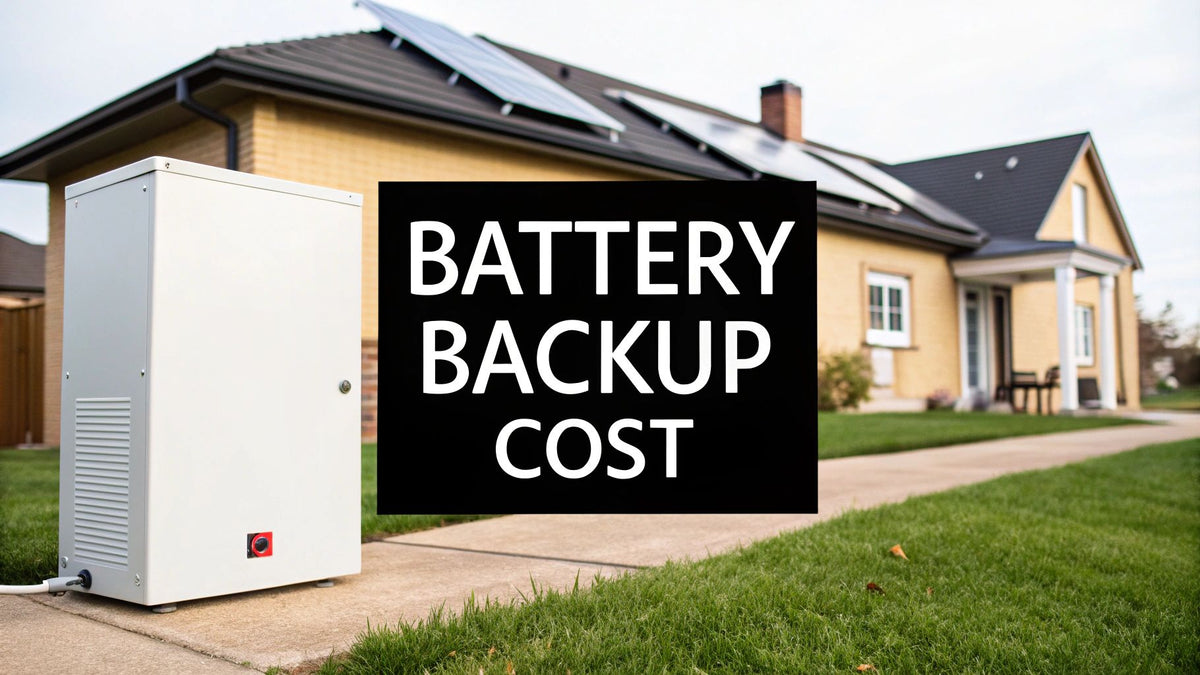
Home battery backup stopped being a niche off-grid purchase a few years ago. Our desk now quotes storage on roughly half the residential solar jobs that come through, and the first question is always the same: what is this actually going to cost me installed, out the door, after incentives? This guide answers that with real budget numbers, the component-by-component breakdown we hand to our own customers, and the sizing math that decides whether you need 10 kWh or 40 kWh on the wall.
We sell and kit battery systems every week — LiFePO4 server-rack batteries, all-in-one hybrids, and AC-coupled units like the Tesla Powerwall 2 — so the numbers below come from live quotes, not a spreadsheet somebody built in 2019.
A Clear Financial Snapshot of Home Battery Backup
A whole-home battery system is not one purchase. It is a battery (or a stack of them), an inverter or hybrid inverter if you do not already have a compatible one, a critical-loads panel or smart panel, possibly a service upgrade, and a licensed electrician's labor for one to three days. Miss any one of those lines in your budget and the final invoice will surprise you.
For a typical American home in 2026, plan on these all-in installed ranges before incentives:
| System Tier | Usable Capacity | Continuous Output | Estimated Installed Cost (before incentives) | Best For |
|---|---|---|---|---|
| Essential Backup | 10–15 kWh | 5–7.6 kW | $11,000 – $20,000 | Fridge, lights, Wi-Fi, furnace blower, a few outlets through an outage |
| Partial Home | 15–25 kWh | 7.6–11.5 kW | $20,000 – $34,000 | Essentials plus a mini-split or well pump, overnight autonomy |
| Whole Home | 27–40 kWh | 11.5–23 kW stacked | $34,000 – $55,000 | Most circuits including some HVAC, multi-day resilience with solar |
| Full Independence | 40–80+ kWh | 23 kW+ | $55,000 – $100,000+ | Near off-grid capability, large homes, electric ranges and EV charging on backup |
Those are installed numbers — equipment, labor, permitting, and inspection. On a dollars-per-usable-kWh basis, residential storage lands between $1,000 and $1,400 per kWh installed for a single battery, and drops toward $800–$1,000 per kWh as you stack units, because the labor, permitting, and gateway costs get amortized across more capacity. That economy of scale is real, and it is why we often talk customers out of the smallest possible battery. The second unit is always cheaper than the first.
Critical Cost Drivers for Budgeting
Five variables move the quote more than everything else combined:
- Capacity (kWh). The single biggest line. Each additional ~5 kWh module typically adds $3,000–$5,000 installed.
- Power rating (kW). If you want to start a 3-ton air conditioner or run a well pump, you need surge and continuous power, not just energy. Higher-output inverters cost more.
- Coupling architecture. AC-coupled batteries retrofit onto existing solar with minimal rewiring. DC-coupled systems are more efficient but usually mean swapping the inverter — fine on a new build, expensive as a retrofit.
- Panel and service condition. A home with a full 100A panel from 1978 may need a bus bar and panel upgrade or a smart load panel before the battery can interconnect legally under NEC 705.12.
- Permitting and AHJ requirements. Some jurisdictions approve residential storage over the counter. Others want structural drawings for wall-mounted units and full NEC 706 documentation. Budget $500–$2,500 depending on your AHJ.
Decoding the Price Tag of Your Battery System
Here is where the money actually goes on a representative 13.5 kWh AC-coupled install at the $17,000–$19,000 mark:
| Component | Typical Share of Invoice | Dollar Range (13.5 kWh job) | Notes from the Field |
|---|---|---|---|
| Battery unit(s) | 45–55% | $8,000 – $10,500 | The hardware itself; prices vary by chemistry and brand |
| Gateway / system controller / transfer equipment | 10–15% | $1,800 – $2,800 | Automatic isolation from the grid per NEC 705; not optional |
| Inverter (if new or swapped) | 10–20% | $2,000 – $4,000 | Only if existing inverter is incompatible or undersized |
| Electrical labor | 12–18% | $2,200 – $3,400 | 1–3 days, two electricians, plus a journeyman sign-off |
| Permits, engineering, inspection | 3–8% | $500 – $1,500 | Highly jurisdiction-dependent |
| Critical loads panel / smart panel (if needed) | 5–10% | $1,000 – $2,000 | Sometimes avoidable with whole-home transfer architecture |
I've walked customers through dozens of these invoices, and the line that always raises eyebrows is the gateway or system controller. People see a $2,000 box and think it is markup. It is not — that controller is what senses the outage, islands your home in under a second, and keeps you from backfeeding a lineman working on the pole outside. NEC 705 and UL 1741 exist for that exact reason. Never let an installer talk you into a cheaper "manual workaround."
The Core Hardware Components
At minimum, a code-compliant grid-tied backup system includes the battery, a UL 1741 SB-listed inverter or integrated power conversion system, an automatic transfer or gateway device rated for your service size, and overcurrent protection on both the battery circuit and the interconnection point. If the battery sits in a garage, NEC 706 and many AHJs also require bollard or barrier protection from vehicle impact — a $150 detail that fails inspections when forgotten.
Installation and Labor: The Other Half of the Equation
Labor is where quotes diverge most between installers. A clean install — battery on a garage wall three feet from the main panel, existing 200A service, solar already present — might take a two-person crew a single long day. The same battery with 60 feet of conduit run to a detached subpanel, stucco coring, and a panel upgrade becomes a three-day job. We have seen the labor line swing from $1,800 to $6,500 on identical hardware. That is why every honest quote starts with a site assessment, not a web form.
How System Sizing Impacts Your Total Investment
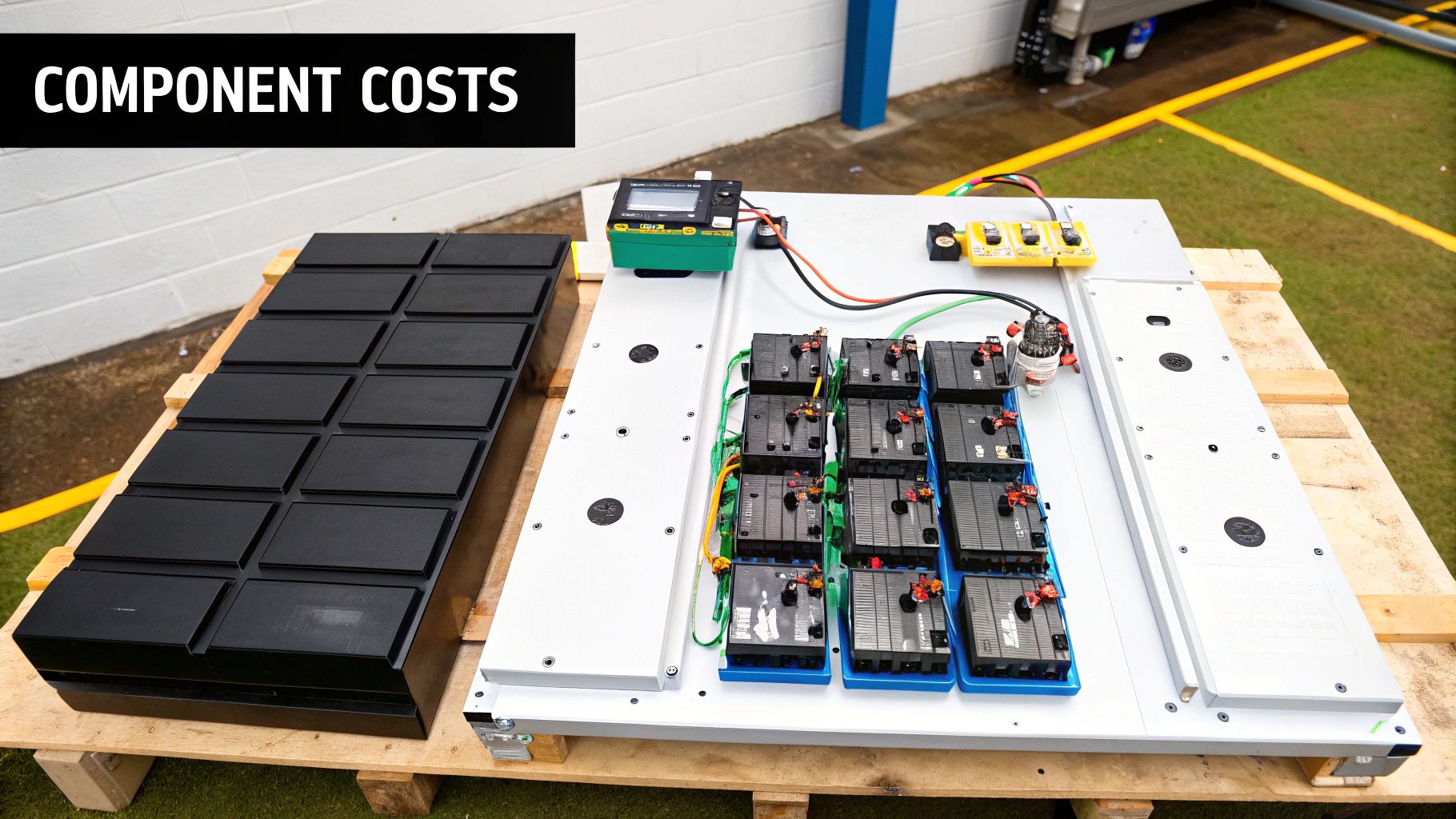
Sizing is where cost and performance meet. Undersize and the battery dies at 2 a.m. on outage night. Oversize and you spent $12,000 on capacity you cycle twice a year. The math is not complicated, but it must be done with your actual loads, not averages.
Essential Loads vs. Whole-Home Backup
The essential-loads strategy backs up only the circuits that matter — refrigerator, lighting, internet, medical devices, the furnace blower — through a dedicated subpanel or a smart panel that sheds everything else. Whole-home backup feeds the entire service and relies on the battery's power rating and software load management to keep big draws from tripping the system. The cost difference is substantial:
| Backup Strategy | Typical Loads Covered | Daily Energy Need | Recommended Battery | Installed Cost Delta |
|---|---|---|---|---|
| Essential loads (subpanel) | Fridge, freezer, lights, Wi-Fi, furnace blower, select outlets | 5–8 kWh | 10–15 kWh | Baseline |
| Essential + one big load | Above plus a mini-split OR well pump | 9–14 kWh | 15–20 kWh, 7.6+ kW output | +$6,000–$10,000 |
| Whole home, managed | All circuits with smart load shedding | 20–30 kWh | 27–40 kWh stacked | +$20,000–$32,000 |
| Whole home, unmanaged | Everything, anytime, including EV charging | 30–45+ kWh | 40–80 kWh | +$40,000 and up |
Want to run your own numbers before calling anyone? Our battery sizing calculator and the battery backup runtime calculator walk through the same load-audit process our engineers use on the phone. For a deeper methodology, the home battery bank sizing guide covers off-grid-style math that applies equally to backup.
Critical Mistakes: Capacity (kWh) vs. Power (kW)
The most expensive mistake we see is confusing energy with power. A 13.5 kWh battery with a 5 kW continuous inverter will run your refrigerator for a day and a half — but it physically cannot start a 4-ton central air conditioner that pulls 8 kW at startup. The battery has the energy; the inverter does not have the muscle. We've had to re-quote jobs where a competitor sold a homeowner "whole home backup" on a single 5 kW unit. The AC never turned on during the first outage. Check three numbers on every proposal: usable kWh, continuous kW, and peak/surge kW. All three must match your load list.
A quick sanity check for the load list: a modern refrigerator draws 150–400W running with a compressor surge around 1,200W; a gas furnace blower pulls 600–900W; a 1/2 HP well pump runs near 1,000W with a 2,300W start; a 3-ton central AC runs 3,500W and can surge past 10 kW without a soft starter. Add the running watts of everything you want simultaneously, add the single largest surge, and that is your minimum inverter size. Multiply your daily essential kWh by the days of autonomy you want, divide by the battery's usable depth of discharge (90–95% for LFP, often 100% nameplate on NMC units like the Powerwall 2), and that is your minimum capacity.
Chemistry and Brand: What You Are Actually Paying For
Not all kWh cost the same because not all batteries are built the same. The two chemistries that dominate residential storage price and age differently:
| Attribute | LFP (Lithium Iron Phosphate) | NMC (Nickel Manganese Cobalt) |
|---|---|---|
| Typical cycle life | 6,000–10,000 cycles | 2,000–5,000 cycles |
| Depth of discharge | 90–100% | 90–100% (manufacturer-limited) |
| Thermal stability | Excellent; very resistant to thermal runaway | Good with proper BMS; more sensitive |
| Energy density | Lower — larger, heavier per kWh | Higher — more compact per kWh |
| Installed cost per usable kWh | $800–$1,100 | $1,000–$1,400 |
| Common form factors | Server-rack and wall-mount modules | Integrated all-in-one units |
| Examples we stock | EG4, Fortress Power, Pylontech | Tesla Powerwall, LG RESU Prime |
For daily-cycling applications — self-consumption, time-of-use arbitrage, off-grid — LFP's cycle life wins on math alone. For occasional backup where compact size matters, NMC all-in-ones install faster and cleaner. We stock both and sell both; the right answer depends on how many cycles per year your use case will actually deliver. A pure backup battery in a stable-grid area might see 30 cycles a year, and either chemistry will outlive its warranty. A TOU-arbitrage battery in California cycles 300+ times a year, and the LFP unit is the one still under warranty in year twelve.
Using Incentives to Reduce Your Upfront Cost
The Federal Clean Energy Credit (ITC)
Under the residential clean energy credit, battery storage of 3 kWh or larger qualifies for a 30% federal tax credit on the full installed cost — equipment and labor — whether or not it is paired with solar. On a $20,000 install, that is $6,000 back at tax time. The credit has no cap for storage. Confirm current law with your tax professional before you sign; credit rules have changed more than once in the last few years and your installer is not your accountant.
State and Local Utility Rebates
Stackable incentives vary wildly by state and utility. Some real examples of the structure you should look for:
| Incentive Type | Typical Structure | Real-World Range |
|---|---|---|
| Federal ITC | Tax credit, 30% of installed cost | $3,300–$30,000+ depending on system |
| State rebate programs | Per-kWh or flat rebate (e.g., SGIP-style) | $150–$1,000 per kWh |
| Utility demand-response / VPP payments | Annual payment for grid dispatch rights | $50–$500+ per year |
| Property/sales tax exemptions | Exemption on equipment value or sale | 5–10% effective savings |
| Time-of-use bill savings | Ongoing arbitrage, not an upfront incentive | $300–$1,500 per year |
Check our running solar incentives by state page for your utility's current program before finalizing a budget — rebate queues open and close mid-year, and some are first-come, first-served.
How to Structure Your Quote for Transparency
When you collect bids — and you should collect three — demand line items. Equipment, labor, permitting, and interconnection should each be visible. Ask what happens to the price if the panel needs an upgrade discovered on install day; get that contingency priced in writing. Ask whether the quote includes the critical loads panel or assumes your existing panel works. And ask for the model numbers of everything, then cross-check them against the manufacturer's spec sheet and listings like our solar battery buyer's guide and the head-to-head on our EG4 vs. Tesla Powerwall comparison.
We have re-quoted more "mystery package" bids than I can count — a single number, no model numbers, no capacity stated. Every single one of them hid either undersized equipment or a missing gateway. A quote you cannot audit is a quote you should not sign.
What Drives Up Installation Costs?

The four most common budget-busters, in order of how often we see them: service or panel upgrades ($2,000–$5,000 when the existing gear cannot accept the interconnection), long wire runs between the battery location and the main panel (conduit, trenching, and labor add up fast past 25 feet), stucco or masonry mounting surfaces that slow the crew down, and AHJs that require stamped structural or electrical engineering for wall-mounted systems. None of these are reasons not to buy a battery. All of them are reasons to get a site visit before you budget.
How to Read a Battery Warranty Before You Sign
Warranty language is where marketing meets reality. Four clauses decide the real coverage: years and cycles (10 years and a stated cycle count, whichever comes first), the retained-capacity guarantee (70% at year ten is the industry standard), the throughput cap in megawatt-hours (heavy daily cyclers can burn through it before the years run out), and the conditions — many warranties require continuous internet connectivity, approved inverter pairing, and installation by a certified contractor. An offline battery can be an unwarrantied battery. Ask for the full warranty document, not the brochure summary, and have your installer confirm in writing that the planned configuration keeps the warranty intact.
Common Questions About Home Battery Costs
How Long Will a Home Battery Last During an Outage?
Runtime is capacity divided by draw. A 13.5 kWh battery running a 500W essential load lasts roughly 24–27 hours; the same battery at a 2 kW average draw lasts about 6–7 hours. Pair it with even a modest solar array and the math changes entirely — the battery becomes a night-time buffer while the panels refill it daily, and runtime stretches from hours to indefinitely for essential loads in decent weather.
Can I Add a Battery to My Existing Solar Panel System?
Yes — AC-coupled batteries exist precisely for this. They connect on the AC side of your service and work with virtually any existing inverter. The retrofit is usually a one- to two-day job with no changes to the array. Our battery installation guide covers the retrofit sequence in detail, and the solar battery sizing article handles the capacity math for both new and existing systems.
What Is the Real Long-Term ROI of a Home Battery?
Honest answer: for pure backup, ROI is measured in avoided spoiled food, avoided hotel nights, and kept HVAC during heat waves — real value, but not a spreadsheet payback. For homes on time-of-use rates, daily arbitrage plus demand-charge avoidance can produce a genuine 8–14 year payback before the resilience value. Run your specific rate schedule through our solar ROI calculator; storage changes that math meaningfully in high-TOU-spread territories.
Are There Ongoing Maintenance Costs I Should Plan For?
Lithium residential batteries are effectively maintenance-free: no watering, no equalization, no venting. Budget nothing annually, but understand the degradation curve — expect the battery to hold roughly 70% of original capacity at the end of a standard 10-year warranty, per the warranty language itself. The battery life extension guide covers the habits (temperature management, charge-window settings) that keep you on the good side of that curve. For households that daily-cycle, the classic 20-80 charge-window practice is worth adopting; for backup-first homes, though, we recommend keeping 100% available during storm season.
Two Real Quotes from the Last Quarter
Numbers land better with addresses attached, so here are two anonymized jobs from our recent quote log. Job one: a 2,400 sq ft suburban home with existing 8 kW solar, a 200A panel with room, and a garage wall six feet from the main panel. The customer wanted fridge, lights, internet, the gas furnace blower, and the home office through outages. We quoted a single 13.5 kWh AC-coupled unit with a gateway: $16,900 installed, $11,830 after the federal credit. One day of labor, one inspection, done. Job two: a 4,800 sq ft rural property on a well, with a shop building, a 3.5-ton heat pump, and an owner who wanted "everything to just work." The load list demanded 27 kWh and 11.5 kW of output — three modular LFP batteries behind a hybrid inverter, plus a soft starter on the heat pump and a supply-side tap because the 200A panel was full. $41,500 installed, $29,050 after the credit, three days of labor, two inspections. Same store, same month, 2.5× price spread — driven entirely by the load list and the panel condition. That is why we start every quote with the loads, not the product.
Battery vs. Generator: The Comparison Everyone Asks For
Customers with generator quotes in hand always ask whether a battery can replace it. The honest framework: batteries win on response time (milliseconds versus 10–30 seconds), silence, zero fuel logistics, daily bill savings, and maintenance-free operation. Generators win on long-duration energy — a 100 kW-class machine with a big propane tank runs for days at full house load, while even a 40 kWh battery stack is measured in hours without solar input. The crossover point sits around outage duration and frequency. For the typical suburban outage profile — a few events a year, most under four hours — a battery is the better tool. For rural properties with multi-day storm outages, a generator or a generator-plus-battery hybrid is the resilient answer; the battery carries the quiet overnight hours and the generator handles bulk recharge. We sell both, and the generator sizing guide pairs naturally with the battery math in this article when you are weighing the two.
The Bottom Line
Budget $11,000–$20,000 for a solid essential-loads system, $20,000–$34,000 for serious partial-home coverage, and $34,000+ for genuine whole-home backup — then take 30% of that back on the federal credit. Size from your load list, demand line-item quotes, and verify every model number. Our team specs and ships complete battery systems daily; browse battery storage and backup kits, and if you want room to grow later, start with a modular LFP stack whose rack accepts additional 5 kWh modules without new permitting or new wall work. Expansion-friendly hardware is the cheapest insurance against an undersized day-one system, and the customers who plan for the second battery rarely regret it.